Thursday, June 16, 2005


where the fungi hits the evolutionary road Posted by Hello

Wednesday, June 15, 2005

'>Evolution in Four Dimensions: Genetic, Epigenetic, Behavioral and Symbolic Variation in the History of Life
By Eva Jablonka and Marion J. Lamb
With illustrations by Anna Zeligowski
MIT Press. $34.95

'>Before Darwin: Reconciling God and Nature
By Keith Thomson
Yale University Press. $25.

by William S. Kowinski

It's the genes, stupid. That's been the battle cry of the orthodox Darwinists (or neo-post-Darwinists if you prefer) in aggressive defense of Darwin's theory of evolution by natural selection.

They used it as the simple, all-purpose weapon to defend against the assault from reactionary forces, revived since Darwin's day and especially since the Scopes "monkey trial" humiliated them and (some say) fueled the so-called Christian fundamentalist movement. That well-financed and messianic movement, with no visible twinges of conscience restraining the scorched earth deployment of hyperbole, character assassination, vitriol, mendacity, harassment and even violence, has successfully returned biological evolution---and with it many basic operating assumptions of science---into the realm of ideological politics. School boards are harrowed, and institutions intimidated. Recently IMAX withdrew from exhibition a film that referred to Darwinian evolution, the basics of which are fundamental to most of modern science and the modern description of reality.

In the battles between the "reality-based" or fact-based, and the "faith-based," such a single powerful idea as the supreme gene, was easily employed and zealously defended--a kind of scientific nuclear device. But those questioning it weren't only reactionaries who deny that evolution took place or that the earth is more than a few thousand years old, or even those who obscure a faith-based model in the appealing jargon of "intelligent design." (Though both intelligence and design are open questions, these politically motivated operations seem to seldom be sincere attempts to address them.)

The questioning was also coming from other scientists, who risked being tarred with the same reactionary brush by the more virulent defenders of Darwinian orthodoxy, who sometimes adopted the tenor and tactics of their reactionary foes. For awhile these subversives were held at bay, but perhaps no longer.

Some charged that the simplicity of orthodox claims was supported by an unduly narrow range of evidence. Most evidence, as in Darwin's day, was from large animals. Challenges came from microbiology and molecular biology, from the study of very small life forms. Lynn Margulis was one of those leading the charge with her forceful research, forceful thinking, and forceful advocacy and writing. '>Acquiring Genomes by Margulis and Dorion Sagan is a landmark work, and highly readable.

But challenges were launched from many other directions. '>Stephen J. Gould (who probably disagreed with Margulis as much as captain of the orthodox team, '>Richard Dawkins) took the heat for awhile. Several summaries of various challenges meant for non-specialists appeared, such as '>Alas Poor Darwin by Hilary and Stephen Rose, and the one I found most informative and balanced in terms of reporting and rhetoric: '>Darwin's Blind Spot by Frank Ryan. (There are several other books on the history and controversy cited in the volume under review, including Bowler's '>Evolution: The History of An Idea and Brown's '>The Darwin Wars) .

Now comes '>Evolution in Four Dimensions, which combines detailed descriptions of the science with conscientious and creative attempts to clarify the situation for the non-specialist reader, in the process of producing a real synthesis, and something like the outlines of a new theory in the Darwinian tradition that takes into account the increasing collections of evidence that tends to poke holes in the "genecentric" orthodoxy.

One more motivation for that orthodoxy ought to be mentioned. The hoopla surrounding the Human Genome Project several years ago wasn't all about the wonders of science, as if we were witnessing the equivalent of the first moon landing. Pharmaceutical companies and other corporate interests were salivating like Pavlov's dogs at the prospect of developing and selling gene therapies to offer cures of diseases and conditions as well as a menu of enhancements for their better-off customers. All of that might be possible once the genome was identified, assuming that it is indeed all about the genes. Well, stupid, it's not, and the revolution promised by the genome project is on hold.

The genecentric dogma supported some political views, such as a neo-social Darwinism of the selfish organism composed of selfish genes. Evidence from the human and animal worlds of altruism and empathy and other unselfish behavior got twisted and scorned. The social was supposed to be a kind of illusion, because only the individual's genes really counted. So the idea that culture or learning or even consciousness could combine to successfully create new behavior, perhaps even on levels beyond individuals, was considered hopeless, counter to the biological imperative.

This orthodoxy also supported the idea that humans were a kind of programmable machine, an android with perhaps too much wetware. So the AI crowd was happy with it, too. The mechanistic and deterministic bias also supported the meme theme craze (mental genes operating as what we used to call fads), leaving little to the imagination, and providing a whif of scientific pizzazz to political p.r. consultants.

Finally, there is the scientific bias for the simple (or "elegant") explanation. However as science gets beyond the more obvious and into the more fundamental, we may find that the fundamental is complex.

In any case, though there may be a biological imperative, we clearly don't yet know what it is. These authors explain how the possibilities have expanded in the areas of heredity and evolution. In addition to the genes, they outline evidence for three other factors involved: the epigenetic (transmission of traits on the cellular level but not involving DNA), behavioral (social learning transmitted through generations, which includes animal behavior) and symbolic (language and other forms of symbolic communication, mostly but not necessarily only operative in humans.)

Simply presenting these four dimensions with illustrative examples and explanations would be useful and provocative. But this book goes beyond that description to suggesting how these dimensions interact, how they may have originated and what roles they may have played in evolution. They also tackle larger issues, including moral questions that follow from this approach.

Though many readers may find this book to be densely technical, but with effort and attention, quite coherent, most readers will learn plenty even without engaging all the detail, especially from the summaries and dialogues (with a kind of devil's advocate) that these authors provide. Because the contents have apparently been road-tested with audiences, this book is a resource, a volume that can be studied and used repeatedly.

This is an important book. It will be a revelation to many, and it is a solid beginning to an important dialogue in science and beyond, with very important societal implications. In broadening evolution beyond genes, it opens up new vistas for many areas of knowledge, and how they interrelate to form our dominant conception of who we are and what the world we're in is all about. It is a vital step in an important shift in conventional wisdom.

For example, I know one of the pioneers of the study of human altruism, whose work was sociological. But one question that his audiences often had, and which bothered him as well, was whether there was a genetic basis for this behavior---whether, as he put it, there is "a gene for altruism." For many people, altruism couldn’t be considered “real” without a genetic basis. With a better understanding of the dimensions of evolution, this question becomes less meaningful. The way is open to showing that altruism is truly part of our inheritance.

Science is troubled territory these days, threatened by political and corporate pressures. One hopeful sign is an increasing diversity among scientists. Women, for example, have made usually unacknowledged contributions throughout the history of western science, but more are becoming prominent in their fields today. These authors, with distinguished careers in related fields of the history and philosophy of science, are prime examples. Since in this book they skewer the theory proposed in a popular book a few years ago that men are by nature rapists (a logical outcome of the selfish gene dogma), I won't engage in gender-based determinism. But the history of science as well as of the emergence of other suppressed social groups suggests that more women in science may bring more collaborative attitudes and greater openness to complexity.


Defending against political and "faith-based" challenges aren't the only reasons why this or any orthodoxy maintains itself. Scientists are human beings, with the same unexamined unconscious fears, needs and motivations as other humans. Despite pieties about evaluating evidence and coming to a conclusion, scientific theories are maintained for all kinds of less rational reasons.

Apart from personal and career motives, from group needs to maintain positions or keep jobs or make money, there seems to be a strong need to believe in the central dogma. We all know at least a little about the controversies over evolution in Darwin's day, though a lot of that little is likely to be inaccurate. But the extent to which Darwin's ideas, and the science that preceded and supported his theories, challenged the basic views of real people at the time, is remarkable. This is the subject of Keith Thompson's fascinating new book, '>Before Darwin: Reconciling God and Nature.

Consider Dr. Plot, a 17th century Doctor of Laws in England who wrote extensively about the fossils then being discovered, laboring mightily to reconcile fossil evidence with the reigning orthodoxy concerning the natural world, largely derived from the Bible. As his possible explanations for what turned out to be fossil dinosaur bones dwindled, the desperate imagination of Dr. Plot thickened to include the idea that such bones were actually left by a race of human giants, which had the virtue of being mentioned in Genesis.

But while it is easy to laugh at an obscure figure, consider also that Thomas Jefferson could not accept the idea that some animal forms had gone extinct. When mastodon bones were found, there were those who theorized that these animals weren't extinct, but simply were living where no man had gone before. (A plot for many intriguing adventure stories and sci-fi films.) Thomson claims that in addition to the other purposes of their epic journey in the American West, Jefferson charged Lewis and Clark with searching for mastodons.

Thomson's book is timely, entertaining and enlightening. It provides a human dimension to these controversies when they first appeared, and a window on what is to me a fascinating period, when most of the science in these fields was being done by what today would be considered amateurs---people initially trained in another profession, who might still practice law or perform their duties as clerics, but whose obsession with aspects of the natural world, combined with great energy and intellectual rigor, advanced and in some ways invented several earth and biological sciences.

Their intellectual interests were sometimes widely shared, as newspapers followed the latest findings and theories, and fossil-hunting and geological outings on the weekend became fashionable pursuits. In fact it was only when the expanding industrial revolution needed more and more applied science, that specialization and professionalism began. The word "scientist" didn't even exist until the mid 19th century. Before that it was more integrated into a larger sense of knowledge and the nature of reality (which is partly why so many were troubled by contradictions between new discoveries and religious worldviews), and more open to innocent enthusiasm. So as Thomson's book shows, even the conscientious doubters and skeptics played a role, as did the dogged subversives, like Darwin in his day.

Darwin was himself torn between orthodoxy and the faith-based worldview. This book follows that central problem of the subtitle. Even though the Catholic church, for example, found a way to accomodate Darwin's theories, the struggle obviously goes on.

Sunday, May 22, 2005


Evolving customer needs in an impactful---hello?  Posted by Hello
'>DEATH SENTENCES: How Cliches, Weasel Words, and Management-Speak Are Strangling Public Language
by Don Watson

'>Gotham Books, 208 pages, $20.

by William S. Kowinski

"Words can be like notes, like expressions of the soul," Don Watson writes. "They can make our hair stand up, they can lift our understanding to a higher plane, make us see things differently. They can inspire love and hope. You can see it happen before your eyes. Words can create a magic halo."

But before closure can be achieved on such product, robust parameters of total quality and competitive international best practices are key self-management and self-marketing requirements, in order to leverage vibrant pre-empowering emotional communication nodes and re-purpose functional deployment as a strategic initiative committed to an enhanced content provider environment. A personal mission statement sometimes helps.

Don Watson wrote speeches for the prime minister of Australia and corporation chief executives, and he wrote company brochures and manuals. The essence of these jobs (as I know from personal experience---except for the prime minister part) is translation. You have to translate their normal vocabulary and syntax into something a little closer to English. That's mostly so you can understand it. You may then be required to re-translate it back into the vocabulary and syntax that lies in their comfort zone, and that of their colleagues, while giving other people at least a hint of what it's all about.

It's a tough job and who can blame Watson for getting snarky about it. But for all the built-in satire (while Watson was writing for the prime minister, he was also writing for a comedian), this is not one of those decorously amusing Edwin Newman collections of bad grammar. Watson quotes Eric Alterman's phrase, "the post-truth environment" as a section title, because that's where we live now and where we must try to survive. Unfortunately, the truth environment surrounds it, and it contains everything necessary for our ultimate survival. If we lose touch with that, we're cooked. Sorry---I meant to say "opted out."

But don't despair: your call is important to us. That's why we've hired these nice Third World people to take it, if you insist on hitting zero while our rich-toned mechanism recites the Tibetan Menu of the Dead.

"Managerial language is an abuse of human rights," Watson writes, in a suspiciously short sentence. "It robs people of their senses, their culture, and their tongue."

I recall a New Yorker cartoon from years ago that I have been pondering ever since. A woman at a cocktail party cornered a corporate officer type to inquire, "If this is the Information Age, why doesn't anyone know anything?"

It's because most people are lying. They may only be lying in that they don't actually know what they are saying, but usually that's because they're selling something, and they're trying to find the magic words.

Watson writes about the new clichés (or are they memes?), the jargon and fashionable abstractions that do actually mean something sometimes, but often not what the people who use them intend. The two most important things in most people's working lives today are being accepted and getting noticed. It's a difficult and dangerous dance. Skillful deployment of cliché is key. Passive voice is such a help.

But of course it must be the right sort of cliché. With loyalties becoming more virtual and temporary, ideology identifies the feathers of the birds you want to flock together with. This of course goes way beyond politics. There are corporate ideologies, and ideologies specific to certain business sectors (used to be "trades" but no longer). "Ideologues speak in language best understood by ideologues of like minds," Watson notes. Elementary. It is language as ritual code. Most people understand this, and so books like this are for private chortles in the bathroom at home, assuming the cell phone is not in use, which is getting to be a big assumption.

"Parrots, when they are separated from their flocks, know by instinct they must quickly join another one or they will make a meal for hawks," Watson observes. He doesn't mean they will realign to a cooking mode. "It is from this understanding that their mimetic skill derives."

So we don't actually need some genetic basis for the sudden popularity of "death tax" or "re-framing" (as in meme theory), although this is kind of a sad biological explanation. In the meantime, in this era of full-time communication, our vocabularies are actually shrinking.
This bodes not well.

A small stroke of genius here is the glossary, which is devilishly revealing. It is largely made up of single buzzwords (like "event," "product," "issue") that are so broadly used that they are just about meaningless, except as they describe what marketing attitude you take towards them. Watson helpfully uses them in a sentence, emphasizing the classic and familiar: "To be or not to be---they are the scenarios," "I workshop, therefore I am," and my favorite, "There is more product in heaven and earth, Horatio/Than is dreamed of in your philosophy."

I would now like to initiate fundraising to coalesce a committee to implement a quality thank you to Gotham Books for bringing this book to America, despite the potential flexible outcomes, and to Don Watson who, at the end of the day, made lemons out of lemonade, for which we'd like to hire someone to express our bottom line, which is gratitude. You may now buy this book.


This seems an appropriate occasion to brag about my good fortune at the recycling center recently. In a pile of discarded books I found a worn but intact copy of English Synonyms and Antonyms by James C. Fernald, published in 1914. It is wonderful.

Much of the book is taken up by indexes and study questions, but the heart of it is a list of several hundred words, with not only their synonyms, but a marvelous paragraph about the proper shades of meaning. For example:

"Anxiety is, according to its derivation, a choking disquiet, akin to anguish; anxiety is mental; anguish may be mental or physical; anguish is in regard to the known, anxiety in regard to the unknown; anguish is because of what has happened, anxiety because of what may happen."

Anxiety is then contrasted with apprehension, fear, dread, forboding, terror, worry, solicitude, fretting, disquiet and perplexity.

I would now like to declare a war on forboding. It will involve bombing the axis of anxiety.

The entry for Physical states: "Whatever is composed of or pertains to matter may be termed material; physical (from Gr. physis, nature) applies to material things considered as parts of a system or organic whole."

That's useful, but frankly I consume these paragraphs like a glutton recently discharged from South Beach. It's a sad prospect but it's unlikely I will ever get to choose between using pique ("denotes a sudden feeling of mingled pain and anger, but slight and usually transient") and umbrage ("a deeper and more persistent displeasure"), but now I know, and I even know why (because pique signifies a sting, as of a nettle, while umbrage, from L.umbra, a shadow, is displeasure at being overshadowed.) And there is the guilty pleasure of these sentences: "It may be said, as a general statement, that pique arises from wounded vanity, umbrage from wounded pride or sometimes suspicion. Resentment rests on more solid grounds, and is deep and persistent. Compare ANGER."

But of course it's all obsolete now---why the entry for "support" says nothing at all about "supportive of." I first heard this loathsome locution in the 70s, when it came directly from T-groups and sensitivity training. It actually meant something specific then, distinguishing a kind of psychological support from a physical (or material) one. I even recall joking that if it caught on, people would go around saying they were supportive of a particular candidate for president, or paying "child supportive of." I don't think the second has happened yet, but we are long past the first. And frankly, I am more than piqued. I am impacted. I take umbrage.
Elsewhere Today...

My review of three books on "the wired revolution--then, now and beyond" can be found in print or on line at the San Francisco Chronicle Book Review.

Sunday, May 15, 2005

Elsewhere...

Notes on the restored version of Capra's "Lost Horizon" based on James Hilton's best-selling novel, at Blue Voice.

Thursday, May 12, 2005

Econ for the Future 101

'>THE GREAT UNRAVELING by Paul Krugman. W.W. Norton & Co.
'>THE END OF POVERTY by Jeffrey D. Sachs. Penguin Press.

by William S. Kowinski

It's called the dismal science because of all those gray lines of figures, but the name might stick because as a science it has been a dismal failure. Abused by ideologues and self-serving liars, puffed up beyond its accomplishments in academia, with a deserved reputation for predicting the obvious and getting even that wrong, economics has failed its function and its potential. In this, a world predicated on economic relationships. Dismal.

Here are two of the few books that do better. There is no better analyst of the economics of our time, especially those involved in political machinations at the federal and global level, than Paul Krugman of the New York Times. His ongoing analysis of the chicanery and cynical foolishness applied to the Social Security debate in Washington is only his latest invaluable contribution to truth, justice and the American way.

His columns should not be missed, and though this book is a few years old---a long time in political economics---it is still the best analysis of what's going on. The venerable Arthur Schlesinger, Jr., author of POLITICS OF HOPE, calls THE GREAT UNRAVELING "required reading for anyone concerned about the American future."

Concerning the world's future, Jeffrey Sachs in his new book offers convincing proof and a practical plan for addressing and essentially ending poverty in our time. We've known since President Kennedy said so in his Inaugural Address in 1961 that eradicating poverty is within our power. This book, which is both based on information gathered for the UN Millennium Project and is the basis for the 20 year effort inaugurated by that project this year to eliminate poverty, offers the blueprint for actually doing it. At very little cost to the wealthy nations and their citizens.

What little hope there seems to be rests with courageous individuals like Krugman who step up to the possibilities that they've been given, and to organizations like the Millennium Project that operate doggedly, under the media radar, to achieve goals that amount to justifying our claims of humanity. The future depends on them, and individuals and organizations like them in many categories of knowledge and endeavor.

Wednesday, April 20, 2005


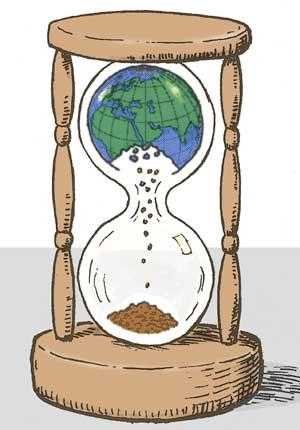
It's April 22, 2005. Do you know where your planet is? Posted by Hello
We've Had Thirty-Five Years of Earth Days and the World Is Still A Mess

by William S. Kowinski

So it's been 35 years since the first Earth Day and the world is still a mess. It's not that we haven't learned a lot and done a lot, just not enough. How far we've come in understanding the extent and nature of the problems, in devising and carrying out solutions, and especially in communicating that understanding and getting politicians and the public to listen, can be gleaned from this new book: '>WISDOM FOR A LIVABLE PLANET by Carl N. McDaniel (Trinity University Press. )

We come to this view of the relative successes and failures of the environmental movement through profiles of eight "visionaries," half being pretty well known at least within enviro circles (Dave Foreman, Wes Jackson, Stephen Schneider the climate scientist and David Orr) and the other half deserve to be better known for their work: Terri Swearingen, whose revealingly unsuccessful and achingly long attempt to shut down a toxic garbage-burning plant in Ohio raised national awareness of this previously ignored air pollution problem; Werner Fornos, president of the Population Institute in Washington, whose new ideas may help counter the bad impressions made by the 1970s "don't have those kids, especially you poor people" activists; economist Herman Daly, adding practicality and a little poetry to the more-is-less philosophy; and Helena Norberg-Hodge, founder of the International Society for Ecology and Culture.

The chapter on Norberg-Hodge caught my eye first. Beginning with a disquisition on language as a distinguishing human characteristic, and how it developed in small human groups, McDaniel describes N.-H.'s first visits to the Shangri-la of Ladakh in isolated Tibet, where she found a culture that proved to her that "the widespread expression of human traits such as greed, selfishness, and acquisitiveness in Western culture are not innate but culturally elicited, as are expressions of traits such as cooperation and generosity."

The people of Ladakh had such a cooperation-based culture, with habits of dealing with conflict that avoided violence. But Norberg-Hodge also was around to see this society transformed by tourism and trade. Innocent of the impact the money economy would have, the people yielded easily to the globalized culture of consumption. But she didn't fade away from this challenge. Instead she helped people understand what was happening to them, and helped them devise strategies for retaining their culture while still enjoying benefits of the modern world. They had little heat in their homes in the old days, but found themselves going away to work to earn money for kerosene, which gave them heat and also pollution. Norberg-Hodge found appropriate methods of renewable solar energy that would provide heat without pollution or the extra step of working elsewhere to pay for it.

So the chapter moves from language and local culture to the impact of globalization on economics and culture, and the political efforts on a global scale as well as local projects to address these problems. The prose is not especially exciting, but it is direct and informative, and the apparently disparate ideas and activities are organized to illuminate the kinds of organic connections that need to be made.

This is a useful guide to the state of environmental action and thought, as it becomes more truly ecological, recognizing such important relationships as economics and culture. It deserves a wide readership.


Childhood teaches us that language and culture both arise, at least partially and potentially, from play. As humans we have perhaps forgotten our species' childhood, when we learned most of what we now think we invented, from animals.

In '>THE GENESIS OF ANIMAL PLAY: Testing the Limits (MIT Press), professor of psychology and ecology Gordon M. Burghardt examines and analyzes the "mysterious" and "enigmatic" phenomena of animal play. Inoculated against the unscientific specter of anthropomorphism (we just think those kittens are playing because they look like children who we know are playing), animal play has been ignored, if not taboo. So Burghardt is careful to include lots of graphs, tables and charts, showing (for example) the "Phylogeny of avian orders and occurrence of different kinds of play." So it turns out that flying really is fun, at least sometimes.

Did dinosaurs play? How about turtles? (How would you know?) Burghardt will tell you, as he evaluates the reasons for playful behavior, the benefits and the costs (you can hear your mother now---don't play with that stick, do you want to put an eye out?) The prose gets a bit thick, but fortunately Burghardt can be, well, a little playful, so even the non-scientist can have some fun here, and learn a bit more about how deeply embedded in our natures is animal play.

And now for something completely different... '>AFTER THE ICE: A Global Human History 20,000-5000 BC by Steven Mithen (Harvard University Press) is getting noticed, and though it's been out for several months, it's another appropriate Earth Day read. It's not environmentalism exactly, but it sure is about the Earth, and some fascinating phenomena on and in it, including the interaction of early humans with the changing environment.

For example, Mithen skillfully sums up the various discoveries and controversies over the settlement of the Americas. After evaluating the archeological claims, he concludes that human occupation began far earlier than previously accepted, some 33,000 years ago, although he doesn't really know how. (For an entertainingly detailed account of the craziness of the controversies, with grown scientists acting like medieval church dogmatists, I recommend '>THE FIRST AMERICANS by J.M. Adovasio with Jake Page (Random House, 2002.)

"To my mind," Mithen concludes in this section, "the First Americans, those who must have traveled from Alaska to southern Chile within less than a hundred generations, were the most extraordinary group of explorers ever to have lived on this planet. I suspect that the mystery of the peopling of the Americas can only be resolved by invoking those peculiar human qualities of curiosity and thirst for adventure that in recent times have taken men to the poles, to the deep oceans, and to the moon."

Except for that "peculiar human qualities" bit---he should read Burghardt---it's a welcome notion in a field that seems to favor materialist explanations too often.

This is only one small part of a book of multi-epic sweep, full of fascinating information and surmises, with terrific illustrations throughout. It was a great idea, and Mithen makes it work beautifully. Mind-expanding. Remember that? We used to say that a lot, on the first Earth Day.

Sunday, April 17, 2005


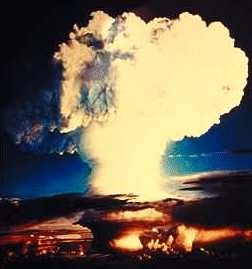
Have We Learned to Forget The Bomb? Posted by Hello
'>THE BOMB: A Life
by Gerard J. DeGroot
Harvard University Press 432 pages, $27.95

by William S. Kowinski

Gerard DeGroot includes a number of eyewitness descriptions of nuclear explosions, which bring the march of names, facts, lies, rationales and theories in this relentless history back to human reality, if only for a moment at a time. The largest hydrogen bomb explosion to that date---twice as large as expected---took place on Bikini Island in 1954. From a U.S. Navy destroyer thirty miles away, Marshall Rosenbluth watched the fireball: "rising and rising, spreading...It looked to me like what you might imagine a diseased brain, or a brain of some mad man would look like...And it just kept getting bigger and bigger..."

DeGroot, Professor of Modern History at the University of St. Andrews in Scotland, writes with grace and economy of a 60-year history still unfolding. Besides his admirable summations and deft narratives based on many long-available sources, he was able to add descriptions of the Russian bomb program and other details that have emerged in recent years (some crucial information about nuclear missiles already in Cuba during the 1962 Cuban Missile Crisis was only revealed in the late 1990s.) Although always ready to call a lie a lie (and there were many), and to name insane policies for what they were, he also provides the reader with enough well-organized facts in convincingly developed contexts to allow everyone to form their own impressions.

The pre-history of the bomb is fascinating. In the mid-1930s, few physicists had even thought about an atomic bomb, or if they had, believed one was possible; or if they believed it was theoretically possible, that it could be made a practical reality. But between 1938 and the autumn of 1941, the bomb went from a weird notion to a massive research and development program in the U.S., and lesser but still significant programs in Germany and the USSR. Eventually there was even a small program in Japan.

That Germany didn't develop the bomb is the most resonant story. Most advanced physics was being done in Europe, and most of that in Germany, until 1933, when Hitler directed that non-Aryans be fired from civil service jobs, which included universities and scientific institutes. Eleven physicists who had won or would win Nobel Prizes were dismissed. Around 100 German physicists, most of them Jews, wound up in the U.S. by 1941. They not only provided the scientific talent but a lot of the motivation for the U.S. bomb program.

But even after Hitler had gotten rid of Jewish practitioners of the "Jew science" of physics, it was a German physicist who had the key insight that for the first time revealed that the atomic bomb was possible. But no one listened. In 1934, Ida Noddack suggested that some puzzling results of an experiment conducted by Enrico Fermi in Italy might be explained by nuclear fission. But Noddack was not well-known, and she was a woman. (In '>The Big Bang, Simon Singh reveals many contributions of women in physics and astronomy through the years, though they didn't get much credit.)

It wasn't until 1938 that Fermi himself figured it out, but even then it took another physicist, Leo Szilard, to understand the implications. He knew immediately that the atomic bomb was possible, because he had already read about it, and how it was developed and used in warfare. It was all in a novel by H.G. Wells, written in 1914, including its name: the atomic bomb. Szilard also realized, from his reading of Wells, that if knowledge of fission and the bomb got into the wrong hands, it could mean the end of civilization.

Szilard won the Nobel Prize in 1938, and after picking up the award in Sweden, he and his wife emigrated to America. In addition to his own researches, Szilard was instrumental in first, getting U.S. and British physicists to stop publishing anything about fission, and then getting Albert Einstein to write his famous letter to FDR, and to enlist other influential people in convincing the U.S. government to develop the bomb before Hitler did.

But as DeGroot shows, the letter was so circumspect, and Szilard, Einstein and other physicists so unable to express in plain language the possible implications, that the American government dragged its feet. Hitler had been given such a clear paragraph, and he started the German program. What convinced FDR was not Einstein's letter but a story, a metaphor. Alexander Sachs was an international financier and friend of Einstein, who got the letter to FDR, but in a later meeting with FDR he simply told a story about a young American inventor who went to Napoleon during wartime and offered his invention, which the emperor turned down. The inventor was James Watt, the invention the steam engine. This got Roosevelt's attention.

The story of the bomb is replete with the tricks of fate and power of metaphor, including some forty years later, when Ronald Reagan finally committed to nuclear arms reductions with the Soviets after seeing the TV movie, '>"The Day After," that depicted the impact of a nuclear strike on families in Kansas.

There is no more powerful and defining story of the past 60 years as well as the world we live in as the story of the Bomb. Though the lethal effects of radioactivity were denied for decades, and the extent of cancers and genetic malformations suffered across America as a result of nuclear tests are still obscured, the bomb settled deeply into our national unconscious, and helped define our feelings about our leaders, about science and scientists, and about the future, or lack thereof.

The Bomb has remained in the national unconscious not only because so much about it is impossible for the rational mind to absorb or the psyche to comprehend, but because of the lies and misinformation. In 1971 Richard Nixon prevented crucial information from reaching the Supreme Court so they would not interfere with the largest bomb ever exploded within the U.S. at Amchitka island in Alaska. Radioactive elements from that explosion were still leaking into the Bering Sea by 1996.

In just a few weeks, diplomats from around the world will gather in New York to discuss the nuclear non-proliferation agreements that U.S. policy now endanger. Some observers expect proliferation to grow substantially as a result of this treaty's failure. Perhaps because visible testing ended decades ago, and the Hiroshima photos are in black and white, Americans don't seem to fear nuclear weapons anymore as beyond the pale. Yet one expert estimates the chances of a nuclear weapon exploding in an American city in the present decade at 50%. This book is essential in more than the classroom.

There are also new books on two of the best-known scientists associated with the Bomb. '>EDWARD TELLER: The Real Dr. Strangelove'> by Peter Goodchild (Harvard University Press) is a careful, detailed biography of the most frightening figure of the atomic age, because he was the most successful in convincing important people and a large segment of the public for a very long time that he was brilliant and trustworthy and courageous, when he was paranoid, dishonest and incapable in the extreme. As the chief model for Dr. Strangelove, Teller was a figure of parody, but in an age that produced Richard Nixon, Henry Kissinger and such lesser- known demonical liars as General Leslie Groves (who ran the U.S. Bomb program for years), he emerges as the era's best argument for the existence of Satan.

I haven't had the opportunity to see '>AMERICAN PROMETHEUS: The Triumph and Tragedy of J. Robert Oppenheimer by Kai Bird and Martin J. Sherwin (Knopf), but my virtual colleague at the San Francisco Chronicle Book Review, Elizabeth Svoboda, found that this this 721 page biography of the director of the Manhattan Project at the Los Alamos laboratories has much to say about the shifting "uneasy partnership between science and politics in America."

While DeGroot's new book takes a comprehensive view of the Bomb's history, there are many worthy books that examine specific facets. One that I particularly admire is '>NO PLACE TO HIDE '>by David Bradley (University Press of New England, 1984) which combines his eyewitness account of the "Crossroads" atomic bomb tests in 1946---of particular interest to me since I was born on the day of the first explosion---with more recent data on the health effects of these and other tests, contrasting with all the lies told to the American people by Leslie Groves and others. The combination is instructive on many levels.

DeGroot writes about the most significant of the many books, movies and television programs that make up an important part of the Atomic Age history, and there are many other books that deal with just these aspects. I still admire'> NUCLEAR FEAR by Spencer Weart (Harvard, 1988)for its thoroughness and insights, though I don't always agree with his conclusions.

Finally, we must not forget that The Bomb was used as a bomb, and may be again. Therefore, Sven Lindquist's '>A HISTORY OF BOMBING (The New Press) remains essential reading.

Sunday, April 10, 2005

My review of Sharon R. Kaufman's '>...And a Time to Die: How American Hospitals Shape the End of Life appears in the San Francisco Chronicle Book Review of April 10,2005, here.

Saturday, April 09, 2005

Watching Your Language #1
Much Ado About Few

by William Severini Kowinski


Fewer things may seem less important than a small alteration in language, but there may be something more to this one. For in common speech and in print, there are fewer and fewer instances of "few", and more and more of "less."

In particular, it's become common to hear the expression "less people" rather than "fewer people." Is this simply a case of English getting more efficient? Or does it suggest something more troubling?

The distinction between "few" and "less" which has been standard English since at least the 18th century, is simply stated: "few" applies to number, "less" to quantity. While there are the usual ambiguous circumstances, the usage has been clear in the most common instances: "few" or "fewer" people, for example. But these days, "less" is increasingly used.

It is not just an American phenomenon. A quick Internet search yielded examples from most English speaking countries, including articles from the Economist ("less people, more water") and AllAfrica.com. ("Less People Buy Bibles as Condom Sales Soar.") "The use of 'less people' etc. is so common in British English that there seems little point in claiming it as an error," wrote a teacher in Great Britain to her listserv. Another agreed that "fewer" is archaic. "...Less means the same as fewer," wrote someone in a different discussion on the subject. " So what is wrong with plain English, simpler English? Want to write a Victorian novel? Use fewer."

Though those of us who cling to "fewer" are fewer, I don't think we are we less democratic. The resources of a rich language can be used to deploy distinctions, which is crucial to meaningful debate in a democratic society. Communication among the many does not have to mean less precision: it very likely depends on more.

There may even be a more direct attack on certain values of our society reflected in this elimination. Perhaps we need to ask what has changed in the phrase "less people." Is it the grammar of "fewer" and "less," or is it our underlying idea of people?

In changing how we express the outcome of a count, are we changing our conception of what we are measuring? Do we see people only in aggregates, and not in affiliations? Do we now consider people not as integers with integrity, but as quantities that are classified according to common characteristics?

Perhaps in our marketing-minded society, numbers of people translate too easily into quantities of money, or of votes. If votes are just quantities, then stealing them is just theft. But if votes are individual commitments added up, to cheat is to dishonor the people who stood in line at the polls for hours in the rain. "Count the votes" means the voters must count more than the outcome.

The cause of human rights is based on the individual as significant, not as an indistinguishable element in a quantity that doesn't count. When justice or health depend more on quantities of money and power, individuals count less.

Quantity applies to objects, implying a passivity, of being acted upon. Number and counting suggest subject, capable of action: "Stand and be counted." Few can become many. When quantities of money have overpowering political effects, only numbers of people can balance it.

Or perhaps it takes only a few. The sense of individual significance is often conveyed in the most famous instances of "few": "Many are called, but few are chosen." "We happy few, we band of brothers," "A few good men." It's the key to the joke in the early 1960s British comedy "Beyond the Fringe", in an exchange between an officer and a soldier, mocking a World War II movie heroism cliché: "Sir, I want to be one of the few." "Sorry, there are far too many."

Yet we're talking more about "less people," as science suggests the individual, and the individual action, is potentially more powerful than previously believed. The now-famous "butterfly effect" of chaos theory is but one example: it can take even less than a few butterflies to change the weather thousands of miles away.

"Fewer" has a dignity lacking in "less." The change in language may be a done deal, but "less people" doesn't necessarily mean fewer butterflies.

Tuesday, March 29, 2005


myth and memory Posted by Hello
'>WHEN THEY SEVERED EARTH FROM SKY:
How The Human Mind Shapes Myth
by Elizabeth Wayland Barber & Paul T. Barber
Princeton University Press.

'>WHY LIFE SPEEDS UP AS YOU GET OLDER:
How Memory Shapes Our Past
by Douwe Draaisma,
translated by Arnold and Erica Pomerans
Cambridge University Press.

by William S. Kowinski

These two books are about memory, although on very different scales: the cultural memories stored over long periods of time through myth, and human memory in an individual's lifetime.

Though I started reading these books at about the same time only because of the accident of their arrival in close proximity, the idea that they are both about memory came quickly, for early in each book they each cite the same 1880 memory experiment, conducted in Germany by Hermann Ebbinghaus. Though they make entirely different (but not opposing) points from their examples, the coincidence suggested how the books naturally go together.

In '>When They Severed Earth From Sky, E.W. and P.T. Barber cite the Ebbinghaus research to support the idea that memories are remembered better when they are structured as stories rather than strung together as isolated facts. The basic premise of their book is that ancient myths are essentially stories that preliterate people used to help them remember important information about the real world, and pass it down. But for various reasons, we no longer recognize the events and phenomena these stories are meant to describe.

Their first example is a story of the Klamath people, about the fire-flinging Chief of the Below World battling the Chief of the Above World at Mount Shasta. Thanks to the sacrifice of Klamath medicine men, the Chief of the Below World was overcome, and his mountain disappeared. It then rained for many years, filling the hole where that mountain had been. The people were saved from the threat of fire, but were cautioned not to look upon the sorrowful waters.

Using details of the story matched up with known geological history, the authors maintain this is actually a story about a volcanic eruption which in fact blew away a mountain near Mt. Shasta, and left a hole now filled with water, which we call Crater Lake. The warning to stay away from the lake (which the Klamath people obeyed for many years) essentially was to protect them from any later eruption.

This book is a pleasure to read. The authors give the impression that they had a good time traveling and doing their research over a number of years, and they seem to have worked hard to make the writing seem easy, which is always appreciated. The result is a very readable romp for any intelligent reader, with lots of forward momentum (at least until the "Of Sky and Time" section) and employing a mostly engaging style consisting of lean, robust sentences and breezy diction. They anticipate the reader's logical questions, and present their theories about why myths are encoded as they are and the mechanisms they use, using a series of cleverly named "Myth Principles," like Memory Crunch, Silence Principle, Lethe Effect, Zone of Convenient Remove Syndrome and UFO Corollary.

Along the way readers will learn what getting up on the wrong side of the bed actually means, as well as fascinating interpretations of dragons (as a collection of ideas stuck together with the same name) and the Prometheus Myth.

The weaknesses of the book, apart from an awful lot of the myths turning out to be descriptions of volcanoes (including Prometheus) and attendant tsunamis (parting of the Red Sea), are in its limited usefulness and jovial reductionism. While it may come as a surprise to some academics that Native stories record real events, in my part of the world---which is not far from the Klamath---even geologists refer to stories of indigenous peoples when they talk about seismic events on the North Coast of California, and they've used these stories for at least a decade to help them understand local geologic history. As these authors admit, on this quality of Native stories, Vine DeLoria got here ahead of them in his impassioned and at times hilarious diatribe, Red Earth, White Lies.

While I'd be surprised if the premise that myths can refer to actual events is big news to academia (but I'm prepared for that eventuality), the authors are really on shaky ground with their apparent contention that this is all these myths represent. For instance, in her A History of God, Karen Armstrong refers to the possibility that the Bible story of the parting of the Red Sea may refer to earlier pagan stories, and that the Israelite god Yahweh might have originally been a god of volcanoes. But Armstrong goes on to discuss how the Israelites changed the nature of this god, and adapted this and other stories to refer to themselves. For them and I suspect in many other cases, the myths are not merely explanations of natural events; the natural events and the stories about them are incorporated into the myths to support a religious, philosophical, political or tribal idea. In other words, at least some myths use the natural events to explain beliefs, not the other way around.

The authors also completely dismiss Carl Jung's theory of mythic archetypes (central to Joseph Campbell's work, too), and later refer only to minor features of their ideas. (They also dis dreams with an oversimplified and reductionist "scientific" explanation that would surprise some neuroscientists.) They apparently reject what I take to be much more likely: that myths can be stories by which peoples remember some natural events, and they express other kinds of beliefs, and they reflect archetypes that may be universally present in human life. Sometimes one, two or all of them, and probably more. There's really no contradiction. We don't call them the mystic chords of memory for nothing.

In '>Why Life Speeds Up As You Get Older, Douwe Draaisma , a professor of history of psychology in the Netherlands, describes Ebbinghaus' researches (which he doggedly conducted using himself as the subject) as one pioneering kind of memory research, which became the dominant kind because it allowed for quantified data. Another early self-researcher, Francis Galton, experimented with associating subjective memories to current observations, but for much of the twentieth century, this way of approaching memory (as actual autobiographical memories) was neglected.

Draaisma uses the fruits of both kinds of researches, in the laboratory and out, as well as the musings of philosophers, writers and psychologists, to freshly examine several phenomena of memory, which always involve the content of memories. He explores reminiscence, so-called photographic memory, forgetting, déjà vu, and other questions of how we experience time and memory, and examines unusual cases, such as the memory of savants and grandmasters, trauma victims, and two people who seemed never to forget anything: one of them fictional, and one real.

Draaisma is a graceful writer (the English version's virtues aided no doubt by translators Arnold and Erica Pomerans), and most chapters have the length and structure of short self-contained essays. Many address questions we all have about memory and memories (since we all have both)with stylish economy and a treatment of relevant research that is involving. The questions begin with why don't we remember more of our earliest years? (Memory, or access to our memories, is autobiographical, and seems to depend on self-awareness and the development of speech.) How do people with unusual or prodigious memories remember so much? (Their memories seem to be laden with more sense data, and their brains structure memories in spatial relationships.)

One of the best essays is on "Smell and Memory," which confronts the question of why certain smells can instantly bring a long forgotten moment to life. Draaisma begins with the literary reference that has become automatic: Proust's moment with the madeleine dipped in tea that floods his memory with images and feelings (which is relevant because taste is so strongly related to smell.) But instead of referencing what has become a cliché, he goes back to the text and reveals that Proust's description of this experience takes up four pages, and his narrator goes through a long process of remembering, which requires hours, and not one but ten tastes of the tea-soaked cake.

Draaisma then examines other similar recorded experiences and the relevant laboratory research. It appears that smell is the exception to the rule: that associations are formed in memory that don't depend on language, which is why memories inspired by smell are different from most other kinds.

Of course, there's more to each question than these paranthetical and somewhat reductive summaries, and much of the pleasure here is in the reading journey. There are intriguing insights within chapters, such as our predeliction to remember insults and humiliations with great clarity, and unlike other memories to see ourselves in these painful scenes, as if from outside.

Not all the chapters are successful either in the questions they ask or the answers. In particular, the chapter that addresses the title question, why does life speed up as you get older? is not very satisfying. One of the central difficulties in talking about memory and time is the difference between subjective experiences and objective facts of each. Sometimes in dealing with them, Draaisma is illuminating, but this chapter seems a bit too confusing. He acknowledges that part of the difference in experiencing time in youth and age is physiological, and some is experiential. His final metaphor in this chapter, of a man running along a river (at first as a child running faster than the river of time, then in youth at the same rate the river is flowing, then with aging, slower and slower until the river runs without him) is a lovely synthesis of the research he cites, but doesn't quite answer the question.

So why does life speed up as we get older? I think it has a lot to do with anticipation and hope. I am writing this a few days after Easter Sunday. In my childhood, Easter was a major holiday, and one that I anticipated and thought about far in advance. The day itself was full of events and feelings (some of joy, some of disappointment, some of boredom.) This Easter had such little significance that the fact that some places were closed was a momentarily unaccountable surprise.

Part of the difference is objective: Easter is not as big a holiday as it was in my particular ethnic Catholic western Pennsylvania context in the 1950s, though among my family still living in the area where I grew up, it is more significant than among people I know where I am now. Much of Easter became oriented towards children, so naturally it would have been more important when I was a child, or if there were children now in my household. But I think an important factor is also the change that comes with disillusion. After awhile, tempered by disappointments and fading possibilities, you no longer expect or anticipate wonders linked to a day or an event, so time does not slow down before or during it.

So much of youth and adolescence (when Draaisma says most retained memories occur) is the experience of discovery. Having discovered through experience the limitations placed on hopes and dreams leads to a disillusion that distances you from the moment. It becomes too painful and wearying to either anticipate or allow yourself to fully experience the flow of time. This translates more generally, as your priorities necessarily shift to dealing with daily responsibilities, especially now that the speed of life has increased. As the habit of anticipation and hope gives way to the habit of coping and the suppression of disillusion, we flatten experience and even hurry through it as unconsciously as possible. For this and other reasons, life speeds up because we aren't paying so much attention to it.

This may also be why as we get older, we live more in our memories. Memories are themselves timeless. The more time we spend in this timeless space, the faster time seems to speed on, in those fewer moments when we rejoin the present. So now when we bite into a marshmallow bunny, it is a more Proustian than present pleasure.

Friday, March 18, 2005

This is What's the Matter with Kansas

by William S. Kowinski

'>Democracy and Populism: Fear and Hatred
by John Lukacs
Yale University Press. 248 pp. $25

Simply in the ideas it addresses and the authority of its arguments, this is a profound and useful book. Historians and other scholars will have to vet its evidence and wrangle over its arguments, but much of it passes the smell test of at least one reader with the same set of questions that pervade one of the more fashionable political books of the year, Thomas Franks' '>What's the Matter With Kansas?

John Lukacs is a historian whose work encompasses politics. He distresses many because his own political ideology can't quite be nailed down. He's blue states on some issues, red states on others, it seems. And his reading of history is his own.

Given the ground it covers and its apparent nature as a summary or a summing up, this is a relatively short book. Despite Lukacs' resulting declaratory, even declamatory tone, or perhaps because of it, he often pulls back suddenly to say, but this isn't the subject of this book, but if it were... That's part of this book's considerable charm, which it needs, considering its subject.

The ideas Lukacs expresses are conclusions he has drawn from his study of history, and we get some fascinating slices of it as he assesses the world since 1870, and especially as he corrects what he considers to be improper use of language, as in throwing the word "Fascist" around too freely (he restricts it to its origins with Mussolini) and misusing the concept of "totalitarian" in respect to the regimes of the most infamous 20th century dictators.

This is meaningful because, Lukacs asserts, such dictatorships, especially Hitler's Germany, were essentially populist regimes, and populism in the modern age is associated with nationalism. So the Nazi Party was what its name said: National Socialism. But especially since all modern governments were and are historically socialist (he argues) in that they provide some social safety net, Hitler's emphasis was on nationalism. It is what links his regime to Stalin's, and in large part now, to ours.

Lukacs contrasts populism with patriotism. The patriot is loyal to the state, but the populist to the nation. The populist is more likely to be racist. "A patriot will not exclude a person of another nationality from a community where they have lived side by side and whom he has known for many years; but a populist will always be suspicious of someone who does not seem to belong to his tribe." (But Lukacs, who is so careful about many words, is imprecise in his use of "tribe.")

Why do the people of Kansas vote against their own economic interests? This was the key question of Franks' book, and a great puzzle of Democrats over the 2004 election result. Without specifically addressing that question, Lukacs answers it: "But what governs the world (and especially in the democratic age) is not the accumulation of money, or even of goods, but the accumulation of opinions." This was true in the age of monarchy, and even more true now because "the accumulation of opinions can be manufactured and even falsified through the machinery of publicity, at times even against contrary appearances." So in a way, a new definition of faith-based v. reality-based.

The emphasis on materialism as motivation is a mistake, Lukacs insists. Past a certain point of basic necessities, humans in society are concerned with, for instance, respectability: for the high opinion of others. While material belongings are a part of that, so is belonging to the group in other ways. And historically, Lukacs asserts, the group is ultimately defined as the nation.

While the conventional wisdom would contrast the power of public opinion in democracies with its silent irrelevance in dictatorships, Lukacs, who is known as an expert on Hitler and his era, does not: "...it is the accumulation of opinions that governs the history of states and nations and of democracies as well as dictatorships in the age of popular sovereignty. It is the main ingredient of nationalisms, the cause of wars, and of the majority support of fanatical speakers like Hitler, or of the less enthusiastic but majoritarian support of less than mediocre presidents." (The ending of this sentence was changed from the bound page proofs, where it read: "but still prevalent support of otherwise colorless presidents such as George W. Bush.")

Lukacs traces the rise of nationalism after 1870, and believes that "the masses" are less conscious of class than of nationalism. They fear foreigners and hate those who are insufficiently nationalist within their own country. (Readers right here might keep this in mind as they read the review of Homeland below.)

The "fear" and "hatred" of his subtitle distinguish the left from the right on the political spectrum. Especially at their extremes, the left is motivated by fear (of oppressive capitalists and reactionaries) while the right is motivated by hatred (for enemies of the nation, of the "people," which translates into those who aren't us.)

"But while hatred amounts to a moral weakness," he writes, "it can be, alas, often, and at least in the short run, a source of strength. Whence the advantage of the Right over the Left---especially in the age of democratic populism."

But fear, of course, is not much better. "Fear and hatred are prevalent among us," he concludes, "manifest and evident in the increasing savagery---"savagery is the proper word, not 'violence'---in and around our everyday lives."

If anything makes noise from this book, it is likely to be Lukacs assertion that liberalism is dead, and a Red State sort of populism triumphant. But it is the savagery that he seems to really want us to understand.

However, he sees conflict within this triumph, because there may be division between "two kinds of Right": "between those who believe that America's destiny is to rule the world and others who do not believe that; between those who trust technology and machines and others who trust tradition and the old human decencies...in sum, between those who do not question Progress and others who do."

I don't know that I buy this division in precisely this way, but I see what he's getting at. In the book as a whole, perhaps the most glaring omission for me is a specific discussion of plutocracy and how it might interact with populism, which is a crucial element of today's that remains insufficiently explained in general.

Lukacs view of the masses is not unfamiliar, but his application to the world we know is pertinent and thought-provoking. Against the collective, mechanical, easily manipulated, nationalistic populist mass, he reintroduces other familiar concepts: freedom and the individual. "Freedom means the capacity to know something about oneself, and the consequent practice or at least the desire to live according to limits imposed on oneself rather than by external powers."

Between the lines I have quoted are his arguments as to why this is so difficult in the modern world. Lukacs presents a historical and political argument that reminds me of other themes, other fears, from the 20th century, such as the fears for "mass man" and the "outer-directed" "Organization Man" or even Jung's "extraverted as hell" Americans. To these characterizations he adds pungent illustrations of the role of publicity in government, and the phenomenon of populist religion.

Historians may buzz a bit about Lukacs' assessments: while he finds Marx, Orwell and even Machiavelli wrong or irrelevant, de Tocqueville turns out to be remarkably astute and prescient. But what I suspect is most likely to be missed, and what I found most moving, is his hope for the future. (He even refers to the "historicity of hope.") "It is hate that unites people, whereas love is always individual, rather than collective. To this we may add something that immediately negates whatever moral essence the purposes of class struggles or of racism or of modern nationalism may have: and this is that love is never the love of oneself, it is the love of another. That is the saving grace of mankind."
Friday, March 04, 2005


Photo by Michael Williamson from "Homeland" Posted by Hello
'>Homeland
by Dale Maharidge, photographs by Michael Williamson
Seven Stories Press

review by William S. Kowinski

There are so many books, too many good ones get lost. That's my excuse for not knowing about Dale Maharidge, and his previous collaborations with photographer Michael Williamson, obsessively chronicling the losers of this American society, most of them innocent of anything but being born in the wrong place and time, and maybe being unlucky and vulnerably flawed, and believing the wrong people.

On the other hand, the major machinery of this culture would naturally work towards obscuring the existence of these books, and only obsession can really account for them even being written. However, these guys were noticed enough to win a Pulitzer Prize, and get Bruce Springsteen's attention. He wrote and recorded a couple of songs based on people they wrote about.

It took their appearance on C-Span to bring them into my life. I heard Maharidge talk about the new secret poverty in America, of not the unemployed but the working poor, in many cases the overemployed (working two or three jobs) but severely underpaid. These are the people who show up at work every day in their nice clean clothes, and sleep in their cars. Or they go home to their well-kept houses on a modest nice street, but there is absolutely no food in the refrigerator or furniture in the house. This scandal, and the outrage it is not inspiring in America, is where the horror begins.

He talked also about the rage among them, but not rage at the rich and the corporate elite. Rage at immigrants and people of other races. And now, after 9/11, rage at anybody who looks Arab or doesn't adore G.W. Bush and the flag on his lapel.

With a friendly intensity, he made some provocative and interesting observations at that bookstore on C-Span, and made some stimulating connections, as between a man's racist rage and his woefully inadequate health insurance, and the hospital bills that have dug him into a ditch of debt he will likely never even see the rim of.

All of that is in this book, but so is some riveting, absorbing writing. This book's effectiveness owes at least as much to literary skill and a mix of adept styles and tones, as to the selection of subjects. The result is a singular reading experience.

The basic focus of "'>Homeland" is post-9/11 so-called patriotism run wild, and the accelerated pungency it braids into the hot fears and cold prejudices that runs through the paradox of the lower middle class. (Mostly.) This is not entirely foreign territory to me; I grew up in western Pennsylvania, the grandson of a coal miner and an immigrant tailor, and I went to college with a lot of kids from Chicago and its suburbs. But this is definitely a scary picture. Maharidge sees a land of barely suppressed hate and open rage, of racism that's changed only in becoming too media sophisticated to ever let on that it is racism. The paradox is everywhere: ordinary people on the skids, blaming people who are often even worse off than they are.

"All these things," he quotes a priest saying. "And we don't grow up. We just don't grow up."

The first part of "Homeland" is a gripping, full-speed-ahead narrative about Katie, a high school student in West Virginia ostracized for her "radical" political views, post-9/11. The rest of the book is more fragmented in its narrative as Maharidge journeys out farther into other uncomfortable corners of America, and inward to try to make sense of it all.

This book quivers with life, its wild tangles of feeling, the everydayness of plodding but easily flaring, near-psychotic possession, and the heroic stands some make to oppose this insanely normal morass of misguided rage, by lone figures who know they will be mowed down for the smallest symbolic gesture and usually are, to the notice of almost no one. That continues to be the great political weakness of the left. While the rightists talk individualism but support each other, the leftists caw about solidarity, and fail to get past their personal fog to lift a finger for anyone. Still, at least Katie got some help from the American Civil Liberties Union.

It's carefully described and reported, but full of feeling and it gets personal, too. Maharidge writes about his father in World War II, and the painful break with an old friend over some of these issues. The book ends with a Thoreau-style manifesto against the Iraq war, from the woods of Humboldt County. Hey, I live in Humboldt County. He's got a sentence in there about a guy who lives down my street. And I had to meet Maharidge on C-Span? It's a strange world.

Maharidge teaches students to practice "Star Trek journalism," to go where nobody has gone before. He certainly walks the walk, nobody's gone where he has since the Depression anyway, and he is remarkably patient and open (much more than I could see myself being), as well as a writer of skill and feeling.

He comes away with some ideas about why we're trembling on the brink of savage chaos. In a conversation with a Civil Liberties attorney, they talk about this "blanket of conformity that had settled over America" in terms of nationalism, and a comfort with authoritarian rule that comes from feeling economically stressed and insecure.

The next review to appear here will be of a book that tries to explain some of this historically, and such explanations are certainly keenly needed: for if the 2000 election showed how divided we are into blue and red mental states, the 2004 election revealed it's more than personality preferences and lifestyle. We awoke in November to how little we know about what goes on in each others' heads or hearts. But theories aren't likely to tell us as much about this country at this moment as this book does, through the sights and the voices Maharidge brings us (and Williamson's portfolio of harrowing photos) and the responses from his head and heart he so honestly and eloquently presents.

Homeland is published in hardback by Seven Stories Press. Their paperback edition is scheduled for August 1.


Sunday, February 13, 2005

THE BIG BANG: The Origin of the Universe by Simon Singh

is reviewed by William S. Kowinski in the San Francisco Chronicle Book Review of February 13, 2005. Here's the link. The review links back to this blog.

Friday, February 11, 2005


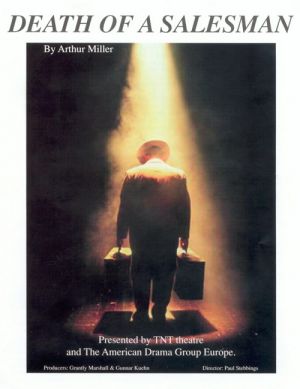
Willy Loman, the American Loser as Everyman . This poster was meant to illustrate the book review below but by coincidence, it also marks the death of Arthur Miller, whose "Death of a Salesman" is just one of his great plays illuminating the American experience. As Edward Albee said in tribute, his works are "essential." Posted by Hello