Showing posts with label Thomas Pynchon. Show all posts

Sunday, July 14, 2024

Reading Mason & Dixon


I like reading long novels. Often they are among my favorites of  favorite authors, like Jonathan Lethem's Chronic City or Richard Powers' Goldbug Variations and The Time Of Our Singing, Don DeLillo's Underworld (though my absolute favorite of his is the somewhat longish Ratner's Star), and Jim Harrison's The Road Home (nearly 500 pages on its own, it is also a kind of sequel to the shorter Dalva.) I've had stretches of taking on long classics all in a row: Moby Dick, War & Peace, Anna Karenina.  In the first few years of my retirement I read several long Dickens' novels, though I admit I haven't attempted the longest, Martin Chuzzlewit.  

I didn't come to this naturally (but that's a longer story) and I don't get through them all--I have yet to sustain interest in the world of Middlemarch, though I appreciate the skill of the writing.  I do need to be involved in the world of the novel, but what grabs me and holds me is the rhythm of the prose.  The pleasures of that are enough to keep me going, even when (as frequently happens) I'm not all that sure what's going on.  I've turned to plot guides, and in the case of Dickens, a good BBC/PBS film adaptation, to help me sort out the characters and events.

The writing, the mesmerizing rhythms of it have especially been the attractions of several of Thomas Pynchon's long novels.  I read V twice and had a pretty good idea of what was going on the second time.  I started Gravity's Rainbow several times, I loved the first section a lot (same with the first section of Ulysses) but couldn't get past it.  Then I read it through in the 1980s (when I noticed that the movie The Adventures of Buckaroo Banzai stole the name of Yoyodine Propulsions from this book.)  After my retirement in 2016 I read it again, this time with a guidebook or two.  That added to the pleasure.


Gravity's Rainbow
is very likely Pynchon's masterpiece, but I have a special fondness for the 1085 pages of Against The Day.  If it has a plot I don't know what it is.  I experienced it as a compendium of early twentieth century genres, including the western and especially boy's adventures. The group of boys as a kind of Starfleet in dirigibles is just perfect.

The occasion for all of this is that I have finally finished another long Pynchon, Mason & Dixon.  I read its 773 pages over several years--so many I can't remember when I started it, but probably two or even three this time.  I've had a copy since it was published in 1997, but I was always stopped in my reading tracks by the strange 18th diction and spelling, and especially the rampant Capitalizations of nouns and their modifiers, and perhaps more. 

  This still slowed me down in this recent attempt, and this hefty volume would drift to the bottom of the pile next to me.  But I'd dip into it every once in awhile, if only for a shot of Pynchon energy in a dismal verbal world.  Then I would get rolling for awhile.  But since I seldom understood what was going on beyond the particulars of a scene, I couldn't sustain the momentum.  Until I did, and read the last two or three hundred pages in a long series of consecutive evenings.  

In general, the novel really is about Mason and Dixon--before, after and especially while they were embarked on the one job for which they are remembered, fixing the border between Pennsylvania and Maryland that by the 19th century became the border between North and South.  Other characters in the novel have historical counterparts as well (George Washington and Samuel Johnson have cameos, and Ben Franklin comes across as a wily crank who keeps getting people to electrocute themselves.)  I suppose I actually did learn things about the 18th century , but basically I was just along for the ride.

Besides--as Eileen Ecklund notes in a contemporary review I chanced upon after writing this piece, "...the most basic of my Pynchon reading lessons: you will not be tested on this later."

Instead of plot developments I noted little allusions, buried anachronisms and jokes.  Several titles of other Pynchon works appear in the prose, like "inherent vice" (p. 272) "against the day" (p.683), and a brief appearance of a family name (Bodine--p.566) that appears in other Pynchon novels, notably in V and Gravity's Rainbow.  There are allusions that perhaps only a Doctor Who fan would know (a Coach designed by the Jesuits--the scientist/magicians of the day--is "bigger on the inside" (p. 354) and a structure decaying in the woods also suspiciously akin to the TARDIS (412.)  And then there's the Kabbalistick sect that flashes a strange hand sign while uttering, "Live Long and Prosper." (485)  

The Reader's Fortitude is rewarded with Pynchon elegance and eloquence, such as on the subject of slavery.  Stories of new scientific technologies and of magic intermingle, especially on the Pennsylvania frontier (including country I know from my own boyhood)  and there is plenty of the Fantastic (a Robot Duck and a Talking Dog for starters.) The futility of the frontier mentality--in which perfection is finally just beyond the next ridge, until it always isn't--and the fluidity of actual and metaphorical border areas, all appear to be themes. But I mention all this less to explain the book, than to celebrate the fact that I read it.

I had just about finished reading it in fact when I learned of the imminent publication of the Mason & Dixon Companion, out next month, which presumably suggests more than I discerned about the plot, themes etc. as well as the many allusions I'm sure I missed.   But as much as I enjoyed this book, I'm not quite ready to start it all over again, Companion at my side.  But maybe someday.  For now, I am comforted by noting that it took 27 years for anyone to write a Companion to Mason & Dixon.

Wednesday, March 25, 2015

For Pleasure Winter 2014-15

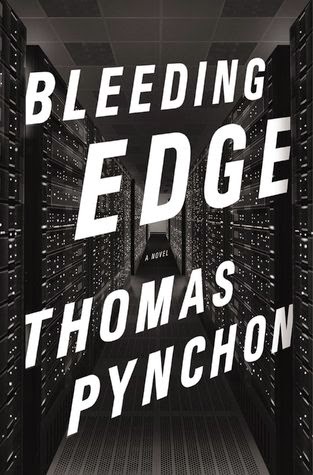
Thomas Pynchon's Bleeding Edge demonstrates his mastery of the early 21st century zeitgeist, to go along with the many other decades he's illuminated.  As usual, the closely observed blends disconcertingly well with the fictional.  When recognized it's funny, as in his hilariously cast series of biopics about famous golfers.  So much of it is in the digital realm, and there it was harder for me to discern the imaginative projections from the dizzying reality.  For example, I thought the "dark web" was a brilliant if typically paranoid Pynchon invention, though I learned that it essentially isn't--that is, in some sense it actually exists.

Pynchon selected a particular New York City voice that to my mind tended to limit the novel's eloquence, though he couldn't always hold back the bon mot.  I grew a bit tired of the voice--but that's also to say that it confirmed in me my overall feeling--despite a short residency it saddened me to end--that I'm glad I don't live in New York.  As for its prophesy, one character talks about omnipresent surveillance potential that people giddily accept with every new device they covet.  He refers the wrist devices that are rumored in today's news to be the next hot product as "the handcuffs of the future."

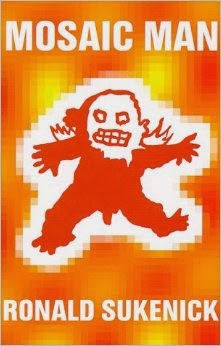
Briefly intercut with that novel in my reading was Mosaic Man by Ronald Sukenick.   Sukenick was a kind of Pynchon who never made it.  He once said he had about twelve readers, but they adored him.  I happened on his Death of the Novel and Other Stories and his first novel Up in a tiny public library in Stony Creek, Connecticut in 1969 or 1970, and was fascinated.  He was doing what later would be called metafiction or postmodern, but with intelligence and a lot of wit.  (I was later to discover his book on Wallace Stevens, Musing the Obscure, which is still my skeleton key to that mesmerizing and difficult--or let's just say mysterious-- poet.)

Sukenick kept publishing, through small presses and the Fiction Collective, in which he was a principal, and I bought them when I ran across them: Out, 98.6, Long Talking, Bad Condition Blues; Blown Away, Doggy Bag.   But it was just this winter that I caught up to his 1999 novel, Mosaic Man.  Once again, the act of storytelling is itself the plot, though this time there's a clear central concern of assembling an identity out of that mosaic of stories.  That seems more to the point than the rough form of books of the Bible (each very different yet somehow parts of the same story), though the pun of Moses-iac Man does suggest something that I don't recall from his earlier books, which is factoring in his Jewish identity.

Anyway, this is clearly a mature work, though still lively and with many of the impulses (and tics) of earlier works.  There are parts of it--the childhood sections especially--that are flat out brilliant.

This book ends in New York, and the Twin Towers and terrorism figure in, although it is not yet 9/11, which happens in the course of Pynchon's book (though it seems to me more a background part of the world than a major element of the narrative.)  However, Sukenick's next novel is about 9/11 and the Twin Towers, near where he lives at the end of this book and in that book.  I've just ordered it.  Sadly, it was his last novel.  He died in 2004.

I read another of Northrup Frye's shorter books based on a lecture series--this one called Creation & Recreation.  But I also very deliberately read a longer collection of essays, The Stubborn Structure, all the way through.  Some essays were of broad concern, and some were more specific, and more specifically literary criticism, as in the chapters on Blake and Yeats.  Frankly I thought I might skip those, no longer being in the academic framework, but I really enjoyed them.  In a way they put me back in touch with my 20s self, but I was also aware I was understanding more than I had then, not because of any increase in intellectual capacity (probably the reverse) but possibly of experience, or maturity.

Of the re-reading: Crooked Cucumber: The Life and Zen Teaching of Shunryu Suzuki by David Chadwick is a biography of the man who founded the San Francisco Zen Center and finally brought Zen meditation to the United States in the 1960s.  I'd forgotten or perhaps not appreciated as much how skillfully Chadwick wrote about Suzuki's life in Japan, which is really the bulk of the book, beginning in 1904.  The first time I read it, during my research for a San Francisco Chronicle article on Buddhism in the Bay Area, I had concentrated on the U.S. chapters.  Suzuki is a fascinating figure, with such profound humor--that also dominated my first impression.  This time I marveled at Chadwick's writing ability, though he was not previously a professional writer--he was a monk at the Zen Center.

Another re-read: Ray Bradbury's The Martian Chronicles.  I'd forgotten what variety there is in this collection of stories, since several of the early ones were so indelible.  Bradbury became a kind of grandfatherly figure but here he is still the young firebrand.

Finally, I'm giving up the pretense that this blog is any longer principally reviewing new books.  When I wrote reviews more regularly for publication, I could afford to do that.  But even in my many years of reviewing new books, I have always needed to write about books that were new to me regardless of when they were first published, or books that became new in re-reading--or maybe more accurately, revealed new facets the way old friends do.

So henceforth I will no longer need to categorize my reading here as "for pleasure" as opposed to new book journalism.  It's all going to be for pleasure now, or at least to respond principally to other needs.

Thursday, January 10, 2013

For Pleasure: Fall into Winter


The DVDs of the BBC Sherlock series and my continuing interest in the Granada Sherlock Holmes series (with Jeremy Brett) inspired me to read (and re-read) Sherlock Holmes stories in my The Illustrated Sherlock Holmes Treasury (Crown 1984) which has many of the original illustrations as well.  Especially when re-watching various Granada episodes (based most closely on the actual stories), I would go to the stories themselves to see how they differ.  Fun and enlightening.  I came to prefer Holmes stories for bedtime.

I happened to see a recent video interview with J.K. Rowling.  She was asked the question: what writer would you most like to be compared to?  I think it was specific to the Harry Potter books.  As the question was asked the name E. Nesbit leapt into my mind.  And so it was with a shiver that I heard her say that same name, E. Nesbit.

English author Edith Nesbit is best known for her children's novels and stories, though she wrote other works and had an otherwise fascinating and dramatic life.  At some point at the old family home, I happened on a couple of her books that had belonged to my younger sisters.  I read them and was enchanted.  When I read the first Harry Potter book much later, the first author I thought of was E. Nesbit.

So I revisited one of those books, The New Treasure Seekers, and for the first time read the original, The Story of the Treasure Seekers.  It was a different reading experience but I wasn't disappointed.

I've also been reading (or re-reading) juveniles from the time of my youth or before.  I've mentioned some before, mostly the science fiction stories but also some sports fictions.  In a box of somebody's giveaways I came across one that I either read or could have read back then: Grand-Slam Homer, a Bronc Burnett story by Wilfred McCormick (1951.)  It did remind me that, next to listening to radio play-by-play of Pittsburgh Pirates games, I learned the most about the finer points of baseball from books like this one.  I learned very little from my own coaches--much more from coaches like Cap'n Al in this book.

Also inspired by viewing a DVD collection of Chekhov plays, I read A New Life of Anton Chekhov by Ronald Hingley.  But with no televisual prompting at all, I also read Michael Billington's 1987 Stoppard, on the plays of Tom Stoppard to that point. Billington is always interesting.  I found myself yearning for the music of James Joyce's sentences, so I began reading the stories in Dubliners, but specifically in the Illustrated (and annotated) Edition by John Wyse Jackson and Bernard McGinley (St. Martins) which I'd been given as a gift many years ago.  For similar reasons, I've reread portions of Gravity's Rainbow by Thomas Pynchon.

Arthur Conan Doyle, Edith Nesbit and H.G. Wells were contemporaries in the late 19th and early 20th centuries.  They all appeared in The Strand Magazine, sometimes in the same issues.  Wells has been a particular interest in recent years, so it was for an ongoing project involving his work as well as my Sherlock phase that I also read Arthur Conan Doyle by Don Richard Cox (1985) and The Doctor and the Detective by Martin Booth (1997.)  I'm evolving my own theory about Conan Doyle's influence on Wells.

Finally, as part of that ongoing writing project, I dipped into several books on and by Wells, and I've been reading with great pleasure as well as interest: Margaret Atwood's In Other Worlds, Robert A. Heinlein by H. Bruce Franklin, and particularly Alien Encounters by Mark Rose.

Sunday, January 16, 2011


For Pleasure: Early Winter 2010-11
There wasn't much time for undemanded reading these past few months, but I managed some. I've continued a few nightly pages of Richardson's Emerson: The Mind on Fire, and am close to finishing it. Emerson's admiration for Bronson Alcott, the educator, reformer and daddy to Louisa May, suggested I might enjoy Fruitlands: The Alcott Family and Their Search for Utopia by Richard Francis, new this past fall from Yale. But Francis' unsympathetic portrait of Alcott, whether that was intentional or not, soured me on reading very far into it. Alcott comes across as a thoroughly, aggressively, self-righteously and cluelessly self-deluded character, who made me so impatient that I couldn't bear reading about him, especially in this undistinguished prose. I sure didn't see any reason reflected in this book for Emerson to admire him.

I also followed up Thomas Peacock's comic early 19th century novel Headlong Hall with his Nightmare Abbey. It too was great fun to read, and as satire of both certain forms of romantic fiction and of various pretentious representatives of various pretentious ideologies and systems of thought, it is often remarkably contemporary. And still funny after all these years.

Reading Mark Rotella's Amore: The Story of Italian American Song (Farrar, Straus) reminded me of a book I bagged at a used bookstore some time ago that has been shelf decoration ever since: Schnozzola: Gene Fowler's Story of Jimmy Durante. So I finally read it, and what a book! It covers Durante's life and career in great detail for his early years (it was published in 1951, just as he was becoming the TV star I recall from my childhood.) Durante started out as a ragtime and New Orleans jazz piano player, became a nightclub star in the 20s, Broadway, radio and the movies in the 30s and 40s, and after his decade or so as a TV star, he became a recording star with several albums of standards and ballads in the 60s and 70s. Some of these renditions were revived in the movie soundtracks of Sleepless in Seattle and City Slickers, and his version of "September Song" is definitive, and heartbreaking.

The Gene Fowler book reads like a Damon Runyon story, with the real Damon Runyon as an occasional walk-on. Fowler suggests this is so because it is about the same people Runyon wrote about and fictionalized--especially the people who talked the way Runyon later wrote. So full circle in a way. Show biz characters like Eddie Cantor, George M. Cohan and Ethel Merman play bit parts, with starring roles going to Durante and Lou Clayton, his biggest booster and manager as well as the third member with Eddie Jackson of the act that ruled the Broadway club scene in the 1920s. Durante's complex relationship with his first wife Jeanne is also a central thread (Fowler speculates that she was the "Mrs. Calabash" Durante famously and forlornly said goodnight to at the end of his shows, something which Durante reportedly confirmed many years later.) But the featured players are the gangsters who ran and supported the clubs and the club scene, especially during Prohibition--guys with actual names like Zimp, Johnny Blue Eyes, Long-Shot Abraham and Benevolent Charlie. They don't make 'em--or write 'em--like that anymore.

Recently I've started reading Thomas Pynchon's Inherent Vice (just as I ran across an Emerson quote in the Richardson book: "...the impracticability and tough unalterableness of sentences which must not stand as they are, demonstrates past a doubt the inherent vice of my writing.") So far this seems a slighter book than Against the Day in more ways that the number of pages. I've also begun Margaret Atwood's novel The Year of the Flood. I've always admired Margaret Atwood, in her nonfiction and interviews and so on as well as her fiction. I especially cherish her book on writing and writers, Negotiations with the Dead. She's still making waves with her 2008 book Payback: Debt and the Shadow Side of Wealth. I believe Margaret Atwood will be the next writer in the English language to win the Nobel Prize for Literature, and I support the idea.

Sunday, October 17, 2010

For Pleasure: Fall 2010
First, to finish summer...I finished Thomas Pynchon's Against the Day (which means among other insane things that I read two novels this summer of more than 1000 pages each.) I not only admired this book but it inspired more feeling than I associate with past forays into Pynchon. So I dipped into some of the older books, as well as a fairly detailed exegesis of his work up to and including Gravity's Rainbow (Joseph W. Slade's book on Pynchon, published in the Warner Paperback Series on Writers for the 70s, which I must have picked up at some used bookstore somewhere), which in turn led me to look again at his sort of autobiographical introduction to Slow Learner, his volume of early stories. A few interesting keys there, including to his taste in detective fiction.

Which takes me into fall, which is busy with work and new fall releases. Two books I will --but have yet to-- review have led me to books I'm now reading for pleasure. Robert D. Richardson's First We Read, Then We Write (U. of Iowa Press) led me to his big biography of Emerson, The Mind on Fire, from which it is derived. The biography is currently my main bedtime reading.

Daisy Hay's Young Romantics (FSG) piqued my interest in the novels of Thomas Love Peacock. I'm currently enjoying his Headlong Hall in a volume from the Humboldt State University Library that was published in 1923 (when it was acquired by the then-Humboldt State Teachers' College) in an Everyman's Library edition first published in 1908, which was not quite a century after it was written. The edition includes Nightmare Abbey, which I'll read next. But there are eloquent and witty passages of Headlong Hall that still apply to today (as do passages and dialogue of G.B. Shaw, who I dip into on one excuse or another.)

Another bedside read--which in this case is a re-read--is Italo Calvino's Cosmicomics. It was only after I started reading it that I realized that it had certain resemblances to Lightman's Einstein's Dreams which I read in the spring in the same circumstances, fulfilling the same function or need--these relatively short, thematically related flights of imagination. Very good ushers into dreamland.

Thursday, August 05, 2010


For Pleasure (summer 2010): This summer's big indulgence (stealing hours from reviewables) is Thomas Pynchon's mammoth Against the Day (Penguin.) I'm at page 415, and so not halfway, but I've gone past the Spock joke, and the time travel-related nod to Jack Finney (I'm speculating.) The Chums of Chance are a marvelous invention, and I'm glad to be back with them after maybe too much of the Wild West. Pynchon is so singular and so fertile that there is nothing I have ever been able to do but read him for pleasure.

Of course there's much more to it, and his choice of era--the 1890s and decades immediately after--are both fascinating (especially in America, where modern cities and technology coexist with the last of the Wild West and original America) and perfect for his themes. I've just read the passages in which refugees from the ominous future when capitalism has finally despoiled and used up too much, raid this past for its innocence...

But the summer's discovery was a shorter and more traditional (but still singular) novel by Alan Sillitoe. He seems to be known primarily in the states as the 1950s author of Saturday Night and Sunday Morning, and The Loneliness of the Long Distance Runner, not coincidentally both made into fine movies. But judging from Internet info, he's had a longer presence in the UK and is considered a distinguished novelist. On the basis of the 1976 novel I've just read, he should be. (Those are two photos of him above, one from his fame days, the other more recent.)

The novel is The Widower's Son, about the son of a provincial working class army sergeant in World War I, raised to be a soldier, who becomes not only a soldier in World War II but an artillery officer (and hence a gentleman) in the process. The writing is crisp, with what seemed to me to be a few fleeting literary illusions or suggestions (Joyce, Hemingway) but basically an individual style that matches the character of the men he's writing about. The word I kept thinking of was wisdom. There's wisdom in his descriptions, especially of thoughts and character. That he can describe in a few sentences the confusion of an ascendant member of the working class might be expected. But describing so well and so economically the feelings of falling in love? That's a surprise.

He's taken that inner conflict of the "working class hero" beyond the young men he first wrote about into later confusions: "The fact that he had become a colonel had had more effect on him than he wanted to admit. He'd blown gaps into himself with his own guns. While still in the army it was all right. But now with no bounds to hold him, he didn't know where he belonged anymore." But also in writing about war, the military, father and son, youth and age, love and marriage, Sillitoe shows a sure hand, and as a reader I felt confident in him. The end of the marriage has some of the more daring sections--like the tour de force of a couple quarreling by describing military operations--that I wasn't as sure of as I read them, but I will certainly remember them. I was impressed, and I hope to read more of Sillitoe's fiction.

One other note--I forgot a book I finished this spring: Einstein's Dreams by Alan Lightman. Its short, thematically related stories were perfect for those last minutes of reading before sleep, and so I savored it over time. And since time is its basic subject, and the stories were dreamlike, that seemed to work out fine.