Tuesday, October 25, 2011

Hallie Flanagan
For Pleasure: Early Fall

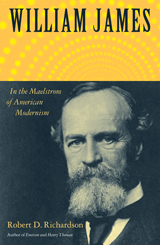
Apart from books I've read or am reading for review: I've almost finished Robert D. Richardson's biography, William James: In the Maelstrom of American Modernism (Houghton Mifflin.)  Richardson is truly a pleasure to read, and he sets a very high bar for biographies.  He's an example to be emulated, and I simply don't know of a better biographer.  Having read his two books on Emerson, I've purchased his biography of Thoreau.


Sherwood Anderson

I've also been reading Poor White, a novel by Sherwood Anderson, and The Colossus of Maroussi by Henry Miller. Both are interesting for the writing and for the sense of the times they portray.  I'm not sure I'm going to finish either of them soon, however.


Sinclair Lewis
 The 75th anniversary of a singular event in American history--the production of It Can't Happen Here, the stage version based on the novel by Sinclair Lewis, in 18 U.S. cities simultaneously by the Federal Theatre Project--is being marked this week by readings of that play by 23 existing theatres.  I was part of the Dell'Arte Theatre's reading, and introduced it with some words about the Federal Theatre.  I'd been astounded to learn about Federal Theatre several years ago, and took this opportunity to read more about it.  In addition to the books from my shelves I'd consulted previously (John Houseman's first memoir, Run-Through, and Mark Schorer's biography, Sinclair Lewis: An American Life) I found Gerald Rabkin's valuable essay in a 1967 anthology edited by Warren French, The Thirties: Fiction, Poetry Drama,  which I had purchased as a library discard.

But that same library still had some other books on the topic, including Arena, the memoir by the Federal Theatre Project's heroic administrator, Hallie Flanagan.  We've had our reading, I made my speech, and posted a lot on Federal Theatre on my Stage Matters site, but I'm still reading Arena.  A couple of other books I found very valuable are Voices From the Federal Theatre (Bonnie Nelson Schwartz and the Educational Film Center, published by the U. of Wisconsin, and which includes a DVD of a television documentary) and Free, Adult, Uncensored: The Living History of the Federal Theatre Project, edited by John O'Connor and Lorraine Brown (New Republic Books, 1978.)  This latter book, which I purchased used, has a wealth of wonderful illustrations, some but not all of which can be found online.  This is a disturbingly neglected subject--few people know about the Federal Theatre and what it accomplished, including theatre people.  But the audience last night was very interested.

I also read most of the novel It Can't Happen Here (Lewis co-wrote the play for the Federal Theatre, and later rewrote it himself for several commercial runs.)  The novel is much more wrapped up in its time, stated as happening in 1936, and using some names of real people. The character I read has three important scenes throughout the play, but in the novel I saw that he's referred to just once, as being sent to a concentration camp.  That's where I stopped reading.  How like an actor already!  The play is virtually unknown now, but despite some dated language and its melodramatic qualities, it's worthy of revival, especially for uncomfortable similarities to today.

Finally, in a bookstore I saw a new edition of F. Scott Fitzgerald's Tender is the Night, emblazoned with the words "Vintage Fitzgerald."  Well, what other kind is there?  Anyway, I picked it up and read the first paragraph, and now I'm reading one of the copies from my shelves--though not the one I marked up in college, which I still have.  Fitzgerald was a particular favorite and writing model then, though I haven't re-read him in years, maybe not since then or shortly after.  So I'm looking forward to it.  And resuming my voyage through Vonnegut.

Monday, October 03, 2011


Red Power Rising: The National Indian Youth Council and the Origins of Native Activism
by Bradley G. Shreve
University of Oklahoma Press

The usual narrative of Native American activism begins with Alcatraz and the American Indian Movement in the late 1960s. But scholar Bradley Shreve makes a persuasive case that activism was rooted in earlier decades, and specifically that much of its character was established through an organization founded in the early 1960s: the National Indian Youth Council. Moreover, the NIYC persists to this day, advocating principles that have become central to Native activism of all kinds: “treaty rights, tribal sovereignty, self-determination and cultural preservation.”

Shreve’s thorough account is enlivened by great personalities, from the legendary Darcy McNickle (who spanned the New Deal and the New Frontier) and Sol Tax (creator of “action anthropology”) to NIYC stalwarts Clyde Warrior, Bill and Karen Rickard, Shirley Hill Witt, Mel Thom, Gerald Wilkerson and others.

NIYC came of age in the Civil Rights and antiwar era. “Like other student activists of the time,” Shreve writes, “they steadfastly believed in the possibility of a moral universe and that it was their duty to make it a reality.” But they were also notably different. Unlike many Civil Rights youth groups, NIYC was started and run by students, and women were among its early leaders. Unlike some other prominent Native groups, its members were rooted in reservation and rural communities (mostly in the West) rather than cities, but it pioneered intertribal activism. It suffered all the convulsions and confusions of other activist groups that eventually fell apart, but NIYC managed to change and survive as a useful and innovative organization.

Though it was formed in a rebellious and youth-oriented spirit, NIYC kept faith with tribal elders, and made reviving traditional knowledge a key goal from the beginning. There were non-Natives elders, too, who were convinced that Native knowledge could benefit society as a whole, and they became part of the mutual education of decades.

It made its first big splash with the “fish-ins” in Washington State, primarily organized by Bruce Wilkie (Makah) and Hank Adams (Assiniboine), protesting the arrests of tribal members exercising their rights to traditional and subsistence fishing as guaranteed by treaties. But in its half-century or so, the organization also pioneered Native education, job training and placement, and defense of sacred sites.

Shreve’s chapters are skillfully crafted to tell an absorbing story, as individuals grapple with issues reflecting the unique history and circumstances of American Indians, from the Teddy Roosevelt and FDR eras through the tumultuous 60s and 70s. This book is informative and judicious (with good notes and sources) but enlivened by detail and reminiscence as well as point of view. It’s a deft and highly readable survey of an important but neglected slice of history, clarifying important connections to the present.

Sunday, September 25, 2011

Why Marx Was Right
by Terry Eagleton
Yale University Press

I suspect no American academic would dare write a book with this title, for fear of losing the comforts of tenure for a cell at Guantanamo. But in the UK at least, the previously influential works of Karl Marx are being reevaluated for contemporary relevance—especially now that capitalism is not proving to be such a utopian success. Prominent among the scholars doing so is Terry Eagleton, who has the additional advantage of not being an economist or political scientist. He teaches literature and cultural theory in England, and would be a delightful writer on any subject. But he’s especially penetrating and persuasive on this one.

Eagleton begins each of his ten chapters with a set of common charges against Marx, and evaluates and largely rebuts them. Did Marx advocate cruel totalitarian regimes? “Maoism and Stalinism were botched, bloody experiments which made the very idea of socialism stink in the nostrils of many of those elsewhere in the world who had most to benefit from it. But what about capitalism?” Genocides, imperialism, exploitation and slavery also accompany capitalism.

And now “the capitalist way of life is threatening to destroy the planet altogether.” So maybe it’s time to reevaluate Marx, especially since (according to Eagleton) his ideas have been intentionally and successfully distorted. (Eagleton however may not fully appreciate the dour effect of Marx’s own turgid prose and that of many followers.)

Among Eagleton’s contentions are that Marx saw socialism building on capitalism, that he was not wedded to violence as the agent of change, and the point of his emphasis on materialism was that in order to enjoy life, liberty and the pursuit of happiness, people need to have enough to eat. “Only then can we learn to play the banjo, write erotic poetry or paint the front porch.”

Eagleton writes with erudition, clear logic and a Wildean wit. Among his conclusions about Marx: “His ideal was leisure, not labour. If he paid such unflagging attention to the economic, it was in order to diminish its power over humanity. His materialism was fully compatible with deeply held moral and spiritual convictions. He lavished praise on the middle class, and saw socialism as the inheritor of its great legacies of liberty, civil rights and material prosperity. His views on Nature and the environment were for the most part startlingly in advance of his time.”

Like a lot of antiwar and antiracism agitators who were supposed to be getting our orders from Moscow back in the day, I had read very little Marx, and I still haven’t. So I can’t say this book has made me any more Marxist, but I am well on the way to becoming an Eagletonist.

Wednesday, September 07, 2011

The Secret War Between Downloading and Uploading: Tales of the Computer as Culture Machine
by Peter Lunenfeld
The MIT Press

What Marshall McLuhan did in analyzing the meaning of 1960s media, Peter Lunenfeld does for the electronic media of 2011—chiefly the computer and the Internet. Like McLuhan, he coins or adapts catchy new expressions for his concepts, like “unimodernism,” “unfinish,” “web n.0,” “info-triage,” “bespoke futures.” He also develops his ideas in cultural and historical context as McLuhan did. Lunenfeld teaches in the Design/Media Arts department at UCLA, but he has a degree in history from Columbia, and his feeling for history is one element that distinguishes this book from other computer-era analyses. (That said, Lunenfeld would probably hate this comparison with McLuhan, as he pretty much dismisses him.)

For Lunenfeld, the passive consumption of corporate-controlled junk food television has led to “cultural diabetes,” and the Internet is rapidly copying that model. But downloading information and entertainment is only half of the computer’s capability: there is also the exercise of creation and uploading. The war is between the corporate absorption of capabilities to provide consumer content versus individuals and sites that create their own content, share files and produce a culture of participation.

“When a new medium explodes on the scene, we have to find ways of responding to the demands on our time and attention,” he writes. For individuals, the computer becomes a healthy culture machine when we engage in both “mindful downloading” and “meaningful uploading.” But these activities can also benefit society, especially in the collaborative creation of “bespoke futures” (“bespoke” being an antique term for custom-made.)

Lunenfeld challenges web denizens to counter the assumed scenario of an apocalyptic future with fresh visions that come together through an interactive process in a scenario of a desirable future worth trying to achieve. “I am not talking about a singularity of utopian vision but instead a networked plurality of vision—a plutopia, as I call it—better suited to this century, this millennium.” If nothing else, he sees value in constructive dreaming beyond our fear-based Official Future.

The practical challenge is “to create a social media that goes beyond sociability into the realms of the useful.” If something like that doesn’t happen the war will be lost, as it has been with television.

Such a summary doesn’t do these concepts or their presentation justice, but this is generally the terrain. The Internet and computer biz history alone is fascinating, especially in sophisticated contexts like modernism and Bomb Culture.This is a relatively short, deftly written and attractively published book that folds relevant historical and personal anecdotes and contexts into the presentation of these intriguing, well-considered and subtle ideas. Applying the techniques of open-source software developers to attacking poverty and countering “fundamentalist death cults,” for example, sure seems worth trying. I haven’t come across a better book on this general topic, or a potentially more influential one.

Tuesday, August 30, 2011


My Faraway One: Selected Letters of Georgia O'Keeffe and Alfred Stieglitz
Edited by Sarah Greenough
Yale University Press

In this odd corner of the Internet I review books--not just texts but books--the physical things--how they look and feel--their confidences and auras--and so regarding this book I have to wonder--what were they thinking?

The letters--even 650 or so of them--of artist Georgia O'Keeffe and photographer/gallery owner Alfred Stieglitz are important and interesting in themselves--despite their mutual habit of punctuating with dashes--like telegraphic Emily Dickinsons--They offer a charming travelogue through the early 20th century as well as into their works and love affairs--

But--but really--this is an enormous volume--big as a Bible--with no illustrations--two of the most visual people of their times--and no pictures at all--in a book that requires assistance to hold--or even hold open--

Why not two volumes--or three--- illustrated--even modestly illustrated--books to curl up with--to savor the weathers, the opinions, the gossip--

But that must not be the point?--It must be for scholars--for libraries--although these days, well--it must be for digital--to be carried about on your Kindle--or peered at on the library computer screen---

I don't know--it's a dark Monday, and it's sad--because you can't believe a word--how can she be in a train station writing when I can hardly get the page to stay open--she'd need a porter to help her haul this around-

Well you get the point.--Publishing is becoming ever more a mystery--simple proofreading seems an antique idea--and books like this--all this work-- all these words--a misbegotten book--unless scholars are even more masochistic than I thought---I leave it to others to evaluate the contents--the text--but as a reader--I am puzzled and disappointed--     

Thursday, August 25, 2011

For Pleasure: Galileo's Dream

Of the summer reading I outlined, I did complete that lovely volume of Margaret Atwood's stories (Moral Disorder,) and a number of James Hillman essays in Puer Papers as well as in Picked Up Pieces--more on those in a later post.  I also read Vonnegut's Cat's Cradle and Mother Night, but I'll probably take a break in my journey through his novels to read a forthcoming biography of him I've received.  But the major read was Kim Stanley Robinson's Galileo's Dream. 


As a fan of his science fiction and near-future fiction (the Mars trilogy, Three Californias, Science in the Capital) I’ve been reluctant to tackle Kim Stanley Robinson’s alternate histories. But I started his latest novel, Galileo's Dream (Spectra), and more than 500 pages later I finished it, wondering what my problem was.

Part of my reluctance was the historical dialogue choice between two equally awkward alternatives: does everybody sound hopelessly antique and false, or do these characters from remote times talk like they’ve got smartphones in their togas?

Robinson opts for a contemporary vocabulary, though with a minimum of anachronisms plus appropriate historical touches and maybe some subtle Italian rhythms. He makes it work mostly because he creates a complex, believable and likeable Galileo, clearly the result of impressive research, but also a literary character—a kind of Italian Falstaff (Galileo and Shakespeare were contemporaries) with a quick and penetrating intelligence.

Galileo’s intellect and insights are formidable, but his ego, impatience and appetites cause him as much humiliation as his battles with the Church over how the solar system works. He’s got marital, family and money problems, devoted friends and dedicated enemies. Plus he keeps getting sent to the moons of Jupiter in the year 3020.

That’s the science fiction part of the story, and some readers have found those scenes and characters less satisfying because less complete. I like the way the problems of the future feed back into the historical story, and manage to even create suspense about Galileo’s ultimate fate. (There are hints that the past of this future is different—even the solar system has a few more planets. And that this future may depend on Galileo being executed. ) That the future characters have mythological names adds another layer of mystery. In terms of how humans react to new knowledge that humbles them, past and future stories correspond.

The future segments allows Robinson to describe a fascinating new cosmology based partly on contemporary theory. (This also makes Galileo’s means of transport credible, and there are other impressive technologies in this future.) Galileo’s scientific attitude and curiosity lends credibility to how easily he accepts what he sees and learns.  The idea of a greater consciousness is not new--Lem's Solaris has a living sea, and the great Olaf Stapledon built up to conscious star systems--but here the importance would seem to be how future humans respond to something that seems to reduce their centrality in the universe, much as people in Galileo's day did to the implications of what he saw through his telescope.

In other ways the interaction not only provides perspective from the future viewing the earth's past, but the other way around. About the inhabitants of these moons, Galileo observes: “Surely living out here must make you all a little bit mad? Never to sit in a garden, never to feel the sun on your neck? We were never born for this.”

Though Robinson (who teaches down the coast at Davis) is just shy of 60, this novel expresses a notably mature perspective, both in content and forthright expression. This gives Galileo’s aging observations even more resonance.

Ultimately this is the story of the first scientist (though the word “scientist” didn’t arrive until the 19th century), and the meaning of his insights as well as the fullness of his life. There’s humor and incident within the framework, and towards the end of his life, when Galileo sees something different in one of his daughters, there’s a feeling of possibility as well as elegy. That’s even stronger when you figure out the identity of his last visitor.

Saturday, August 20, 2011

Darwin just never goes out of style.  It seems that with the unique and daunting challenges of the 21st century, his work is even more important.  These three books are evidence for that impression.

Genetics of Original Sin: The Impact of Natural Selection on the Future of Humanity by Christian de Duve (with Neil Patterson) (Yale University Press) is forthrightly dedicated to this theme.  De Duve, Nobel Laureate in Medicine, contends that natural selection, the means of human survival as a species so far, is now becoming its fatal flaw.  Those qualities that got us here are leading us to our ruin.  The basic reason is that natural selection works for the present and the immediate future, while our survival now depends on working to secure the long-term future.  With our short-term adaptations, we've made a sustainable future impossible otherwise. The book's first three sections tour the science of evolution.  In the last section, de Duve lists and evaluates various options for overcoming this flaw and getting to the future.

This paradox of natural selection for humanity was stated more than a century ago by Thomas H. Huxley, whose name does not appear in this book.  Huxley and his student H.G. Wells worried about the short-sightedness and self-destruction that natural selection encouraged, just as humans were developing destructive technologies that could end civilization.  Part of their answer--only obliquely touched upon in this book--was that humans inject a moral imperative in the natural selection equation, as well as using their big brains to anticipate the consequences of their actions in the future.


Stanley A. Rice comes closer to this answer in his book, Life of Earth: Portrait of A Beautiful, Middle-Aged, Stressed-Out World (Prometheus Books.)  Rice covers some of the same preliminary and expository ground on natural selection, but in a blunt, declarative, authoritative and occasionally authoritarian style.  But in terms of where evolutionary science is at the moment, he makes a very interesting move.  He includes long chapters on symbiosis and altruism, two areas that at least until recently were pretty controversial in the field.  I'm no expert, but this is the first time I've come across a combination of the theories of Richard Dawkins and Lynn Margulis--whose work seemed incompatible for awhile-- stated with such certainty.

Altruism especially has been a conundrum for selfish gene theorists, and Rice goes to the heart of it with his opening sentence on the subject: "It feels good to be good."  The altruism chapter alone is reason to obtain and read this book.  Rice goes on to religion (which de Duve also considers), science and the environment--again, making pretty blunt statements like "Welcome to the Republican Climate"--which is itself bracing and entertaining.  In  a sense, Rice answers de Duve's conundrum by correcting the view that natural selection doesn't include altruism, empathy and reciprocity.   Something like a moral imperative is part of us, too.


Elliott Sober is a respected voice in the philosophy of science, and his book Did Darwin Write the Origin Backwards?  (Prometheus Books)  is a collection of essays on Darwin and natural selection, group selection, sex and "naturalism" (the religious question.)  The "Group Selection" chapter also deals with altruism in evolution theory.  Sober quickly reviews the literature and makes closely argued observations, laced with appropriate math.  His book will likely be of most interest to academics, while Rice's book is the most accessible to all intelligent readers, with de Duve somewhere in between but leaning away from an academic style.                   

Sunday, August 14, 2011

A Couple (of Books) in Search of Happiness

In The Great Disruption, Paul Gilding foresees that the onrushing climate crisis in combination with resource depletion and other factors will create catastrophes that force major changes, including (and especially) the transition to a no-growth, steady-state world economy. So in such a society, what will replace material acquisition and the joy of shopping as the definition of the good life? He calls his best case scenario “the happiness economy.”

Never out of style, redefining happiness acquires new urgency when contemplating these immense future challenges. The two books noted in this review are among recent examples.


Arthur Dobrin is a former Peace Corps volunteer and leader of the Ethical Culture movement. In The Lost Art of Happiness (Prometheus Books), he emphasizes the link between personal happiness and doing good for others that he finds reflected in founding religious texts and classic philosophers as well as the work of social scientists. He uses his own experiences with traditional cultures to relate their sources of happiness in relationships, moral behavior and appreciation for the beauty of the world.

Dobrin astutely summarizes research that shows the roots of empathy and altruism in animal and human evolution. These tendencies, strongest for close relatives and members of the band, can be extended to strangers. He reviews relevant research in modern societies, including the work of Samuel and Pearl Oliner in their work on Holocaust rescuers, particularly in The Altruistic Personality.


Though he skillfully weaves the research and writings of others to support his thesis, Dobrin’s book has a strong point of view, and is occasionally dogmatic. In contrast, Exploring Happiness: From Aristotle to Brain Science (Yale University Press) by famed Harvard philosopher Sissela Bok is more scholarly in approach and more nuanced in its judgments.

Bok deals with even more philosophy, literature and neuroscience, and the complex and competing definitions of happiness. She places a greater emphasis on the individual (such as those who find value in solitude) in contrast to Dobrin’s brief for relationship as the source of happiness. But Bok as well as Dobrin explores the roles of morality, empathy and resilience in happiness. Like both Dobrin and Gilding, she sees happiness related to more equality (gender and racial, as well as economic) but not wholly residing in material wealth.

Dobrin skillfully makes his largely inspirational case, but Bok asks more questions and suggests more complexity, irony and subtlety. Both books are thought-provoking, well constructed and written. Both books—plus Gilding’s—suggest one important area of inquiry about how to cope with the challenges ahead. Once the reality of those challenges is accepted, one task will be to encourage the values, attitudes and virtues that will be needed in the oncoming future.

Wednesday, August 10, 2011

The Great Disruption

by Paul Gilding
Bloomsbury Press

Our first truly human evolutionary test was whether we could anticipate the future catastrophe we were blindly causing, and act effectively in time to prevent it. Well, we flunked that one. Like other recent books on the climate crisis, this one asserts that the global catastrophe is unstoppable.

Gilding, an Australian former human rights and environmental activist as well as a businessman and corporate advisor, is forthright on the irrefutable factors besides the climate crisis that are converging: unsustainable population and economic growth outrunning and crashing resources. He says straight out what others have avoided for years: “I expect we’ll tragically lose a few billion people.”

Yet the buzz about this book is that it’s optimistic.

Gilding asserts that there will come a point, perhaps an event, when the crisis will be really obvious, and humanity will respond in its characteristic “slow but not stupid, late but dramatic” way, as for example when the West geared up to defeat Hitler.

There will be what he calls the Great Awakening: “an exciting and ultimately positive transformation, with great innovation and change in technology, business and economic models alongside a parallel shift in human development. It could well be, in a nonbiological sense, a move to a higher state of evolution and consciousness.” (Presumably that’s if you’re not one of the lost billions.) It’s humanity’s second evolutionary test—and if we blow this one, it’s pretty much over for civilization. And this transformation could begin in this decade.

At least half the book is devoted to Gilding’s ideas of what must be done over the next 40 years to create a sustainable no-growth economy and the values that go with it--ideas tested so far in his speeches and peer-reviewed papers, but now available for wider scrutiny and participation. Though he uses big labels and inspirational generalities, he’s practical and subtle on the process and on as many details as he musters.

Gilding acknowledges the emotional impact of a future of earthquake-like disruptions, and a transition that “will shake us to the core, forcing a substantial rearrangement of human values, political systems, and our physical lives.”  This has happened before, but perhaps never so intentionally. He writes that “Grieving is an appropriate response” for the world we’ve destroyed and the resulting pain, “but sustained despair is not.” Any chance for civilization surviving depends on “active, engaged and strategic hope.” Hope is not a response but a commitment. Optimism is “the most important and political choice an individual can make.”

This hope must be enacted partly by working to define the plans necessary to meet this crisis, so when society demands them, they’ll be ready. That makes this a book to keep. It takes awhile to absorb its information and the emotions it evokes. But there’s getting to be a consensus that the catastrophe “that will shake us to the core” is coming. It’s time to choose this way to be human, face the grief and think hard about the future.

Combining a brief sketch of the depth and extent of catastrophe with a brief sketch of a program to get through it and make things better seems a proper enterprise, but it makes for a very weird book.  The implications of living through the death of millions--as we're seeing right now in the climate-related starvation in the Horn of Africa--as well as the chaos, the fear, uncertainty (is this intractable recession the beginning of the permanent economic growth collapse?) and denial--seem to need more than a simple acknowledgement they are coming.  A moment's reflection makes the rest of the book seem like whistling in the dark, and the occasional inspirational self-help book tone doesn't help.

That's not to say that his program isn't a useful one, or that it won't work.  It just makes for a schizoid reading experience.  Also, its subtitle is so silly I can't even bring myself to use it.  But all of that just has to be acknowledged--then the content of the book worked with and absorbed.

Tuesday, August 02, 2011


American Georgics: Writing on Farming, Culture, and the Land
Edited by Edwin C. Hagenstein, Sara M Gregg & Brian Donahue
Yale University Press

This is a collection of agrarian writing--about farming and the land--in America from its founding as a nation until just about now.  It's of more than historical interest, not only in the general ecological way but in view of the new interest in local self-sustaining communities, including the self-named New Agrarians.  The title comes from Virgil's Georgics, about an ideal rural society.  Not exactly a selling title, except perhaps for scholars and the already initiated.

For the rest of us there are little discoveries, like an example of Louisa May Alcott's satirical writing--at which she excels. There are quite a few otherwise neglected voices here, though I leave it to experts to evaluate the adequacy of this selection.  In a section called "The Machine in the Garden," I would have expected something from the classic work by Leo Marx of that title.  But otherwise this is a handsome, useful volume, with a graceful foreword by Wes Jackson.

Thursday, July 28, 2011

What works, what doesn't?  Eventually the public dialogue will get to this, once all the denial and posturing about energy and the Climate Crisis comes to naught.  Actually, at least two groups are looking closely at these questions: ordinary people who need to watch their energy costs closely and are open to alternatives, and the researchers, policymakers and journalists professionally involved in the technical and policy questions.

What doesn't work?  Michael J. Graetz in The End of Energy: The Unmaking of America's Environment, Security, and Independence (The MIT Press) looks at the U.S. policymaking history over the past 40 years, and sees that just about nothing at that level has been effective, and much of what was done (and not done) has made matters worse.  It's not an unfamiliar story--especially the machinations of the fossil fuel industries--but it's all here, in scholarly detail, though with particular interpretations.  It seems to support the suggestion by David Orr and others that the last best chance to avoid the fall into the horrors of the likely future were in the 1970s.  Graetz offers the ray of hope that the events of the near future could create enough public pressure to force needed changes in energy policy.


Why public policy so far has by and large not worked gets another answer from Brendon Larson in Metaphors for Environmental Sustainability: Redefining Our Relationship with Nature (Yale).  That scientists and the technicians that tend to lobby for environmental laws use metaphors may be the first revelation of this book, especially to them.  That their choices of metaphors has been largely lame and hurt their cause is perhaps another.  I've long been frustrated with the predominantly tin-eared choices they've made, even in the labels and names, as well as other terminology--all of which are basically metaphors. The Greenhouse Effect, for instance, is neat scientific shorthand for a process, if you know what greenhouse effect you're talking about.  But for the general public, greenhouses are pretty good places--plants grow in them.  Global warming sounds very pleasant and inviting, especially in winter; happiness is a warm puppy, after all.

Words that become technical terms and then become cliches can be so confusing and mind-numbing that they become worse than meaningless.   For example, there are two distinct sets of actions needed to confront the Climate Crisis: dealing with the causes, and dealing with the effects.  Those two categories go by the names of mitigation and adaptation.  Do you know which is which?  Truth is, either could mean the other.

Larson asserts that metaphors employed until they become standard (or "naturalized") begin to limit critical thinking and establish a view that passes for scientific, foreclosing other interpretations and even other evidence. The standard interpretation of Darwinian evolution, favoring competition over cooperation with such ferocity that evidence to the contrary is dismissed is more than a metaphor problem, but it may be news to a lot of scientists that their metaphors (for instance, the selfish gene) become literalized, and dangerous.

"Environmental scientists may also have little opportunity to develop an appreciation for the power of language," Larson writes.  Maybe they should have taken a literature course or two?  I applaud this book for centering on this subject and for its insights and the issues it raises, though it's heavy going in places for non-academic readers.  But if that's what it takes for environmental and other scientists to take this problem seriously, it serves the future.    


Okay--so what does work? I've long felt that the best hope for a clean renewable energy future was in solar.  It's virtually unlimited energy, delivered by technologies that can be scaled from the very large to the solar cells on your house or your wrist, or maybe even in the paint on your car.  In Switching to Solar: What We Can Learn from Germany's Success in Harnessing Clean Energy (Prometheus Books), Bob Johnstone provides a history of the solar industry with most of the attention focused on Germany, where much of the action has been.  Just the fact that Germany has done so much, as counterintuitive as that is (sunny Italy, sunny Brazil, even sunny California---but sunny Germany?) suggests what the potential for this source of power might really be.  His account is full of characters and companies, and it is a business as well as a technology story.  If you're looking for something positive, try this account of entrepreneurial spirit and a sense of opportunity combined with ecological awareness and commitment,  resulting in technological, business and policy innovations.  And maybe even in something like a future.

Sunday, July 24, 2011

The Dalai Lama met with President Obama in the White House on the last day of his recent trip to the United States.  As in past visits to the White House, the Dalai Lama wasn't photographed in the Oval Office, which might suggest he was being treated as a head of state.  But the Chinese government protested vociferously anyway.

So it is in the current phase of Tibet's troubled history with China.  Tibet: A History by Sam Van Schaik (Yale University Press) uses a narrative approach to that varied history, from the seventh century until now.  It is an absorbing if complex set of stories, of emperors, warriors, monks and tribal leaders in this vast land, which nevertheless had many significant encounters with neighboring countries and empires.  In considering the contemporary conquest by China, Van Shaik is more measured and perhaps hopeful about Tibet retaining its cultural identity than, for example, Tim Johnson in Tragedy in Crimson: How the Dalai Lama Conquered the World but Lost the Battle with China (Nation Books.)  Against other recent portraits of Tibet--the cruel oppression of Buddhist monks and nuns, the destruction of shrines and temples while others are Disneyfied for tourists and run by Chinese immigrants--Van Schaik tells stories of cultural resilience.

Another recent book from Yale, The Taming of Demons: Violence and Liberation in Tibetan Buddhism by Jacob P. Dalton is a narrower history and analysis of the creativity as well as destructiveness of ritual violence in Tibetan Buddhism, mostly in the distant past.  This attempt to provide "a history of violence in Tibetan Buddhism in Tibetans' own terms" probably will interest to scholars and others deeply interested in the subject.    Van Shaik's book however has wider appeal, with its larger than life narratives about a region still shrouded in mystery. 

Friday, July 15, 2011

While Beyond Boundaries (reviewed below) is essentially a brief for the research and potential of a new technology, these three books are outside analyses of the nature, uses and future of new and on-the-horizon technologies by people who know these technologies well. 

The Techno-Human Condition by Braden R. Allensby and Daniel Sarewitz (MIT Press) examines the many aspects of technological enhancements to human beings.  The authors nudge the less knowledgeable into realizing that these technologies are underway and are in a sense just the latest in a long line of enhancements.  But they also aim to restrain the overenthusiastic who are thoughtless of consequences, counselling a bit more humility.

This is a sophisticated examination of the issues and assumptions that applies to areas beyond these technologies, to an approach to technological change--or even other sources of change-- and future ramifications in general.  The section on war ("Killer Aps") is chilling. There's jargon and technical language to navigate, with lots of long paragraphs, but the process is helped by wit ("In short, we are now back in the comfort zone of ambivalence, ambiguity, and mud wrestling") and a balanced skepticism.  The book itself is handy to hold and carry--always a plus when reading about an alien world that is rapidly becoming our own.

Technological Nature: Adaptations and the Future of Human Life by Peter H. Kahn, Jr. (MIT Press) looks at the psychological effects of experiencing nature second-hand through technology.  It's got case studies, statistics and analysis, with the author's summaries and recommendations.  These occasionally highlight the absurdity of technological nature, as when he suggests that instead of creating simulated views of nature in offices and hospitals, it might make more sense to create views of actual nature.

Some of the examples of how far technological nature has gone may well be surprising, though the prescriptions are not.  The broader and deeper work on these subjects (particularly children and nature) by human ecologist Paul Shepard and others is bearing some fruit in studies like those described here.


Sentient City: ubiquitous computing, architecture and the future of urban space (MIT Press) is a collection of articles and studies by various authors, edited by Mark Shepard, that stems from a 2009 exhibit at New York's Urban Center.  The topic is certainly topical, as information technologies are embedded in the everyday street, often invisibly, with a plethora of often hidden sources, intentions and effects.

Some of the chapters describes projects and studies, while others offer analysis and context, including historical context.  The vocabulary is often pretty dense for the general reader and no sustained examination is possible in a collection from various authors, but this volume can serve the non-specialist as an often provocative introduction to the technologies and issues involved.  And with technologies that enable a park bench to eject someone who oversits his welcome, or that can create an entire city of linked workers (or data-slaves), these issues are pertinent.  Plus the projects themselves can be witty.

Wednesday, July 13, 2011

Beyond Boundaries: The New Neuroscience of Connecting Brains With Machines—And How It Will Change Our Lives

by Miguel Nicolellis
Times Books

The results of his research on brain-machine interfaces (BMI) has made Miguel Nicolellis a famous scientist, even capturing the attention of Jon Stewart on The Daily Show. This book describes his experiments, culminating in the monkey with electrodes implanted in his brain who played video games or controlled a distant robot just by thinking.

Nicolellis is not shy in predicting future applications—and neither is anyone else. Besides hopes for victims of various diseases, disorders and accidents, he asks us to “imagine living in a world where people use their computers, drive their cars, and communicate with one another simply by thinking.” Or even “touch the surface of a different planet” or “download the thoughts of one of your forefathers” to create a Holodeck encounter in your head.

These resemble the visions of adherents of different and perhaps competing research, into brain-computer interfaces (BCI.) The great weakness of this book is Nicolellis’ refusal to consider that any of this is creepy, or that it would ever be used for nefarious purposes with catastrophic results.

But then, that’s what we have science fiction writers for—to imagine the unforeseen consequences when real people are involved. Already his exoskeleton suit to enable paraplegics to walk looks a lot like Robocop. As he notes, it’s this kind of research that inspired The Matrix and Avatar, though he rejects such dour scenarios without saying why. Especially considering that the Pentagon is already experimenting with BCI.

Nor does Nicolellis consider that a future with the economics necessary to support all of this is getting less likely every day. Such tunnel vision exposes another continuing danger—that we think we know enough to assume everything in the psyche is a matter of manipulating neurons.

Still, one can hope for cooler and more cautious heads with more balanced evaluations, since the research itself clearly has potential. Besides, these speculations make up a very small part of the book. Much of it is a brief for the anti-reductionist view of neurons not as single function push-buttons but as part of a neuronal orchestra—a musical metaphor which he uses in various ways throughout, generally to good effect. It’s also clearly a metaphor, after the supposedly literal explanations of the brain as the current dominant technology, depending on the century: clockworks, steam engine, telephone exchange or computer.

Perhaps the most intriguing hypothesis being tested is that the brain continuously creates models of the body’s interactions with the world, including imagining future possibilities and rehearsing simulations.  Thus the brain is always rehearsing the future, even at the neuronal level.

Except for some egregious overwriting (especially early on) and often endearing awkwardness, these chapters and the accounts of the experiments are often absorbing and engaging. Meshing the science with personal anecdotes and philosophical observations seems to have become standard in books by brain scientists, but here as is often the case they add to both understanding and reading pleasure for the non-specialist.

Thursday, July 07, 2011


The Fate of Greenland: Lessons from Abrupt Climate Change by Philip Conklin, Richard Alley, Wallace Broecker and George Denton, with photographs by Gary Comer
The MIT Press

In late June, U.S. government scientists announced that more of Greenland’s ice melted in 2010 than in any year since comparable measurements were first made in 1958. Melting of the vast ice sheets of Greenland and Antarctica are major determinants of how high the oceans will rise along the world’s coasts. But as this book shows, that’s only one reason that Greenland is key to our understanding of climate change.

Greenland’s history of habitation during a climate shift, its peculiarly sensitive location amidst temperature zones and ocean currents, and the deep history of climate changes over eons available by analyzing samples from its deep ice, are all part of its central story. Research suggests that warming in Greenland propagates globally.

Beginning in 2002, Land’s End billionaire entrepreneur Gary Comer took selected leading researchers (the co-authors of this book) on several scientific expeditions to Greenland, before succumbing to cancer in 2006. By combining these expeditions with narratives of the relevant scientific history and the science itself, this book creates a compelling story of both Greenland and the sciences involved. It ranges from the 19th century geologists dawning understanding of ice ages, to how to drill an ice core. It does so with remarkable narrative momentum. Despite some jargon and awkward constructions, the writing has a calm conversational cadence, but organized with the logic of a master storyteller.

This is the kind of physical book that ebooks and Kindle can never replace. Not only are Comer’s photographs of Greenland's landscapes and icescapes beautiful in themselves, but they are well placed in a well-designed book, down to the subtle color scheme and typography. The book is a size and weight that craves being held and carried.

All that is important to the reader’s morale, considering the message. The news is not all bad: the danger of melting waters changing the major moderating ocean currents—the abrupt climate change scenario of The Day After Tomorrow movie and Kim Stanley Robinson’s climate crisis novels—seems less likely than was first feared.

But their findings basically confirm that global heating is happening and will continue, with more bad than good effects. The chances are much greater that its future extent and damage have been underestimated than overestimated. The researches chronicled here confirm that past climate changes can be explained only when taking into consideration changes in the amount of carbon dioxide in the atmosphere. They also support the roles of feedback effects and tipping points—in other words, the science in the United Nations reports, and those of other major scientific organizations on the climate crisis.

This research adds particular support to the idea that the climate can change radically and abruptly—in the past, as fast as in a few years. Though that now seems unlikely in the near future, it’s still possible, especially if we keep increasing greenhouse gases.

But this book’s calm narrative of the science lends reassurance to its sense that the climate crisis can be addressed, although the impact of effects already in the pipeline are outside this book’s purview. The beauty of Greenland it shows, the intrepid scientific adventure it chronicles, make it a valuable contribution to the now.

Sunday, July 03, 2011


For Pleasure: Summer Reading
So I noticed on several newspaper and magazine sites this weekend a feature about books that people (usually famous people) are reading this summer, usually accompanied by a photo like the one above (the pipe stem is a nice if unintended touch--I used to smoke it many years ago, and now I keep it around for the occasional phantom pipe tobacco taste, but mostly as decor.)

So in addition to my never-dwindling pile of books to review (many still to go from this past spring), my summer reading so far is this pile of books.  I wish I could say it was a considered literary program, but all of them were recent finds in used bookstores and a big bookstore sale (except the Vonnegut and the James Hillman, which I've had for years and am re-reading; I generally do a Hillman around my birthday, especially big ones.)

I've just completed reading (for the first time, I'm ashamed to say) Memories of My Melancholy Whores, so far the last published novel by Gabriel Garcia Marquez.  It's better than the reviews I remember.  I kept waiting to find a proper hardback used or remaindered, but at this late date I settled for this new paperback.  It was also an interesting book to read around my birthday (though still a quarter century from my 90th, which is the narrator's age.)

I've been re-reading Vonnegut's novels more or less in order.  I read Player Piano and The Sirens of Titan last month and started Cat's Cradle, only to realize I re-read this one last year.  But it has been years since I've read the rest.  I'm also intrigued by the idea of re-reading J.D. Salinger.  I haven't re-read any of those books in decades.

I've started Margaret Atwood's Moral Disorder collection of stories. The voice is very similar to that in the occasional pieces in Writing With Intent--same sort of humor, of little leaps and connections, but with more literary qualities.  The first story in the collection, "The Bad News," is an absolute masterpiece, the best apocalyptic in everyday life story I can recall since one by Charles Baxter many years ago.  I'm enjoying this a lot--come on, Nobel Prize committee!

I've started Kim Stanley Robinson's latest novel, Galileo's Dream. I've been a little wary of his historical/alternate history novels, though I can't exactly explain why.  I guess I couldn't see how they could be as good as his s/f and future vision novels.  And Galileo has always seemed more of a symbol to me--he seems to be treated that way in several plays about him--and not my choice for someone I'd like to see Doctor Who visit.  But he's a real character here, and not at all stiff or stuffy.  I am enjoying this, and I sense there's more to it in regard to the contemporary world than noted in reviews or descriptions.

Earlier this year I had a chance to buy a remainder copy of Jack Kornfield's The Wise Heart, and passed on it.  Though I went back to get it, I'd lost my chance.  Faced with it again as a sale paperback, I couldn't pass it up again. I tend to start but not finish his books, though I don't know why.  I started reading it as a spiritual balance to the soul concerns of Hillman (Hillman makes a big distinction between soul and spirit, and it makes a lot of sense.)  Its subtitle is "A Guide to the Universal Teachings of Buddhist Psychology" which is of great pith and moment.

That's the summer so far, though I'm likely to roam through my library (and probably a few more bookstores) in search of another kind of moment, another reading experience, as the spirit (and the soul) moves.

Monday, June 20, 2011


Droppers: America’s First Hippie Commune, Drop City

by Mark Matthews
University of Oklahoma Press

“Drop City” is the title of a 2003 fiction by well-known novelist T.C. Boyle, about members of a 1970s Sonoma County commune. Boyle apparently appropriated stories (or legends) from a commune in Sebastapol (the Morning Star Ranch), and other communes in Marin County and San Francisco. But one place his novel is not about is Drop City.

The community that called itself Drop City was near Trinidad, Colorado. One of its founders, Eugene Bernofsky, described Boyle’s novel as “total bullshit. It was nothing like that.” The novel, and the interest of freelance journalist Mark Matthews, apparently sparked Bernofsky (by then a postman and surprisingly effective environmental advocacy filmmaker in Missoula, Montana) to cooperate in setting the record straight.

The first surprise is the name. To “drop acid” was 1960s argot for taking LSD. The expression “dropping out” as in dropping out of society goes back to at least the 1950s. But Bernofsky claims that “Drop City” referred to neither.

It didn’t come from Greenwich Village or Haight-Ashbury. It was an idea hatched among art students at the University of Kansas in Lawrence in the early 60s. Inspired by Jackson Pollock’s “dripping period” paintings, they literally dropped things from a loft window onto canvas on the street. They called themselves droppers. They saw this as antidote to art world elitism and solemnity, but also as a way of making art spontaneously and unconventionally, using the materials of ordinary life and involving spectators with surprise.

In their loft and neighborhood, Bernofsky and friends merged art and life, scavenging for both, and creatively recombined the detritus of the affluent society. The next step was founding a community on these principles: Drop City.

Later Bernofsky would write a lexicon for a Drop City newsletter:  “Drop City—to sponsor and create the avant-garde of civilization, utilizing all the remnants, at least of art, science, technology, etc.  Dropping—an elaborate put-on.”

Matthews’ very readable book chronicles Drop City’s intense life, from 1965 and the building of its unique structures using castoff materials and creative designs based on Bucky Fuller’s geodesic dome, through its sudden notoriety when it got publicized as a hippie commune during the national media frenzy a few years later, to its implosion from internal strife and confusion soon thereafter.

It’s not actually a long story, so Matthews often takes side trips to summarize what else was going on at the time, plus the history of utopian and intentional communities, a history of LSD, etc. As it turns out these side trips are interesting in themselves, and together serve as a pretty decent brief guide to the 1960s, even for people who were there.

The book also benefits from a colorful central character—Eugene Victor Debs Bernofsky, who in 2004 was living in Missoula, Montana, working as a postman while making environmental advocacy films on his own that nevertheless have been instrumental in getting some environmental degradations stopped. He is a raconteur who hasn’t lost his enthusiasm for “dropping.” He first told Matthews he’d majored in radiation biology, which he later admitted didn’t exist. Matthews hadn’t checked it, and neither had the Kansas University alumni magazine that printed it. Though Matthews did his journalistic due diligence, he wisely allows Bernofsky’s colorful personality to come through.

Friday, June 10, 2011

Lab Coats in Hollywood: Science, Scientists and Cinema

by David A. Kirby
The MIT Press

From Fritz Lang’s Woman on the Moon in 1929 through Iron Man 2 in 2010, Hollywood filmmakers have hired real scientists to work on their scientific fantasies. David Kirby looks at the phenomenon from a scientific point of view: what do consultants do, and what do they and the filmmakers get out of the relationship?

Why first of all do filmmakers hire science consultants? The most important reason is because scientific accuracy adds to a film’s credibility and makes the movie more believable. This (and some other observations) will be familiar to readers of The Making of Star Trek (Stephen Whitfield with Gene Roddenberry, 1968) and similar books and articles since. But Kirby drills farther down to find some revealing distinctions.

According to Kirby, audiences expect widely known scientific fact (what he calls “public science”) to be accurate. Audiences like cutting-edge science and especially up-to-the-minute portrayals about how scientists work (“expert science”) because it’s new. But audiences also expect their beliefs about science to be included (“folk science”), regardless of accuracy. Like a laboratory always must have vials of bubbling colored liquids, even when real ones don’t. Or the surface of Mars has to be red (because it’s the Red Planet) even if photos show it isn’t.

But even “public science” is relative. Lang’s Woman on the Moon showed people strolling on the moon’s surface without spacesuits mostly because filmmaking technology wasn’t up to showing facial expressions behind helmets, crucial in a silent movie. But in 1929 they could get away with it, because few non-scientists knew the moon had no atmosphere. Otherwise, great care was taken to portray rocketry in a plausible way—and (in some ways unfortunately, since this was Germany) this movie did that.

Sometimes the science consultant’s advice results in a visually arresting scene (the Enterprise coming out of the rings of Saturn to avoid detection in the 2009 Star Trek) or even actual drama (the volcanic vents on the asteroid in Deep Impact that created a fatal accident.) But scientific advice is just as easily rejected. Maybe it’s technically impossible or too expensive, or just not dramatic enough. Filmmakers differ on these judgments: while Deep Impact mostly listened to their scientists, the other asteroid-threatening-Earth movie, Armageddon, mostly didn’t.

Scientists may feel used, particularly when their advice was unheeded but their participation is exploited in publicity. But they can also benefit. Jack Horner’s controversial theories about dinosaur evolution got a major boost, even within science, by being dramatized in Jurassic Park. Starting with Lang’s 1929 Woman in the Moon and Destination Moon in 1950 and Kubrick's 2001 in 1968, movies made space travel seem possible and exciting.

Scientists working with filmmakers to fashion the physical results of a theory may see new things that helps them refine the theory or the technology itself. (Movie spacesuits have inspired real ones as well as vice versa.) Probably the best example of a mutually beneficial feedback effect is one Kirby doesn’t describe, because it began not with the movie Contact, but the novel. Author Carl Sagan asked physicist Kip Thorne how traveling across the universe and coming back a few minutes later might really be possible. This led Thorne to develop his highly influential theories about wormholes. Thorne then became a science consultant for the movie Contact—and years later Thorne wrote his own Hollywood movie further dramatizing his theories: Interstellar, coming to a theatre near you in 2013.

Both science and the public benefit by seeing the dramatic and visual consequences of science and scientific theories, even if the science is not totally accurate. Kirby discusses the expectations and impact on awareness and public policy of films like The China Syndrome and The Day After Tomorrow.

But does care with science pay off? While Ang Lee’s 2003 Hulk tried to furnish at least a scientific theory for all its comic book characteristics, the 2008 Incredible Hulk film made no such attempt, but did slightly better at the box office. So who knows?

Readers may be surprised at what movies overruled scientists (Steven Spielberg convened a panel of futurists for Minority Report, but thought some of their ideas were too futuristic for audiences to understand) and wonder what in the world filmmakers had on their minds to hire a science advisor for Watchman II. But if you’re into these movies the subject is fascinating anyway.

Though he is a lecturer in science communication studies in England, Kirby actually can communicate on the topic, with a minimum of jargon, a modicum of theory, and some sharp, informative writing. There’s some of the academically necessary stating the obvious, but plenty of good reporting. Besides, his backlot revelations about specific movies inspire seeing them again with this information in mind. For sci-fi and science-based adventure film buffs, always a good thing.

Wednesday, June 01, 2011


Bob Dylan: Like A Complete Unknown

by David Yaffe
Yale University Press

Music critic and professor David Yaffe, who seems to have made a mini-career writing about Bob Dylan, has produced a carefully considered and basically fair-minded set of essays that offer some provocative perceptions and stylish writing. He apparently did not interview or even casually speak with Dylan or anyone else. So his insights and thematic narratives are derived from studying the texts—the music, films, books and so on.

This book is in four sections, offering perspectives from four different standpoints: “The Cawing, Derisive Voice” centers on Dylan’s singing, “Screen Test” examines movies by and about Dylan, “Not Dark Yet” is about Dylan’s relationship to African Americans and their music, and “Don’t Steal, Don’t Lift” is about the complicated questions of Dylan’s use of sources: appropriation, inspiration or plagiarism, depending.

The question of plagiarism, made public by Joni Mitchell in 2010, is also discussed in Lewis Hyde’s Common As Air. That Dylan’s first 70 recorded songs allegedly had clear predecessors and two-thirds of the melodies were directly lifted may be (as Dylan said) common to the “folk process.” But Yaffe also notes Dylan in his autobiography expressing feelings by using unacknowledged lines from Proust, and he derides Dylan’s recent “Modern Times” album as largely plagiarized, though from public domain sources.

It’s a complex subject (all musicians copy each other) as Yaffe affirms. But no matter how many melodies Dylan stole or lines he appropriated, his best songs arrived by grace to express (among other things) a spirit of the times. In his magic years of the 60s even a minor song like “Bob Dylan’s 115th Dream” perfectly represents a certain segment of a generation. (The test of Dylan’s relationship to sources really will be how he enforces his copyrights when someone copies him.)

Yaffe makes much of Dylan’s elusiveness, his Masked and Anonymous “busy being born” changes, but also notes that at 70, Dylan has found a personae and a voice for a part of life few of his generation of stars have managed.

My Dylan was the early one--"Freewheelin'" to "Blood on the Tracks"-- when each new album was a revelation tied in memory to specific places, events and even people.  Yet Yaffe does add information as well as perspective to this period.  I know less about the years following, but though he has more to say about them than the typical treatment, I felt the frustration of his thematic method and sketchy history in the chronology.  In particular he deals with the Traveling Wilburys in only one tantalizing sentence, as exceptionally creative in a murky period.  I thought Dylan was unusually strong in those collaborations and would have liked to know more about why that might be, how it all happened and what lasting relationships or musical insights might have ensued.  (He did have a prior musical relationship with the late George Harrison, and if I'm not mistaken, he has worked since with at least one of the other surviving members: Tom Petty.)

The elegance of this small book is marred by repetitions that are either the product of sloppy editing or have some subtle functions that elude me. Though it’s smarter than most Dylanology, in the end the mysteries it explores tend to dissolve when actually listening to Dylan’s best, or watching the filmed performances in the Martin Scorsese film, No Direction Home, (none of which Scorsese actually shot, Yaffe says). For those of us who don’t know him as anything else, Dylan is his inimitable music and his voice—his “pillar of breath” as Allen Ginsberg said--and they are like a force of nature. The response is wonder.

Thursday, May 19, 2011

For Pleasure: Winter Into Spring 2011

Winter here on the North Coast is the rainy season.  This year it began late, in February rather than January, and dripped into April.  It was a busy winter for me, but it took on a new character when I caught one of the variety of bugs that were going around--a flu, a virus, whatever it was.  I haven't gotten so much as a cold in several years, but this was a double-dipper: it started with a cough, became a sinus cold, went away, came back and went through it all again.

So being sick sent me back to sick days reading.  I finished the Pynchon novel (Inherent Vice) which is not his most demanding, but after that I was up to nothing more complicated than a couple of Star Trek novels, which I normally save for airports and similar situations. They are plot driven yet thoughtful, in a story universe I know and feel comfortable in. They are the closest to audio books I can come to by actually reading, since I can hear the Star Trek characters in my head.  (And I'm not big on actual audio books--I'm too sensitive to the voice of the reader.  If I don't like it, the book is over.)

Actually, this spate of Star Trek did begin in the airport, on my November flight to my niece's wedding in Pennsylvania, when I read one of William Shatner's Trek novels (only to find it was Part 1--fortunately I had the second part at home, which I read upon my return.)  But in my February binge I at least read one by Greg Bear, a science fiction writer I admire (and who I met--at the 40th anniversary Star Trek convention in Seattle.)  Corona was a Kirk-Spock era story, so I balanced it with a Next Generation novel.

I also re-read Kim Stanley Robinson's climate crisis in Washington trilogy, for the third time, and I may read it again this summer and "blog it" on my Dreaming Up Daily site, because it focuses on the issues so well.  Sixty Days and Counting in particular should be required reading in the White House and on Capitol Hill.

But I did manage some other reading, apart from new books for review. I got a used copy of Margaret Atwood's latest book of essays, reviews and forewords, Writing with Intent.  Very impressive in the perfect match of style and substance on each topic and occasion. I picked Jonathan Lethem's short novel, as she climbed across the table from my own shelves. It was just what I was hoping for.


Then just last week when I was in the university library, one of those serendipitous coincidences that involved a seemingly random selection on a sale table hit me.  In this case, it was a shelf of books the library was giving away.  Among the outdated computer manuals I picked up two.  One was an astonishing (and scary) find: a free copy of Randall Jarrell's Complete Poems, hardback first edition with dust jacket intact.  In book value I suppose it doesn't quite measure up to my biggest find--a first edition of Wallace Steven's first book--for 10 cents at a public library sale.  But I knew immediately this find meant something.  When I took it away, the first three poems I read at random were stunning, and did mean something to my current state of mind.  I really know very little about Jarrell--he was a name, but not a poet we read much in college.  But I have collected a few of his other books: a volume of criticism, a volume of childrens stories, and a volume of letters.  Now as I read more, I am more curious.  I'll have to go back to the library to see if they have books on him, they haven't given away.

The other book was a coincidence of another kind.  I'd just received Harold Bloom's new and announced as final book, The Anatomy of Influence (Yale.)  I've learned to mine Bloom rather than read him--he's not my kind of critic.  I've never been comfortable with his "anxiety of influence" approach.  He writes out of a sensibility or tradition he identifies as Jewish that isn't mine, though I recognize it.  But I respect him and his work, and I admire him for doing it.  I celebrate his life, which is so much a part of this book.  And I expect to profit from this book, especially since we admire some of the same writers, from Shakespeare and Emerson to Joyce and Ashbery.  Even though he reads so much more knowledgeably and with greater literary complexity that I possibly could.  I mean, I didn't lead that life. Had I been of  his generation, or lived in academia maybe, but probably I don't have quite his kind of intelligence.

In any case, Bloom begins by staking out critical territory with the distinction between the "Longinian" and the--well, the non-Longinian I guess, the New Critic and its progeny, if any.  "To be a Longinian critic is to celebrate the sublime as the supreme aesthetic virtue..." from Longinus' essay.  If my college teachers made this distinction, I don't remember it.  (They were mostly New Critics, and one of them moved on to the New Cynicism as Bloom aptly calls it.  I didn't.)  I don't recall running into it since.

But I picked up another book off that free shelf at the library, called Literate Culture: Pope's Rhetorical Art, by Ruben Quintero (U. of Delaware Press, 1992.)   I don't have much interest in Pope, but I opened it, and saw that it, too was literary criticism of the old kind--still my kind--before Theory, etc.  But what grabbed my heart was the inside cover, signed by the author, with a note to his "dear friend" "with fond regards."  I don't know why the dear friend gave this book away--maybe he died.  But I couldn't just leave it there.  It obviously was going to be thrown out (I've seen this library's discarded books in the big dumpsters out back.)

So I took it home, and was rewarded almost immediately with a discussion of the Longinian approach--for the second time in a few days.  This seems a gracefully written book, and informative about and beyond Pope.  So now it has a home next to Bloom.  I don't know what any of this means.  But it seems, if not sublime, right.