We've Had Thirty-Five Years of Earth Days and the World Is Still A Mess
by William S. Kowinski
So it's been 35 years since the first Earth Day and the world is still a mess. It's not that we haven't learned a lot and done a lot, just not enough. How far we've come in understanding the extent and nature of the problems, in devising and carrying out solutions, and especially in communicating that understanding and getting politicians and the public to listen, can be gleaned from this new book: '>WISDOM FOR A LIVABLE PLANET by Carl N. McDaniel (Trinity University Press. )
We come to this view of the relative successes and failures of the environmental movement through profiles of eight "visionaries," half being pretty well known at least within enviro circles (Dave Foreman, Wes Jackson, Stephen Schneider the climate scientist and David Orr) and the other half deserve to be better known for their work: Terri Swearingen, whose revealingly unsuccessful and achingly long attempt to shut down a toxic garbage-burning plant in Ohio raised national awareness of this previously ignored air pollution problem; Werner Fornos, president of the Population Institute in Washington, whose new ideas may help counter the bad impressions made by the 1970s "don't have those kids, especially you poor people" activists; economist Herman Daly, adding practicality and a little poetry to the more-is-less philosophy; and Helena Norberg-Hodge, founder of the International Society for Ecology and Culture.
The chapter on Norberg-Hodge caught my eye first. Beginning with a disquisition on language as a distinguishing human characteristic, and how it developed in small human groups, McDaniel describes N.-H.'s first visits to the Shangri-la of Ladakh in isolated Tibet, where she found a culture that proved to her that "the widespread expression of human traits such as greed, selfishness, and acquisitiveness in Western culture are not innate but culturally elicited, as are expressions of traits such as cooperation and generosity."
The people of Ladakh had such a cooperation-based culture, with habits of dealing with conflict that avoided violence. But Norberg-Hodge also was around to see this society transformed by tourism and trade. Innocent of the impact the money economy would have, the people yielded easily to the globalized culture of consumption. But she didn't fade away from this challenge. Instead she helped people understand what was happening to them, and helped them devise strategies for retaining their culture while still enjoying benefits of the modern world. They had little heat in their homes in the old days, but found themselves going away to work to earn money for kerosene, which gave them heat and also pollution. Norberg-Hodge found appropriate methods of renewable solar energy that would provide heat without pollution or the extra step of working elsewhere to pay for it.
So the chapter moves from language and local culture to the impact of globalization on economics and culture, and the political efforts on a global scale as well as local projects to address these problems. The prose is not especially exciting, but it is direct and informative, and the apparently disparate ideas and activities are organized to illuminate the kinds of organic connections that need to be made.
This is a useful guide to the state of environmental action and thought, as it becomes more truly ecological, recognizing such important relationships as economics and culture. It deserves a wide readership.
Childhood teaches us that language and culture both arise, at least partially and potentially, from play. As humans we have perhaps forgotten our species' childhood, when we learned most of what we now think we invented, from animals.
In '>THE GENESIS OF ANIMAL PLAY: Testing the Limits (MIT Press), professor of psychology and ecology Gordon M. Burghardt examines and analyzes the "mysterious" and "enigmatic" phenomena of animal play. Inoculated against the unscientific specter of anthropomorphism (we just think those kittens are playing because they look like children who we know are playing), animal play has been ignored, if not taboo. So Burghardt is careful to include lots of graphs, tables and charts, showing (for example) the "Phylogeny of avian orders and occurrence of different kinds of play." So it turns out that flying really is fun, at least sometimes.
Did dinosaurs play? How about turtles? (How would you know?) Burghardt will tell you, as he evaluates the reasons for playful behavior, the benefits and the costs (you can hear your mother now---don't play with that stick, do you want to put an eye out?) The prose gets a bit thick, but fortunately Burghardt can be, well, a little playful, so even the non-scientist can have some fun here, and learn a bit more about how deeply embedded in our natures is animal play.
And now for something completely different... '>AFTER THE ICE: A Global Human History 20,000-5000 BC by Steven Mithen (Harvard University Press) is getting noticed, and though it's been out for several months, it's another appropriate Earth Day read. It's not environmentalism exactly, but it sure is about the Earth, and some fascinating phenomena on and in it, including the interaction of early humans with the changing environment.
For example, Mithen skillfully sums up the various discoveries and controversies over the settlement of the Americas. After evaluating the archeological claims, he concludes that human occupation began far earlier than previously accepted, some 33,000 years ago, although he doesn't really know how. (For an entertainingly detailed account of the craziness of the controversies, with grown scientists acting like medieval church dogmatists, I recommend '>THE FIRST AMERICANS by J.M. Adovasio with Jake Page (Random House, 2002.)
"To my mind," Mithen concludes in this section, "the First Americans, those who must have traveled from Alaska to southern Chile within less than a hundred generations, were the most extraordinary group of explorers ever to have lived on this planet. I suspect that the mystery of the peopling of the Americas can only be resolved by invoking those peculiar human qualities of curiosity and thirst for adventure that in recent times have taken men to the poles, to the deep oceans, and to the moon."
Except for that "peculiar human qualities" bit---he should read Burghardt---it's a welcome notion in a field that seems to favor materialist explanations too often.
This is only one small part of a book of multi-epic sweep, full of fascinating information and surmises, with terrific illustrations throughout. It was a great idea, and Mithen makes it work beautifully. Mind-expanding. Remember that? We used to say that a lot, on the first Earth Day.
Wednesday, April 20, 2005

Sunday, April 17, 2005
'>THE BOMB: A Life
by Gerard J. DeGroot
Harvard University Press 432 pages, $27.95
by William S. Kowinski
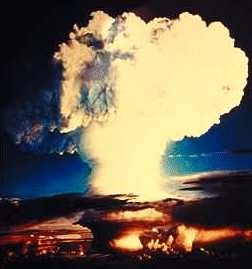
Gerard DeGroot includes a number of eyewitness descriptions of nuclear explosions, which bring the march of names, facts, lies, rationales and theories in this relentless history back to human reality, if only for a moment at a time. The largest hydrogen bomb explosion to that date---twice as large as expected---took place on Bikini Island in 1954. From a U.S. Navy destroyer thirty miles away, Marshall Rosenbluth watched the fireball: "rising and rising, spreading...It looked to me like what you might imagine a diseased brain, or a brain of some mad man would look like...And it just kept getting bigger and bigger..."
DeGroot, Professor of Modern History at the University of St. Andrews in Scotland, writes with grace and economy of a 60-year history still unfolding. Besides his admirable summations and deft narratives based on many long-available sources, he was able to add descriptions of the Russian bomb program and other details that have emerged in recent years (some crucial information about nuclear missiles already in Cuba during the 1962 Cuban Missile Crisis was only revealed in the late 1990s.) Although always ready to call a lie a lie (and there were many), and to name insane policies for what they were, he also provides the reader with enough well-organized facts in convincingly developed contexts to allow everyone to form their own impressions.
The pre-history of the bomb is fascinating. In the mid-1930s, few physicists had even thought about an atomic bomb, or if they had, believed one was possible; or if they believed it was theoretically possible, that it could be made a practical reality. But between 1938 and the autumn of 1941, the bomb went from a weird notion to a massive research and development program in the U.S., and lesser but still significant programs in Germany and the USSR. Eventually there was even a small program in Japan.
That Germany didn't develop the bomb is the most resonant story. Most advanced physics was being done in Europe, and most of that in Germany, until 1933, when Hitler directed that non-Aryans be fired from civil service jobs, which included universities and scientific institutes. Eleven physicists who had won or would win Nobel Prizes were dismissed. Around 100 German physicists, most of them Jews, wound up in the U.S. by 1941. They not only provided the scientific talent but a lot of the motivation for the U.S. bomb program.
But even after Hitler had gotten rid of Jewish practitioners of the "Jew science" of physics, it was a German physicist who had the key insight that for the first time revealed that the atomic bomb was possible. But no one listened. In 1934, Ida Noddack suggested that some puzzling results of an experiment conducted by Enrico Fermi in Italy might be explained by nuclear fission. But Noddack was not well-known, and she was a woman. (In '>The Big Bang, Simon Singh reveals many contributions of women in physics and astronomy through the years, though they didn't get much credit.)
It wasn't until 1938 that Fermi himself figured it out, but even then it took another physicist, Leo Szilard, to understand the implications. He knew immediately that the atomic bomb was possible, because he had already read about it, and how it was developed and used in warfare. It was all in a novel by H.G. Wells, written in 1914, including its name: the atomic bomb. Szilard also realized, from his reading of Wells, that if knowledge of fission and the bomb got into the wrong hands, it could mean the end of civilization.
Szilard won the Nobel Prize in 1938, and after picking up the award in Sweden, he and his wife emigrated to America. In addition to his own researches, Szilard was instrumental in first, getting U.S. and British physicists to stop publishing anything about fission, and then getting Albert Einstein to write his famous letter to FDR, and to enlist other influential people in convincing the U.S. government to develop the bomb before Hitler did.
But as DeGroot shows, the letter was so circumspect, and Szilard, Einstein and other physicists so unable to express in plain language the possible implications, that the American government dragged its feet. Hitler had been given such a clear paragraph, and he started the German program. What convinced FDR was not Einstein's letter but a story, a metaphor. Alexander Sachs was an international financier and friend of Einstein, who got the letter to FDR, but in a later meeting with FDR he simply told a story about a young American inventor who went to Napoleon during wartime and offered his invention, which the emperor turned down. The inventor was James Watt, the invention the steam engine. This got Roosevelt's attention.
The story of the bomb is replete with the tricks of fate and power of metaphor, including some forty years later, when Ronald Reagan finally committed to nuclear arms reductions with the Soviets after seeing the TV movie, '>"The Day After," that depicted the impact of a nuclear strike on families in Kansas.
There is no more powerful and defining story of the past 60 years as well as the world we live in as the story of the Bomb. Though the lethal effects of radioactivity were denied for decades, and the extent of cancers and genetic malformations suffered across America as a result of nuclear tests are still obscured, the bomb settled deeply into our national unconscious, and helped define our feelings about our leaders, about science and scientists, and about the future, or lack thereof.
The Bomb has remained in the national unconscious not only because so much about it is impossible for the rational mind to absorb or the psyche to comprehend, but because of the lies and misinformation. In 1971 Richard Nixon prevented crucial information from reaching the Supreme Court so they would not interfere with the largest bomb ever exploded within the U.S. at Amchitka island in Alaska. Radioactive elements from that explosion were still leaking into the Bering Sea by 1996.
In just a few weeks, diplomats from around the world will gather in New York to discuss the nuclear non-proliferation agreements that U.S. policy now endanger. Some observers expect proliferation to grow substantially as a result of this treaty's failure. Perhaps because visible testing ended decades ago, and the Hiroshima photos are in black and white, Americans don't seem to fear nuclear weapons anymore as beyond the pale. Yet one expert estimates the chances of a nuclear weapon exploding in an American city in the present decade at 50%. This book is essential in more than the classroom.
There are also new books on two of the best-known scientists associated with the Bomb. '>EDWARD TELLER: The Real Dr. Strangelove'> by Peter Goodchild (Harvard University Press) is a careful, detailed biography of the most frightening figure of the atomic age, because he was the most successful in convincing important people and a large segment of the public for a very long time that he was brilliant and trustworthy and courageous, when he was paranoid, dishonest and incapable in the extreme. As the chief model for Dr. Strangelove, Teller was a figure of parody, but in an age that produced Richard Nixon, Henry Kissinger and such lesser- known demonical liars as General Leslie Groves (who ran the U.S. Bomb program for years), he emerges as the era's best argument for the existence of Satan.
I haven't had the opportunity to see '>AMERICAN PROMETHEUS: The Triumph and Tragedy of J. Robert Oppenheimer by Kai Bird and Martin J. Sherwin (Knopf), but my virtual colleague at the San Francisco Chronicle Book Review, Elizabeth Svoboda, found that this this 721 page biography of the director of the Manhattan Project at the Los Alamos laboratories has much to say about the shifting "uneasy partnership between science and politics in America."
While DeGroot's new book takes a comprehensive view of the Bomb's history, there are many worthy books that examine specific facets. One that I particularly admire is '>NO PLACE TO HIDE '>by David Bradley (University Press of New England, 1984) which combines his eyewitness account of the "Crossroads" atomic bomb tests in 1946---of particular interest to me since I was born on the day of the first explosion---with more recent data on the health effects of these and other tests, contrasting with all the lies told to the American people by Leslie Groves and others. The combination is instructive on many levels.
DeGroot writes about the most significant of the many books, movies and television programs that make up an important part of the Atomic Age history, and there are many other books that deal with just these aspects. I still admire'> NUCLEAR FEAR by Spencer Weart (Harvard, 1988)for its thoroughness and insights, though I don't always agree with his conclusions.
Finally, we must not forget that The Bomb was used as a bomb, and may be again. Therefore, Sven Lindquist's '>A HISTORY OF BOMBING (The New Press) remains essential reading.
by Gerard J. DeGroot
Harvard University Press 432 pages, $27.95
by William S. Kowinski
Gerard DeGroot includes a number of eyewitness descriptions of nuclear explosions, which bring the march of names, facts, lies, rationales and theories in this relentless history back to human reality, if only for a moment at a time. The largest hydrogen bomb explosion to that date---twice as large as expected---took place on Bikini Island in 1954. From a U.S. Navy destroyer thirty miles away, Marshall Rosenbluth watched the fireball: "rising and rising, spreading...It looked to me like what you might imagine a diseased brain, or a brain of some mad man would look like...And it just kept getting bigger and bigger..."
DeGroot, Professor of Modern History at the University of St. Andrews in Scotland, writes with grace and economy of a 60-year history still unfolding. Besides his admirable summations and deft narratives based on many long-available sources, he was able to add descriptions of the Russian bomb program and other details that have emerged in recent years (some crucial information about nuclear missiles already in Cuba during the 1962 Cuban Missile Crisis was only revealed in the late 1990s.) Although always ready to call a lie a lie (and there were many), and to name insane policies for what they were, he also provides the reader with enough well-organized facts in convincingly developed contexts to allow everyone to form their own impressions.
The pre-history of the bomb is fascinating. In the mid-1930s, few physicists had even thought about an atomic bomb, or if they had, believed one was possible; or if they believed it was theoretically possible, that it could be made a practical reality. But between 1938 and the autumn of 1941, the bomb went from a weird notion to a massive research and development program in the U.S., and lesser but still significant programs in Germany and the USSR. Eventually there was even a small program in Japan.
That Germany didn't develop the bomb is the most resonant story. Most advanced physics was being done in Europe, and most of that in Germany, until 1933, when Hitler directed that non-Aryans be fired from civil service jobs, which included universities and scientific institutes. Eleven physicists who had won or would win Nobel Prizes were dismissed. Around 100 German physicists, most of them Jews, wound up in the U.S. by 1941. They not only provided the scientific talent but a lot of the motivation for the U.S. bomb program.
But even after Hitler had gotten rid of Jewish practitioners of the "Jew science" of physics, it was a German physicist who had the key insight that for the first time revealed that the atomic bomb was possible. But no one listened. In 1934, Ida Noddack suggested that some puzzling results of an experiment conducted by Enrico Fermi in Italy might be explained by nuclear fission. But Noddack was not well-known, and she was a woman. (In '>The Big Bang, Simon Singh reveals many contributions of women in physics and astronomy through the years, though they didn't get much credit.)
It wasn't until 1938 that Fermi himself figured it out, but even then it took another physicist, Leo Szilard, to understand the implications. He knew immediately that the atomic bomb was possible, because he had already read about it, and how it was developed and used in warfare. It was all in a novel by H.G. Wells, written in 1914, including its name: the atomic bomb. Szilard also realized, from his reading of Wells, that if knowledge of fission and the bomb got into the wrong hands, it could mean the end of civilization.
Szilard won the Nobel Prize in 1938, and after picking up the award in Sweden, he and his wife emigrated to America. In addition to his own researches, Szilard was instrumental in first, getting U.S. and British physicists to stop publishing anything about fission, and then getting Albert Einstein to write his famous letter to FDR, and to enlist other influential people in convincing the U.S. government to develop the bomb before Hitler did.
But as DeGroot shows, the letter was so circumspect, and Szilard, Einstein and other physicists so unable to express in plain language the possible implications, that the American government dragged its feet. Hitler had been given such a clear paragraph, and he started the German program. What convinced FDR was not Einstein's letter but a story, a metaphor. Alexander Sachs was an international financier and friend of Einstein, who got the letter to FDR, but in a later meeting with FDR he simply told a story about a young American inventor who went to Napoleon during wartime and offered his invention, which the emperor turned down. The inventor was James Watt, the invention the steam engine. This got Roosevelt's attention.
The story of the bomb is replete with the tricks of fate and power of metaphor, including some forty years later, when Ronald Reagan finally committed to nuclear arms reductions with the Soviets after seeing the TV movie, '>"The Day After," that depicted the impact of a nuclear strike on families in Kansas.
There is no more powerful and defining story of the past 60 years as well as the world we live in as the story of the Bomb. Though the lethal effects of radioactivity were denied for decades, and the extent of cancers and genetic malformations suffered across America as a result of nuclear tests are still obscured, the bomb settled deeply into our national unconscious, and helped define our feelings about our leaders, about science and scientists, and about the future, or lack thereof.
The Bomb has remained in the national unconscious not only because so much about it is impossible for the rational mind to absorb or the psyche to comprehend, but because of the lies and misinformation. In 1971 Richard Nixon prevented crucial information from reaching the Supreme Court so they would not interfere with the largest bomb ever exploded within the U.S. at Amchitka island in Alaska. Radioactive elements from that explosion were still leaking into the Bering Sea by 1996.
In just a few weeks, diplomats from around the world will gather in New York to discuss the nuclear non-proliferation agreements that U.S. policy now endanger. Some observers expect proliferation to grow substantially as a result of this treaty's failure. Perhaps because visible testing ended decades ago, and the Hiroshima photos are in black and white, Americans don't seem to fear nuclear weapons anymore as beyond the pale. Yet one expert estimates the chances of a nuclear weapon exploding in an American city in the present decade at 50%. This book is essential in more than the classroom.
There are also new books on two of the best-known scientists associated with the Bomb. '>EDWARD TELLER: The Real Dr. Strangelove'> by Peter Goodchild (Harvard University Press) is a careful, detailed biography of the most frightening figure of the atomic age, because he was the most successful in convincing important people and a large segment of the public for a very long time that he was brilliant and trustworthy and courageous, when he was paranoid, dishonest and incapable in the extreme. As the chief model for Dr. Strangelove, Teller was a figure of parody, but in an age that produced Richard Nixon, Henry Kissinger and such lesser- known demonical liars as General Leslie Groves (who ran the U.S. Bomb program for years), he emerges as the era's best argument for the existence of Satan.
I haven't had the opportunity to see '>AMERICAN PROMETHEUS: The Triumph and Tragedy of J. Robert Oppenheimer by Kai Bird and Martin J. Sherwin (Knopf), but my virtual colleague at the San Francisco Chronicle Book Review, Elizabeth Svoboda, found that this this 721 page biography of the director of the Manhattan Project at the Los Alamos laboratories has much to say about the shifting "uneasy partnership between science and politics in America."
While DeGroot's new book takes a comprehensive view of the Bomb's history, there are many worthy books that examine specific facets. One that I particularly admire is '>NO PLACE TO HIDE '>by David Bradley (University Press of New England, 1984) which combines his eyewitness account of the "Crossroads" atomic bomb tests in 1946---of particular interest to me since I was born on the day of the first explosion---with more recent data on the health effects of these and other tests, contrasting with all the lies told to the American people by Leslie Groves and others. The combination is instructive on many levels.
DeGroot writes about the most significant of the many books, movies and television programs that make up an important part of the Atomic Age history, and there are many other books that deal with just these aspects. I still admire'> NUCLEAR FEAR by Spencer Weart (Harvard, 1988)for its thoroughness and insights, though I don't always agree with his conclusions.
Finally, we must not forget that The Bomb was used as a bomb, and may be again. Therefore, Sven Lindquist's '>A HISTORY OF BOMBING (The New Press) remains essential reading.
Sunday, April 10, 2005
My review of Sharon R. Kaufman's '>...And a Time to Die: How American Hospitals Shape the End of Life appears in the San Francisco Chronicle Book Review of April 10,2005, here.
Saturday, April 09, 2005
Watching Your Language #1
Much Ado About Few
by William Severini Kowinski
Fewer things may seem less important than a small alteration in language, but there may be something more to this one. For in common speech and in print, there are fewer and fewer instances of "few", and more and more of "less."
In particular, it's become common to hear the expression "less people" rather than "fewer people." Is this simply a case of English getting more efficient? Or does it suggest something more troubling?
The distinction between "few" and "less" which has been standard English since at least the 18th century, is simply stated: "few" applies to number, "less" to quantity. While there are the usual ambiguous circumstances, the usage has been clear in the most common instances: "few" or "fewer" people, for example. But these days, "less" is increasingly used.
It is not just an American phenomenon. A quick Internet search yielded examples from most English speaking countries, including articles from the Economist ("less people, more water") and AllAfrica.com. ("Less People Buy Bibles as Condom Sales Soar.") "The use of 'less people' etc. is so common in British English that there seems little point in claiming it as an error," wrote a teacher in Great Britain to her listserv. Another agreed that "fewer" is archaic. "...Less means the same as fewer," wrote someone in a different discussion on the subject. " So what is wrong with plain English, simpler English? Want to write a Victorian novel? Use fewer."
Though those of us who cling to "fewer" are fewer, I don't think we are we less democratic. The resources of a rich language can be used to deploy distinctions, which is crucial to meaningful debate in a democratic society. Communication among the many does not have to mean less precision: it very likely depends on more.
There may even be a more direct attack on certain values of our society reflected in this elimination. Perhaps we need to ask what has changed in the phrase "less people." Is it the grammar of "fewer" and "less," or is it our underlying idea of people?
In changing how we express the outcome of a count, are we changing our conception of what we are measuring? Do we see people only in aggregates, and not in affiliations? Do we now consider people not as integers with integrity, but as quantities that are classified according to common characteristics?
Perhaps in our marketing-minded society, numbers of people translate too easily into quantities of money, or of votes. If votes are just quantities, then stealing them is just theft. But if votes are individual commitments added up, to cheat is to dishonor the people who stood in line at the polls for hours in the rain. "Count the votes" means the voters must count more than the outcome.
The cause of human rights is based on the individual as significant, not as an indistinguishable element in a quantity that doesn't count. When justice or health depend more on quantities of money and power, individuals count less.
Quantity applies to objects, implying a passivity, of being acted upon. Number and counting suggest subject, capable of action: "Stand and be counted." Few can become many. When quantities of money have overpowering political effects, only numbers of people can balance it.
Or perhaps it takes only a few. The sense of individual significance is often conveyed in the most famous instances of "few": "Many are called, but few are chosen." "We happy few, we band of brothers," "A few good men." It's the key to the joke in the early 1960s British comedy "Beyond the Fringe", in an exchange between an officer and a soldier, mocking a World War II movie heroism cliché: "Sir, I want to be one of the few." "Sorry, there are far too many."
Yet we're talking more about "less people," as science suggests the individual, and the individual action, is potentially more powerful than previously believed. The now-famous "butterfly effect" of chaos theory is but one example: it can take even less than a few butterflies to change the weather thousands of miles away.
"Fewer" has a dignity lacking in "less." The change in language may be a done deal, but "less people" doesn't necessarily mean fewer butterflies.
Much Ado About Few
by William Severini Kowinski
Fewer things may seem less important than a small alteration in language, but there may be something more to this one. For in common speech and in print, there are fewer and fewer instances of "few", and more and more of "less."
In particular, it's become common to hear the expression "less people" rather than "fewer people." Is this simply a case of English getting more efficient? Or does it suggest something more troubling?
The distinction between "few" and "less" which has been standard English since at least the 18th century, is simply stated: "few" applies to number, "less" to quantity. While there are the usual ambiguous circumstances, the usage has been clear in the most common instances: "few" or "fewer" people, for example. But these days, "less" is increasingly used.
It is not just an American phenomenon. A quick Internet search yielded examples from most English speaking countries, including articles from the Economist ("less people, more water") and AllAfrica.com. ("Less People Buy Bibles as Condom Sales Soar.") "The use of 'less people' etc. is so common in British English that there seems little point in claiming it as an error," wrote a teacher in Great Britain to her listserv. Another agreed that "fewer" is archaic. "...Less means the same as fewer," wrote someone in a different discussion on the subject. " So what is wrong with plain English, simpler English? Want to write a Victorian novel? Use fewer."
Though those of us who cling to "fewer" are fewer, I don't think we are we less democratic. The resources of a rich language can be used to deploy distinctions, which is crucial to meaningful debate in a democratic society. Communication among the many does not have to mean less precision: it very likely depends on more.
There may even be a more direct attack on certain values of our society reflected in this elimination. Perhaps we need to ask what has changed in the phrase "less people." Is it the grammar of "fewer" and "less," or is it our underlying idea of people?
In changing how we express the outcome of a count, are we changing our conception of what we are measuring? Do we see people only in aggregates, and not in affiliations? Do we now consider people not as integers with integrity, but as quantities that are classified according to common characteristics?
Perhaps in our marketing-minded society, numbers of people translate too easily into quantities of money, or of votes. If votes are just quantities, then stealing them is just theft. But if votes are individual commitments added up, to cheat is to dishonor the people who stood in line at the polls for hours in the rain. "Count the votes" means the voters must count more than the outcome.
The cause of human rights is based on the individual as significant, not as an indistinguishable element in a quantity that doesn't count. When justice or health depend more on quantities of money and power, individuals count less.
Quantity applies to objects, implying a passivity, of being acted upon. Number and counting suggest subject, capable of action: "Stand and be counted." Few can become many. When quantities of money have overpowering political effects, only numbers of people can balance it.
Or perhaps it takes only a few. The sense of individual significance is often conveyed in the most famous instances of "few": "Many are called, but few are chosen." "We happy few, we band of brothers," "A few good men." It's the key to the joke in the early 1960s British comedy "Beyond the Fringe", in an exchange between an officer and a soldier, mocking a World War II movie heroism cliché: "Sir, I want to be one of the few." "Sorry, there are far too many."
Yet we're talking more about "less people," as science suggests the individual, and the individual action, is potentially more powerful than previously believed. The now-famous "butterfly effect" of chaos theory is but one example: it can take even less than a few butterflies to change the weather thousands of miles away.
"Fewer" has a dignity lacking in "less." The change in language may be a done deal, but "less people" doesn't necessarily mean fewer butterflies.
Tuesday, March 29, 2005

'>WHEN THEY SEVERED EARTH FROM SKY:
How The Human Mind Shapes Myth
by Elizabeth Wayland Barber & Paul T. Barber
Princeton University Press.
'>WHY LIFE SPEEDS UP AS YOU GET OLDER:
How Memory Shapes Our Past
by Douwe Draaisma, translated by Arnold and Erica Pomerans
Cambridge University Press.
by William S. Kowinski
These two books are about memory, although on very different scales: the cultural memories stored over long periods of time through myth, and human memory in an individual's lifetime.
Though I started reading these books at about the same time only because of the accident of their arrival in close proximity, the idea that they are both about memory came quickly, for early in each book they each cite the same 1880 memory experiment, conducted in Germany by Hermann Ebbinghaus. Though they make entirely different (but not opposing) points from their examples, the coincidence suggested how the books naturally go together.
In '>When They Severed Earth From Sky, E.W. and P.T. Barber cite the Ebbinghaus research to support the idea that memories are remembered better when they are structured as stories rather than strung together as isolated facts. The basic premise of their book is that ancient myths are essentially stories that preliterate people used to help them remember important information about the real world, and pass it down. But for various reasons, we no longer recognize the events and phenomena these stories are meant to describe.
Their first example is a story of the Klamath people, about the fire-flinging Chief of the Below World battling the Chief of the Above World at Mount Shasta. Thanks to the sacrifice of Klamath medicine men, the Chief of the Below World was overcome, and his mountain disappeared. It then rained for many years, filling the hole where that mountain had been. The people were saved from the threat of fire, but were cautioned not to look upon the sorrowful waters.
Using details of the story matched up with known geological history, the authors maintain this is actually a story about a volcanic eruption which in fact blew away a mountain near Mt. Shasta, and left a hole now filled with water, which we call Crater Lake. The warning to stay away from the lake (which the Klamath people obeyed for many years) essentially was to protect them from any later eruption.
This book is a pleasure to read. The authors give the impression that they had a good time traveling and doing their research over a number of years, and they seem to have worked hard to make the writing seem easy, which is always appreciated. The result is a very readable romp for any intelligent reader, with lots of forward momentum (at least until the "Of Sky and Time" section) and employing a mostly engaging style consisting of lean, robust sentences and breezy diction. They anticipate the reader's logical questions, and present their theories about why myths are encoded as they are and the mechanisms they use, using a series of cleverly named "Myth Principles," like Memory Crunch, Silence Principle, Lethe Effect, Zone of Convenient Remove Syndrome and UFO Corollary.
Along the way readers will learn what getting up on the wrong side of the bed actually means, as well as fascinating interpretations of dragons (as a collection of ideas stuck together with the same name) and the Prometheus Myth.
The weaknesses of the book, apart from an awful lot of the myths turning out to be descriptions of volcanoes (including Prometheus) and attendant tsunamis (parting of the Red Sea), are in its limited usefulness and jovial reductionism. While it may come as a surprise to some academics that Native stories record real events, in my part of the world---which is not far from the Klamath---even geologists refer to stories of indigenous peoples when they talk about seismic events on the North Coast of California, and they've used these stories for at least a decade to help them understand local geologic history. As these authors admit, on this quality of Native stories, Vine DeLoria got here ahead of them in his impassioned and at times hilarious diatribe, Red Earth, White Lies.
While I'd be surprised if the premise that myths can refer to actual events is big news to academia (but I'm prepared for that eventuality), the authors are really on shaky ground with their apparent contention that this is all these myths represent. For instance, in her A History of God, Karen Armstrong refers to the possibility that the Bible story of the parting of the Red Sea may refer to earlier pagan stories, and that the Israelite god Yahweh might have originally been a god of volcanoes. But Armstrong goes on to discuss how the Israelites changed the nature of this god, and adapted this and other stories to refer to themselves. For them and I suspect in many other cases, the myths are not merely explanations of natural events; the natural events and the stories about them are incorporated into the myths to support a religious, philosophical, political or tribal idea. In other words, at least some myths use the natural events to explain beliefs, not the other way around.
The authors also completely dismiss Carl Jung's theory of mythic archetypes (central to Joseph Campbell's work, too), and later refer only to minor features of their ideas. (They also dis dreams with an oversimplified and reductionist "scientific" explanation that would surprise some neuroscientists.) They apparently reject what I take to be much more likely: that myths can be stories by which peoples remember some natural events, and they express other kinds of beliefs, and they reflect archetypes that may be universally present in human life. Sometimes one, two or all of them, and probably more. There's really no contradiction. We don't call them the mystic chords of memory for nothing.
In '>Why Life Speeds Up As You Get Older, Douwe Draaisma , a professor of history of psychology in the Netherlands, describes Ebbinghaus' researches (which he doggedly conducted using himself as the subject) as one pioneering kind of memory research, which became the dominant kind because it allowed for quantified data. Another early self-researcher, Francis Galton, experimented with associating subjective memories to current observations, but for much of the twentieth century, this way of approaching memory (as actual autobiographical memories) was neglected.
Draaisma uses the fruits of both kinds of researches, in the laboratory and out, as well as the musings of philosophers, writers and psychologists, to freshly examine several phenomena of memory, which always involve the content of memories. He explores reminiscence, so-called photographic memory, forgetting, déjà vu, and other questions of how we experience time and memory, and examines unusual cases, such as the memory of savants and grandmasters, trauma victims, and two people who seemed never to forget anything: one of them fictional, and one real.
Draaisma is a graceful writer (the English version's virtues aided no doubt by translators Arnold and Erica Pomerans), and most chapters have the length and structure of short self-contained essays. Many address questions we all have about memory and memories (since we all have both)with stylish economy and a treatment of relevant research that is involving. The questions begin with why don't we remember more of our earliest years? (Memory, or access to our memories, is autobiographical, and seems to depend on self-awareness and the development of speech.) How do people with unusual or prodigious memories remember so much? (Their memories seem to be laden with more sense data, and their brains structure memories in spatial relationships.)
One of the best essays is on "Smell and Memory," which confronts the question of why certain smells can instantly bring a long forgotten moment to life. Draaisma begins with the literary reference that has become automatic: Proust's moment with the madeleine dipped in tea that floods his memory with images and feelings (which is relevant because taste is so strongly related to smell.) But instead of referencing what has become a cliché, he goes back to the text and reveals that Proust's description of this experience takes up four pages, and his narrator goes through a long process of remembering, which requires hours, and not one but ten tastes of the tea-soaked cake.
Draaisma then examines other similar recorded experiences and the relevant laboratory research. It appears that smell is the exception to the rule: that associations are formed in memory that don't depend on language, which is why memories inspired by smell are different from most other kinds.
Of course, there's more to each question than these paranthetical and somewhat reductive summaries, and much of the pleasure here is in the reading journey. There are intriguing insights within chapters, such as our predeliction to remember insults and humiliations with great clarity, and unlike other memories to see ourselves in these painful scenes, as if from outside.
Not all the chapters are successful either in the questions they ask or the answers. In particular, the chapter that addresses the title question, why does life speed up as you get older? is not very satisfying. One of the central difficulties in talking about memory and time is the difference between subjective experiences and objective facts of each. Sometimes in dealing with them, Draaisma is illuminating, but this chapter seems a bit too confusing. He acknowledges that part of the difference in experiencing time in youth and age is physiological, and some is experiential. His final metaphor in this chapter, of a man running along a river (at first as a child running faster than the river of time, then in youth at the same rate the river is flowing, then with aging, slower and slower until the river runs without him) is a lovely synthesis of the research he cites, but doesn't quite answer the question.
So why does life speed up as we get older? I think it has a lot to do with anticipation and hope. I am writing this a few days after Easter Sunday. In my childhood, Easter was a major holiday, and one that I anticipated and thought about far in advance. The day itself was full of events and feelings (some of joy, some of disappointment, some of boredom.) This Easter had such little significance that the fact that some places were closed was a momentarily unaccountable surprise.
Part of the difference is objective: Easter is not as big a holiday as it was in my particular ethnic Catholic western Pennsylvania context in the 1950s, though among my family still living in the area where I grew up, it is more significant than among people I know where I am now. Much of Easter became oriented towards children, so naturally it would have been more important when I was a child, or if there were children now in my household. But I think an important factor is also the change that comes with disillusion. After awhile, tempered by disappointments and fading possibilities, you no longer expect or anticipate wonders linked to a day or an event, so time does not slow down before or during it.
So much of youth and adolescence (when Draaisma says most retained memories occur) is the experience of discovery. Having discovered through experience the limitations placed on hopes and dreams leads to a disillusion that distances you from the moment. It becomes too painful and wearying to either anticipate or allow yourself to fully experience the flow of time. This translates more generally, as your priorities necessarily shift to dealing with daily responsibilities, especially now that the speed of life has increased. As the habit of anticipation and hope gives way to the habit of coping and the suppression of disillusion, we flatten experience and even hurry through it as unconsciously as possible. For this and other reasons, life speeds up because we aren't paying so much attention to it.
This may also be why as we get older, we live more in our memories. Memories are themselves timeless. The more time we spend in this timeless space, the faster time seems to speed on, in those fewer moments when we rejoin the present. So now when we bite into a marshmallow bunny, it is a more Proustian than present pleasure.
How The Human Mind Shapes Myth
by Elizabeth Wayland Barber & Paul T. Barber
Princeton University Press.
'>WHY LIFE SPEEDS UP AS YOU GET OLDER:
How Memory Shapes Our Past
by Douwe Draaisma, translated by Arnold and Erica Pomerans
Cambridge University Press.
by William S. Kowinski
These two books are about memory, although on very different scales: the cultural memories stored over long periods of time through myth, and human memory in an individual's lifetime.
Though I started reading these books at about the same time only because of the accident of their arrival in close proximity, the idea that they are both about memory came quickly, for early in each book they each cite the same 1880 memory experiment, conducted in Germany by Hermann Ebbinghaus. Though they make entirely different (but not opposing) points from their examples, the coincidence suggested how the books naturally go together.
In '>When They Severed Earth From Sky, E.W. and P.T. Barber cite the Ebbinghaus research to support the idea that memories are remembered better when they are structured as stories rather than strung together as isolated facts. The basic premise of their book is that ancient myths are essentially stories that preliterate people used to help them remember important information about the real world, and pass it down. But for various reasons, we no longer recognize the events and phenomena these stories are meant to describe.
Their first example is a story of the Klamath people, about the fire-flinging Chief of the Below World battling the Chief of the Above World at Mount Shasta. Thanks to the sacrifice of Klamath medicine men, the Chief of the Below World was overcome, and his mountain disappeared. It then rained for many years, filling the hole where that mountain had been. The people were saved from the threat of fire, but were cautioned not to look upon the sorrowful waters.
Using details of the story matched up with known geological history, the authors maintain this is actually a story about a volcanic eruption which in fact blew away a mountain near Mt. Shasta, and left a hole now filled with water, which we call Crater Lake. The warning to stay away from the lake (which the Klamath people obeyed for many years) essentially was to protect them from any later eruption.
This book is a pleasure to read. The authors give the impression that they had a good time traveling and doing their research over a number of years, and they seem to have worked hard to make the writing seem easy, which is always appreciated. The result is a very readable romp for any intelligent reader, with lots of forward momentum (at least until the "Of Sky and Time" section) and employing a mostly engaging style consisting of lean, robust sentences and breezy diction. They anticipate the reader's logical questions, and present their theories about why myths are encoded as they are and the mechanisms they use, using a series of cleverly named "Myth Principles," like Memory Crunch, Silence Principle, Lethe Effect, Zone of Convenient Remove Syndrome and UFO Corollary.
Along the way readers will learn what getting up on the wrong side of the bed actually means, as well as fascinating interpretations of dragons (as a collection of ideas stuck together with the same name) and the Prometheus Myth.
The weaknesses of the book, apart from an awful lot of the myths turning out to be descriptions of volcanoes (including Prometheus) and attendant tsunamis (parting of the Red Sea), are in its limited usefulness and jovial reductionism. While it may come as a surprise to some academics that Native stories record real events, in my part of the world---which is not far from the Klamath---even geologists refer to stories of indigenous peoples when they talk about seismic events on the North Coast of California, and they've used these stories for at least a decade to help them understand local geologic history. As these authors admit, on this quality of Native stories, Vine DeLoria got here ahead of them in his impassioned and at times hilarious diatribe, Red Earth, White Lies.
While I'd be surprised if the premise that myths can refer to actual events is big news to academia (but I'm prepared for that eventuality), the authors are really on shaky ground with their apparent contention that this is all these myths represent. For instance, in her A History of God, Karen Armstrong refers to the possibility that the Bible story of the parting of the Red Sea may refer to earlier pagan stories, and that the Israelite god Yahweh might have originally been a god of volcanoes. But Armstrong goes on to discuss how the Israelites changed the nature of this god, and adapted this and other stories to refer to themselves. For them and I suspect in many other cases, the myths are not merely explanations of natural events; the natural events and the stories about them are incorporated into the myths to support a religious, philosophical, political or tribal idea. In other words, at least some myths use the natural events to explain beliefs, not the other way around.
The authors also completely dismiss Carl Jung's theory of mythic archetypes (central to Joseph Campbell's work, too), and later refer only to minor features of their ideas. (They also dis dreams with an oversimplified and reductionist "scientific" explanation that would surprise some neuroscientists.) They apparently reject what I take to be much more likely: that myths can be stories by which peoples remember some natural events, and they express other kinds of beliefs, and they reflect archetypes that may be universally present in human life. Sometimes one, two or all of them, and probably more. There's really no contradiction. We don't call them the mystic chords of memory for nothing.
In '>Why Life Speeds Up As You Get Older, Douwe Draaisma , a professor of history of psychology in the Netherlands, describes Ebbinghaus' researches (which he doggedly conducted using himself as the subject) as one pioneering kind of memory research, which became the dominant kind because it allowed for quantified data. Another early self-researcher, Francis Galton, experimented with associating subjective memories to current observations, but for much of the twentieth century, this way of approaching memory (as actual autobiographical memories) was neglected.
Draaisma uses the fruits of both kinds of researches, in the laboratory and out, as well as the musings of philosophers, writers and psychologists, to freshly examine several phenomena of memory, which always involve the content of memories. He explores reminiscence, so-called photographic memory, forgetting, déjà vu, and other questions of how we experience time and memory, and examines unusual cases, such as the memory of savants and grandmasters, trauma victims, and two people who seemed never to forget anything: one of them fictional, and one real.
Draaisma is a graceful writer (the English version's virtues aided no doubt by translators Arnold and Erica Pomerans), and most chapters have the length and structure of short self-contained essays. Many address questions we all have about memory and memories (since we all have both)with stylish economy and a treatment of relevant research that is involving. The questions begin with why don't we remember more of our earliest years? (Memory, or access to our memories, is autobiographical, and seems to depend on self-awareness and the development of speech.) How do people with unusual or prodigious memories remember so much? (Their memories seem to be laden with more sense data, and their brains structure memories in spatial relationships.)
One of the best essays is on "Smell and Memory," which confronts the question of why certain smells can instantly bring a long forgotten moment to life. Draaisma begins with the literary reference that has become automatic: Proust's moment with the madeleine dipped in tea that floods his memory with images and feelings (which is relevant because taste is so strongly related to smell.) But instead of referencing what has become a cliché, he goes back to the text and reveals that Proust's description of this experience takes up four pages, and his narrator goes through a long process of remembering, which requires hours, and not one but ten tastes of the tea-soaked cake.
Draaisma then examines other similar recorded experiences and the relevant laboratory research. It appears that smell is the exception to the rule: that associations are formed in memory that don't depend on language, which is why memories inspired by smell are different from most other kinds.
Of course, there's more to each question than these paranthetical and somewhat reductive summaries, and much of the pleasure here is in the reading journey. There are intriguing insights within chapters, such as our predeliction to remember insults and humiliations with great clarity, and unlike other memories to see ourselves in these painful scenes, as if from outside.
Not all the chapters are successful either in the questions they ask or the answers. In particular, the chapter that addresses the title question, why does life speed up as you get older? is not very satisfying. One of the central difficulties in talking about memory and time is the difference between subjective experiences and objective facts of each. Sometimes in dealing with them, Draaisma is illuminating, but this chapter seems a bit too confusing. He acknowledges that part of the difference in experiencing time in youth and age is physiological, and some is experiential. His final metaphor in this chapter, of a man running along a river (at first as a child running faster than the river of time, then in youth at the same rate the river is flowing, then with aging, slower and slower until the river runs without him) is a lovely synthesis of the research he cites, but doesn't quite answer the question.
So why does life speed up as we get older? I think it has a lot to do with anticipation and hope. I am writing this a few days after Easter Sunday. In my childhood, Easter was a major holiday, and one that I anticipated and thought about far in advance. The day itself was full of events and feelings (some of joy, some of disappointment, some of boredom.) This Easter had such little significance that the fact that some places were closed was a momentarily unaccountable surprise.
Part of the difference is objective: Easter is not as big a holiday as it was in my particular ethnic Catholic western Pennsylvania context in the 1950s, though among my family still living in the area where I grew up, it is more significant than among people I know where I am now. Much of Easter became oriented towards children, so naturally it would have been more important when I was a child, or if there were children now in my household. But I think an important factor is also the change that comes with disillusion. After awhile, tempered by disappointments and fading possibilities, you no longer expect or anticipate wonders linked to a day or an event, so time does not slow down before or during it.
So much of youth and adolescence (when Draaisma says most retained memories occur) is the experience of discovery. Having discovered through experience the limitations placed on hopes and dreams leads to a disillusion that distances you from the moment. It becomes too painful and wearying to either anticipate or allow yourself to fully experience the flow of time. This translates more generally, as your priorities necessarily shift to dealing with daily responsibilities, especially now that the speed of life has increased. As the habit of anticipation and hope gives way to the habit of coping and the suppression of disillusion, we flatten experience and even hurry through it as unconsciously as possible. For this and other reasons, life speeds up because we aren't paying so much attention to it.
This may also be why as we get older, we live more in our memories. Memories are themselves timeless. The more time we spend in this timeless space, the faster time seems to speed on, in those fewer moments when we rejoin the present. So now when we bite into a marshmallow bunny, it is a more Proustian than present pleasure.
Friday, March 18, 2005
This is What's the Matter with Kansas
by William S. Kowinski
'>Democracy and Populism: Fear and Hatred
by John Lukacs
Yale University Press. 248 pp. $25
Simply in the ideas it addresses and the authority of its arguments, this is a profound and useful book. Historians and other scholars will have to vet its evidence and wrangle over its arguments, but much of it passes the smell test of at least one reader with the same set of questions that pervade one of the more fashionable political books of the year, Thomas Franks' '>What's the Matter With Kansas?
John Lukacs is a historian whose work encompasses politics. He distresses many because his own political ideology can't quite be nailed down. He's blue states on some issues, red states on others, it seems. And his reading of history is his own.
Given the ground it covers and its apparent nature as a summary or a summing up, this is a relatively short book. Despite Lukacs' resulting declaratory, even declamatory tone, or perhaps because of it, he often pulls back suddenly to say, but this isn't the subject of this book, but if it were... That's part of this book's considerable charm, which it needs, considering its subject.
The ideas Lukacs expresses are conclusions he has drawn from his study of history, and we get some fascinating slices of it as he assesses the world since 1870, and especially as he corrects what he considers to be improper use of language, as in throwing the word "Fascist" around too freely (he restricts it to its origins with Mussolini) and misusing the concept of "totalitarian" in respect to the regimes of the most infamous 20th century dictators.
This is meaningful because, Lukacs asserts, such dictatorships, especially Hitler's Germany, were essentially populist regimes, and populism in the modern age is associated with nationalism. So the Nazi Party was what its name said: National Socialism. But especially since all modern governments were and are historically socialist (he argues) in that they provide some social safety net, Hitler's emphasis was on nationalism. It is what links his regime to Stalin's, and in large part now, to ours.
Lukacs contrasts populism with patriotism. The patriot is loyal to the state, but the populist to the nation. The populist is more likely to be racist. "A patriot will not exclude a person of another nationality from a community where they have lived side by side and whom he has known for many years; but a populist will always be suspicious of someone who does not seem to belong to his tribe." (But Lukacs, who is so careful about many words, is imprecise in his use of "tribe.")
Why do the people of Kansas vote against their own economic interests? This was the key question of Franks' book, and a great puzzle of Democrats over the 2004 election result. Without specifically addressing that question, Lukacs answers it: "But what governs the world (and especially in the democratic age) is not the accumulation of money, or even of goods, but the accumulation of opinions." This was true in the age of monarchy, and even more true now because "the accumulation of opinions can be manufactured and even falsified through the machinery of publicity, at times even against contrary appearances." So in a way, a new definition of faith-based v. reality-based.
The emphasis on materialism as motivation is a mistake, Lukacs insists. Past a certain point of basic necessities, humans in society are concerned with, for instance, respectability: for the high opinion of others. While material belongings are a part of that, so is belonging to the group in other ways. And historically, Lukacs asserts, the group is ultimately defined as the nation.
While the conventional wisdom would contrast the power of public opinion in democracies with its silent irrelevance in dictatorships, Lukacs, who is known as an expert on Hitler and his era, does not: "...it is the accumulation of opinions that governs the history of states and nations and of democracies as well as dictatorships in the age of popular sovereignty. It is the main ingredient of nationalisms, the cause of wars, and of the majority support of fanatical speakers like Hitler, or of the less enthusiastic but majoritarian support of less than mediocre presidents." (The ending of this sentence was changed from the bound page proofs, where it read: "but still prevalent support of otherwise colorless presidents such as George W. Bush.")
Lukacs traces the rise of nationalism after 1870, and believes that "the masses" are less conscious of class than of nationalism. They fear foreigners and hate those who are insufficiently nationalist within their own country. (Readers right here might keep this in mind as they read the review of Homeland below.)
The "fear" and "hatred" of his subtitle distinguish the left from the right on the political spectrum. Especially at their extremes, the left is motivated by fear (of oppressive capitalists and reactionaries) while the right is motivated by hatred (for enemies of the nation, of the "people," which translates into those who aren't us.)
"But while hatred amounts to a moral weakness," he writes, "it can be, alas, often, and at least in the short run, a source of strength. Whence the advantage of the Right over the Left---especially in the age of democratic populism."
But fear, of course, is not much better. "Fear and hatred are prevalent among us," he concludes, "manifest and evident in the increasing savagery---"savagery is the proper word, not 'violence'---in and around our everyday lives."
If anything makes noise from this book, it is likely to be Lukacs assertion that liberalism is dead, and a Red State sort of populism triumphant. But it is the savagery that he seems to really want us to understand.
However, he sees conflict within this triumph, because there may be division between "two kinds of Right": "between those who believe that America's destiny is to rule the world and others who do not believe that; between those who trust technology and machines and others who trust tradition and the old human decencies...in sum, between those who do not question Progress and others who do."
I don't know that I buy this division in precisely this way, but I see what he's getting at. In the book as a whole, perhaps the most glaring omission for me is a specific discussion of plutocracy and how it might interact with populism, which is a crucial element of today's that remains insufficiently explained in general.
Lukacs view of the masses is not unfamiliar, but his application to the world we know is pertinent and thought-provoking. Against the collective, mechanical, easily manipulated, nationalistic populist mass, he reintroduces other familiar concepts: freedom and the individual. "Freedom means the capacity to know something about oneself, and the consequent practice or at least the desire to live according to limits imposed on oneself rather than by external powers."
Between the lines I have quoted are his arguments as to why this is so difficult in the modern world. Lukacs presents a historical and political argument that reminds me of other themes, other fears, from the 20th century, such as the fears for "mass man" and the "outer-directed" "Organization Man" or even Jung's "extraverted as hell" Americans. To these characterizations he adds pungent illustrations of the role of publicity in government, and the phenomenon of populist religion.
Historians may buzz a bit about Lukacs' assessments: while he finds Marx, Orwell and even Machiavelli wrong or irrelevant, de Tocqueville turns out to be remarkably astute and prescient. But what I suspect is most likely to be missed, and what I found most moving, is his hope for the future. (He even refers to the "historicity of hope.") "It is hate that unites people, whereas love is always individual, rather than collective. To this we may add something that immediately negates whatever moral essence the purposes of class struggles or of racism or of modern nationalism may have: and this is that love is never the love of oneself, it is the love of another. That is the saving grace of mankind."
Friday, March 04, 2005

'>Homeland
by Dale Maharidge, photographs by Michael Williamson
Seven Stories Press
review by William S. Kowinski
There are so many books, too many good ones get lost. That's my excuse for not knowing about Dale Maharidge, and his previous collaborations with photographer Michael Williamson, obsessively chronicling the losers of this American society, most of them innocent of anything but being born in the wrong place and time, and maybe being unlucky and vulnerably flawed, and believing the wrong people.
On the other hand, the major machinery of this culture would naturally work towards obscuring the existence of these books, and only obsession can really account for them even being written. However, these guys were noticed enough to win a Pulitzer Prize, and get Bruce Springsteen's attention. He wrote and recorded a couple of songs based on people they wrote about.
It took their appearance on C-Span to bring them into my life. I heard Maharidge talk about the new secret poverty in America, of not the unemployed but the working poor, in many cases the overemployed (working two or three jobs) but severely underpaid. These are the people who show up at work every day in their nice clean clothes, and sleep in their cars. Or they go home to their well-kept houses on a modest nice street, but there is absolutely no food in the refrigerator or furniture in the house. This scandal, and the outrage it is not inspiring in America, is where the horror begins.
He talked also about the rage among them, but not rage at the rich and the corporate elite. Rage at immigrants and people of other races. And now, after 9/11, rage at anybody who looks Arab or doesn't adore G.W. Bush and the flag on his lapel.
With a friendly intensity, he made some provocative and interesting observations at that bookstore on C-Span, and made some stimulating connections, as between a man's racist rage and his woefully inadequate health insurance, and the hospital bills that have dug him into a ditch of debt he will likely never even see the rim of.
All of that is in this book, but so is some riveting, absorbing writing. This book's effectiveness owes at least as much to literary skill and a mix of adept styles and tones, as to the selection of subjects. The result is a singular reading experience.
The basic focus of "'>Homeland" is post-9/11 so-called patriotism run wild, and the accelerated pungency it braids into the hot fears and cold prejudices that runs through the paradox of the lower middle class. (Mostly.) This is not entirely foreign territory to me; I grew up in western Pennsylvania, the grandson of a coal miner and an immigrant tailor, and I went to college with a lot of kids from Chicago and its suburbs. But this is definitely a scary picture. Maharidge sees a land of barely suppressed hate and open rage, of racism that's changed only in becoming too media sophisticated to ever let on that it is racism. The paradox is everywhere: ordinary people on the skids, blaming people who are often even worse off than they are.
"All these things," he quotes a priest saying. "And we don't grow up. We just don't grow up."
The first part of "Homeland" is a gripping, full-speed-ahead narrative about Katie, a high school student in West Virginia ostracized for her "radical" political views, post-9/11. The rest of the book is more fragmented in its narrative as Maharidge journeys out farther into other uncomfortable corners of America, and inward to try to make sense of it all.
This book quivers with life, its wild tangles of feeling, the everydayness of plodding but easily flaring, near-psychotic possession, and the heroic stands some make to oppose this insanely normal morass of misguided rage, by lone figures who know they will be mowed down for the smallest symbolic gesture and usually are, to the notice of almost no one. That continues to be the great political weakness of the left. While the rightists talk individualism but support each other, the leftists caw about solidarity, and fail to get past their personal fog to lift a finger for anyone. Still, at least Katie got some help from the American Civil Liberties Union.
It's carefully described and reported, but full of feeling and it gets personal, too. Maharidge writes about his father in World War II, and the painful break with an old friend over some of these issues. The book ends with a Thoreau-style manifesto against the Iraq war, from the woods of Humboldt County. Hey, I live in Humboldt County. He's got a sentence in there about a guy who lives down my street. And I had to meet Maharidge on C-Span? It's a strange world.
Maharidge teaches students to practice "Star Trek journalism," to go where nobody has gone before. He certainly walks the walk, nobody's gone where he has since the Depression anyway, and he is remarkably patient and open (much more than I could see myself being), as well as a writer of skill and feeling.
He comes away with some ideas about why we're trembling on the brink of savage chaos. In a conversation with a Civil Liberties attorney, they talk about this "blanket of conformity that had settled over America" in terms of nationalism, and a comfort with authoritarian rule that comes from feeling economically stressed and insecure.
The next review to appear here will be of a book that tries to explain some of this historically, and such explanations are certainly keenly needed: for if the 2000 election showed how divided we are into blue and red mental states, the 2004 election revealed it's more than personality preferences and lifestyle. We awoke in November to how little we know about what goes on in each others' heads or hearts. But theories aren't likely to tell us as much about this country at this moment as this book does, through the sights and the voices Maharidge brings us (and Williamson's portfolio of harrowing photos) and the responses from his head and heart he so honestly and eloquently presents.
Homeland is published in hardback by Seven Stories Press. Their paperback edition is scheduled for August 1.
by Dale Maharidge, photographs by Michael Williamson
Seven Stories Press
review by William S. Kowinski
There are so many books, too many good ones get lost. That's my excuse for not knowing about Dale Maharidge, and his previous collaborations with photographer Michael Williamson, obsessively chronicling the losers of this American society, most of them innocent of anything but being born in the wrong place and time, and maybe being unlucky and vulnerably flawed, and believing the wrong people.
On the other hand, the major machinery of this culture would naturally work towards obscuring the existence of these books, and only obsession can really account for them even being written. However, these guys were noticed enough to win a Pulitzer Prize, and get Bruce Springsteen's attention. He wrote and recorded a couple of songs based on people they wrote about.
It took their appearance on C-Span to bring them into my life. I heard Maharidge talk about the new secret poverty in America, of not the unemployed but the working poor, in many cases the overemployed (working two or three jobs) but severely underpaid. These are the people who show up at work every day in their nice clean clothes, and sleep in their cars. Or they go home to their well-kept houses on a modest nice street, but there is absolutely no food in the refrigerator or furniture in the house. This scandal, and the outrage it is not inspiring in America, is where the horror begins.
He talked also about the rage among them, but not rage at the rich and the corporate elite. Rage at immigrants and people of other races. And now, after 9/11, rage at anybody who looks Arab or doesn't adore G.W. Bush and the flag on his lapel.
With a friendly intensity, he made some provocative and interesting observations at that bookstore on C-Span, and made some stimulating connections, as between a man's racist rage and his woefully inadequate health insurance, and the hospital bills that have dug him into a ditch of debt he will likely never even see the rim of.
All of that is in this book, but so is some riveting, absorbing writing. This book's effectiveness owes at least as much to literary skill and a mix of adept styles and tones, as to the selection of subjects. The result is a singular reading experience.
The basic focus of "'>Homeland" is post-9/11 so-called patriotism run wild, and the accelerated pungency it braids into the hot fears and cold prejudices that runs through the paradox of the lower middle class. (Mostly.) This is not entirely foreign territory to me; I grew up in western Pennsylvania, the grandson of a coal miner and an immigrant tailor, and I went to college with a lot of kids from Chicago and its suburbs. But this is definitely a scary picture. Maharidge sees a land of barely suppressed hate and open rage, of racism that's changed only in becoming too media sophisticated to ever let on that it is racism. The paradox is everywhere: ordinary people on the skids, blaming people who are often even worse off than they are.
"All these things," he quotes a priest saying. "And we don't grow up. We just don't grow up."
The first part of "Homeland" is a gripping, full-speed-ahead narrative about Katie, a high school student in West Virginia ostracized for her "radical" political views, post-9/11. The rest of the book is more fragmented in its narrative as Maharidge journeys out farther into other uncomfortable corners of America, and inward to try to make sense of it all.
This book quivers with life, its wild tangles of feeling, the everydayness of plodding but easily flaring, near-psychotic possession, and the heroic stands some make to oppose this insanely normal morass of misguided rage, by lone figures who know they will be mowed down for the smallest symbolic gesture and usually are, to the notice of almost no one. That continues to be the great political weakness of the left. While the rightists talk individualism but support each other, the leftists caw about solidarity, and fail to get past their personal fog to lift a finger for anyone. Still, at least Katie got some help from the American Civil Liberties Union.
It's carefully described and reported, but full of feeling and it gets personal, too. Maharidge writes about his father in World War II, and the painful break with an old friend over some of these issues. The book ends with a Thoreau-style manifesto against the Iraq war, from the woods of Humboldt County. Hey, I live in Humboldt County. He's got a sentence in there about a guy who lives down my street. And I had to meet Maharidge on C-Span? It's a strange world.
Maharidge teaches students to practice "Star Trek journalism," to go where nobody has gone before. He certainly walks the walk, nobody's gone where he has since the Depression anyway, and he is remarkably patient and open (much more than I could see myself being), as well as a writer of skill and feeling.
He comes away with some ideas about why we're trembling on the brink of savage chaos. In a conversation with a Civil Liberties attorney, they talk about this "blanket of conformity that had settled over America" in terms of nationalism, and a comfort with authoritarian rule that comes from feeling economically stressed and insecure.
The next review to appear here will be of a book that tries to explain some of this historically, and such explanations are certainly keenly needed: for if the 2000 election showed how divided we are into blue and red mental states, the 2004 election revealed it's more than personality preferences and lifestyle. We awoke in November to how little we know about what goes on in each others' heads or hearts. But theories aren't likely to tell us as much about this country at this moment as this book does, through the sights and the voices Maharidge brings us (and Williamson's portfolio of harrowing photos) and the responses from his head and heart he so honestly and eloquently presents.
Homeland is published in hardback by Seven Stories Press. Their paperback edition is scheduled for August 1.
Sunday, February 13, 2005
THE BIG BANG: The Origin of the Universe by Simon Singh
is reviewed by William S. Kowinski in the San Francisco Chronicle Book Review of February 13, 2005. Here's the link. The review links back to this blog.
is reviewed by William S. Kowinski in the San Francisco Chronicle Book Review of February 13, 2005. Here's the link. The review links back to this blog.
Friday, February 11, 2005
Willy Loman, the American Loser as Everyman . This poster was meant to illustrate the book review below but by coincidence, it also marks the death of Arthur Miller, whose "Death of a Salesman" is just one of his great plays illuminating the American experience. As Edward Albee said in tribute, his works are "essential."

'>Born Losers: A History of Failure in America
by Scott A. Sandage
Harvard University Press, 208 pages, $35.
review by William S. Kowinski
From the 19th century of Emerson and Thoreau (the first and most paradigmatic "born loser" in the book) to the formulation of the American Dream in 1931 and presumably through the Dale Carnegie-redux 1980s of "market yourself" which is still with us, America has defined losers in economic terms, yet attributed that losing to personal character failure. We continue to do this today, '>Scott Sandage writes, "because a century and a half ago we embraced business as the dominant model for our outer and inner lives."
But the crass go-getter business model had philosophical help from the likes of Emerson, whose raptures extolling individual achievement transferred to blaming the victims of downward economic trends, large-scale chicanery and corporate confidence games, not to mention illness, guilelessness and sheer bad luck.
Sandage, who now (perhaps ironically) teaches at Carnegie Mellon University, shows through the lives of 19th century individuals how pernicious these otherwise exalting beliefs could be. Merchants who lost their Southern states markets overnight in the Civil War, for example, were still blamed---and blamed themselves---for their sudden insolvency.
Sandage shows how the question of responsibility echoed through the century ("Are we merely toiling at the eternal task of Sisyphus, or are we merely the victims of a vicious system and a more vicious practice?" asked an 1857 popular magazine), reflected in the evolution of bankruptcy law. Though "speculation" and capitalist risk made heroes of a few, they made humiliated losers of most. The "choice" Americans are supposed to cherish is all too often the choice of Melville's Bartelby the Scrivener, which is a life of self-deluded drudgery enslaved by a stupid system, or refusal and the ostracized pain and penury that all but inevitably results.
This is a fascinating book, both as history and moral history. The decade or so Sandage spent on it has paid off in its copious scholarship and polished writing. His epigrammatic style is thought provoking (and very quotable), though I would have welcomed a bit more context and exposition. The mostly 19th century history is revelatory, but his epilogue bringing his topic into the present, through the Great Depression, Willy Loman and Charlie Brown, to Bob Dylan, is positively scintillating. "Failure is not the dark side of the American Dream;" he concludes," it is the foundation of it."
It may be of some cold comfort to learn that there is ample historical foundation for the numbed moral blindness of the twenty-first century, that consigns the many to low wage servitude amidst the unimaginable wealth of a few. The number of bankruptcies is exploding, and separate studies show that half are due to health care costs of a single illness, even among those with insurance, yet medical costs in America are twice as high as they need to be. With a vastly larger population in communities without cohesion, America may soon find itself on the losing end of history.
by Scott A. Sandage
Harvard University Press, 208 pages, $35.
review by William S. Kowinski
From the 19th century of Emerson and Thoreau (the first and most paradigmatic "born loser" in the book) to the formulation of the American Dream in 1931 and presumably through the Dale Carnegie-redux 1980s of "market yourself" which is still with us, America has defined losers in economic terms, yet attributed that losing to personal character failure. We continue to do this today, '>Scott Sandage writes, "because a century and a half ago we embraced business as the dominant model for our outer and inner lives."
But the crass go-getter business model had philosophical help from the likes of Emerson, whose raptures extolling individual achievement transferred to blaming the victims of downward economic trends, large-scale chicanery and corporate confidence games, not to mention illness, guilelessness and sheer bad luck.
Sandage, who now (perhaps ironically) teaches at Carnegie Mellon University, shows through the lives of 19th century individuals how pernicious these otherwise exalting beliefs could be. Merchants who lost their Southern states markets overnight in the Civil War, for example, were still blamed---and blamed themselves---for their sudden insolvency.
Sandage shows how the question of responsibility echoed through the century ("Are we merely toiling at the eternal task of Sisyphus, or are we merely the victims of a vicious system and a more vicious practice?" asked an 1857 popular magazine), reflected in the evolution of bankruptcy law. Though "speculation" and capitalist risk made heroes of a few, they made humiliated losers of most. The "choice" Americans are supposed to cherish is all too often the choice of Melville's Bartelby the Scrivener, which is a life of self-deluded drudgery enslaved by a stupid system, or refusal and the ostracized pain and penury that all but inevitably results.
This is a fascinating book, both as history and moral history. The decade or so Sandage spent on it has paid off in its copious scholarship and polished writing. His epigrammatic style is thought provoking (and very quotable), though I would have welcomed a bit more context and exposition. The mostly 19th century history is revelatory, but his epilogue bringing his topic into the present, through the Great Depression, Willy Loman and Charlie Brown, to Bob Dylan, is positively scintillating. "Failure is not the dark side of the American Dream;" he concludes," it is the foundation of it."
It may be of some cold comfort to learn that there is ample historical foundation for the numbed moral blindness of the twenty-first century, that consigns the many to low wage servitude amidst the unimaginable wealth of a few. The number of bankruptcies is exploding, and separate studies show that half are due to health care costs of a single illness, even among those with insurance, yet medical costs in America are twice as high as they need to be. With a vastly larger population in communities without cohesion, America may soon find itself on the losing end of history.
Monday, January 31, 2005
'>Italian Tales:
An Anthology of Contemporary Italian Fiction
Massimo Riva, editor
Yale University Press. 272 pages, $30.
book review by William Severini Kowinski
My mother was born in Italy, although this fact was kept from her children for years, ostensibly to forestall any question of her citizenship (she arrived at the age of 4) but her reticence was probably due to her mother's residual caution. In the 1930s and 40s, Italians weren't universally popular in America. Then came Joe DiMaggio and Perry Como, and in the 50s Italian language songs were top forty hits.
More recently, I read somewhere about a common experience of Italian-Americans returning to the old country. Steeped on their grandparents' tales of escaping poverty and gratitude for generous American G.I.s, they visited Italian relatives who turned out to be more prosperous and urban than they, and not so impressed with America. Why should they be? Despite more obvious government corruption, they have better health care.
Italian literature has also changed with the times, as '>Massimo Riva tells us in a fascinating introduction to this anthology specifically meant for an American readership. Italian literature is as old as the classics of Rome, yet comparatively young in that Italy has existed as a united country for only about a century and a half, and at the time of unification in the 1860s, most people spoke regional dialects. Three quarters of the population did not speak or write Italian.
Even today, with Italian as the spoken standard and much greater literacy---but with the explosive growth and influence of mass media--- the readership for literature written in Italian within the country, Riva says, is still small. But Italian writers have been influential in world literature, especially since World War II. Ernest Hemingway, who wrote A Farewell to Arms based on his World War I experiences in Italy (and wrote about Venice in a later novel, Across the River and Into the Trees, which I read on my only visit to Venice), wrote a fulsome introduction to Elio Vittorini's novel, Conversations in Sicily. This was published in 1949, so it is impossible to say who influenced who, but quite a bit of the book reads like vintage Hemingway.
Two anthologies published by Penguin in the 1960s (Italian Short Stories, with parallel English and Italian text, and Italian Writing Today) contain work by authors who were then world famous, or who soon would be: Cesare Pavese, Alberto Moravia, Natalia Ginzburg, Ignazio Silone, Carlo Gadda, Pier Paolo Pasolini and Italo Calvino. (Silone's Bread and Wine was the only modernist Italian I was asked to read in college, although I recently read Fontomara, his novel about the Abruzzi region where my mother was born, with great pleasure.)
In the past several decades, it was Calvino and Umberto Eco who became the best known in America. Eco doesn't do much for me, but I consider Calvino one of the greatest of his time in the world. In imagination and style he ranks with Marquez, and his intellect and literary taste are unparalleled. I find his fiction wondrous and his nonfiction singularly stimulating.
According to Riva, Calvino cast a long shadow in Italy as well. While some of the writers in this anthology are actually Calvino's contemporaries, they and others represented here are also Calvino's literary children. I don't want to characterize Calvino's writing, because that is to unfairly limit a protean body of work. But in his thoughtful approach to literature, he does represent a certain consciousness about process and possibility. He also linked traditional stories (as in Italian Folktales, which he edited) to more fabulous forms (like his own brand of science fiction in Cosmicomics) and concerns with contemporary life. Another strand in Italian writing may be more clearly represented by Pasolini, who is best known for his neo-realist films.
So even though Calvino is deliberately left out of this anthology, his spirit pervades it, especially as the man of world letters who nevertheless was consciously Italian. In his work as a publisher in a literary community based in Turino, Calvino had what few Americans ever do, even in universities: a life centered on literature. That sense of literature seems present to these writers, though their circumstances differ. (Some have had teaching careers in America.)
These writers and their short stories, novel excerpts and nonfiction pieces, are of the 80s and 90s (there are notably more women writers than in those past anthologies.) Many are trying to reconcile contemporary Italy with its past and traditions, including its landscape, using various literary strategies. These writers seem to me to be writing about Italy for a world audience, perhaps even for that timeless audience of unknown and unborn readers that defines literature. That is, regardless of their relationship to the Italian readership of today, they are writing of Italy today.
So Giorgio Manganelli tells a story from the point of view of a labyrinth, Fabrizia Ramondino describes a neighborhood over time, while Erri De Luca presents a poor adolescent's journal in almost a neo-realist style. Time is a central concern for Pier Maria Pasinetti looking at history, and Pier Vittorio Tondelli, looking at his old room.
Editor Riva divides these pieces into sections with themes keyed to Italian life and concerns, such as the presence of ruins, the persistence of the piazza and the opera of life. He provides useful glosses on each piece and each writer. I hope to read more by several of them, including Gesualdo Bufalino (his story concerns a man who treats dead cars as Coliseum-like ruins), Daniele Dei Giudice (whose excerpt about a lost pilot is a cliffhanger) and Antonio Tabucchi, who seems to apply magic realism to film noir.
Riva, who is professor of Italian studies at Brown University, has collected tales that curious and casual readers can enjoy, while supplying helpful background and point of view for both interested readers and scholars of literature and culture. Bravo!
An Anthology of Contemporary Italian Fiction
Massimo Riva, editor
Yale University Press. 272 pages, $30.
book review by William Severini Kowinski
My mother was born in Italy, although this fact was kept from her children for years, ostensibly to forestall any question of her citizenship (she arrived at the age of 4) but her reticence was probably due to her mother's residual caution. In the 1930s and 40s, Italians weren't universally popular in America. Then came Joe DiMaggio and Perry Como, and in the 50s Italian language songs were top forty hits.
More recently, I read somewhere about a common experience of Italian-Americans returning to the old country. Steeped on their grandparents' tales of escaping poverty and gratitude for generous American G.I.s, they visited Italian relatives who turned out to be more prosperous and urban than they, and not so impressed with America. Why should they be? Despite more obvious government corruption, they have better health care.
Italian literature has also changed with the times, as '>Massimo Riva tells us in a fascinating introduction to this anthology specifically meant for an American readership. Italian literature is as old as the classics of Rome, yet comparatively young in that Italy has existed as a united country for only about a century and a half, and at the time of unification in the 1860s, most people spoke regional dialects. Three quarters of the population did not speak or write Italian.
Even today, with Italian as the spoken standard and much greater literacy---but with the explosive growth and influence of mass media--- the readership for literature written in Italian within the country, Riva says, is still small. But Italian writers have been influential in world literature, especially since World War II. Ernest Hemingway, who wrote A Farewell to Arms based on his World War I experiences in Italy (and wrote about Venice in a later novel, Across the River and Into the Trees, which I read on my only visit to Venice), wrote a fulsome introduction to Elio Vittorini's novel, Conversations in Sicily. This was published in 1949, so it is impossible to say who influenced who, but quite a bit of the book reads like vintage Hemingway.
Two anthologies published by Penguin in the 1960s (Italian Short Stories, with parallel English and Italian text, and Italian Writing Today) contain work by authors who were then world famous, or who soon would be: Cesare Pavese, Alberto Moravia, Natalia Ginzburg, Ignazio Silone, Carlo Gadda, Pier Paolo Pasolini and Italo Calvino. (Silone's Bread and Wine was the only modernist Italian I was asked to read in college, although I recently read Fontomara, his novel about the Abruzzi region where my mother was born, with great pleasure.)
In the past several decades, it was Calvino and Umberto Eco who became the best known in America. Eco doesn't do much for me, but I consider Calvino one of the greatest of his time in the world. In imagination and style he ranks with Marquez, and his intellect and literary taste are unparalleled. I find his fiction wondrous and his nonfiction singularly stimulating.
According to Riva, Calvino cast a long shadow in Italy as well. While some of the writers in this anthology are actually Calvino's contemporaries, they and others represented here are also Calvino's literary children. I don't want to characterize Calvino's writing, because that is to unfairly limit a protean body of work. But in his thoughtful approach to literature, he does represent a certain consciousness about process and possibility. He also linked traditional stories (as in Italian Folktales, which he edited) to more fabulous forms (like his own brand of science fiction in Cosmicomics) and concerns with contemporary life. Another strand in Italian writing may be more clearly represented by Pasolini, who is best known for his neo-realist films.
So even though Calvino is deliberately left out of this anthology, his spirit pervades it, especially as the man of world letters who nevertheless was consciously Italian. In his work as a publisher in a literary community based in Turino, Calvino had what few Americans ever do, even in universities: a life centered on literature. That sense of literature seems present to these writers, though their circumstances differ. (Some have had teaching careers in America.)
These writers and their short stories, novel excerpts and nonfiction pieces, are of the 80s and 90s (there are notably more women writers than in those past anthologies.) Many are trying to reconcile contemporary Italy with its past and traditions, including its landscape, using various literary strategies. These writers seem to me to be writing about Italy for a world audience, perhaps even for that timeless audience of unknown and unborn readers that defines literature. That is, regardless of their relationship to the Italian readership of today, they are writing of Italy today.
So Giorgio Manganelli tells a story from the point of view of a labyrinth, Fabrizia Ramondino describes a neighborhood over time, while Erri De Luca presents a poor adolescent's journal in almost a neo-realist style. Time is a central concern for Pier Maria Pasinetti looking at history, and Pier Vittorio Tondelli, looking at his old room.
Editor Riva divides these pieces into sections with themes keyed to Italian life and concerns, such as the presence of ruins, the persistence of the piazza and the opera of life. He provides useful glosses on each piece and each writer. I hope to read more by several of them, including Gesualdo Bufalino (his story concerns a man who treats dead cars as Coliseum-like ruins), Daniele Dei Giudice (whose excerpt about a lost pilot is a cliffhanger) and Antonio Tabucchi, who seems to apply magic realism to film noir.
Riva, who is professor of Italian studies at Brown University, has collected tales that curious and casual readers can enjoy, while supplying helpful background and point of view for both interested readers and scholars of literature and culture. Bravo!
Tuesday, January 18, 2005

Monday, January 17, 2005
review by William S. Kowinski
'>Just Work
by Russell Muirhead. Harvard University Press, 204 pages, $24.95.
For all the time and energy we devote to work, there are surprisingly few books dealing with it. Work is often much less important in the lives of characters in novels and movies than in our own. Perhaps that's part of their appeal.
But for most people, work is a central fact and daily preoccupation. Though parents may have counseled us to "just do it," and the responsibilities of earning a live are paramount, some latitude of choice (or at least the illusion of it) has combined with the sense that self-fulfillment in work is a goal if not a right, and that our responsibilities in the work we do go beyond self and family to society and the planet.
It's not an easy time to be dealing with these issues. While New Age success mystics preach that self-fulfillment is within our grasp, more people are working harder under greater pressures for less income, as the gap between rich and poor grows to an abyss. People feel stuck in alienating or dishonest jobs that require them to not only act inauthentically but seem to demand their hearts and souls as well as their minds and bodies. They spend too much time on the job, where they are required to lie to each other and to themselves, while pretending they don't know they are being lied to.
The title of '>Russell Muirhead's book is an obvious pun that speaks to this situation. It's just work, after all, it says, the most mundane part of our lives, yet so important than we deny it, especially in the throes of shame for not having fulfilled our dreams, or outside expectations. But is it also asks if justice is served: is it just work, fair to us and to the world around us? And where do we get the idea that work should be or can be just?
An Associate Professor of Government at Harvard, Muirhead examines some of these knotty common issues ("Can we each get our due while at the same time contributing to the common good?" ) as problems in political theory. This book examines philosophical approaches to the issues of work, the individual and society, from Plato and Aristotle, through John Stuart Mill and Betty Friedan. This is basically a scholarly work, well-organized and quite readable in style. It is a solid contribution, a thorough background that raises the pertinent issues, though few readers are likely to find it the last word on their own concerns.
I especially enjoyed the treatment of Mill, who seems to get short shrift these days, but I remember being intensely interested in him as I was about to enter college, and forming my ideas about my place in the larger world. It's also interesting to see the Protestant work ethic, more often referred to than explained, more fully described in a larger historical context. In an economy that is enlarging the proportion, numbers and categories of "service" occupations, a history of service (or servants) in America is very enlightening. The servant class existed before the working class, and apparently has returned in force, though changed.
Other books on the subject of work offer complementary approaches and perspectives. Among those emphasizing the personal experience of work are'> Crossing the Unknown Sea: Work as a Pilgrimage of Identity by David Whyte, a poet who works with corporations. In recounting his own journey, Whyte offers perspectives on career and its place in a well-lived life, where personal and societal meaning are important considerations. It's appropriately the most literary of the books mentioned, with the best storytelling, and so brings that power and complexity to its effects.
Lewis Richmond's '>Work as a Spiritual Practice is pretty much explained by its subtitle: A Practical Buddhist Approach to Inner Growth and Satisfaction on the Job (Broadway Books, $13). These stories, observations and suggestions apply to almost any job, though the relationship of personal values and societal values are always a concern, especially considering the Buddhist concept of Right Livelihood. Like a lot of writing from the Buddhist perspective, the content is worth considering for non-practitioners as well as those who follow that path.
As an example and perhaps an exemplar of books that attempt the difficult dance of examining personal values and experiences within a larger societal context is '>The Reinvention of Work: A New Vision of Livelihood for Our Time by Matthew Fox. Though Fox is an advocate for meaningful work and societal change that might make that more possible, to the benefit of individuals and society as well, he is also broadly informative on present conditions (into the late 90s anyway)---in some ways, more informative than the strictly scholarly presentation of Muirhead.
Though not in book form, author '>Thomas Moore has issued an audio work called '>On Meaningful Work (Sounds True) that should appeal to readers of the above named books.
'>Just Work
by Russell Muirhead. Harvard University Press, 204 pages, $24.95.
For all the time and energy we devote to work, there are surprisingly few books dealing with it. Work is often much less important in the lives of characters in novels and movies than in our own. Perhaps that's part of their appeal.
But for most people, work is a central fact and daily preoccupation. Though parents may have counseled us to "just do it," and the responsibilities of earning a live are paramount, some latitude of choice (or at least the illusion of it) has combined with the sense that self-fulfillment in work is a goal if not a right, and that our responsibilities in the work we do go beyond self and family to society and the planet.
It's not an easy time to be dealing with these issues. While New Age success mystics preach that self-fulfillment is within our grasp, more people are working harder under greater pressures for less income, as the gap between rich and poor grows to an abyss. People feel stuck in alienating or dishonest jobs that require them to not only act inauthentically but seem to demand their hearts and souls as well as their minds and bodies. They spend too much time on the job, where they are required to lie to each other and to themselves, while pretending they don't know they are being lied to.
The title of '>Russell Muirhead's book is an obvious pun that speaks to this situation. It's just work, after all, it says, the most mundane part of our lives, yet so important than we deny it, especially in the throes of shame for not having fulfilled our dreams, or outside expectations. But is it also asks if justice is served: is it just work, fair to us and to the world around us? And where do we get the idea that work should be or can be just?
An Associate Professor of Government at Harvard, Muirhead examines some of these knotty common issues ("Can we each get our due while at the same time contributing to the common good?" ) as problems in political theory. This book examines philosophical approaches to the issues of work, the individual and society, from Plato and Aristotle, through John Stuart Mill and Betty Friedan. This is basically a scholarly work, well-organized and quite readable in style. It is a solid contribution, a thorough background that raises the pertinent issues, though few readers are likely to find it the last word on their own concerns.
I especially enjoyed the treatment of Mill, who seems to get short shrift these days, but I remember being intensely interested in him as I was about to enter college, and forming my ideas about my place in the larger world. It's also interesting to see the Protestant work ethic, more often referred to than explained, more fully described in a larger historical context. In an economy that is enlarging the proportion, numbers and categories of "service" occupations, a history of service (or servants) in America is very enlightening. The servant class existed before the working class, and apparently has returned in force, though changed.
Other books on the subject of work offer complementary approaches and perspectives. Among those emphasizing the personal experience of work are'> Crossing the Unknown Sea: Work as a Pilgrimage of Identity by David Whyte, a poet who works with corporations. In recounting his own journey, Whyte offers perspectives on career and its place in a well-lived life, where personal and societal meaning are important considerations. It's appropriately the most literary of the books mentioned, with the best storytelling, and so brings that power and complexity to its effects.
Lewis Richmond's '>Work as a Spiritual Practice is pretty much explained by its subtitle: A Practical Buddhist Approach to Inner Growth and Satisfaction on the Job (Broadway Books, $13). These stories, observations and suggestions apply to almost any job, though the relationship of personal values and societal values are always a concern, especially considering the Buddhist concept of Right Livelihood. Like a lot of writing from the Buddhist perspective, the content is worth considering for non-practitioners as well as those who follow that path.
As an example and perhaps an exemplar of books that attempt the difficult dance of examining personal values and experiences within a larger societal context is '>The Reinvention of Work: A New Vision of Livelihood for Our Time by Matthew Fox. Though Fox is an advocate for meaningful work and societal change that might make that more possible, to the benefit of individuals and society as well, he is also broadly informative on present conditions (into the late 90s anyway)---in some ways, more informative than the strictly scholarly presentation of Muirhead.
Though not in book form, author '>Thomas Moore has issued an audio work called '>On Meaningful Work (Sounds True) that should appeal to readers of the above named books.
Friday, January 07, 2005
What thou lovest well is remaindered #1
Gabriel Garcia Marquez
Living to Tell the Tale
by William Severini Kowinski
Though this is out in paperback now, I waited until I could get a bargain copy of the hardback. This is one of my favorite authors--- and always my favorite when I'm reading him.
Author of One Hundred Years of Solitude and other novels, stories, reportage and screenplays, this is his first memoir (with perhaps two more volumes to come.) The framework of the first two chapters or so is a trip Marquez took as a young impoverished writer with his mother back to his childhood home in Aracatata, Columbia to sell their house. As I read his narrative of revived childhood memories, I had a curious sense of recognition, and finally a kind of shock. Marquez achieved international fame with One Hundred Years of Solitude, probably the greatest novel of the second half of the twentieth century, which sparked a fashion for Latin American fiction and sired an entirely new genre, called magical realism.
But according to his memoir, many of the enchanted characters of mythical singularity in that novel were actual people, and many of the transcendent and dreamlike events really happened. It wasn't a magical realism, it was realism about an innately magical reality.
Can you believe it? The shy girl who didn't speak or take food, but silently stole into the garden at night to eat earth, was real. The noble Colonel in his workshop between wars, fashioning little gold fishes, was his grandfather. The sons who show up from all over the country on the same day with ashes on their foreheads---that happened. Even the moment of seeing ice for the first time that opens the novel happened to young Gabo, though a little differently. The girl so beautiful and pure that one day she simply ascends into heaven while hanging clothes was only a slight exaggeration. Even Macondo existed, although it was the name of an abandoned banana plantation rather than his town.
It also turns out that another of his novels, Love at the Time of the Cholera, is an almost exact account of the courtship of his parents. It seems that Marquez was a bit more of a magical journalist than many readers might expect.
It was almost disillusioning. But fortunately, when his account turns to his days as a young writer and earlier as a student, the narrative breaks new ground and we are free of comparisons. Of course he is just as much a word magician in memoir as he is in novels and stories.
I am as transported by his accounts of his student days, his love of poetry, his skill at song (I knew he had to be musical; the mystery for me is how his translators, Gregory Rabassa and now Edith Grossman, can transpose his sonorous Spanish into English sonatas, cantatas and symphonies.) And then there are the blazing sentences that come out of almost nowhere, that transcend any possible specific, earthly meaning: " The boarders from the coast, with our well-deserved reputation for rowdiness and ill-breeding, had the good manners to dance like artists to popular music and the good taste to fall in love forever."
He poured out his heart in song but as a poet he was more scholarly, first memorizing and then imitating the poets of the day, become skilled at form and expressing sentiments he hadn't yet experienced. But his elders encouraged him, as did his schoolmates, as besotted with literature as he was. Even as an adolescent student he met some of the poets he read, and they also encouraged him. Sounds magical to me.
In both the childhood and student memoirs, something that is added to the worlds built in the novels is a more specific sense of place within the real geography and history. And the quality of otherworldliness of the novels, even with the violence and death that is nevertheless on an otherworldly scale and told in the rhetoric of wonder, is grounded in recognizable references, as in his young fascination with Flash Gordon serials, or his spontaneous schoolboy oration at the end of World War II in which he praised FDR as being "like El Cid, who knows how to win battles after death."
I am writing this when only halfway through the book, not because I'm abandoning it, but because I intend to savor the rest for as long as possible.
UPDATE: Alas, I've finished it. The second half is fully as absorbing as the first, which is interesting because the narrative interest must carry it completely, as there is little reference to incidents that recur in some form in his fiction. These pages are about his life as a young man, practicing journalism of the time (and place) while learning to be a literary writer. (Marquez has always maintained there is a close connection, not a widely held sentiment here these days.) He continued to be blessed with friends, a necessity in the political chaos of Colombia. His literary talent was recognized early, another near necessity for a young man from a provincial area and a family that slips in and out of near-poverty. There are more wonderful sentences and observations. But Marquez takes nothing for granted, even as an eminence writing his memoirs: he ends this first volume with a cliffhanger.
Hardcover edition by Knopf, 2003. Paperback is Vintage 2004.
Gabriel Garcia Marquez
Living to Tell the Tale
by William Severini Kowinski
Though this is out in paperback now, I waited until I could get a bargain copy of the hardback. This is one of my favorite authors--- and always my favorite when I'm reading him.
Author of One Hundred Years of Solitude and other novels, stories, reportage and screenplays, this is his first memoir (with perhaps two more volumes to come.) The framework of the first two chapters or so is a trip Marquez took as a young impoverished writer with his mother back to his childhood home in Aracatata, Columbia to sell their house. As I read his narrative of revived childhood memories, I had a curious sense of recognition, and finally a kind of shock. Marquez achieved international fame with One Hundred Years of Solitude, probably the greatest novel of the second half of the twentieth century, which sparked a fashion for Latin American fiction and sired an entirely new genre, called magical realism.
But according to his memoir, many of the enchanted characters of mythical singularity in that novel were actual people, and many of the transcendent and dreamlike events really happened. It wasn't a magical realism, it was realism about an innately magical reality.
Can you believe it? The shy girl who didn't speak or take food, but silently stole into the garden at night to eat earth, was real. The noble Colonel in his workshop between wars, fashioning little gold fishes, was his grandfather. The sons who show up from all over the country on the same day with ashes on their foreheads---that happened. Even the moment of seeing ice for the first time that opens the novel happened to young Gabo, though a little differently. The girl so beautiful and pure that one day she simply ascends into heaven while hanging clothes was only a slight exaggeration. Even Macondo existed, although it was the name of an abandoned banana plantation rather than his town.
It also turns out that another of his novels, Love at the Time of the Cholera, is an almost exact account of the courtship of his parents. It seems that Marquez was a bit more of a magical journalist than many readers might expect.
It was almost disillusioning. But fortunately, when his account turns to his days as a young writer and earlier as a student, the narrative breaks new ground and we are free of comparisons. Of course he is just as much a word magician in memoir as he is in novels and stories.
I am as transported by his accounts of his student days, his love of poetry, his skill at song (I knew he had to be musical; the mystery for me is how his translators, Gregory Rabassa and now Edith Grossman, can transpose his sonorous Spanish into English sonatas, cantatas and symphonies.) And then there are the blazing sentences that come out of almost nowhere, that transcend any possible specific, earthly meaning: " The boarders from the coast, with our well-deserved reputation for rowdiness and ill-breeding, had the good manners to dance like artists to popular music and the good taste to fall in love forever."
He poured out his heart in song but as a poet he was more scholarly, first memorizing and then imitating the poets of the day, become skilled at form and expressing sentiments he hadn't yet experienced. But his elders encouraged him, as did his schoolmates, as besotted with literature as he was. Even as an adolescent student he met some of the poets he read, and they also encouraged him. Sounds magical to me.
In both the childhood and student memoirs, something that is added to the worlds built in the novels is a more specific sense of place within the real geography and history. And the quality of otherworldliness of the novels, even with the violence and death that is nevertheless on an otherworldly scale and told in the rhetoric of wonder, is grounded in recognizable references, as in his young fascination with Flash Gordon serials, or his spontaneous schoolboy oration at the end of World War II in which he praised FDR as being "like El Cid, who knows how to win battles after death."
I am writing this when only halfway through the book, not because I'm abandoning it, but because I intend to savor the rest for as long as possible.
UPDATE: Alas, I've finished it. The second half is fully as absorbing as the first, which is interesting because the narrative interest must carry it completely, as there is little reference to incidents that recur in some form in his fiction. These pages are about his life as a young man, practicing journalism of the time (and place) while learning to be a literary writer. (Marquez has always maintained there is a close connection, not a widely held sentiment here these days.) He continued to be blessed with friends, a necessity in the political chaos of Colombia. His literary talent was recognized early, another near necessity for a young man from a provincial area and a family that slips in and out of near-poverty. There are more wonderful sentences and observations. But Marquez takes nothing for granted, even as an eminence writing his memoirs: he ends this first volume with a cliffhanger.
Hardcover edition by Knopf, 2003. Paperback is Vintage 2004.
Saturday, December 18, 2004

Subscribe to:
Posts (Atom)