'>Homeland
by Dale Maharidge, photographs by Michael Williamson
Seven Stories Press
review by William S. Kowinski
There are so many books, too many good ones get lost. That's my excuse for not knowing about Dale Maharidge, and his previous collaborations with photographer Michael Williamson, obsessively chronicling the losers of this American society, most of them innocent of anything but being born in the wrong place and time, and maybe being unlucky and vulnerably flawed, and believing the wrong people.
On the other hand, the major machinery of this culture would naturally work towards obscuring the existence of these books, and only obsession can really account for them even being written. However, these guys were noticed enough to win a Pulitzer Prize, and get Bruce Springsteen's attention. He wrote and recorded a couple of songs based on people they wrote about.
It took their appearance on C-Span to bring them into my life. I heard Maharidge talk about the new secret poverty in America, of not the unemployed but the working poor, in many cases the overemployed (working two or three jobs) but severely underpaid. These are the people who show up at work every day in their nice clean clothes, and sleep in their cars. Or they go home to their well-kept houses on a modest nice street, but there is absolutely no food in the refrigerator or furniture in the house. This scandal, and the outrage it is not inspiring in America, is where the horror begins.
He talked also about the rage among them, but not rage at the rich and the corporate elite. Rage at immigrants and people of other races. And now, after 9/11, rage at anybody who looks Arab or doesn't adore G.W. Bush and the flag on his lapel.
With a friendly intensity, he made some provocative and interesting observations at that bookstore on C-Span, and made some stimulating connections, as between a man's racist rage and his woefully inadequate health insurance, and the hospital bills that have dug him into a ditch of debt he will likely never even see the rim of.
All of that is in this book, but so is some riveting, absorbing writing. This book's effectiveness owes at least as much to literary skill and a mix of adept styles and tones, as to the selection of subjects. The result is a singular reading experience.
The basic focus of "'>Homeland" is post-9/11 so-called patriotism run wild, and the accelerated pungency it braids into the hot fears and cold prejudices that runs through the paradox of the lower middle class. (Mostly.) This is not entirely foreign territory to me; I grew up in western Pennsylvania, the grandson of a coal miner and an immigrant tailor, and I went to college with a lot of kids from Chicago and its suburbs. But this is definitely a scary picture. Maharidge sees a land of barely suppressed hate and open rage, of racism that's changed only in becoming too media sophisticated to ever let on that it is racism. The paradox is everywhere: ordinary people on the skids, blaming people who are often even worse off than they are.
"All these things," he quotes a priest saying. "And we don't grow up. We just don't grow up."
The first part of "Homeland" is a gripping, full-speed-ahead narrative about Katie, a high school student in West Virginia ostracized for her "radical" political views, post-9/11. The rest of the book is more fragmented in its narrative as Maharidge journeys out farther into other uncomfortable corners of America, and inward to try to make sense of it all.
This book quivers with life, its wild tangles of feeling, the everydayness of plodding but easily flaring, near-psychotic possession, and the heroic stands some make to oppose this insanely normal morass of misguided rage, by lone figures who know they will be mowed down for the smallest symbolic gesture and usually are, to the notice of almost no one. That continues to be the great political weakness of the left. While the rightists talk individualism but support each other, the leftists caw about solidarity, and fail to get past their personal fog to lift a finger for anyone. Still, at least Katie got some help from the American Civil Liberties Union.
It's carefully described and reported, but full of feeling and it gets personal, too. Maharidge writes about his father in World War II, and the painful break with an old friend over some of these issues. The book ends with a Thoreau-style manifesto against the Iraq war, from the woods of Humboldt County. Hey, I live in Humboldt County. He's got a sentence in there about a guy who lives down my street. And I had to meet Maharidge on C-Span? It's a strange world.
Maharidge teaches students to practice "Star Trek journalism," to go where nobody has gone before. He certainly walks the walk, nobody's gone where he has since the Depression anyway, and he is remarkably patient and open (much more than I could see myself being), as well as a writer of skill and feeling.
He comes away with some ideas about why we're trembling on the brink of savage chaos. In a conversation with a Civil Liberties attorney, they talk about this "blanket of conformity that had settled over America" in terms of nationalism, and a comfort with authoritarian rule that comes from feeling economically stressed and insecure.
The next review to appear here will be of a book that tries to explain some of this historically, and such explanations are certainly keenly needed: for if the 2000 election showed how divided we are into blue and red mental states, the 2004 election revealed it's more than personality preferences and lifestyle. We awoke in November to how little we know about what goes on in each others' heads or hearts. But theories aren't likely to tell us as much about this country at this moment as this book does, through the sights and the voices Maharidge brings us (and Williamson's portfolio of harrowing photos) and the responses from his head and heart he so honestly and eloquently presents.
Homeland is published in hardback by Seven Stories Press. Their paperback edition is scheduled for August 1.
Friday, March 04, 2005

Sunday, February 13, 2005
THE BIG BANG: The Origin of the Universe by Simon Singh
is reviewed by William S. Kowinski in the San Francisco Chronicle Book Review of February 13, 2005. Here's the link. The review links back to this blog.
is reviewed by William S. Kowinski in the San Francisco Chronicle Book Review of February 13, 2005. Here's the link. The review links back to this blog.
Friday, February 11, 2005
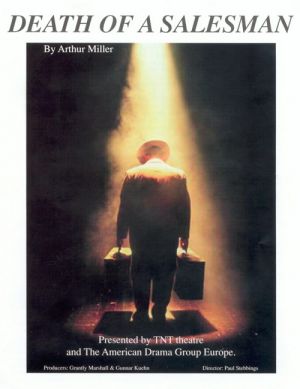
Willy Loman, the American Loser as Everyman . This poster was meant to illustrate the book review below but by coincidence, it also marks the death of Arthur Miller, whose "Death of a Salesman" is just one of his great plays illuminating the American experience. As Edward Albee said in tribute, his works are "essential."

'>Born Losers: A History of Failure in America
by Scott A. Sandage
Harvard University Press, 208 pages, $35.
review by William S. Kowinski
From the 19th century of Emerson and Thoreau (the first and most paradigmatic "born loser" in the book) to the formulation of the American Dream in 1931 and presumably through the Dale Carnegie-redux 1980s of "market yourself" which is still with us, America has defined losers in economic terms, yet attributed that losing to personal character failure. We continue to do this today, '>Scott Sandage writes, "because a century and a half ago we embraced business as the dominant model for our outer and inner lives."
But the crass go-getter business model had philosophical help from the likes of Emerson, whose raptures extolling individual achievement transferred to blaming the victims of downward economic trends, large-scale chicanery and corporate confidence games, not to mention illness, guilelessness and sheer bad luck.
Sandage, who now (perhaps ironically) teaches at Carnegie Mellon University, shows through the lives of 19th century individuals how pernicious these otherwise exalting beliefs could be. Merchants who lost their Southern states markets overnight in the Civil War, for example, were still blamed---and blamed themselves---for their sudden insolvency.
Sandage shows how the question of responsibility echoed through the century ("Are we merely toiling at the eternal task of Sisyphus, or are we merely the victims of a vicious system and a more vicious practice?" asked an 1857 popular magazine), reflected in the evolution of bankruptcy law. Though "speculation" and capitalist risk made heroes of a few, they made humiliated losers of most. The "choice" Americans are supposed to cherish is all too often the choice of Melville's Bartelby the Scrivener, which is a life of self-deluded drudgery enslaved by a stupid system, or refusal and the ostracized pain and penury that all but inevitably results.
This is a fascinating book, both as history and moral history. The decade or so Sandage spent on it has paid off in its copious scholarship and polished writing. His epigrammatic style is thought provoking (and very quotable), though I would have welcomed a bit more context and exposition. The mostly 19th century history is revelatory, but his epilogue bringing his topic into the present, through the Great Depression, Willy Loman and Charlie Brown, to Bob Dylan, is positively scintillating. "Failure is not the dark side of the American Dream;" he concludes," it is the foundation of it."
It may be of some cold comfort to learn that there is ample historical foundation for the numbed moral blindness of the twenty-first century, that consigns the many to low wage servitude amidst the unimaginable wealth of a few. The number of bankruptcies is exploding, and separate studies show that half are due to health care costs of a single illness, even among those with insurance, yet medical costs in America are twice as high as they need to be. With a vastly larger population in communities without cohesion, America may soon find itself on the losing end of history.
by Scott A. Sandage
Harvard University Press, 208 pages, $35.
review by William S. Kowinski
From the 19th century of Emerson and Thoreau (the first and most paradigmatic "born loser" in the book) to the formulation of the American Dream in 1931 and presumably through the Dale Carnegie-redux 1980s of "market yourself" which is still with us, America has defined losers in economic terms, yet attributed that losing to personal character failure. We continue to do this today, '>Scott Sandage writes, "because a century and a half ago we embraced business as the dominant model for our outer and inner lives."
But the crass go-getter business model had philosophical help from the likes of Emerson, whose raptures extolling individual achievement transferred to blaming the victims of downward economic trends, large-scale chicanery and corporate confidence games, not to mention illness, guilelessness and sheer bad luck.
Sandage, who now (perhaps ironically) teaches at Carnegie Mellon University, shows through the lives of 19th century individuals how pernicious these otherwise exalting beliefs could be. Merchants who lost their Southern states markets overnight in the Civil War, for example, were still blamed---and blamed themselves---for their sudden insolvency.
Sandage shows how the question of responsibility echoed through the century ("Are we merely toiling at the eternal task of Sisyphus, or are we merely the victims of a vicious system and a more vicious practice?" asked an 1857 popular magazine), reflected in the evolution of bankruptcy law. Though "speculation" and capitalist risk made heroes of a few, they made humiliated losers of most. The "choice" Americans are supposed to cherish is all too often the choice of Melville's Bartelby the Scrivener, which is a life of self-deluded drudgery enslaved by a stupid system, or refusal and the ostracized pain and penury that all but inevitably results.
This is a fascinating book, both as history and moral history. The decade or so Sandage spent on it has paid off in its copious scholarship and polished writing. His epigrammatic style is thought provoking (and very quotable), though I would have welcomed a bit more context and exposition. The mostly 19th century history is revelatory, but his epilogue bringing his topic into the present, through the Great Depression, Willy Loman and Charlie Brown, to Bob Dylan, is positively scintillating. "Failure is not the dark side of the American Dream;" he concludes," it is the foundation of it."
It may be of some cold comfort to learn that there is ample historical foundation for the numbed moral blindness of the twenty-first century, that consigns the many to low wage servitude amidst the unimaginable wealth of a few. The number of bankruptcies is exploding, and separate studies show that half are due to health care costs of a single illness, even among those with insurance, yet medical costs in America are twice as high as they need to be. With a vastly larger population in communities without cohesion, America may soon find itself on the losing end of history.
Monday, January 31, 2005
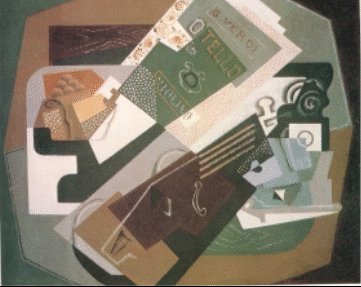
'>Italian Tales:
An Anthology of Contemporary Italian Fiction
Massimo Riva, editor
Yale University Press. 272 pages, $30.
book review by William Severini Kowinski
My mother was born in Italy, although this fact was kept from her children for years, ostensibly to forestall any question of her citizenship (she arrived at the age of 4) but her reticence was probably due to her mother's residual caution. In the 1930s and 40s, Italians weren't universally popular in America. Then came Joe DiMaggio and Perry Como, and in the 50s Italian language songs were top forty hits.
More recently, I read somewhere about a common experience of Italian-Americans returning to the old country. Steeped on their grandparents' tales of escaping poverty and gratitude for generous American G.I.s, they visited Italian relatives who turned out to be more prosperous and urban than they, and not so impressed with America. Why should they be? Despite more obvious government corruption, they have better health care.
Italian literature has also changed with the times, as '>Massimo Riva tells us in a fascinating introduction to this anthology specifically meant for an American readership. Italian literature is as old as the classics of Rome, yet comparatively young in that Italy has existed as a united country for only about a century and a half, and at the time of unification in the 1860s, most people spoke regional dialects. Three quarters of the population did not speak or write Italian.
Even today, with Italian as the spoken standard and much greater literacy---but with the explosive growth and influence of mass media--- the readership for literature written in Italian within the country, Riva says, is still small. But Italian writers have been influential in world literature, especially since World War II. Ernest Hemingway, who wrote A Farewell to Arms based on his World War I experiences in Italy (and wrote about Venice in a later novel, Across the River and Into the Trees, which I read on my only visit to Venice), wrote a fulsome introduction to Elio Vittorini's novel, Conversations in Sicily. This was published in 1949, so it is impossible to say who influenced who, but quite a bit of the book reads like vintage Hemingway.
Two anthologies published by Penguin in the 1960s (Italian Short Stories, with parallel English and Italian text, and Italian Writing Today) contain work by authors who were then world famous, or who soon would be: Cesare Pavese, Alberto Moravia, Natalia Ginzburg, Ignazio Silone, Carlo Gadda, Pier Paolo Pasolini and Italo Calvino. (Silone's Bread and Wine was the only modernist Italian I was asked to read in college, although I recently read Fontomara, his novel about the Abruzzi region where my mother was born, with great pleasure.)
In the past several decades, it was Calvino and Umberto Eco who became the best known in America. Eco doesn't do much for me, but I consider Calvino one of the greatest of his time in the world. In imagination and style he ranks with Marquez, and his intellect and literary taste are unparalleled. I find his fiction wondrous and his nonfiction singularly stimulating.
According to Riva, Calvino cast a long shadow in Italy as well. While some of the writers in this anthology are actually Calvino's contemporaries, they and others represented here are also Calvino's literary children. I don't want to characterize Calvino's writing, because that is to unfairly limit a protean body of work. But in his thoughtful approach to literature, he does represent a certain consciousness about process and possibility. He also linked traditional stories (as in Italian Folktales, which he edited) to more fabulous forms (like his own brand of science fiction in Cosmicomics) and concerns with contemporary life. Another strand in Italian writing may be more clearly represented by Pasolini, who is best known for his neo-realist films.
So even though Calvino is deliberately left out of this anthology, his spirit pervades it, especially as the man of world letters who nevertheless was consciously Italian. In his work as a publisher in a literary community based in Turino, Calvino had what few Americans ever do, even in universities: a life centered on literature. That sense of literature seems present to these writers, though their circumstances differ. (Some have had teaching careers in America.)
These writers and their short stories, novel excerpts and nonfiction pieces, are of the 80s and 90s (there are notably more women writers than in those past anthologies.) Many are trying to reconcile contemporary Italy with its past and traditions, including its landscape, using various literary strategies. These writers seem to me to be writing about Italy for a world audience, perhaps even for that timeless audience of unknown and unborn readers that defines literature. That is, regardless of their relationship to the Italian readership of today, they are writing of Italy today.
So Giorgio Manganelli tells a story from the point of view of a labyrinth, Fabrizia Ramondino describes a neighborhood over time, while Erri De Luca presents a poor adolescent's journal in almost a neo-realist style. Time is a central concern for Pier Maria Pasinetti looking at history, and Pier Vittorio Tondelli, looking at his old room.
Editor Riva divides these pieces into sections with themes keyed to Italian life and concerns, such as the presence of ruins, the persistence of the piazza and the opera of life. He provides useful glosses on each piece and each writer. I hope to read more by several of them, including Gesualdo Bufalino (his story concerns a man who treats dead cars as Coliseum-like ruins), Daniele Dei Giudice (whose excerpt about a lost pilot is a cliffhanger) and Antonio Tabucchi, who seems to apply magic realism to film noir.
Riva, who is professor of Italian studies at Brown University, has collected tales that curious and casual readers can enjoy, while supplying helpful background and point of view for both interested readers and scholars of literature and culture. Bravo!
An Anthology of Contemporary Italian Fiction
Massimo Riva, editor
Yale University Press. 272 pages, $30.
book review by William Severini Kowinski
My mother was born in Italy, although this fact was kept from her children for years, ostensibly to forestall any question of her citizenship (she arrived at the age of 4) but her reticence was probably due to her mother's residual caution. In the 1930s and 40s, Italians weren't universally popular in America. Then came Joe DiMaggio and Perry Como, and in the 50s Italian language songs were top forty hits.
More recently, I read somewhere about a common experience of Italian-Americans returning to the old country. Steeped on their grandparents' tales of escaping poverty and gratitude for generous American G.I.s, they visited Italian relatives who turned out to be more prosperous and urban than they, and not so impressed with America. Why should they be? Despite more obvious government corruption, they have better health care.
Italian literature has also changed with the times, as '>Massimo Riva tells us in a fascinating introduction to this anthology specifically meant for an American readership. Italian literature is as old as the classics of Rome, yet comparatively young in that Italy has existed as a united country for only about a century and a half, and at the time of unification in the 1860s, most people spoke regional dialects. Three quarters of the population did not speak or write Italian.
Even today, with Italian as the spoken standard and much greater literacy---but with the explosive growth and influence of mass media--- the readership for literature written in Italian within the country, Riva says, is still small. But Italian writers have been influential in world literature, especially since World War II. Ernest Hemingway, who wrote A Farewell to Arms based on his World War I experiences in Italy (and wrote about Venice in a later novel, Across the River and Into the Trees, which I read on my only visit to Venice), wrote a fulsome introduction to Elio Vittorini's novel, Conversations in Sicily. This was published in 1949, so it is impossible to say who influenced who, but quite a bit of the book reads like vintage Hemingway.
Two anthologies published by Penguin in the 1960s (Italian Short Stories, with parallel English and Italian text, and Italian Writing Today) contain work by authors who were then world famous, or who soon would be: Cesare Pavese, Alberto Moravia, Natalia Ginzburg, Ignazio Silone, Carlo Gadda, Pier Paolo Pasolini and Italo Calvino. (Silone's Bread and Wine was the only modernist Italian I was asked to read in college, although I recently read Fontomara, his novel about the Abruzzi region where my mother was born, with great pleasure.)
In the past several decades, it was Calvino and Umberto Eco who became the best known in America. Eco doesn't do much for me, but I consider Calvino one of the greatest of his time in the world. In imagination and style he ranks with Marquez, and his intellect and literary taste are unparalleled. I find his fiction wondrous and his nonfiction singularly stimulating.
According to Riva, Calvino cast a long shadow in Italy as well. While some of the writers in this anthology are actually Calvino's contemporaries, they and others represented here are also Calvino's literary children. I don't want to characterize Calvino's writing, because that is to unfairly limit a protean body of work. But in his thoughtful approach to literature, he does represent a certain consciousness about process and possibility. He also linked traditional stories (as in Italian Folktales, which he edited) to more fabulous forms (like his own brand of science fiction in Cosmicomics) and concerns with contemporary life. Another strand in Italian writing may be more clearly represented by Pasolini, who is best known for his neo-realist films.
So even though Calvino is deliberately left out of this anthology, his spirit pervades it, especially as the man of world letters who nevertheless was consciously Italian. In his work as a publisher in a literary community based in Turino, Calvino had what few Americans ever do, even in universities: a life centered on literature. That sense of literature seems present to these writers, though their circumstances differ. (Some have had teaching careers in America.)
These writers and their short stories, novel excerpts and nonfiction pieces, are of the 80s and 90s (there are notably more women writers than in those past anthologies.) Many are trying to reconcile contemporary Italy with its past and traditions, including its landscape, using various literary strategies. These writers seem to me to be writing about Italy for a world audience, perhaps even for that timeless audience of unknown and unborn readers that defines literature. That is, regardless of their relationship to the Italian readership of today, they are writing of Italy today.
So Giorgio Manganelli tells a story from the point of view of a labyrinth, Fabrizia Ramondino describes a neighborhood over time, while Erri De Luca presents a poor adolescent's journal in almost a neo-realist style. Time is a central concern for Pier Maria Pasinetti looking at history, and Pier Vittorio Tondelli, looking at his old room.
Editor Riva divides these pieces into sections with themes keyed to Italian life and concerns, such as the presence of ruins, the persistence of the piazza and the opera of life. He provides useful glosses on each piece and each writer. I hope to read more by several of them, including Gesualdo Bufalino (his story concerns a man who treats dead cars as Coliseum-like ruins), Daniele Dei Giudice (whose excerpt about a lost pilot is a cliffhanger) and Antonio Tabucchi, who seems to apply magic realism to film noir.
Riva, who is professor of Italian studies at Brown University, has collected tales that curious and casual readers can enjoy, while supplying helpful background and point of view for both interested readers and scholars of literature and culture. Bravo!
Tuesday, January 18, 2005

Monday, January 17, 2005
review by William S. Kowinski
'>Just Work
by Russell Muirhead. Harvard University Press, 204 pages, $24.95.
For all the time and energy we devote to work, there are surprisingly few books dealing with it. Work is often much less important in the lives of characters in novels and movies than in our own. Perhaps that's part of their appeal.
But for most people, work is a central fact and daily preoccupation. Though parents may have counseled us to "just do it," and the responsibilities of earning a live are paramount, some latitude of choice (or at least the illusion of it) has combined with the sense that self-fulfillment in work is a goal if not a right, and that our responsibilities in the work we do go beyond self and family to society and the planet.
It's not an easy time to be dealing with these issues. While New Age success mystics preach that self-fulfillment is within our grasp, more people are working harder under greater pressures for less income, as the gap between rich and poor grows to an abyss. People feel stuck in alienating or dishonest jobs that require them to not only act inauthentically but seem to demand their hearts and souls as well as their minds and bodies. They spend too much time on the job, where they are required to lie to each other and to themselves, while pretending they don't know they are being lied to.
The title of '>Russell Muirhead's book is an obvious pun that speaks to this situation. It's just work, after all, it says, the most mundane part of our lives, yet so important than we deny it, especially in the throes of shame for not having fulfilled our dreams, or outside expectations. But is it also asks if justice is served: is it just work, fair to us and to the world around us? And where do we get the idea that work should be or can be just?
An Associate Professor of Government at Harvard, Muirhead examines some of these knotty common issues ("Can we each get our due while at the same time contributing to the common good?" ) as problems in political theory. This book examines philosophical approaches to the issues of work, the individual and society, from Plato and Aristotle, through John Stuart Mill and Betty Friedan. This is basically a scholarly work, well-organized and quite readable in style. It is a solid contribution, a thorough background that raises the pertinent issues, though few readers are likely to find it the last word on their own concerns.
I especially enjoyed the treatment of Mill, who seems to get short shrift these days, but I remember being intensely interested in him as I was about to enter college, and forming my ideas about my place in the larger world. It's also interesting to see the Protestant work ethic, more often referred to than explained, more fully described in a larger historical context. In an economy that is enlarging the proportion, numbers and categories of "service" occupations, a history of service (or servants) in America is very enlightening. The servant class existed before the working class, and apparently has returned in force, though changed.
Other books on the subject of work offer complementary approaches and perspectives. Among those emphasizing the personal experience of work are'> Crossing the Unknown Sea: Work as a Pilgrimage of Identity by David Whyte, a poet who works with corporations. In recounting his own journey, Whyte offers perspectives on career and its place in a well-lived life, where personal and societal meaning are important considerations. It's appropriately the most literary of the books mentioned, with the best storytelling, and so brings that power and complexity to its effects.
Lewis Richmond's '>Work as a Spiritual Practice is pretty much explained by its subtitle: A Practical Buddhist Approach to Inner Growth and Satisfaction on the Job (Broadway Books, $13). These stories, observations and suggestions apply to almost any job, though the relationship of personal values and societal values are always a concern, especially considering the Buddhist concept of Right Livelihood. Like a lot of writing from the Buddhist perspective, the content is worth considering for non-practitioners as well as those who follow that path.
As an example and perhaps an exemplar of books that attempt the difficult dance of examining personal values and experiences within a larger societal context is '>The Reinvention of Work: A New Vision of Livelihood for Our Time by Matthew Fox. Though Fox is an advocate for meaningful work and societal change that might make that more possible, to the benefit of individuals and society as well, he is also broadly informative on present conditions (into the late 90s anyway)---in some ways, more informative than the strictly scholarly presentation of Muirhead.
Though not in book form, author '>Thomas Moore has issued an audio work called '>On Meaningful Work (Sounds True) that should appeal to readers of the above named books.
'>Just Work
by Russell Muirhead. Harvard University Press, 204 pages, $24.95.
For all the time and energy we devote to work, there are surprisingly few books dealing with it. Work is often much less important in the lives of characters in novels and movies than in our own. Perhaps that's part of their appeal.
But for most people, work is a central fact and daily preoccupation. Though parents may have counseled us to "just do it," and the responsibilities of earning a live are paramount, some latitude of choice (or at least the illusion of it) has combined with the sense that self-fulfillment in work is a goal if not a right, and that our responsibilities in the work we do go beyond self and family to society and the planet.
It's not an easy time to be dealing with these issues. While New Age success mystics preach that self-fulfillment is within our grasp, more people are working harder under greater pressures for less income, as the gap between rich and poor grows to an abyss. People feel stuck in alienating or dishonest jobs that require them to not only act inauthentically but seem to demand their hearts and souls as well as their minds and bodies. They spend too much time on the job, where they are required to lie to each other and to themselves, while pretending they don't know they are being lied to.
The title of '>Russell Muirhead's book is an obvious pun that speaks to this situation. It's just work, after all, it says, the most mundane part of our lives, yet so important than we deny it, especially in the throes of shame for not having fulfilled our dreams, or outside expectations. But is it also asks if justice is served: is it just work, fair to us and to the world around us? And where do we get the idea that work should be or can be just?
An Associate Professor of Government at Harvard, Muirhead examines some of these knotty common issues ("Can we each get our due while at the same time contributing to the common good?" ) as problems in political theory. This book examines philosophical approaches to the issues of work, the individual and society, from Plato and Aristotle, through John Stuart Mill and Betty Friedan. This is basically a scholarly work, well-organized and quite readable in style. It is a solid contribution, a thorough background that raises the pertinent issues, though few readers are likely to find it the last word on their own concerns.
I especially enjoyed the treatment of Mill, who seems to get short shrift these days, but I remember being intensely interested in him as I was about to enter college, and forming my ideas about my place in the larger world. It's also interesting to see the Protestant work ethic, more often referred to than explained, more fully described in a larger historical context. In an economy that is enlarging the proportion, numbers and categories of "service" occupations, a history of service (or servants) in America is very enlightening. The servant class existed before the working class, and apparently has returned in force, though changed.
Other books on the subject of work offer complementary approaches and perspectives. Among those emphasizing the personal experience of work are'> Crossing the Unknown Sea: Work as a Pilgrimage of Identity by David Whyte, a poet who works with corporations. In recounting his own journey, Whyte offers perspectives on career and its place in a well-lived life, where personal and societal meaning are important considerations. It's appropriately the most literary of the books mentioned, with the best storytelling, and so brings that power and complexity to its effects.
Lewis Richmond's '>Work as a Spiritual Practice is pretty much explained by its subtitle: A Practical Buddhist Approach to Inner Growth and Satisfaction on the Job (Broadway Books, $13). These stories, observations and suggestions apply to almost any job, though the relationship of personal values and societal values are always a concern, especially considering the Buddhist concept of Right Livelihood. Like a lot of writing from the Buddhist perspective, the content is worth considering for non-practitioners as well as those who follow that path.
As an example and perhaps an exemplar of books that attempt the difficult dance of examining personal values and experiences within a larger societal context is '>The Reinvention of Work: A New Vision of Livelihood for Our Time by Matthew Fox. Though Fox is an advocate for meaningful work and societal change that might make that more possible, to the benefit of individuals and society as well, he is also broadly informative on present conditions (into the late 90s anyway)---in some ways, more informative than the strictly scholarly presentation of Muirhead.
Though not in book form, author '>Thomas Moore has issued an audio work called '>On Meaningful Work (Sounds True) that should appeal to readers of the above named books.
Friday, January 07, 2005
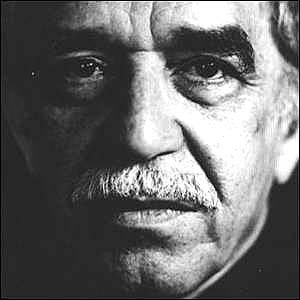
What thou lovest well is remaindered #1
Gabriel Garcia Marquez
Living to Tell the Tale
by William Severini Kowinski
Though this is out in paperback now, I waited until I could get a bargain copy of the hardback. This is one of my favorite authors--- and always my favorite when I'm reading him.
Author of One Hundred Years of Solitude and other novels, stories, reportage and screenplays, this is his first memoir (with perhaps two more volumes to come.) The framework of the first two chapters or so is a trip Marquez took as a young impoverished writer with his mother back to his childhood home in Aracatata, Columbia to sell their house. As I read his narrative of revived childhood memories, I had a curious sense of recognition, and finally a kind of shock. Marquez achieved international fame with One Hundred Years of Solitude, probably the greatest novel of the second half of the twentieth century, which sparked a fashion for Latin American fiction and sired an entirely new genre, called magical realism.
But according to his memoir, many of the enchanted characters of mythical singularity in that novel were actual people, and many of the transcendent and dreamlike events really happened. It wasn't a magical realism, it was realism about an innately magical reality.
Can you believe it? The shy girl who didn't speak or take food, but silently stole into the garden at night to eat earth, was real. The noble Colonel in his workshop between wars, fashioning little gold fishes, was his grandfather. The sons who show up from all over the country on the same day with ashes on their foreheads---that happened. Even the moment of seeing ice for the first time that opens the novel happened to young Gabo, though a little differently. The girl so beautiful and pure that one day she simply ascends into heaven while hanging clothes was only a slight exaggeration. Even Macondo existed, although it was the name of an abandoned banana plantation rather than his town.
It also turns out that another of his novels, Love at the Time of the Cholera, is an almost exact account of the courtship of his parents. It seems that Marquez was a bit more of a magical journalist than many readers might expect.
It was almost disillusioning. But fortunately, when his account turns to his days as a young writer and earlier as a student, the narrative breaks new ground and we are free of comparisons. Of course he is just as much a word magician in memoir as he is in novels and stories.
I am as transported by his accounts of his student days, his love of poetry, his skill at song (I knew he had to be musical; the mystery for me is how his translators, Gregory Rabassa and now Edith Grossman, can transpose his sonorous Spanish into English sonatas, cantatas and symphonies.) And then there are the blazing sentences that come out of almost nowhere, that transcend any possible specific, earthly meaning: " The boarders from the coast, with our well-deserved reputation for rowdiness and ill-breeding, had the good manners to dance like artists to popular music and the good taste to fall in love forever."
He poured out his heart in song but as a poet he was more scholarly, first memorizing and then imitating the poets of the day, become skilled at form and expressing sentiments he hadn't yet experienced. But his elders encouraged him, as did his schoolmates, as besotted with literature as he was. Even as an adolescent student he met some of the poets he read, and they also encouraged him. Sounds magical to me.
In both the childhood and student memoirs, something that is added to the worlds built in the novels is a more specific sense of place within the real geography and history. And the quality of otherworldliness of the novels, even with the violence and death that is nevertheless on an otherworldly scale and told in the rhetoric of wonder, is grounded in recognizable references, as in his young fascination with Flash Gordon serials, or his spontaneous schoolboy oration at the end of World War II in which he praised FDR as being "like El Cid, who knows how to win battles after death."
I am writing this when only halfway through the book, not because I'm abandoning it, but because I intend to savor the rest for as long as possible.
UPDATE: Alas, I've finished it. The second half is fully as absorbing as the first, which is interesting because the narrative interest must carry it completely, as there is little reference to incidents that recur in some form in his fiction. These pages are about his life as a young man, practicing journalism of the time (and place) while learning to be a literary writer. (Marquez has always maintained there is a close connection, not a widely held sentiment here these days.) He continued to be blessed with friends, a necessity in the political chaos of Colombia. His literary talent was recognized early, another near necessity for a young man from a provincial area and a family that slips in and out of near-poverty. There are more wonderful sentences and observations. But Marquez takes nothing for granted, even as an eminence writing his memoirs: he ends this first volume with a cliffhanger.
Hardcover edition by Knopf, 2003. Paperback is Vintage 2004.
Gabriel Garcia Marquez
Living to Tell the Tale
by William Severini Kowinski
Though this is out in paperback now, I waited until I could get a bargain copy of the hardback. This is one of my favorite authors--- and always my favorite when I'm reading him.
Author of One Hundred Years of Solitude and other novels, stories, reportage and screenplays, this is his first memoir (with perhaps two more volumes to come.) The framework of the first two chapters or so is a trip Marquez took as a young impoverished writer with his mother back to his childhood home in Aracatata, Columbia to sell their house. As I read his narrative of revived childhood memories, I had a curious sense of recognition, and finally a kind of shock. Marquez achieved international fame with One Hundred Years of Solitude, probably the greatest novel of the second half of the twentieth century, which sparked a fashion for Latin American fiction and sired an entirely new genre, called magical realism.
But according to his memoir, many of the enchanted characters of mythical singularity in that novel were actual people, and many of the transcendent and dreamlike events really happened. It wasn't a magical realism, it was realism about an innately magical reality.
Can you believe it? The shy girl who didn't speak or take food, but silently stole into the garden at night to eat earth, was real. The noble Colonel in his workshop between wars, fashioning little gold fishes, was his grandfather. The sons who show up from all over the country on the same day with ashes on their foreheads---that happened. Even the moment of seeing ice for the first time that opens the novel happened to young Gabo, though a little differently. The girl so beautiful and pure that one day she simply ascends into heaven while hanging clothes was only a slight exaggeration. Even Macondo existed, although it was the name of an abandoned banana plantation rather than his town.
It also turns out that another of his novels, Love at the Time of the Cholera, is an almost exact account of the courtship of his parents. It seems that Marquez was a bit more of a magical journalist than many readers might expect.
It was almost disillusioning. But fortunately, when his account turns to his days as a young writer and earlier as a student, the narrative breaks new ground and we are free of comparisons. Of course he is just as much a word magician in memoir as he is in novels and stories.
I am as transported by his accounts of his student days, his love of poetry, his skill at song (I knew he had to be musical; the mystery for me is how his translators, Gregory Rabassa and now Edith Grossman, can transpose his sonorous Spanish into English sonatas, cantatas and symphonies.) And then there are the blazing sentences that come out of almost nowhere, that transcend any possible specific, earthly meaning: " The boarders from the coast, with our well-deserved reputation for rowdiness and ill-breeding, had the good manners to dance like artists to popular music and the good taste to fall in love forever."
He poured out his heart in song but as a poet he was more scholarly, first memorizing and then imitating the poets of the day, become skilled at form and expressing sentiments he hadn't yet experienced. But his elders encouraged him, as did his schoolmates, as besotted with literature as he was. Even as an adolescent student he met some of the poets he read, and they also encouraged him. Sounds magical to me.
In both the childhood and student memoirs, something that is added to the worlds built in the novels is a more specific sense of place within the real geography and history. And the quality of otherworldliness of the novels, even with the violence and death that is nevertheless on an otherworldly scale and told in the rhetoric of wonder, is grounded in recognizable references, as in his young fascination with Flash Gordon serials, or his spontaneous schoolboy oration at the end of World War II in which he praised FDR as being "like El Cid, who knows how to win battles after death."
I am writing this when only halfway through the book, not because I'm abandoning it, but because I intend to savor the rest for as long as possible.
UPDATE: Alas, I've finished it. The second half is fully as absorbing as the first, which is interesting because the narrative interest must carry it completely, as there is little reference to incidents that recur in some form in his fiction. These pages are about his life as a young man, practicing journalism of the time (and place) while learning to be a literary writer. (Marquez has always maintained there is a close connection, not a widely held sentiment here these days.) He continued to be blessed with friends, a necessity in the political chaos of Colombia. His literary talent was recognized early, another near necessity for a young man from a provincial area and a family that slips in and out of near-poverty. There are more wonderful sentences and observations. But Marquez takes nothing for granted, even as an eminence writing his memoirs: he ends this first volume with a cliffhanger.
Hardcover edition by Knopf, 2003. Paperback is Vintage 2004.
Saturday, December 18, 2004

A Terrible Love of War
by James Hillman
reviewed by William S. Kowinski in the San Francisco Chronicle
A San Francisco Chronicle Best Book of 2004
Now in his 80s, James Hillman notes in the first of his interpolated personal commentaries in this volume: "Strange indeed that what I'm assuming to be my last book should land on the shores of this theme..." Strange but perhaps fated, for this uncompromising examination of war arrives as portraits of flag-draped coffins and images of young Americans abusing captives in Saddam's torture prison hover over its pages. They illustrate the gripping mythic power of war that Hillman insists we recognize and acknowledge.
"James Hillman is an artist of psychology," Thomas Moore writes in his still indispensable Prologue to A Blue Fire, his 1989 selection of Hillman's early writings. " He turns upside down many ideas people hold dear and unreflected. After an hour with Hillman's writing, a reader might feel himself twisting and turning in the wind." In the cruel spring of 2004, this reader certainly did.
James Hillman studied with Carl Jung in the 1950s, and wrote prominently on Jungian themes while deconstructing psychoanalysis in the 1970s in such landmark books as The Myth of Analysis and Re-Visioning Psychology. His "archetypal psychology" and re-imagined concept of soul, soon resonated with artists and others outside his first audiences of professional therapists.
By the 1980s, Hillman engaged in book-length dialogues with Italian journalist Laura Pozzo (Inter/Views) and Los Angeles writer Michael Ventura (We've Had a Hundred Years of Psychotherapy and the World is Getting Worse.) After A Blue Fire and a collaboration on men's poetry with Robert Bly and Michael Meade (The Rag and Bone Shop of the Heart), he went public in a big way beginning in the 1990s with Kinds of Power (addressing the psychology of business) and his best-sellers, The Soul's Code and The Force of Character.
This book is perhaps his most accessible, and therefore his most devastating. Hillman has never been one for therapeutic bromides or blanket comfort. He has counterbalanced the usual emphasis on spiritual growth, hope and happiness with a call to experience the soul's depths of complexity, limitation, loss, patience and relationship with death. Soul confronts what ego would like to deny.
For instance, the reality---and normality---of war. It is with us every hour now, but even in the supposedly placid 1990s, something like 6 million people died in at least 14 wars. More than 60 million were killed in the 20th century's wars. For every year of recorded human history there have been at least two wars. This is not a pretty picture of humanity but to avoid it entirely leads to such products of denial as neglecting to confront the damage that ruins the lives of many returning soldiers. The "failure of imagination" we heard about concerning 9-11 (and have heard long enough to be noted in this book) is a failure to painfully apply imagination to the nature of war, so our stupidity masked as innocence leads us into avoidable repetitions of mass killing.
But reader beware: there is nothing pacifist about Hillman's approach. He says war is normal, not just usual. He says it is inhuman, but not just for its horrors---it is inhuman as are the gods, even if their autonomy resides in our psyches. War is not just the province of Mars but of Venus, so war has its sublime beauty and love. This book's title is not rhetorical-the subject is the terrible love of war. "Because war reveals our being, we are brutal and insane in action," he writes, "and we are ethical and loving in essence."
Hillman agrees with political philosophers who say war is inherent in the existence of states. His most aggressively presented theme is that war is a result of the either/or of monotheistic religions. Polytheism (not as literal belief but as a way of exploring the human soul and the soul of the world) shows us the complexity of shadings, relationships and contained contraries. One of his more startling illustrations is a Homeric Hymn to the Greek god of war that ends, "give me courage,/let me linger/in the safe laws of peace..."
Our task, he writes, is to dig "below the blanket of hypocrisies" and stop blaming the beliefs of others, especially when the inflammatory clerics and history of religious warfare we decry are mirrored in our own. "Psychoanalysis has moved civilization to where it must do what its patients do: take back easy blame from out there in search of the more difficult blame in here."
At times Hillman's concluding pages sound as bleak as the despairing H.G. Wells in his last book, Mind At the End of Its Tether. But he dares to make a case for beauty and the complexities of culture as a necessary counterbalance even more strongly than the case for consciousness that Jungian Anthony Stevens shapes in his new book on war and terrorism. And while Hillman states starkly that "There is no practical solution to war because war is not a problem for the practical mind..." he also says that recognizing "War belongs to our souls as an archetypal truth of the cosmos" may help us focus more effectively on preventing war's bloody enactment in the world. "We may understand it better, delay it longer, and work to wean war from its support in hypocritical religion."
Hillman can be a seductive writer. Living now in Wallace Stevens' Connecticut, Hillman's voice on a recent audiobook sounds eerily like Stevens', and there are lines of his prose that could easily be slipped into certain Stevens' poems, and vice versa. But this book presents more of his provocative side, and much more of his intriguing personal history than he's shown before. Its' a skillfully constructed tour de force with more virtues than omissions. It took a warrior courage to publish it, and it will take warrior courage to absorb it. But without either endorsing or denying all its conclusions, this reader can recommend it as important reading for our time, as we try to make sense of its terrors.
A Terrible Love of War by James Hillman (The Penguin Press; 256 pages, $23.95.)
by James Hillman
reviewed by William S. Kowinski in the San Francisco Chronicle
A San Francisco Chronicle Best Book of 2004
Now in his 80s, James Hillman notes in the first of his interpolated personal commentaries in this volume: "Strange indeed that what I'm assuming to be my last book should land on the shores of this theme..." Strange but perhaps fated, for this uncompromising examination of war arrives as portraits of flag-draped coffins and images of young Americans abusing captives in Saddam's torture prison hover over its pages. They illustrate the gripping mythic power of war that Hillman insists we recognize and acknowledge.
"James Hillman is an artist of psychology," Thomas Moore writes in his still indispensable Prologue to A Blue Fire, his 1989 selection of Hillman's early writings. " He turns upside down many ideas people hold dear and unreflected. After an hour with Hillman's writing, a reader might feel himself twisting and turning in the wind." In the cruel spring of 2004, this reader certainly did.
James Hillman studied with Carl Jung in the 1950s, and wrote prominently on Jungian themes while deconstructing psychoanalysis in the 1970s in such landmark books as The Myth of Analysis and Re-Visioning Psychology. His "archetypal psychology" and re-imagined concept of soul, soon resonated with artists and others outside his first audiences of professional therapists.
By the 1980s, Hillman engaged in book-length dialogues with Italian journalist Laura Pozzo (Inter/Views) and Los Angeles writer Michael Ventura (We've Had a Hundred Years of Psychotherapy and the World is Getting Worse.) After A Blue Fire and a collaboration on men's poetry with Robert Bly and Michael Meade (The Rag and Bone Shop of the Heart), he went public in a big way beginning in the 1990s with Kinds of Power (addressing the psychology of business) and his best-sellers, The Soul's Code and The Force of Character.
This book is perhaps his most accessible, and therefore his most devastating. Hillman has never been one for therapeutic bromides or blanket comfort. He has counterbalanced the usual emphasis on spiritual growth, hope and happiness with a call to experience the soul's depths of complexity, limitation, loss, patience and relationship with death. Soul confronts what ego would like to deny.
For instance, the reality---and normality---of war. It is with us every hour now, but even in the supposedly placid 1990s, something like 6 million people died in at least 14 wars. More than 60 million were killed in the 20th century's wars. For every year of recorded human history there have been at least two wars. This is not a pretty picture of humanity but to avoid it entirely leads to such products of denial as neglecting to confront the damage that ruins the lives of many returning soldiers. The "failure of imagination" we heard about concerning 9-11 (and have heard long enough to be noted in this book) is a failure to painfully apply imagination to the nature of war, so our stupidity masked as innocence leads us into avoidable repetitions of mass killing.
But reader beware: there is nothing pacifist about Hillman's approach. He says war is normal, not just usual. He says it is inhuman, but not just for its horrors---it is inhuman as are the gods, even if their autonomy resides in our psyches. War is not just the province of Mars but of Venus, so war has its sublime beauty and love. This book's title is not rhetorical-the subject is the terrible love of war. "Because war reveals our being, we are brutal and insane in action," he writes, "and we are ethical and loving in essence."
Hillman agrees with political philosophers who say war is inherent in the existence of states. His most aggressively presented theme is that war is a result of the either/or of monotheistic religions. Polytheism (not as literal belief but as a way of exploring the human soul and the soul of the world) shows us the complexity of shadings, relationships and contained contraries. One of his more startling illustrations is a Homeric Hymn to the Greek god of war that ends, "give me courage,/let me linger/in the safe laws of peace..."
Our task, he writes, is to dig "below the blanket of hypocrisies" and stop blaming the beliefs of others, especially when the inflammatory clerics and history of religious warfare we decry are mirrored in our own. "Psychoanalysis has moved civilization to where it must do what its patients do: take back easy blame from out there in search of the more difficult blame in here."
At times Hillman's concluding pages sound as bleak as the despairing H.G. Wells in his last book, Mind At the End of Its Tether. But he dares to make a case for beauty and the complexities of culture as a necessary counterbalance even more strongly than the case for consciousness that Jungian Anthony Stevens shapes in his new book on war and terrorism. And while Hillman states starkly that "There is no practical solution to war because war is not a problem for the practical mind..." he also says that recognizing "War belongs to our souls as an archetypal truth of the cosmos" may help us focus more effectively on preventing war's bloody enactment in the world. "We may understand it better, delay it longer, and work to wean war from its support in hypocritical religion."
Hillman can be a seductive writer. Living now in Wallace Stevens' Connecticut, Hillman's voice on a recent audiobook sounds eerily like Stevens', and there are lines of his prose that could easily be slipped into certain Stevens' poems, and vice versa. But this book presents more of his provocative side, and much more of his intriguing personal history than he's shown before. Its' a skillfully constructed tour de force with more virtues than omissions. It took a warrior courage to publish it, and it will take warrior courage to absorb it. But without either endorsing or denying all its conclusions, this reader can recommend it as important reading for our time, as we try to make sense of its terrors.
A Terrible Love of War by James Hillman (The Penguin Press; 256 pages, $23.95.)
Saturday, November 27, 2004

Now in paperback
The Fifth Book of Peace
By Maxine Hong Kingston
Vintage $14.95
Notice the quote on the front cover of this book's paperback edition? It's from the following review which appeared originally in the San Francisco Chronicle Sunday Book Review.
by William Severini Kowinski
Maxine Hong Kingston's long-awaited new book combines fiction and memoir in a "tour de force"--or more appropriately, a "tour de paix"--- that's full of thought and feeling, with interweaving themes and literary layers to keep her Berkeley students busy, and wonderful reading for us all.
As far back as her late 1980s interview with Bill Moyers, Kingston talked about re-imagining the contents of ancient China's three Books of Peace, instructions on how to avoid war and induce tranquility, which according to legend were all deliberately burned by incoming emperors. She also planned to follow the further adventures of Wittman Ah Sing, protagonist of her novel, Tripmaster Monkey, during the Viet Nam war. She combined these intentions in 156 pages she spent two years writing, the beginning of a fourth Book of Peace.
But then in 1991 came the devastating fire in the Berkeley-Oakland hills that destroyed her home and turned her manuscript to ashes: the fourth book of peace had suffered the fate of the first three. And so her new book, The Fifth Book of Peace, begins with a section called "Fire."She was returning from "the red ceremony," a family memorial for her recently deceased father, in which the living fend off the temptation to join the black and white world of the dead by wearing red; by displaying vibrance. Then she was walking in the ash-blackened and heat-scorched white landscape that had been her neighborhood, where the only color left was the red of flame.
Starting with a fiery disaster is a dramatic way to begin a book, and by documenting her sense impressions, thoughts, feelings and encounters with others in the fire zone, Kingston produces a mesmerizing description of an event creating its own fatal landscape, both stark and hallucinatory. But it is also a thematic initiation: before they get to peace, many have gone through fire.
The devastation is itself an object lesson. Kingston quotes an Oakland fire captain and Viet Nam vet who looked down from a helicopter on the melted phantoms of beloved neighborhoods and cautioned, "When we decide to send our military and our bombs into a country, this is what we're deciding to do." (He's quoted again, applying this observation to 9/11 in the book's epilogue.)
The next section, "Paper," is about the Books of Peace, and about books, writing, words and storytelling; paper is the human element. These sections are memoir as in "The Woman Warrior" and "China Men," though more weighted to contemporary America. "Water" is the re-written remnant of the intended earlier book, a fiction following Wittman, his wife and young son to Hawaii where he hides from the Vietnam era draft.
If "Tripmaster Monkey" is discursive, hermetic and Whitmanesque in its frenetic energies, this tale is more descriptive, economical and open, imbued with the magic of discovery, of first times. In its depiction of young war resisters from within the military, it is both generous and accurate to the era. If asked for prose that reflects the realities of the Viet Nam 60s in America, I'd have no hesitation in recommending these pages. There's also memorable writing, like the description of two men walking: "The small soldier and the tall soldier walked the same way; they made their shoulders big, and moved shoulders and feet in rhythm, one side of the body at a step."
The last section, "Earth," is a reportorial and collaborative account of writing and meditation workshops Kingston held in the mid 90s with war veterans---mostly Viet Nam vets (including civilian women), but also World War II Americans and veterans of other armies and wars. Again she brings her considerable skills to describing the emotionally ragged process that leads to a series of dramatic and revelatory moments, including several of reconciliation and even peace.
The war veterans find their way back to community through honest saying and story. There are countless little jewels to admire glittering on the path throughout this book, such as a different ending for the woman warrior tale, and the true account of how Thich Nhat Hanh invented the Hugging Meditation.The relevance of all this to our current moment, as we revisit in Iraq the slowly unfolding horrors of quagmire, gives these journeys a particular resonance.
But the issues and emotions of war and peace are always with us, and this book does a service for all seasons. The author doesn't back off from uncomfortable observations, such as the vets' willingness to forgive Vietnamese enemies but not American war protestors. Liberation through self-expression turns out to be not enough; some shadow work is also indicated. But others must write more books of peace to follow this inspirational example. For now, we have this marvelous opus to talk story to us on all our roads to peace.
The Fifth Book of Peace
By Maxine Hong Kingston
Vintage $14.95
Notice the quote on the front cover of this book's paperback edition? It's from the following review which appeared originally in the San Francisco Chronicle Sunday Book Review.
by William Severini Kowinski
Maxine Hong Kingston's long-awaited new book combines fiction and memoir in a "tour de force"--or more appropriately, a "tour de paix"--- that's full of thought and feeling, with interweaving themes and literary layers to keep her Berkeley students busy, and wonderful reading for us all.
As far back as her late 1980s interview with Bill Moyers, Kingston talked about re-imagining the contents of ancient China's three Books of Peace, instructions on how to avoid war and induce tranquility, which according to legend were all deliberately burned by incoming emperors. She also planned to follow the further adventures of Wittman Ah Sing, protagonist of her novel, Tripmaster Monkey, during the Viet Nam war. She combined these intentions in 156 pages she spent two years writing, the beginning of a fourth Book of Peace.
But then in 1991 came the devastating fire in the Berkeley-Oakland hills that destroyed her home and turned her manuscript to ashes: the fourth book of peace had suffered the fate of the first three. And so her new book, The Fifth Book of Peace, begins with a section called "Fire."She was returning from "the red ceremony," a family memorial for her recently deceased father, in which the living fend off the temptation to join the black and white world of the dead by wearing red; by displaying vibrance. Then she was walking in the ash-blackened and heat-scorched white landscape that had been her neighborhood, where the only color left was the red of flame.
Starting with a fiery disaster is a dramatic way to begin a book, and by documenting her sense impressions, thoughts, feelings and encounters with others in the fire zone, Kingston produces a mesmerizing description of an event creating its own fatal landscape, both stark and hallucinatory. But it is also a thematic initiation: before they get to peace, many have gone through fire.
The devastation is itself an object lesson. Kingston quotes an Oakland fire captain and Viet Nam vet who looked down from a helicopter on the melted phantoms of beloved neighborhoods and cautioned, "When we decide to send our military and our bombs into a country, this is what we're deciding to do." (He's quoted again, applying this observation to 9/11 in the book's epilogue.)
The next section, "Paper," is about the Books of Peace, and about books, writing, words and storytelling; paper is the human element. These sections are memoir as in "The Woman Warrior" and "China Men," though more weighted to contemporary America. "Water" is the re-written remnant of the intended earlier book, a fiction following Wittman, his wife and young son to Hawaii where he hides from the Vietnam era draft.
If "Tripmaster Monkey" is discursive, hermetic and Whitmanesque in its frenetic energies, this tale is more descriptive, economical and open, imbued with the magic of discovery, of first times. In its depiction of young war resisters from within the military, it is both generous and accurate to the era. If asked for prose that reflects the realities of the Viet Nam 60s in America, I'd have no hesitation in recommending these pages. There's also memorable writing, like the description of two men walking: "The small soldier and the tall soldier walked the same way; they made their shoulders big, and moved shoulders and feet in rhythm, one side of the body at a step."
The last section, "Earth," is a reportorial and collaborative account of writing and meditation workshops Kingston held in the mid 90s with war veterans---mostly Viet Nam vets (including civilian women), but also World War II Americans and veterans of other armies and wars. Again she brings her considerable skills to describing the emotionally ragged process that leads to a series of dramatic and revelatory moments, including several of reconciliation and even peace.
The war veterans find their way back to community through honest saying and story. There are countless little jewels to admire glittering on the path throughout this book, such as a different ending for the woman warrior tale, and the true account of how Thich Nhat Hanh invented the Hugging Meditation.The relevance of all this to our current moment, as we revisit in Iraq the slowly unfolding horrors of quagmire, gives these journeys a particular resonance.
But the issues and emotions of war and peace are always with us, and this book does a service for all seasons. The author doesn't back off from uncomfortable observations, such as the vets' willingness to forgive Vietnamese enemies but not American war protestors. Liberation through self-expression turns out to be not enough; some shadow work is also indicated. But others must write more books of peace to follow this inspirational example. For now, we have this marvelous opus to talk story to us on all our roads to peace.
Friday, November 26, 2004

Thursday, November 25, 2004
Ghost Ships: A Surrealist Love Triangle
by Robert McNab
Yale University Press. 266 pages, $40.
In the fabled Paris of the 1920s, the poet Paul Eluard was a leader of the Surrealists. His wife was a woman of Russian extraction everyone called Gala. When the young artist Max Ernst arrived from Germany, he and Eluard became friends and collaborators on artistic projects (most of Eluard's books of poetry included art by Ernst.) Their friendship was deepened by the knowledge that they had faced each other anonymously across the battlefield in specific battles of the Great War they both detested. But then Gala and Max Ernst became entangled in a sexual affair, and for awhile the three shared the same house, while Gala shared and was shared by the two men.
If this sounds like the plot of Truffaut's "Jules and Jim," right down to the historical period, it almost is. Truffaut's film is based on an autobiographical novel by Henre-Pierre Roche, whose own triangle was separated from this triangle by one degree: they all had friends in common, notably the Surrealist Marcel Duchamp.
But then apparently agitated by the prospect of losing Gala as well as other aspects of his life, Paul Eluard suddenly disappeared from Paris, launching himself on a journey that would take him to Saigon, where Ernst and Gala would meet him. After their reunion, Ernst was the odd man out as Eluard and Gala left together to give their marriage a final try. It didn't work. Gala left both men behind, and soon began her most famous and tumultuous relationship with Salvador Dali, which ended with them both at advanced age, hitting each other with walking sticks in public. Both men married other women, and through years of active friendship and periods of estrangement, they remained deeply loyal. When Ernst was imprisoned in a French concentration camp at the start of World War II, Eluard's influence got him out. When Eluard died, Ernst produced one of his most luminous paintings as a memorial.
Though this story winds through it, this book centers on that voyage to what was then Indochina and its subsequent influence, particularly on Ernst's art. It required detective work by author Robert McNab, a documentary filmmaker, for until now little was known about this journey, and art historians hadn't examined Ernst's art with it in mind.
So while McNab's description of the triangle is pretty clinical and attenuated (in particular Gala's attraction remains a mystery, except that it apparently had a lot to do with sexual performance), the heart of this book is in carefully linking a number of Max Ernst's artworks to the particulars of these voyages.
McNab insists on the historical context of this travel, in a particular and brief period when long sea voyages on huge steamships were accessible in a way we're now used to, but were different in ways we are not. The differences were in the time they took, and the few ships involved at the beginning of what would be the tourist age. This resulted in long, isolated periods in the open sea with no other contact.
The most impressive sight at the end of this voyage was Angkor Wat, the ruins of a lost city discovered in the ever-encroaching jungle. McNab describes how a trip there would go at the time, and what visitors would see. It was still a remote site, but reachable by ship or a two-day drive by car. There was one hotel, where visitors were advised to sleep through the intense heat of midday, and approach the ruins at six p.m. Though the jungle was still an imposing presence, a winding road had been built so visitors could see major sites with relative ease and speed.
According to McNab, Eluard left Indochina with new political fervor, having seen the oppressions of the French colonial regime. Though Ernst agreed politically, he was more haunted by the images of powerful and implacable nature, overwhelming human pretensions. In the lush and unfamiliar plants and animals as well as the exotic, ornate temples decaying in fierce and dazzling light, he saw surrealism come alive, and it stimulated both his outer and inner eye.
McNab's careful analysis is accompanied by dazzling reproductions of some of Ernst's most haunting works. Ernst produced a lot of varied art in his long lifetime, so most surveys can show a small portion, but these certainly deserve the extended treatment they receive here. Several paintings are reproduced opposite photographs of scenes that might have inspired them. So more despite the story of the triangle than because of it, this is a very satisfying book. I enjoyed it and learned a lot, too. I suspect it is so carefully researched and written that it will become a standard work for scholars, as well as a resource and a pleasure for students and other readers.
Besides artists and scholars, the readership for this book I suspect is comprised of people like me, who are fascinated with the arts and artists of this period and these places: western Europe and particularly Paris for the first thirty or so years of the twentieth century. Attracted by the giant romantic figures of Picasso in art and Joyce in literature perhaps, or the presence of Hemingway, Fitzgerald and Gertrude Stein, we hungrily turn our attention to each of the many others like Ernst and Eluard whose major accomplishments and fascinating stories continue the revelations and discoveries in this incredibly rich and seemingly inexhaustible milieu.
My own interest, begun in college and even more intense in my early 20s on account of the mixture of art and political activism in the period, was suddenly made more personal by two more or less simultaneous discoveries. In one or another of the books I devoured in my old and barely maintained apartment in the unfashionable east side of Cambridge, I saw reference to a woman artist, said to be the only American and only woman artist in the Paris surrealist group. She was Dorothea Tanning, born and bred in Galesburg, Illinois, the quintessential middle American rural Midwestern town where I had gone to college.
A painter and writer still alive and working in New York (she had a poem in a recent New Yorker), Tanning married Max Ernst and shared the rest of his very productive career. Her beautifully written autobiographical books link those common Galesburg streets to this surrealistic life that included so many famous people whose accomplishments (well beyond the 1930s) formed the imaginative environment of our time. Plus I like her painting a great deal, and in her book Between Lives: An Artist and Her World (Norton), she offers a necessary corrective to this period, from the point of view of a woman and a wife whose own work was considered subsidiary.
The hint of an even more evocative connection came from another book, which mentioned the Italian Futurists and their representative in Paris, the painter Gino Severini. Severini is my mother's family name, and I soon learned from my grandmother that there is a good chance I am related by blood (though perhaps distantly) to a man who was at the center of everything happening in Paris during these decades. I learned about his associations from various fragmentary sources, until Severini's own autobiographical works were translated into English and published as Gino Severini: The Life of a Painter in 1986 by Princeton University Press. (Gino Severini died in 1966, the same year as Ignazio Severini, my grandfather.)
These closer degrees of separation added an unexpected texture, a different kind of grounding, to my interest, and helped keep it alive, even as my relationship to the art shifted---deepening here, becoming less involving there. I wonder how many others who are fascinated with this era have discovered something in their lives that connects them to it. A book that explores the relationship of life to art in the lives of artists reminds us that such complex interpenetrations and expressions of inner and outer life are also at work (and at play) in what attracts readers to read about them.
by Robert McNab
Yale University Press. 266 pages, $40.
In the fabled Paris of the 1920s, the poet Paul Eluard was a leader of the Surrealists. His wife was a woman of Russian extraction everyone called Gala. When the young artist Max Ernst arrived from Germany, he and Eluard became friends and collaborators on artistic projects (most of Eluard's books of poetry included art by Ernst.) Their friendship was deepened by the knowledge that they had faced each other anonymously across the battlefield in specific battles of the Great War they both detested. But then Gala and Max Ernst became entangled in a sexual affair, and for awhile the three shared the same house, while Gala shared and was shared by the two men.
If this sounds like the plot of Truffaut's "Jules and Jim," right down to the historical period, it almost is. Truffaut's film is based on an autobiographical novel by Henre-Pierre Roche, whose own triangle was separated from this triangle by one degree: they all had friends in common, notably the Surrealist Marcel Duchamp.
But then apparently agitated by the prospect of losing Gala as well as other aspects of his life, Paul Eluard suddenly disappeared from Paris, launching himself on a journey that would take him to Saigon, where Ernst and Gala would meet him. After their reunion, Ernst was the odd man out as Eluard and Gala left together to give their marriage a final try. It didn't work. Gala left both men behind, and soon began her most famous and tumultuous relationship with Salvador Dali, which ended with them both at advanced age, hitting each other with walking sticks in public. Both men married other women, and through years of active friendship and periods of estrangement, they remained deeply loyal. When Ernst was imprisoned in a French concentration camp at the start of World War II, Eluard's influence got him out. When Eluard died, Ernst produced one of his most luminous paintings as a memorial.
Though this story winds through it, this book centers on that voyage to what was then Indochina and its subsequent influence, particularly on Ernst's art. It required detective work by author Robert McNab, a documentary filmmaker, for until now little was known about this journey, and art historians hadn't examined Ernst's art with it in mind.
So while McNab's description of the triangle is pretty clinical and attenuated (in particular Gala's attraction remains a mystery, except that it apparently had a lot to do with sexual performance), the heart of this book is in carefully linking a number of Max Ernst's artworks to the particulars of these voyages.
McNab insists on the historical context of this travel, in a particular and brief period when long sea voyages on huge steamships were accessible in a way we're now used to, but were different in ways we are not. The differences were in the time they took, and the few ships involved at the beginning of what would be the tourist age. This resulted in long, isolated periods in the open sea with no other contact.
The most impressive sight at the end of this voyage was Angkor Wat, the ruins of a lost city discovered in the ever-encroaching jungle. McNab describes how a trip there would go at the time, and what visitors would see. It was still a remote site, but reachable by ship or a two-day drive by car. There was one hotel, where visitors were advised to sleep through the intense heat of midday, and approach the ruins at six p.m. Though the jungle was still an imposing presence, a winding road had been built so visitors could see major sites with relative ease and speed.
According to McNab, Eluard left Indochina with new political fervor, having seen the oppressions of the French colonial regime. Though Ernst agreed politically, he was more haunted by the images of powerful and implacable nature, overwhelming human pretensions. In the lush and unfamiliar plants and animals as well as the exotic, ornate temples decaying in fierce and dazzling light, he saw surrealism come alive, and it stimulated both his outer and inner eye.
McNab's careful analysis is accompanied by dazzling reproductions of some of Ernst's most haunting works. Ernst produced a lot of varied art in his long lifetime, so most surveys can show a small portion, but these certainly deserve the extended treatment they receive here. Several paintings are reproduced opposite photographs of scenes that might have inspired them. So more despite the story of the triangle than because of it, this is a very satisfying book. I enjoyed it and learned a lot, too. I suspect it is so carefully researched and written that it will become a standard work for scholars, as well as a resource and a pleasure for students and other readers.
Besides artists and scholars, the readership for this book I suspect is comprised of people like me, who are fascinated with the arts and artists of this period and these places: western Europe and particularly Paris for the first thirty or so years of the twentieth century. Attracted by the giant romantic figures of Picasso in art and Joyce in literature perhaps, or the presence of Hemingway, Fitzgerald and Gertrude Stein, we hungrily turn our attention to each of the many others like Ernst and Eluard whose major accomplishments and fascinating stories continue the revelations and discoveries in this incredibly rich and seemingly inexhaustible milieu.
My own interest, begun in college and even more intense in my early 20s on account of the mixture of art and political activism in the period, was suddenly made more personal by two more or less simultaneous discoveries. In one or another of the books I devoured in my old and barely maintained apartment in the unfashionable east side of Cambridge, I saw reference to a woman artist, said to be the only American and only woman artist in the Paris surrealist group. She was Dorothea Tanning, born and bred in Galesburg, Illinois, the quintessential middle American rural Midwestern town where I had gone to college.
A painter and writer still alive and working in New York (she had a poem in a recent New Yorker), Tanning married Max Ernst and shared the rest of his very productive career. Her beautifully written autobiographical books link those common Galesburg streets to this surrealistic life that included so many famous people whose accomplishments (well beyond the 1930s) formed the imaginative environment of our time. Plus I like her painting a great deal, and in her book Between Lives: An Artist and Her World (Norton), she offers a necessary corrective to this period, from the point of view of a woman and a wife whose own work was considered subsidiary.
The hint of an even more evocative connection came from another book, which mentioned the Italian Futurists and their representative in Paris, the painter Gino Severini. Severini is my mother's family name, and I soon learned from my grandmother that there is a good chance I am related by blood (though perhaps distantly) to a man who was at the center of everything happening in Paris during these decades. I learned about his associations from various fragmentary sources, until Severini's own autobiographical works were translated into English and published as Gino Severini: The Life of a Painter in 1986 by Princeton University Press. (Gino Severini died in 1966, the same year as Ignazio Severini, my grandfather.)
These closer degrees of separation added an unexpected texture, a different kind of grounding, to my interest, and helped keep it alive, even as my relationship to the art shifted---deepening here, becoming less involving there. I wonder how many others who are fascinated with this era have discovered something in their lives that connects them to it. A book that explores the relationship of life to art in the lives of artists reminds us that such complex interpenetrations and expressions of inner and outer life are also at work (and at play) in what attracts readers to read about them.
Tuesday, November 23, 2004

HERO, HAWK AND OPEN HAND: American Indian Art of the Ancient Midwest and South
edited by Richard F. Townsend. Yale University Press, in Association with the Art Institute of Chicago. 288 pages, 9x12. cloth $60, paper $34.95.
The sheer number of gorgeous images in this book is breathtaking. But for many readers I suspect the most astonishing image might be a fairly simple one on page 17: a rendering of a orderly semicircle of structures facing a river, it is a city in Louisiana----in 1500 B.C. This book reveals Native American civilizations rivaling what we know of the Maya and Inca, but in the heartland of North America.
In the south and Midwest a series of sophisticated cultures left behind artifacts and even structures that we are just now beginning to study and understand. For example, the Hopewell site in Ohio, where "the most dramatic" sacred structures were "geometric in form and combined circular, oval, square, octagonal, or other elements in compositions covering hundreds of acres."
The artistry of the artifacts presented here is amazing, and this book has a generous selection of large, excellent photographs. But the prose is equally good: intelligent but intelligible, often with an interesting narrative. Even the occasional semiotic language is used as vocabulary rather than jargon. (In addition to editor Townsend, there are essays by 18 other scholars.)
Not only does this book explore so much about these next-to-unknown cultures, but it provides an exemplary context of explaining a worldview shared by many Native cultures and peoples. So it is a terrific introduction to Native cultures of the past and the present, and why these cultures are particularly important to explore now.
Although this is a scholarly presentation based on a traveling art exhibit, it is pretty graceful about integrating contemporary Native views and information. It's only in recent years that scholars have taken the testimony of contemporary Native Americans about their own culture as seriously as they take their own theories about old artifacts that survived.
For all of these reasons I count this book as instantly one of my most treasured.
edited by Richard F. Townsend. Yale University Press, in Association with the Art Institute of Chicago. 288 pages, 9x12. cloth $60, paper $34.95.
The sheer number of gorgeous images in this book is breathtaking. But for many readers I suspect the most astonishing image might be a fairly simple one on page 17: a rendering of a orderly semicircle of structures facing a river, it is a city in Louisiana----in 1500 B.C. This book reveals Native American civilizations rivaling what we know of the Maya and Inca, but in the heartland of North America.
In the south and Midwest a series of sophisticated cultures left behind artifacts and even structures that we are just now beginning to study and understand. For example, the Hopewell site in Ohio, where "the most dramatic" sacred structures were "geometric in form and combined circular, oval, square, octagonal, or other elements in compositions covering hundreds of acres."
The artistry of the artifacts presented here is amazing, and this book has a generous selection of large, excellent photographs. But the prose is equally good: intelligent but intelligible, often with an interesting narrative. Even the occasional semiotic language is used as vocabulary rather than jargon. (In addition to editor Townsend, there are essays by 18 other scholars.)
Not only does this book explore so much about these next-to-unknown cultures, but it provides an exemplary context of explaining a worldview shared by many Native cultures and peoples. So it is a terrific introduction to Native cultures of the past and the present, and why these cultures are particularly important to explore now.
Although this is a scholarly presentation based on a traveling art exhibit, it is pretty graceful about integrating contemporary Native views and information. It's only in recent years that scholars have taken the testimony of contemporary Native Americans about their own culture as seriously as they take their own theories about old artifacts that survived.
For all of these reasons I count this book as instantly one of my most treasured.
Monday, November 22, 2004
Maps of the Imagination: The Writer as Cartographer
by Peter Turchi
Trinity University Press 242 pages, $24.95.
During the 2004 election, the TV networks featured their maps of America: the few blue states surrounding the wide field of red states. But afterwards there were other versions flooding the Internet. Weighted according to population, the blue states swelled and curved around the shrunken center of red. Maps of color-coded counties showed a panorama of red cut with shards of blue. But coding according to precinct and proportioned by population produced thin stripes and swirls of red and blue across the map.
One website put side by side a map of the blue and red states, and a map of the free and slave states: a close match. And in my email I found a map of North America that linked the blue states with "our neighbor to the north" to produce the new nation of the United States of Canada, edging and topping a broad red plain dubbed Jesusland.
Maps tell stories, which is more or less the starting point for Peter Turchi's meditations on the manifold relationship of maps and mapmaking with books and writing. Turchi teaches writing and he knows the literature that tends to interest writers. But non-writers can profit by his ruminations as well, especially readers looking for ways to consider revered authors who work in less conventionally naturalistic forms.
In a way, this book confounds the Gregory Bateson dictim that the map is not the territory. In this case, the map is quite a journey. For example, Turchi notes that in Arctic Dreams, a book by Barry Lopez, there is a map of the Alaska coast drawn by a Native American fisherman. "The product of years of mental mapmaking, the map shows the coast as seen from above---that is, it offers a view the fisherman had never seen---yet the map is extraordinarily accurate." The map is a mental construct, based on experience of the senses. This suggests what the Italian writer, Italo Calvino, noted about reading the great Argentine writer, Jose Luis Borges: that while much of 20th century writing attempts to express the chaotic flow of existence, Borges represents another tendency (which Calvino would himself explore) of imposing a mental order---"a rigorous geometry"--- on that chaos. This leads Turchi to a consideration of Borges, Nabokov, and the games of Risk, Monopoly and chess, ending this relatively brief section with an analysis of Roadrunner cartoons.
Besides the fine and lively prose, there are wonderful maps and other well-chosen illustrations. Physically this is an unusually handsome book, with comfortably thick and well-bound pages, and an attractive typeface and layout. It even feels good and well-balanced in the hand. These are not minor virtues, especially when combined with this text. For this is a book to savor, to explore, to hold and to keep.
by Peter Turchi
Trinity University Press 242 pages, $24.95.
During the 2004 election, the TV networks featured their maps of America: the few blue states surrounding the wide field of red states. But afterwards there were other versions flooding the Internet. Weighted according to population, the blue states swelled and curved around the shrunken center of red. Maps of color-coded counties showed a panorama of red cut with shards of blue. But coding according to precinct and proportioned by population produced thin stripes and swirls of red and blue across the map.
One website put side by side a map of the blue and red states, and a map of the free and slave states: a close match. And in my email I found a map of North America that linked the blue states with "our neighbor to the north" to produce the new nation of the United States of Canada, edging and topping a broad red plain dubbed Jesusland.
Maps tell stories, which is more or less the starting point for Peter Turchi's meditations on the manifold relationship of maps and mapmaking with books and writing. Turchi teaches writing and he knows the literature that tends to interest writers. But non-writers can profit by his ruminations as well, especially readers looking for ways to consider revered authors who work in less conventionally naturalistic forms.
In a way, this book confounds the Gregory Bateson dictim that the map is not the territory. In this case, the map is quite a journey. For example, Turchi notes that in Arctic Dreams, a book by Barry Lopez, there is a map of the Alaska coast drawn by a Native American fisherman. "The product of years of mental mapmaking, the map shows the coast as seen from above---that is, it offers a view the fisherman had never seen---yet the map is extraordinarily accurate." The map is a mental construct, based on experience of the senses. This suggests what the Italian writer, Italo Calvino, noted about reading the great Argentine writer, Jose Luis Borges: that while much of 20th century writing attempts to express the chaotic flow of existence, Borges represents another tendency (which Calvino would himself explore) of imposing a mental order---"a rigorous geometry"--- on that chaos. This leads Turchi to a consideration of Borges, Nabokov, and the games of Risk, Monopoly and chess, ending this relatively brief section with an analysis of Roadrunner cartoons.
Besides the fine and lively prose, there are wonderful maps and other well-chosen illustrations. Physically this is an unusually handsome book, with comfortably thick and well-bound pages, and an attractive typeface and layout. It even feels good and well-balanced in the hand. These are not minor virtues, especially when combined with this text. For this is a book to savor, to explore, to hold and to keep.
Tuesday, November 16, 2004

Subscribe to:
Posts (Atom)