Monday, April 23, 2007

Posted by Picasa
Shakespeare the Thinker
by A. D. Nuttall
Yale University Press

William Shakespeare would have to count this year's as a pretty good birthday, even with 442 earlier ones to compare. He was simultaneously on the covers of Harper's Magazine, the New York Review of Books and the Times Literary Supplement a few weeks ago, and today marks the official publication for a new edition of his Complete Works and several other new books, including a new biography by René Weis, a description of the powerful effect of his plays performed by prisoners in Shakespeare Inside, and the work under review here: a lively, penetrating and convivial discussion of his plays that will surely become a classic.

A. D. Nuttall, retired Oxford University professor of English who died before this book was published, writes with the careful and fearless precision that honors the best academic standards, yet in an almost conversational style. He writes about nearly all the plays, and his approach is variously appropriate to that particular play as well as its relationship to the others, to its "type," to Shakespeare's times and what we know about him. In that sense, you might even call this journalistic.

This book has already proven to be an excellent companion when considering a specific play, especially before and after seeing a new production. The contexts and meanings of the histories for someone so remote in time and place is invaluable. Nuttall does not shrink from the issues which certain plays raise for 21st century audiences: the role of women within marriage in The Taming of the Shrew, for example. Other commentators may suggest that Kate's submission is meant ironically, but Nuttall does not take that easy escape.

What makes this book especially valuable is that Nuttall brings not only a lifetime of reading and discussion of the plays, but a lifetime of seeing them performed. Shakespeare the Thinker instantly becomes one of my favorites, along with such titles as Shakespeare: A Life in Drama by Stanley Wells, the discussion of the comedies in Michael Gelven's Truth and the Comedic Art, and William Gibson's unjustifiably neglected masterpiece, Shakespeare's Game.

I'm not a Shakespeare scholar, and I don't agree with all of Nuttall's interpretation, but that's the joy of Shakespeare--the dialogue with the plays can be endless. For reference and for reading, I will be returning to Shakespeare the Thinker.

P.S. I'm posting more on Shakespeare on the occasion of his birthday at Stage Matters.

Thursday, April 05, 2007

Posted by Picasa
Back on the Fire
Essays by Gary Snyder
Shoemaker & Hoard 2007


We waited each afternoon amidst the 19th century décor in the largest first floor room of Old Main. We could hear him coming—the jingling sound of the bells in his boots as he strode hard down that hallway where Abraham Lincoln had once walked. Then for a couple of hours each day for two or three days running, we listened, mesmerized, to Gary Snyder read his poems.

That was in the spring of 1967, when apparently he hadn’t yet moved permanently back to the U.S. from Japan. We knew him as a West Coast representative, the lineage of Beat and Zen becoming hippie maybe, bringing mind-expanding poetic visions to the Illinois prairie, just ahead of Sergeant Pepper’s Lonely Hearts Club Band.

He read—intoned, chanted—from Riprap and Cold Mountain Poems, probably Myths and Texts, and definitely his long poem even then in progress, Mountains and Rivers Without End.

Lay down these words
Before your mind like rocks
placed, solid, by hands
In choice of place, set
Before the body of the mind
in space and time…

(Riprap)

For those of us writing poetry in my student years at Knox College, Gary Snyder’s visit was the most momentous, with the possible exception of Robert Creeley’s week of readings in 1964. I saw Snyder read again in 1970 as part of a group of Bay Area poets. By then, the relationship to the natural world we felt lacking in our lives had names: ecology, environmentalism, and this was a benefit reading for that cause. Many of the major Beat era poets were there, including Lew Welch, who disappeared months later, presumed to be a suicide. Even then, I saw Snyder as an elder, not only for his sunburned, gnomish, Zen monk face and form, but for the authority and clarity he carried.

We were young, unanchored, floundering in the winds of Vietnam, doom and consumerism as well as sex, drugs, rock & roll and cultural change, and most of us lacked discipline as well as direction. But those of us of good heart sought out elders and tried to learn from them. Gary Snyder was certainly one of those, and so he would remain for the forty plus years since.

It’s largely forgotten but not irrelevant that when we smoked weed and did psychedelics in our 1960s searching, we often sought natural settings. We were conscious of that lost connection. Some of us didn’t take too many more direct steps to integrate the wild into our lives (I expect mostly those who’d learned no skills applied in woods or water as children) but in his poetry and prose, Gary Snyder was a guide for both those who did and those who didn’t.

In these post-60s decades, Snyder’s essays in particular have been beacons. Sometimes they are integrated with poems, as in Turtle Island (1974) and The Old Ways (1977), sometimes formed as interviews and talks, as in The Real Work (1980), but also collected as formal essays in The Practice of the Wild (1990) and A Place in Space (1995). Together they have been enormously influential. The Practice of the Wild in particular is among my favorite books of all time, especially as I read it shortly after becoming a resident of northern California (although farther north and in a more coastal environment that Snyder’s mountain homestead to the south and east.)

Now in 2007 this new book of essays appears. I saw a review of it that implied it is a minor work, but that’s not so. These essays, including those written as talks or prefaces to other people’s books, are in no sense minor. They are often distillations—not so much argument as succinct statements of profound if still largely unacknowledged truths, simply and generously interwoven with history, anecdote, example, biography and autobiography.

Though there may appear to be no unifying theme, and though the specific subject of the role of fire in healthy forests recurs, this volume is a whole defined by itself, and by the quality of Snyder’s observation, thought and expression. For me, the connection between his immersion in East Asian writing, in Buddhism, in the realities of living and working in the natural world, in American literature (Native and non-Native), and his own writing and approach to the world, has never been clearer. It is clear moreover in reading these essays, beyond any summary or description. But reading together such essays as “Ecology, Literature and the New World Disorder,” “Thinking Toward the Thousand Year Forest Plan,” “The Mountain Spirit’s True (No) Nature,” “Writers and the War Against Nature,” “Coyote Makes Things Hard,” among others, nourishes this impression.

Some pieces are short and specific, and thanks to Snyder’s writing, evocative, including a short piece on the death of one of the best known “Beat” poets, Allen Ginsberg, and a fond and informative remembrances of one of the least known, Philip Zenshin Whalen. But even these are important because of Snyder’s knowledge of them and perspective over time. Others about particular people and places (especially about Snyder’s own family, as in “Helen Callicotte’s Stone in Kansas”) are also fun to read, but always connect to larger mysteries.

In the essays in this book, Snyder writes with warmth as well as pith, and with the occasional bursts of exuberant humor we especially loved in the old days. He writes with specific humility, yet is not afraid to state the largest possible conclusions: “These environmental histories are cautionary. They tell us that our land planning must extend ahead more than a few decades. Even a few centuries may be insufficient.”

This of course represents a sea-change in decisive thinking that seems improbable at best. In “Sustainability Means Winning Hearts and Minds,” he describes what hope there is and what’s at stake in the opening paragraph: “ If societies were incapable of surprising shifts and turns, if religions and philosophies, language and clothing never changed, we’d surely have to grimly crunch away in the same old story, and certainly drown in some sort of Blade Runner-type movie.”

So what’s the answer? Changing hearts and minds, with but beyond the usual suspects. “The oh-so-foolish deep ecologists, greens, eco-feminists, etc.—are out there, providing imagination, vision, passion, a deeply felt ethical stance, and in many cases some living examples of practice.”

There’s a more than gentle nudge there with the “some” examples of practice, enough to make people like me, who identify with everything after the dash until the practice part, wince. But that’s a vital part of Snyder’s authority: he practices. Just the description of the tools he acquired for his home on a ridge of the Sierras in “Lifetimes With Fire” installs his somewhat intimidating credibility with me. He’s lived what he’s advocated, and helped create a real community in a real place based on these attitudes and approaches, practical enough to accommodate change and allow for human and other weakness. And it’s by living what he advocates and values (not only on that ridge, but in literature and the Buddhist precepts, and in performance) that in turn informs his thought and writing.

I found also a significant comment that bears on how he’s lived his life, as well as those readings (and even those jingling boots) I remember from long ago. “Song, story and dance are fundamental to all later ‘civilized’ culture… Performance is of key importance because this phenomenal world and all life is, of itself, not a book but a performance.” Committed to a deep involvement in the place where he lives, and to meditation, scholarship and writing, he nevertheless has integrated travel, going forth, and his own kind of performance—his readings and talks as well as informal essays.

To read these essays as a collection is to see the relationship between nature, time and literature that also outlines Gary Snyder’s world. This is a book of an elder. We have so few, really.

There was a fascinating book of essays and reminiscences about Snyder by people as various as Allen Ginsberg, Dave Foreman, Peter Coyote and Paul Winter, published in 1991 called Gary Snyder: Dimensions of a Life (edited by Jon Halper.) The cover illustration was from a painting by Robert Davidson, especially appropriate because he is Haida, and Snyder’s college thesis was about a Haida myth. (Later published by Grey Fox Press as He Who Hunted in His Father’s Village.) I was in Davidson studio outside Vancouver a few years later, for a story on him published in Smithsonian Magazine, and I saw a copy of “Dimensions” there. I mentioned it, and Davidson spoke about it as if it was a volume of memorial tributes. I told him that Snyder was still very much alive. “I mourned for nothing,” Davidson said dryly, and grinned.

More than a decade later, we all continue to benefit from Snyder’s long experience, his very particular and exacting journey that has such effect and application for the larger us. This book is for our time and place, especially for those who have been on parallel journeys. But everyone can delight in this good writing’s main result, which is good reading…in evocations of places distant and near, of times gone by, and the naming of things in their moment and place—which of course in the end all turn out to be constituents of the same moment, which is now.

Sunday, March 04, 2007


Lincoln defined the American Dream as including
"For the people."
Posted by Picasa
Faith-Based Exploitation

The American Dream and the Gospel of Wealth:
The Fight for a Productive Middle Class Economy
by Norton Garfinkle
Yale University Press

A recent analysis of economic data by the McClatchy newspaper chain found that the number of severely poor Americans--those earning half or less of the income that defines poverty--grew by 26% in just five years, from 2000 to 2005.

This was not an isolated phenomenon. The report stated: "Worker productivity has increased dramatically since the brief recession of 2001, but wages and job growth have lagged behind. At the same time, the share of national income going to corporate profits has dwarfed the amount going to wages and salaries."

Norton Garfinkle provides the recent facts and figures to support his historical arguments in which the American Dream has been pitted against the Gospel of Wealth before, although there's been a mighty effort today to identify the latter with the former.

This book (which Bill Moyers called the most important in years) bears a laudatory blurb from Senator Hillary Clinton, but her current adversary for the Democratic nomination, Senator Barack Obama of Illinois may find in it an outline for his campaign. Since he began his campaign in Springfield, where Abraham Lincoln began his, he would be interested in Garfinkle's contention that it was Lincoln who first and most firmly identified economic opportunity as essential to the American experiment. (And of course, other Democrats--notably John Edwards and Bill Richardson--are also champions of this issue.)

Garfinkle shows that when America embraced the dream of economic opportunity and government's role in ensuring it, the country prospered. And when it fell for the Gospel of Wealth--which these days goes by the names of privatization and supply side economics--the great divide between the very rich and everyone else led to economic and social disaster.

A book for our times, indeed. My only disappointment is that a book published in 2006 doesn't have a word about the Apollo Alliance of labor, government and environmentalists, nor does it deal with the idea of "green collar" jobs, which represent one basis of hope for economic opportunity and a new American Dream for the future.

Sunday, February 18, 2007


Michael Frayn
Posted by Picasa
The Human Touch: Our Part in the Creation of a Universe
By Michael Frayn

Metropolitan/Henry Holt. 505 pages.

Here in America, land of geographically and socially separated enclaves of experts where only one "brand" per person is permitted, British writer Michael Frayn would be not only an anomaly but a suspicious character. As a playwright, he wrote "Noises Off," the international hit that critic Frank Rich called "the funniest play written in my lifetime," and "Copenhagen," a drama about quantum physicists, another international hit.

Frayn is also an accomplished journalist, novelist, translator, screenwriter and writer of nonfiction, including philosophy, of which "The Human Touch" is the latest example. Moreover, it is not the "how to win friends" or just "how to win" sort of philosophy, but serious analysis of what we know and how we know it, particularly concerning the nature of scientific knowledge, as well as the nature of reality.

For more on Michael Frayn's new book, click here for my review in today's San Francisco Chronicle Book Review.

Friday, December 22, 2006

On Book Reviewing 2006

Of my published reviews this past year, I was most proud of my piece on Richard Powers' novel, The Echo Makers, although not the review as it was published--as it appears here at Books in Heat. There were editorial changes I wasn't given the opportunity to see in advance that hurt the content a bit, but really (at least for me) hurt the writing. The rhythms are very important.

But I was pleased that when that novel was named a finalist for National Book Award for fiction, my review was linked from the official site. And gratified as well that the review by Margaret Atwood in the New York Review of Books echoed the theme my review started with: that Powers' should have received some major awards by now. And now he has: Powers' The Echo Makers won the 2006 National Book Award for Fiction.

That review was also one of only two published this year that I proposed (the other was Alan Wolfe's Does American Democracy Still Work?, a question that may have been answered in the affirmative by the 2006 election). The others were assignments--I seem to be the go-to guy at the SF Chronicle for science and technology books for a general audience, which is a little baffling considering all the actual science and techology people there are in the Bay Area who could write with more expertise, but maybe that's the point.

The major problem I had as a reviewer of nonfiction this year is the absense of indexes in bound galleys. The Chronicle wants to publish reviews very close to the book's pub date, which means reading the bound galleys that are available a few months ahead of time. No longer marked-up pages bound between generic-looking soft covers, galleys these days are cleaned-up versions packaged pretty much as they will appear in hardback. The photos don't look as good, but non-fiction books often include the author's notes and bibliography. What they don't include is precisely what reviewers--or this one anyway-- would find very useful: the index.

As I read the book I come upon passages that seem key and/or quotable, and I mark or note those. But I can't mark the whole book, and I don't always know until further along, or even until I've finished the book, which passages are going to be important, or memorable. An index would help me find what I'm looking for, when it comes time to write the review.

I don't see a technical or cost problem--if my computer can do an index on command, I expect theirs can. I don't know why they don't include an index, even if it's changed to reflect changes for publication. Maybe it's as crass as discouraging reviewers from selling the galleys to bookstores. But it's my most fervent plea for 2007--give me your indexes, for the sake of my tired poor eyes.

Wednesday, December 13, 2006


 Posted by Picasa
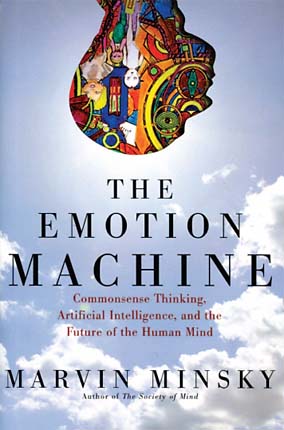
The Emotion Machine
Commonsense Thinking, Artificial Intelligence and the Future of the Human Mind
By Marvin Minsky
SIMON & SCHUSTER; 387 Pages; $26

Science may begin with wonder and strives ultimately for understanding, but as a practical matter, science is interested in how to do things. Physics formulated a few simple laws (governing how falling bodies behave, for example), which enabled engineering and technology to develop.

So when some scientists set out to create intelligent machines -- "machines to mimic our minds" -- Marvin Minsky writes, they looked for simple laws that govern how our brains work. They didn't find them, he argues, because our brains are "complicated machinery" and we need "to find more complicated ways to explain our most familiar mental events." Humans adapt to different environments and situations because our brains are resourceful -- we have lots of different ways to solve problems, and if one doesn't work, we can switch to another. This book is about what Minsky believes those processes are.

continued at the San Francisco Chronicle Book Review

Monday, October 23, 2006


A swale in the Hoosier National Forest. Posted by Picasa
A Trinity from Trinity

Barbara Ras is one of those friends it is sometimes hard for me to believe I haven't actually met. I may have spoken to her once on the phone, but almost our entire relationship over the past 8 or 9 years has been through emails and through our respective writing.

Barbara was the editor in chief at University of Georgia Press back then, and has since taken over and, as far as I can tell, essentially transformed Trinity University Press. Trinity specializes in her two chief areas of interests, the natural world and literature, as well as specifically Texan topics (it's in San Antonio.)

She is also a widely published and award-winning poet, and she recently sent me her new collection, One Hidden Stuff (Penguin). It reflects those Trinity concerns as well, in the context of her life and our times. She works with long lines, so it helps that she has a sure sense of rhythm. As a reader as well as a writer, rhythm is very important to me, in prose, in dialogue and especially in poetry. Appropriately then, the book begins with "Rhapsody Today." The first lines flow melodically, until a slight pause in the fourth for a fine effect, a fawn on gawky legs with "some leftover dazed grace," and so we see the fawn's motion standing still.

My current favorites among these enticing poems come towards the end of the book, like "Late Summer Night" which seems to have been written soon after her move to Texas, and reminds me of the surprising dislocation I felt after my latest move, to California. "Sometimes Like the Ocean" makes poetry from the poetics of a dream, and "Elsewhere" merges the horror of distant war with more personal loss, within the theme of motherhood. "Our Flowers" seems to contain all the elements of previous poems in the book, and contains a favorite line: " Failure is such a beautiful word for something/lousy..." I'm glad for the opportunity to read these poems, and to have them around to read again, and I'll bet you will be, too.

As it happened, two books from Trinity Press itself arrived soon after. In A Special Light by Elroy Bode is a book of essays heavy on reminicence and observation of the Texas hill country. That's not a landscape that frankly attracts me much, but I found myself beguiled by Bode's prose and his memories of times if not places we've shared. The conversational style is most obvious in the very short chapters but its flow, and Bode's way with the particular, can keep you reading despite yourself, or the call of supposedly more urgent matters.

The mail occasionally brings a treasure, and that's the word for Home Ground: Language for an American Landscape, edited by Barry Lopez. It's a kind of dictionary of terms pertaining to the landscape, with definitions by a number of distinguished writers, including William Kittredge, Greta Ehrlich, Bill McKibben, Barbara Kingsolver, Linda Hogan and Charles Frazier. Some 45 writers participated, in a three year first draft process with managing editor Debra Gwartney, and another year with Lopez.

My first thought was quite practical--at last a companion to reading the likes of Jim Harrison, only instead of a few line definition of "swale"in the standard dictionary, here is a full page--with history, examples and an illustration! But besides ignoramuses like me, I'm sure people who know these words from familiarity with what they denote will find something in these definitions to light them up as well. There are regional terms and words from folklore that have fallen out of use, plus examples of their use from literary works.

Start at any page and there's something interesting. Barbara Kingsolver provides a precise definition of "derramadero" right after she defines "derelict land" as "Land that has been used, ruined, and consequently abandoned by humans is peculiarly described as derelict--as if the land itself had become careless of its duties." The San Francisco Chronicle review goes into more detail. This volume becomes an instant reference resource, while itself being a connection to place and a portrait of the American landscape.

Saturday, October 07, 2006


Posted by Picasa
Everything Dances

by William S. Kowinski

A different version of this review appeared in the San Francisco Chronicle.

The Echo Maker
By Richard Powers
Farrar, Straus & Giroux, 464 PAGES; $25.

That Richard Powers did not win the Pulitzer for his 2003 novel, The Time of Our Singing, or the National Book Award for Plowing the Dark (2000) astonishes me. He’s generally considered to be among America’s foremost novelists, but as an academic in Illinois, he’s overlooked in Flyoverland. Perhaps a New York character in his new novel will help.

As publishing converts to the condition of Hollywood, I imagine this book being pitched as “Oliver Sacks meets Aldo Leopold on CSI.” Gerald Weber, a Sacks-like neuroscientist and essayist in New York (Sacks wrote the bestsellers, Anticipations and The Man Who Mistook His Wife for a Hat), is drawn to Kearney, Nebraska to meet Mark, a man who mistakes his sister for an actress pretending to be his sister. Mark is a 27-year-old worker in a slaughterhouse whose car crashes on an empty highway. Desperate to help him, his older sister Karin contacts Weber, who can’t resist the chance to observe someone with this very rare disorder caused by the accident.

Mark valiantly improvises a version of reality to account for his persistent feeling that he’s trapped in someone else’s dream, which Powers renders with a convincing seamlessness (including a few neurologically-justified Joycean leaps). Mark’s fierce insistence on his half-constructed delusions begins to affect Karin and Weber, prodding their own self-doubts. They all meet and are affected by Barbara, a mysterious nurse’s aide. Meanwhile, Karin renews relationships with two old flames who turn out to be on opposite sides of a dispute affecting what is becoming the town’s biggest industry: the annual presence of migrating sandhill cranes, and the tourists they attract.

Traditional mysteries propel the narrative: what happened on that dark stretch of highway? Mark can’t remember the accident, the police find three sets of tire tracks, but someone who was apparently there has left a note by Mark’s bedside, and vanished. Who made the other tire tracks and why? Who called in the accident, and who wrote the enigmatic note? (And for the whodunit fans in each of us, all is revealed, with not-quite the mystic symmetry of the conclusion to Powers’ last two novels.) There are also the familiar novelistic conundrums of personality and relationships: What are the true motives of Karin’s lovers, and which will she choose? Who is Barbara—cipher, saint or something else? Will Mark recover, and will anyone else?

But of course this is a Richard Powers novel—the writer who has previously dealt with relationships of image and time, molecular biology and Bach, human and artificial intelligence, the corporate body and the human body, race and culture, terror and magic. So there are deeper mysteries as well, prompted by mind science and crucial in our lives: what really is the relationship of memories to exterior events? Do we construct stories to explain reality, or recollect reality according to the stories we tell ourselves? What indeed is a person-- what identity holds together beings who are “every second being born?”


For all their explorations of ideas, Powers novels are always grounded in place and time. This one occurs just as the current Iraq war is beginning, but this well-storied place is even more significant: the Nebraska of fiction from Willa Cather through Jim Harrison, Ted Kooser’s poetry and essays by John Janovy and other naturalists. Powers finds a contemporary part of it to make his own, in the urbanized, small-city landscape, with brief but significant forays into the realm of the cranes.

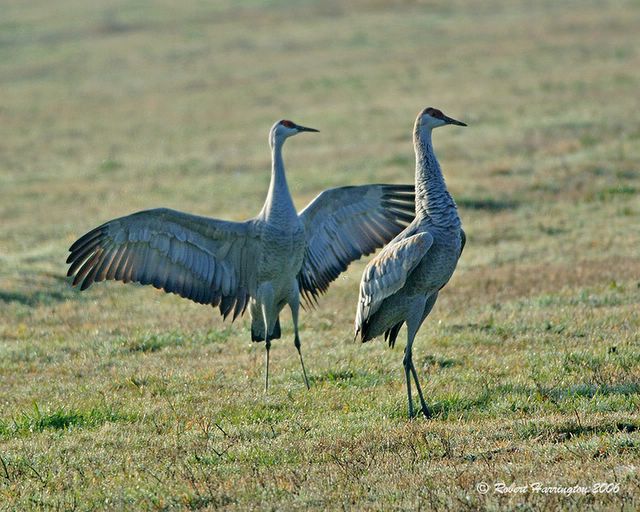
The cranes are “…the oldest flying things on earth, one stutter-step away from pterodactyls.” Half a million fly from Mexico and the southwest to stop for the last weeks of winter along the Platte river, before continuing to the Arctic. Partly because of the apparent speech of their calls, the cranes have symbolic power: Powers notes that the name of one Native American tribe’s crane clan translates as the Echo Makers. Echoes reflect, refract, double and distort. Description is a kind of echo, affected by the physics of time, distance and substance, as is mental reflection and perception itself, in individuals, society and the species. Emotion and instinct, personal history and parental echoes are part of the ongoing song.

But the cranes have more than metaphorical weight—their plight signals a physical crisis. Daniel, Karin’s environmentalist lover, notes that the greater number of cranes coming to Kearney actually mean that their days are numbered—this is one of the last habitats left for them to gather along their migratory route. Like the last part of Plowing the Dark, there’s a definite apocalyptic feel to this novel, intimations of an imminent and unstoppable finality, and of people dealing with this fragility in their individual ways, including those who listen to what these greater forces ask of them.

The mysteries of perception and cognition, of normality and dysfunction, of reality and dream--all of them are louder echoes of the most pressing mystery that Powers begins to deal with here: the neglected relationship of human beings with the rest of nature, as well as their own. Recalling a Native American legend, he writes “When animals and people all spoke the same language, crane calls said exactly what they meant. Now we live in unclear echoes.” And then he quotes a bit of scripture that may have inspired more than one of his books: “The turtledove, swallow, and crane keep the time of their coming…”


Powers’ prose is sensual and musical; he writes mostly convincing characters, and he structures story to meet a reader’s needs as well as for more subtle purposes. So even though this is a novel with multiple resonance, it’s also readable in the airplane’s stale oxygen drone. But beware: this novel will echo beyond the airport. It may even suggest that the echo of reality is all that we have, and to that music we improvise our lives with as much grace as we can. Or as Barbara says to Weber as they observe the cranes at dawn: everything dances.

Monday, September 18, 2006


 Posted by Picasa

Democracy In Question

Does American Democracy Still Work?
By Alan Wolfe
Yale University Press

Whose Freedom?
The Battle Over America's Most Important Idea
By George Lakoff
Farrar, Straus & Giroux

If you are left aghast and amazed by politics and government today, these two books are for you. There are plenty of screeds and exposes on the details, but Boston College political scientist Alan Wolfe and UC Berkeley professor of linguistics George Lakoff concentrate on the bigger picture of what is happening and why.

This is not your grandfather’s democracy, they say; it’s not even your father’s. Most Americans over 30 -- especially liberals and moderates -- who formed their impressions of political institutions and the political dialogue before, say, 1984, are in for a rude awakening.

Continued at the San Francisco Chronicle Book Review

Wednesday, July 19, 2006


Robbie Posted by Picasa
Technology Matters: Questions to Live With
by David E. Nye
The MIT Press

Technology, historian David Nye writes, is a very recent word, in the sense we use it today--perhaps routinely used only since the 1930s. But what our machines are doing to us has been a deep concern ever since there were machines. Leo Marx wrote beautifully about its impact on the thinking of American writers like Hawthorne and Thoreau in The Machine in the Garden. (Nye cites the author though not this work.) Machine dreams and machine nightmares became central to a lot of English literature from Mary Shelley through Dickens to H.G. Wells, and into the 20th century.

David Nye writes clearly and succinctly about many of the issues that technology raises, from an early 21st century historical perspective. He examines the relationship of technology to nature, cultural diversity, economics and human consciousness and intelligence. You may not always agree with his point of view, but he provides a sound basis for discussion, as well as a fascinating reading experience.

This is a book for more than a season. It goes on my shelf of books on this subject I will return to and refer to for years.

Monday, June 12, 2006


Jerome Kagan Posted by Picasa