Sunday, April 30, 2006


 Posted by Picasa
The Trends in Fads: What We Meme When We Say "New and Improved"


Flavor of the Month: Why Smart People Fall for Fads
by Joel Best
University of California Press

Note: A slightly different version of this review appears today in the San Francisco Chronicle.

by William S. Kowinski

A fad, says the Oxford English Dictionary, is "a peculiar notion as to the right way of doing something." Its traditional reference has been to "a pet project, especially of social and political reform, to which an exaggerated importance is attributed."

Fads define themselves by being the absolute right answer, quickly replaced by the next one. The only way to lose weight is: cut calories, low carb, low fat (and carbon loading), high fiber, milkshakes, low carb again. Joel Best's book focuses on institutional fads, that suddenly dominate management meetings, training sessions, newsletters and retreats, before they wanly disappear and are replaced by the next bright promise. For instance, in business over the past decade or so, there's been: quality management, Excellence, Theory Z, paradigm shifts, fire-walking, business process re-engineering, the Fifth Discipline and Six Sigma, among others. Academics will be wearily familiar with: distance learning, service learning, online learning, zero-based budgeting, the demographic bulge, the demographic bust.

Best analyzes the lifecycle of institutional fads, how (in his terminology) they emerge, surge, diffuse and are purged. Fads are made possible by networks of fast-moving information and an either/or mentality that demands a single answer to perceived problems. Best writes that educators, alarmed that some children are slow to learn to read, have instituted a series of new regimens concentrating on one key method, such as phonics, which emphasizes sounding out words in parts, or "whole language" (also called "word recognition") that emphasizes words in context. Best points out that both methods are essential, and that favoring one over the other has not altered the fundamental fact that some children learn to read faster than others.

Not all fads represent pendulum swings, and beyond the talking points, Best engages in some deeper analysis of fad-making mechanisms. But casual readers will probably be most amused by the many anonymous commentaries Best reproduces, that appear on office bulletin boards and these days circulate by email, such as the American solution to losing a rowing match with Japan in which it had one person rowing and eight steering: after a consultant study and management reorganization, the American team added three steering directors and two steering supervisors. When that didn't work, they laid off the rower. This office folklore is frequently wittier and wiser than any signed analysis, with the possible exception of the Dilbert cartoon strip (which uses ideas suggested by readers.)

Why do we fall for fads? Why do fools fall in love? Novelty attracts our nervous systems, our faith is progress and our passion is hope. Something new might be the next great thing (the last one sure wasn't), no matter how bizarre it seems at first. They all laughed at Christopher Columbus when he said the world was round. They all laughed when Edison recorded sound.

Some fads begin with a really neat word. Best mentions chaos theory, which began in physics but quickly spread to areas like analyzing literature, where it was deployed with little understanding of its original meaning. A more recent example might be meme, which biologist Richard Dawkins proposed as the mental analogue of the gene. As dubious as Dawkins original claim might be, the word itself has spread like wildfire, but used essentially to mean an idea quickly replicated through the media. It is the latest fad for a word that means: the latest fad.

Although Best barely mentions it, elements of many institutional fads survive the surge and purge cycle to settle into the synthesis of how things are done. Mission statements, just-in-time supply lines, bench-marking and attention to corporate culture were all parts of 1980s management fads like Excellence and Quality. Now they're so normal that young managers might be surprised to learn they are newer than video stores.

That's because these flavors aren't ice cream-they're basically ideas, however initially inflated the claims. They enter the mix for experiment, evaluation and transformation, becoming part of how business, education and our lives are managed and mis-managed. It's also been known for years that one reason many good ideas become failed fads is that management tries to impose practices on the employees who must implement them without taking their practical modifications or point of view seriously. Instead, these dogmatic approaches become the hula hoops employees must jump through.

There's a lot more to be said about the subject, like why managers are so susceptible to magical thinking (I call it the Blue Angel Syndrome---what do you think, have I got a book there?) But this book is a clearly written and overdue overview and analysis of the subject. Besides, there may be just enough to make this book on fads into one: it offers a simple step-by-step explanation with catchy names (I see a Power Point accompaniment) that will entertain business and academic conventions for the usual year.

There is a problem, however. Flavor of the Month is a well-worn name for the phenomenon. A fad needs a brand-new catchy title, like The Tipping Point, Flow, The Peter Principle, Future Shock, Psychobabble (the title of a forgotten book by Richard Rosen) or even The Malling of America.

Saturday, April 29, 2006


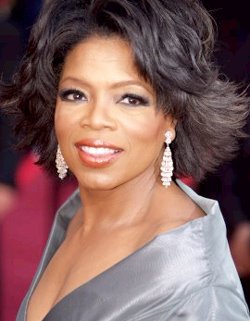
Oprah exemplifies and champions the narrative of Redemption. Posted by Picasa
To Be the Hero of Your Own Life

The Redemptive Self: Stories Americans Live By
by Dan P. McAdams
Oxford University Press

by William S. Kowinski

When Oprah Winfrey called the Larry King Show--the Queen of Talk calling the King, so to speak (although she's Queen of a larger land)--she defended author James Frey, an act she has since repudiated. (If you're not sure who I'm talking about, there are several posts below this one, from earlier this year, that should refresh your memory.) She noted that while some of what he'd written wasn't altogether true, the power of his story remained intact: a story of redemption. She used that word: redemption. Redemption as the payoff that motivates hope was so powerful to her that she was temporarily willing to overlook what was soon revealed to be large scale deception. When she turned against Frey, it was with a passion due presumably to the damage he'd done, not only to credibility, but to hope, and his manipulation of redemption.

Though Frey isn't mentioned in psychologist Dan P. McAdams' book, Oprah is a major character and example of McAdams' thesis that redemption is a primal theme in the life narratives of "generative" people--people who accomplish a lot (he probably could have vastly increased sales of this book simply by calling them "successful.")

"If you are looking for the redemptive self, you should know that it is not hard to find," he writes. "You need go no further than the Oprah Winfrey show, the self-help aisle at your local bookstore, or Hollywood's latest drama about the humble hero who overcame all the odds to find vivid expressions of the power of redemption in human lives."

But it's not just Oprah's show, but her own story--her life as she describes it-- that exemplifies the redemption theme. McAdams shows how it is deep in the American way of looking at things, and he illustrates how it typically plays out according to race and class and historical context. But essential to this basically melodramatic theme is the idea that bad things happen for a reason; they happen to form and motivate redemption.

McAdams finds the theme in Emerson and in American slave narratives; in the Gettysburg Address and in the stories that generative people tell about themselves. Redemption requires suffering, and it makes violence and deprivation to the innocent, or visited seemingly at random, a comprehensible part of a story with a happy ending. It channels guilt and regret for past mistakes into a narrative of personal triumph, overcoming those errors, sins and crimes. It provides hope (and perhaps also additional guilt) to those born into devastating circumstances or subjugated groups that an individual can overcome the obstacles and rise above their apparent fate.

This is a well-written book that makes scholarship and theory accessible. It's not the kind of treatment that is itself likely to make it onto the self-help best-seller displays, but McAdams has put his finger on something that he argues is prominently and characteristically American. He explores the inspiring and troubling aspects of the redemption narrative: hope and self-deception, belief in oneself and the belief that one was "chosen" for redemption and success.

There's plenty of content here, and generous notes to add further depth and texture. Maybe we all wonder, with David Copperfield, if we're going to be the hero of our own story. It seems we Americans go to some length to make sure we are.

Thursday, February 02, 2006


Happy birthday, James Joyce.  Posted by Picasa

Wednesday, February 01, 2006

I've written several times at Dreaming Up Daily on the James Frey fray over the past week or so. I'm presenting those pieces here, one after the other, beginning in book-style with the first at the top and the rest following.

A Million Easy Pieces
(originally posted January 24, 2006)

Sunday's San Francisco Chronicle Insight published two opinions concerning James Frey and his fabrications in his bestselling memoir, A Million Little Pieces: one by Martha Sherrill, a young writer whose first novel has just been published, and the other by novelist Cynthia Bass.

Sherrill had herself accepted a big publisher advance to write a memoir but found it paralyzing. She felt more comfortable turning the same material into a novel, though she found that readers were still hungry to know what in it was "real" or "true." Though the controversy over the accuracy of Frey's memoir has provided him with even more publicity, she writes that "I do think there's a way he might be helping novelists everywhere. Once they're over their shock and sense of betrayal, Frey's readers might come to realize the fictional bits were some of the best moments in his book -- that without those thrilling embellishments it would have been just another true story. Maybe next time they go to the bookstore, they'll decide to try the real thing: an honest-to-god novel. "

Novelist Cynthia Bass writes that the Frey fray should be a cautionary tale, about just how much "truth" is in any non-fiction. The vagaries of memory, the limitation of one perspective, and the exegencies of telling a good story mitigate against certainty. She points out that before recently memoirs were by famous people concerning public events, with facts that could be easily checked. But memoirs these days are personal stories by previously non-famous people, usually of lurid events--addictions, incest, etc.-- with an arc of redemption. Their factuality has to be taken on faith. "If I claim to have hit a home run at my last at-bat at Fenway, you can look it up. If I claim to have hit a home run at my last at-bat at Patrick Henry Elementary, that's impossible to confirm. "Yet the authenticity of personal memoirs is even more important to readers (hence the Frey fray.)"The unspoken bond of trust between reader and author is breached. Deliberately doing this to a reader is, for an author and a publisher, as close to a sin as you can get in the world of writing. "

Bass acknowledges that new writers are under tremendous pressure to write in the memoir form because it is potentially so much more commercial than all but a few novels (Only the latest Harry Potter novel has apparently been outselling Frey's first book.) She admits that she was asked to write a memoir instead of a novel and was tempted; and that other writers she saw commenting on the Frey fray found nothing wrong in whatever inventing he did. "The prevailing sentiment is to do whatever it takes. Which is just what Frey did. After failing to sell his book as fiction, he said it was a memoir."

She suggests "a rearrangement of attitude: less cynicism from the producers, and more from the consumers. There's nothing more dispiriting than learning what you thought was true -- what you hoped was true -- was a lie, perpetrated for money, ambition and fame. "But while both Sherrill and Bass make valid points, neither they nor Frey have addressed the most importance qualities of non-fiction or fiction.

I haven't read Frey's book but just the excerpts I saw in the now-famous Smoking Gun analysis were so plainly outrageous, melodramatic and exaggerated, that I didn't believe them on their face. I hope for the sake of his readers than in context they were made more convincing by better writing.

Clearly, the memoir's popularity has something to do with an immense hunger for certain kinds of redemption stories. That is apparently more important than any fact to these readers---the journey from sin to redemption---and especially the redemption-- forms "the truth" of the story for them. Perhaps these memoirs and their redemption stories are an outgrowth of the recovery movement, and the spreading of various new ways of approaching behavior and the big questions of life, from simplified psychology to the varieties of religious experience.

But some prominent writers and teachers, like philosopher Martha Nussbaum (Poetic Justice)and psychologist Robert Coles (The Call of Stories) have found that real literature still speaks to people on a very personal level, and helps them see themselves and the world around them in new ways.What troubles me beyond truth in labeling is the simplistic analysis of fiction as embroidered memoir. Novels are more than stuff that happened, touched up for effect, like a Photoshop portrait. There is little sense in what either of these novelists said of what a literary work can be, of its complexities and resonances. Children don't seem to have any problem dealing with the literary intentions of the Harry Potter books, so it's not like contemporary readers can't handle it.

Novels are more than "thrilling embellishments." They are stories with their own integrity, following their own necessities. Literature is something alive ; truth is in the reader.The cynicism of the writers Bass refers to is pretty troubling, especially in an age of institutionalized cynicism, as represented by current commercial capitalism and political fundamentalism. While I see nonfiction as a literary form, I believe that what Frey did was beyond the bounds of nonfiction storytelling; it was dishonest. What little I read wasn't even good pulp fiction, so the intention to deceive for profit wouldn't surprise me in a work that obviously stresses the extreme for easy effect. If so, it's mirror cynicism: a paint-by-number Best-Selling Memoir using the most lurid colors in the box.

We face complex problems in the present affecting the future, and we will face ever more complex situations requiring relatively quick decisions in that future. We need leaders and citizens who can apply the complexities learned from literature to understanding the dimensions of the future and to help them craft solutions to the problems that emerge. This is not a pipedream: it has been a feature of leaders in the West and East throughout history, though not uniformly, and its absense in current U.S. leadership is tragically clear.

It is also not a panacea, as history shows, especially if not widely shared by the citizenry. But literature is accessible to more citizens than ever before, as are opportunities to acquire the skills to augment intuitive responses. These skills are as just as important for an informed citizenry. Lacking leadership in this regard, it becomes a personal and family responsibility.
The Frey Continues---What A Story! (And A Postscript About Empathy and Phony Indians)
(originally posted Jan. 27)

Volume 1: Into the Frey.

A previously unpublished writer tries to sell his self-help novel and ends up getting it published as a memoir. In his book, the man called Frey confesses to, well everything that Augustine does in his Confessions---all the sins and mis-spent youth (for similiar before-and-after, add the Buddha, St. Paul, Thomas Merton, Sebastian in Brideshead Revisited, etc.) but to the max: selfishiness, drunkenness, drug addiction, violence, jail, a lover's tragedy, another lover' tragedy when his girlfriend commits suicide on the VERY DAY they are to be reunited when he's released from jail--it's got everything! It's got sure fire success because it's got TOO MUCH of everything (gotta stand out in the crowd of incest victims, abuse victims, and vice versa and etc.).Yes! It's sin, sorrow, Conversion, Suffering and the Big Redemption.

Which leads to Oprah and her book club, and the books are selling like---well, like Oprah's book club books sell. Only MORE. BIGGER. The author Frey himself gets on Oprah and basks in the sunshine of her approval. The book is powerful, because It's All True. The hero has returned from his quest to share his wisdom with his people.

But just when the hero is about to stride off into the sunset, the dirty smut peddling Internet Enemy shows up, and calls out the golden boy. Says he's a liar, big time. My gosh. What will happen next?

Volume 2: The Frey Strikes Back

Frey defends himself at the broadcast court of Larry the King. He admits there's maybe a fib here and there, but nothing important to the Story. The Story is True.

He sits on the other side of that vast expanse of table, not with his lawyer or even his editor, but with his Mom. Character witness. So Mom is there to support his claim-- no the boy wasn't a suburban wuss whose jail time added up to a few hours in the suburban police facility waiting for ride, he was a drug-addicted, violent drunken bad-ass, Mom believe him and she couldn't be prouder.(Where was she at the time anyway? Sorry--not part of The Story.)

But Mom's testimony is not as important as Oprah's. Her surprise, unsolicited call--swooping in like the Millennium Falcon to save Luke's ass---tells the world that maybe he did fib a little but his Story was important to people--the Redemption! The Redemption!

But just as it looked as if our hero had escaped the jaws of certain death again, and well before he could ascend the stage for his medals while singing his theme song, Who's a-Freyed of a Million Little White Lies?.....

Volume 3: Revenge of the FreyedNow there's Oprah on her own show, with the erstwhile Hero and his Adviser (not his Mom this time, but his editor!) --but not for praise! No no no! Reversal of fortune! Sudden and Devastating!

Oprah with her flashing furious eyes. Oprah who says she is "humiliated." Oprah apologizes for her witness to the King. She gave the impression that the Truth does not matter. She has Guests, Important Heads all, all of whom intone, the Truth Does So Matter.

The hero is there, no more a hero. He looks terrified, frightened, a-freyed. But Oprah the Prosecutor presses him--is this true? Is that true? (The girl didn't really commit suicide on the day you didn't get out of jail, didn't she? Or did she?) Not even Frey knew for sure. Did he REALLY have a tooth pulled without novocaine? He really, truly, honestly...couldn't remember.

The audience BOOED. The mob has made him, the mob has turned against him! What irony! What television!

The Jimmy Hoffa defense doesn't wash. Nobody likes that dishonest fifth amendment anyway. Come on, the whole Redemption thing loses its punch if he didn't feel REAL PAIN ( or is that Reel Pain??) as that "wisdom" tooth came screaming out by the roots. I guess.

Anyway, the hero is brought down. He is stung with the whips of scorn, crucified on national TV! So now it's the Hollywood story---the struggle, the rise, the triumph, the fall. What could possibly be next?Come on. You know what's next. Resurrection!

And it begins with: gee, I've really learned my lesson this time. Some say Oprah smiled her forgiveness, others that she indicated her satisfaction, though with what, no one can yet say.

But let's not get carried away. Resurrection---not too many can pull that off. And this tattered and Freyed copy of a writer--convicted of overweening Ambition, Greed, and pathological Lying--is not a likely candidate. He may end his days drinking with Jason Blair.

No, Volume 4 may not be The Frey-Shammed Resurrection. It may be more like: oh no, over my dead body! They are not getting the money back! The Frey Fugitive: Escape to the Freyman Islands! Which at the moment he could afford. Stay tuned!

But don't hold your breath.

Addendum: Beyond what this all says about greed and credulity and uncertain reading skills, there's another issue better highlighted by a somewhat similiar case: several books purporting to be by a Navajo named Nasdijj, another suffering and redemption narrative, this time about harsh life on the reservation.

It turns out there is no Nasdijj, and the books were written by a white man nowhere near the reservation, described as "a semi-successful gay porn writer" in the same online piece that quotes Sherman Alexie, an actual Native American who is a distinguished and excellent writer (and caught on to Nasdijj as a phony early on, but couldn't get anyone to believe him) stating an essential point about all this: "The backbone of multicultural literature is the empathy of its audience--their curiosity for the condition of a group other than themselves. Nasdijj is taking advantage of that empathy."

This is a vital feature of not only multicultural but all literature. Keeping faith with the reader is a precondition of empathy. And empathy is one of the major social functions of literature, especially in relation to the needs of the future.
Call the Talese, They're Trying to Steal My Sales!

originally posted AM February 1

Our Story So Far: Nan Talese is James Frey's editor, and she went on the Oprah Purgatario to explain the publishing business. I don't know if she was booed, but someone wrote that Oprah gave her a dirty look when her cell phone chimed. To keep you up to date on the zeitgeist, Oprah was criticized for backing Frey in a call to Larry King. Then she was applauded for apologizing and going after Frey on her own show. Now the predictable backlash has begun, and Oprah is getting criticized for holding a public stoning, humiliating Frey and his editor, and not listening to Their Side.

So here's how a Wall Street Journal article (Yes! This is today's free one! Oh thank you thankyou WSJ!) begins:

Last Thursday, publishing-industry veteran Nan Talese was excoriated on television by Oprah Winfrey for publishing James Frey's 2003 "A Million Little Pieces," a bestselling memoir about the author's struggle to overcome drug dependency that he has since admitted is partly fictitious.But on Friday morning, Ms. Talese walked into 22nd-floor offices in Midtown Manhattan to a standing ovation from her colleagues. Soon afterward, she received a call of support from Peter Olson, chief executive of Bertelsmann AG's Random House Inc. publishing arm.

"I've gotten more than 500 emails over the last few days, and the overwhelming majority have been supportive," says Ms. Talese whose imprint, Nan A. Talese, is part of Random House's Doubleday Broadway Publishing Group. Indeed, many members of the publishing industry have rallied around Ms. Talese and Random House, saying that they would have published "A Million Little Pieces" as well and could have been duped just as easily.

The WSJ story is ostensibly about how it's too expensive for poor poor pitiful publishers to fact check their books. Not everyone in publishing agrees that nothing can or should be done, however. Some publishers say the "Million Little Pieces" incident may well result in some changes in how books are vetted. "The entire process will have to be rethought," says James Atlas, president of Atlas Books LLC [followed by a plug for Atlas' last book.]

Full disclosure: Many years ago I had a very short meeting with Nan Talese, when she was an editor at a different publishing house. It was a courtesy to one of her (fiction, acknowleded that is) writers who I knew. I waited around, got to sit down long enough to hear her dis everything I'd done and everything I proposed to do, thanked her very much and left.

I also used to know James Atlas, and I believe the last time I saw him I was pitching story ideas when he was an editor at the NY Times Magazine. He was more positive about the ideas but when it came time to assign, Atlas shrugged.

Also, I must warn you that reading this blog or anything else on your computer can cause headaches, heartaches and acid indigestion. A small number of readers have suffered seizures and required medical attention. Others have dipped into prolonged depression, puncutated by anxiety and anger, leading to reading a lot of psychology books and babbling on blogs. If symptoms persist, tough shit, you're not covered.

Now where was I? Right---the story quotes others pointing out various relevant factors: the much larger marketing budgets for some books which cut into editing resources for all books, and even the Power of Oprah as a key factor in what kinds of books get published. Implying that Frey wouldn't have gotten on the show if he'd called his book fiction, as he apparently did until other publishers passed on it.

But none of this bothers Nan Talese. She goes right from harvesting applause, phone calls and e-mails to a working lunch with--who else?--James Frey, as they go over wording to be added to new copies of his book, pointing out in the best possible way that it's apparently a pack of lies (although on Oprah, Frey reportedly had problems remembering what was and what wasn't the truth, if any. )

And here's her bottom line (via WSJ):

Last week, the publisher issued a statement saying, "We bear a responsibility for what we publish, and apologize to the reading public for any unintentional confusion surrounding the publication of 'A Million Little Pieces.'" In an interview, Ms. Talese said, "We will continue to print the book as long as there is public demand for it."

We bear "a" responsibility? Apologize for any "unintentional confusion surrounding the publication"? What is that supposed to mean? There was no confusion surrounding the publication. It was published satisfactorily, well enough to get in stores and sell three million copies. The problem is with the words in the book, and its author, who shows signs of being a pathological liar.

But the last part is very clear. "We will continue to print the book as long as there is public demand for it." Makes it sound like a public service. Here's the book, judge for yourself, we won't be a party to censorship. Right. And because we're so sincere, we're giving the book away free.

Not exactly. They didn't say that, of course. Frey may have been disgraced and suffered an hour of humiliation, but he's rich. And absolutely no one is asking him to give back the money. Because that might lead to Nan Talese and Random House being asked to give back the money. This is America. Ain't nobody going to give back no money, pardner. And I ain't lyin. Really.

Another Random House editor is quoted in the story saying he"expects that the future reception for first-time memoirists could be different, especially 'those with highly melodramatic, uncorroborated life narratives.'" What an ironist. Frey has killed the memoir market for awhile, except for his own books. But the implication is clearly that when faced with "highly melodramatic" life narratives, those with integrity and an actual sense of responsibility exercise editorial skepticism. But then there are those who read with greed, and the ease of exploiting paying readers is the chief if not the only deciding factor.

I mean, what would happen if you expressed doubts and he took the book elsewhere? Or if you checked into it a little and found out it wasn't true---that the truth was not nearly so gripping and un-putdownable as the lies? You certainly don't want to put yourself in that position.

And clearly this is something that Nan Talese understands, along with apparently everyone she knows.
Once More Into the Frey, Dear Friends

originally posted PM February 1

Today's New York Times has a short account of the explanation/apology that James Frey has released as an explanatory note to be included in future copies of his Million Man Lies book, apparently the text that he and his Nanny were working on over her tuna salad (the WSJ doesn't say what he ate, if anything) in the meeting described in the Wall Street Journal article ( see above.) Frey's statement is posted as a PDF file on the Random House site.

Frey indicates that he is genuinely unsure of the tooth-pulling incident, and says his doctors at the Hazelden clinic think his memory is flawed. (However, several treatment professionals formerly employed there are on record saying that the majority of Frey's book, about his treatment, is false.) There is something of the insanity defense in this, but it may well be true.

He also writes that he had no idea his book would be this popular, and he's felt overwhelmed at times, which also rings true. So possible factors begin to emerge: his purchase on the truth is flawed by the effects of the addiction he writes about, and he probably persuaded himself that a few "embellishments" wouldn't matter in a book that might sell a few thousand copies to a particular market.

I also feel it's churlish to continue writing about a book I have not read, and as no one is paying me to go through that travail, a book I don't intend to read. But I can comment on the statement, which I have read.

Frey says some of his embellishments had a structural purpose, to make a better narrative. But he offers another reason, summarized by the Times:

Overall, his self-portrayal in "A Million Little Pieces," is "a combination of facts about my life and certain embellishments," about a person who "I created in my mind to help me cope" with drug addiction and recovery. He said most of the invented material "portrayed me in ways that made me tougher and more daring and more aggressive than in reality I was, or I am."The events and details were invented, he said, "in order to serve what I felt was the greater purpose of the book," specifically to "detail the fight addicts and alcoholics experience in their minds and in their bodies, and detail why that fight is difficult to win."

This suggests that some of these "embellishments" were part of the pathology of drug addiction and the tools he employed in coping and recovery. In literary terms, he is describing a function and a strategy known as the "unreliable narrator." It is a technique rich in possibilities. The problem is that it works when the author uses it consciously, and the work is fiction.

It's true that some of the earliest novels were counterfeit journals of voyages, sermons and cautionary tales about the sins of people who didn't actually exist. But these quickly became conscious literary devices, and there were always clues to the "deception." There come to be clues as to what is outside the narrator's head and what's only inside it, or clues that it's all in his head, or that you can't trust any of it to be objectively true.

But in Frey's case, he was selling these melodramatic lies as true, without irony. He suggests he wasn't in total control of this material, representing what may have gone on only in his mind as things which happened in the outer world. He describes a pathology, not a legitimate writing approach. But let's skip to the final paragraph of his statement, where he justifies this:

There is much debate now about the respective natures of works of memoir,nonfiction, and fiction. That debate will likely continue for sometime. I believe, and I understand others strongly disagree, that memoir allowsthe writer to work from memory instead of from a strict journalisticor historical standard. It is about impression and feeling, about individualrecollection. This memoir is a combination of facts about my life and certainembellishments. It is a subjective truth, altered by the mind of a recoveringdrug addict and alcoholic. Ultimately, it’s a story, and one that Icould not have written without having lived the life I’ve lived.

The key here is the assertion that memoirs are about memory, and it's categorically inappropriate to hold them to a "strict journalistic or historical standard." The problem is that in books, readers expect to know what is the writer's fantasy and what actually happened in the shared world. Many of Frey's "embellishments" involve other people, including a tragic death that affected families and their friends. It's interesting in a literary sense for an author to inject himself into those events even when he wasn't actually part of them, because he feels so strongly about them. But it is dishonest to assert this fantasy was true, and in effect it exploits those events.

In his statement Frey says he'd been writing movies in Hollywood when he started this book. No one expects a Hollywood biography or historical story to be anything more than loosely true. Most moviegoers understand that liberties will be taken for dramatic effect (usually the creation of subsidiary characters or combining several into one, collapsing time, leaving out messy details and contradictions to the arc of the story, etc.) but these days there is usually some textual indication--after the show, buried in the credits, etc.--of the extent of the changes. This Hollywood standard however has not been the standard for books. At least not until now.

I don't think anyone is calling for a "strict" journalistic standard---Frey would be forgiven for saying he was in jail for a year if it turned out it was 10 months (it was a few hours.) But by his own admission Frey asserted things happened in the shared world that happened only in his mind, however addled. That's inflicting delusion on readers with the assertion it is public fact.

What Frey suggests could make a fascinating book---this interplay of fantasy and objectively verifiable, with expressionistic interpolations into shared reality as a reflection of the inner world of an addict, coping and recovering. But apparently that's not the book that was published.

Frey may defend his imposing fantasies, exploiting both people he wrote about and the reader, but he also suggests his own perceptions are flawed. In any case, the real fault here is with his editor and publisher. His editor should have questioned the more extreme events and coincidences, and worked with him to craft a book that presented these fantasies in context. If Frey could not be objective about this, his editor had the responsibility to be. And to either help him make the necessary changes to craft what quite possibly could have been a better book, or to decline to publish deluded recollections as true, along with conscious fabrications beyond the accepted boundaries for nonfiction.

What I still don't understand is how the first deception to be discovered---Frey's jail time, which was actually hours and not months---can be considered an "embellishment." From descrptions I've read, other important events, as well as his entire next book, follow from this phantom incarceration. What's up with that?

Finally, that there is a controversy shows at least a residual concern for truthfulness, as opposed to the assertion and appearance of truth, as I gather is meant by the current buzzword, "truthiness." We are so used to politicans and journalists repeating utter falsehoods until they become the conventional shared truth, that it's surprising anybody cares to make the distinctions. Of course those distinctions are vital. If Al Gore bragged that he invented the Internet, then his veracity is not to be trusted. (In fact he did not claim this. He rightly claimed a hand in certain legislation that enabled it.) If other administrations did what Bush is doing in his domestic spying, as he asserts, then how can he be faulted, let alone impeached? (It's a lie, but it takes some explaining, which makes lying alot easier in impatient times.)

People believe so many objectively crazy things, so many obvious projections of their fears and frustrations, that the existence of any standard of shared truth beyond the scores of major sporting events (perhaps the last bastion of shared truth) is nearly miraculous.

In his statement Frey makes a point of saying how much he wanted to be the author of books. I certainly empathize with the anxiety and finally the desperation to be published---the idea that it justifies and transforms your life, as it transformed Frey's. And I understand the frustration and the deep anger with editors, agents and publishing that it quite clear in other accounts of Frey's attempts to be published, and is especially a feature of the writer who passed himself off as a Navajo named Nasdijj, in an earlier if lesser known publishing scandal.

I have my own grievances against editors, agents and publishers, which I have written about openly (for instance, in my account of the making of The Malling of America, added to the paperback edition.) I had hoped for a career as an author but like a minor league baseball player who gets a "cup of coffee" and a few innings with a major league club, it didn't happen, and along with related dreams that were thereby dashed, with the outcome I can only describe as a broken heart.

So I feel a certain awe for those who exploited the system's hypocrisies and greed, as well as engaging in other manipulations of a corrupt and simplistic system. (The Nasdijj author was once involved in a gallery show of gay images that wasn't drawing crowds, so he wrote a letter to the editor under a false name attacking it with enraged gaybashing language, and had a friend draft an offended and righteous response. Like clockwork, political groups took up the cause and the show became a hit.)

But apart from whether I'm up to carrying off that kind of deception, as well as the question of whether I could write a conscious exploitation if I tried, I can't in the end support such travesties of what I believe in as a central commitment of my life.

So it is easy enough to say this is sour grapes, and my own relative poverty is the best argument for jettisoning these quaint standards. Believe me, I've heard that before. But so what? I've stated my case, and you can believe what you want. I've had my say. The whole damn world can read it and no publisher can prevent it. Apart from competition from a few hundred million other sources, it's as good as published by Random House.

Sunday, January 22, 2006


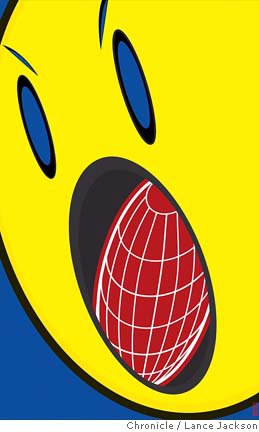
SF Chronicle illo by Lance Jackson Posted by Picasa
The Store That Ate The World

by William S. Kowinski

The Wal-Mart Effect: How the World’s Most Powerful Company Really Works---and How It’s Transforming the American Economy
By Charles Fishman
Penguin Press

Wal-Mart: The Face of Twenty-First Century Capitalism
Edited by Nelson Lichtenstein
The New Press

Business journalist Charles Fishman begins with a disarming story of how Wal-Mart produced an environmental benefit when the company decided that paperboard boxes around cans of deodorant were unnecessary. So they disappeared—not only from Wal-Mart but from everywhere—thereby saving many trees. But the reason Wal-Mart did this, and the reason everyone else followed, are also the key factors in a new kind and extent of destructiveness.

Read the rest of my review at the San Francisco Chronicle Book Review or in an expanded version at Shopopolis.

Friday, December 30, 2005

Dept. of What Thou Lovest Well is Remaindered

Diminished Capacity
A novel by Sherwood Kiraly

I just got a Christmas card from Sherwood Kiraly. He must be one of the last in America to send Christmas cards through the regular mail, with pictures of the family and so on. And it's not because he doesn't do email. It just one of those things about Sherwood.

So this is my Christmas card. Dear Sherwood, I came upon a copy of your novel, Diminished Capacity in a used bookstore, I bought it and read it, and loved it. I realize I'm a little behind the curve here (since you published it a decade ago) , and I probably shouldn't say I liked it better than Big Babies, which I liked a lot, because writers don't usually like it when you like an earlier book more than a newer one. And maybe it's not a better book, just that I felt closer to the story and the characters in D.C.

Anyway, it's terrific, I had a great time reading it, and thanks for writing it. If I were you, I'd be proud to have written it.

For those people looking in who aren't Sherwood, this novel is a lot of fun--there's a solid and funny and fast moving story, well-crafted (everything pays off) and appealing, well-rendered characters, stylishly told in a gentler kind of Vonnegut way. (Although when I think of Sherwood and Vonnegut, I remember my copy of Slaughterhouse Five he borrowed in college and returned all bent up. That was a first edition, Sherwood. Do you realize what it would be worth now, unbent? Not as much as some of those baseball cards, but still...)

So as I was saying, it's very midwestern and would make a terrific movie, the kind that actually got made in the 60s and 70s. But on the page, it's the kind of a novel you see as a movie while you're reading, which is also fun. The story does involve baseball cards, love lost and found, and diminished capacities redeemed. And fish poetry, of course. That's in all your midwestern authors. Twain, Sinclair Lewis, Sherwood Anderson, F. Scott Fitzgerald... Ernest Hemingway and the fish poetry of the Big Two-Hearted River up in Michigan.

The thing about books is, they're news that stays news. (Another midwesterner said that.) So treat yourself to this one. It definitely won't hurt you.

Sunday, December 18, 2005


A musical picnic in the 1930s Posted by Picasa
Holiday Gift Books from 2005: Social Studies

Brother, Can You Spare Me
Some Time

by William S. Kowinski

THE MARCH OF SPARE TIME: The Problem and Promise of Leisure
in the Great Depression
by Susan Currell
University of Pennsylvania Press

I highly recommend this absorbing and revelatory book. Though her subject seems narrow, Currell traces the relationships of prevailing thought that shaped a wide range of policies affecting all of us to this day.

It also seems an odd if not frivolous subject—leisure in the Great Depression? We are used to a different emphasis in books on the 1930s, as in Malcolm Cowley’s sharp and steady memoir, The Dream of the Golden Mountains, which I’ve recently read. The spectre of vast unemployment, drought, malnutrition, incipient revolution and half a million men a year riding boxcars, would seem to make the issue of leisure irrelevant, or even perverse.

But beginning in the late 1920s it was a concern, and not applied to the rich or leisure classes, but to the working class. The industrial revolution was transforming the country, and even with the Depression between the 20s and 40s, it continued (many innovations and inventions were actually created in the 30s but would not make their impact until later.) Greater mechanization would inevitably lead to shorter work days and weeks, and what were workers going to do in the slack time?

And if you were unemployed, you had lots of time on your hands. Still, many families made it through the Depression with difficulty but basically intact. The powers that be worried about their idle hands as well.

There was a lot of class and other bias involved in how the question was approached, going back to late 19th century immigration. As Currell tells the story, much of the concern had to do with the science and pseudo-science of the day, including eugenics.

(One reason I prefer the old designation “social studies” to “social science” is that these young disciplines don’t seem like science to me, and too often engaged in presumptuous social engineering. What Currell writes about in this book only further convinces me.)

The social engineers wanted to divert the non-leisure classes to good and healthful use of their downtime, rather than bad. What was bad? It was Trouble, right here in River City, with a capital T, that rhymes with P, that stands for Pool. And worse.

The results were not always nefarious: public parks beginning in the 1890s, then amusement parks, family sports, board games, and the sand box. (Not much about marching bands, though, despite the title.) Still, the theories of eugenics, sex differences (movies were good for men but “morally corrupting” for women), race and class are chilling, even when they fostered reforms, like the expanded role of public libraries for "self-improvement."

This is a very different take on a fascinating period of history just outside the memory of most of us today, but one which has many lessons for our time, and quite probably our future.


WEIGHING THE WORLD: The Quest to Measure the Earth
by Edwin Danson
Oxford University Press

This sort of book, combining science and history, has become quite popular, with a version often turning up on PBS at some point. Danson has previously written about how Mason and Dixon surveyed their famous line. This time he takes on a bigger subject---the entire world. As more of it was being explored and more money dependent on trade in the 18th century, accurate maps became essential. For real accuracy, larger questions had to be answered, including the shape and size of the planet itself.

There is plenty of history and some science and adventure in this chronicle for the general reader. The prose is sometimes a bit fevered and strained, but also has its shining moments. Danson presents context, description and background, though not much personality. Fans of popular history should find it congenial.


ALSO RECOMMENDED

THE BOMB: A Life
by Gerard J. DeGroot
Harvard University Press

This biography of the atomic bomb has to be ranked as one of the best and most important books published this year. Making deft use of accumulated history and new information from Soviet archives, DeGroot, Professor of Modern History at the University of St. Andrews in Scotland, writes with grace and economy of a 60-year history still unfolding. More HERE.


BORN LOSERS: A History of Failure in America
by Scott A. Sandage
Harvard University Press

From the 19th century of Emerson and Thoreau (the first and most paradigmatic "born loser" in the book) to the formulation of the American Dream in 1931 and presumably through the Dale Carnegie-redux 1980s of "market yourself" which is still with us, America has defined losers in economic terms, yet attributed that losing to personal character failure. We continue to do this today, '>Scott Sandage writes, "because a century and a half ago we embraced business as the dominant model for our outer and inner lives." MORE HERE

THE END OF POVERTY
by Jeffrey D. Sachs


Penguin Press

Concerning the world's future, Jeffrey Sachs in his new book offers convincing proof and a practical plan for addressing and essentially ending poverty in our time. We've known since President Kennedy said so in his Inaugural Address in 1961 that eradicating poverty is within our power. This book, which is both based on information gathered for the UN Millennium Project and is the basis for the 20 year effort inaugurated by that project this year to eliminate poverty, offers the blueprint for actually doing it. At very little cost to the wealthy nations and their citizens.

JUST WORK
By Russell Muirhead

Harvard University Press

An Associate Professor of Government at Harvard, Muirhead examines some of these knotty common issues ("Can we each get our due while at the same time contributing to the common good?" ) as problems in political theory. This book examines philosophical approaches to the issues of work, the individual and society, from Plato and Aristotle, through John Stuart Mill and Betty Friedan. This is basically a scholarly work, well-organized and quite readable in style. It is a solid contribution, a thorough background that raises the pertinent issues, though few readers are likely to find it the last word on their own concerns. MORE HERE.

AND A TIME TO DIE
How American Hospitals Shape the End of Life
By Sharon R. Kaufman
Scribner

The spectacle of demonstrations and the political as well as judicial intervention in the decision to withdraw life support from Terri Schiavo, the Florida woman who was kept alive in a persistent vegetative state for more than a decade, is a dramatic illustration of many issues and emotions that Sharon R. Kaufman addresses in "And a Time to Die." For when hospitals can prolong most organ functions indefinitely, decisions can hinge on such apparently straightforward yet suddenly uncertain concepts as recovery, responsiveness, personhood and life itself. MORE HERE.

You can search for new and used books at Powells bookstore using the search box on this page. If you order anything after linking from here, this site gets a cut. Thanks.

Sunday, December 11, 2005


by Dutch company Submarine, at Doors of Perception.com. Posted by Picasa
Holiday Gift Books from 2005: Design & the Future

The Things of Shapes To Come
by William S. Kowinski

SHAPING THINGS
by Bruce Sterling
Mediawork Pamphlet Series
The M.I.T. Press

I tend to see the future in terms of story, while real professional futurists see it in terms of design. (Then there’s Star Trek, which sees it as both. I know, you don’t want to hear about Star Trek.)

As a science-fiction writer and a futurist, Bruce Sterling also sees it as both. This particular slim but very full of pith and moment book (under 150 pages) is about designing---and redefining---things, as leading the design of the future.

Things, as created objects, and more. “Properly understood, a thing is not merely a material object, but a frozen technosocial relationship. Things have to exist in relationship with an organism: the human being.” Though this book comes pre-underlined and highlighted, that’s a quote I lifted all on my own.

But things are not generic. They are, for example, artifacts, machines, products, gizmos, spimes and arphids. My spell-check doesn’t like spimes and arphids, they come pre-underlined in red, but that’s because these are new words Sterling coins to extend the technosocial relationships into the present and future characterized by new proportions of physicality and information.

This is all pretty fascinating, especially when Sterling links the design future to the sustainable society he understands as the only lengthy future possible for civilization, though he assumes this more than makes a case for it. There are real designers referenced---the section on Raymond Loewy, for example, is informative and entertaining. I like the brisk elegance and wit of Sterling’s prose, so I went along for the ride even when I wasn’t quite sure where I was going, or even where I’d been.

Of the stuff I understood, I found some revelatory, some reassuringly what I believe is so, and some I’d like to argue about. Oddly, for a book that articulates the changes and possibilities of the Internet and information technology, the book doesn’t name a website for the discussions this book prompts. (However, Sterling is a principal of Viridian Design , with a website where more of his entertaining commentary can be found.)

Here’s one of the parts I like: “ A SYNCHRONIC SOCIETY sets high value on the human engagement with TIME…we are not objects, but processes. Our names are not nouns, but verbs.” Though Sterling disses Buckminster Fuller later in his book without naming him (specifically Fuller's “Utopia or Oblivion” choice, which he topples partly by constricting the definitions), I seem to recall that it was Fuller who famously said, “I seem to be a verb.”

Anyway, before this becomes longer than the book, Shaping Things is a highly recommended read, and a great gift for “designers and thinkers, engineers and scientists” (I’m copying the cover now) and anyone on your list interested in how information technology is changing us, and its role in designing the future. Because that’s what's on these folk's minds, that’s what the buzz is going to be, and besides it’s, you know, short.


MAKING THINGS PUBLIC: Atmospheres of Democracy
Edited by Bruno Latour and Peter Weibel
M.I.T. Press

As Shaping Things is short, this book is long---really, really long. Well over a thousand pages. But at only fifty bucks, it’s a truly great deal. It’s a compendium of fascination, an anthology of great photos, illustrations and pieces of prose you are unlikely to find anywhere else.

My first browsing foray took me to Richard Powers describing his process on his novel about the personhood of technology’s freak child, the corporation, and its relationship to the personhood of people; a chronicle of the role of photography in the human-Great Ape relationship, and another about the contemporary obelisks of Stockholm, attractive, oddly iconic and mysterious objects which also visually monitor urban water quality. And an essay on Northwest Coast Native art (which I actually know something about---and recognized people in the photo.)

I’m sure that the editors have a carefully worked out progression of arguments about making, unmaking, remaking, assembling (as in assembly lines and also the state assembly), disassembling and dissembling, of things as they define public relationships. But at least for the first many hours, my guess is this book’s main appeal is in its gorgeous variety, a browser’s paradise, a dilettante’s delight, a playground of ideas and images ultimately relating to contemporary and future design and technosocial meaning, including especially the political---a different emphasis of Sterling’s schema.

More than a hundred writers are represented (including relevant excerpts from the likes of Melville, Hobbes and Jonathan Swift)—philosophers, scientists, political scientists, anthropologists, sociobiologists, artists and scholars. And the illustrations are very well done, probably worth the price alone. Making Things Public is related to a show at the ZKM Center for Art and Media, where co-author Peter Weibel is Director.

IN THE BUBBLE: Designing in A Complex World
by John Thackara
M.I.T. Press

So this makes a trifecta for MIT Press, but design and the future is clearly a major theme for this publisher. The people involved are all over the world---a lot from Europe-- but as a group it's probably a small world (this book comes with a plug from Bruce Sterling on the cover.)

Still, I believe this is an important book, at least as much as Sterling's, and it's also fascinating to read. So it's a highly recommended choice from earlier in the year.

Thackara skewers conventional wisdom and many guiding delusions of the digital revolution with pungent facts, while noting contrarian trends and suggesting greater possibilities with all the elusive precision of aphorism. His intent goes beyond analysis. Director of a design firm called Doors of Perception, headquartered in Amsterdam, Thackara uses 10 principles to organize his ideas about "sustainable and engaging futures and the design steps we need to take to realize them."

The tech revolution didn't lead to the paperless office, nor to eradicating business travel or product transport (in fact, it created much more), and many plans for future uses, such as implanting computers in appliances and "smart" buildings, seemed doomed to equally dour unintended consequences. Nor does technology exist in a valueless vacuum. For all its vaunted efficiencies, like most consumer products it involves vast waste: It takes 15 to 19 tons of energy and materials to make one desktop computer. Cyberspace may seem ethereal but Internet computing alone may soon use as much power as the whole U.S. economy did in 2001. "We've built a technology-focused society that is remarkable on means," Thackara writes, "but hazy about ends."

The ends are near, though Thackara is not so indelicate to say so, but he does point out that we're using up the planet with incredible rapidity, even as we refuse to face the greatest threat that may very well dominate human history for the next century: the climate crisis. Instead, he accentuates the positive. Some 80 percent of environmental impact is determined by design, and "If we can design our way into difficulty, we can design our way out. ... Designing is what human beings do."

"Sensitivity to context, to relationships, and to consequences are key aspects of the transition from mindless development to design mindfulness," he writes. This includes paying "close attention to the natural, industrial, and cultural systems," and material and energy flows. It means focusing on services over things, and treating place, time and cultural difference as positive values rather than obstacles. " 'Out of control' is an ideology," he writes, "not a fact."

As much influenced by Italian literary artist Italo Calvino as by visionary American architect William McDonough, Thackara brings a refreshingly European perspective, not only in examples from societies consciously grappling with social implications and solutions, but in an ability to bring the macro and micro, the big picture and life as it is lived, into a more capacious and balanced perspective. His principles include lightness, conviviality, smartness and flow. "Our machines are disturbingly lively," he points out, "and we are frighteningly inert." He calls passive acceptance of technology "borg drift."

"In the Bubble" is often delightful, stimulating and surprising. Thackara may well emerge as a visionary voice for the wired era. For planners, designers and anyone with an interest in the future, this book is a rich resource of inspiration, ideas, and guiding principles as well as sharply observed cautionary tales. It suggests that what the tech revolution most needs, and may already be moving toward, is a sense of purpose.

If you search for new or used books from the Powell's Bookstore box on this page, and buy something after linking from here, this site gets a cut. Thanks.
Wednesday, December 07, 2005


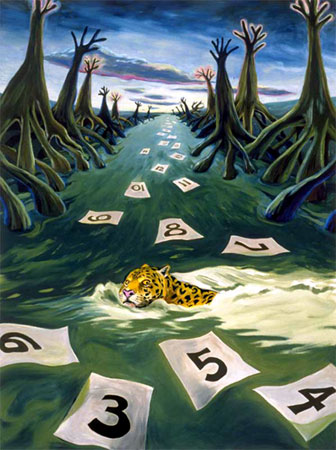
"Jaguar" by Andree Tracey at andreetracey.com. Posted by Picasa
Holiday gift books from 2005: Nature, Environment and Science

Encounters with our given world
by William S. Kowinski

THE LAND’S WILD MUSIC
by Mark Tredinnick.
Trinity University Press.

Mark Tredinnick calls them “encounters,” with the kind of care for parsing both words and experience that characterizes this author’s approach to what others might just call profiles of four prominent “nature writers” (another troublesome term, especially to these writers): Barry Lopez, Peter Matthiessen, Terry Tempest Williams and James Galvin.

In a lovely essay called “The Job is To Pour Your Heart Out,” Edward Hoagland writes, “I believe, incidentally, that those of us who care about bears and frogs haven’t much time left to write about them, not just because---among the world’s other emergencies---a twilight is settling over them, but because people are losing their capacity to fathom any form of nature except, in a more immediate sense, their own.”

These four writers grapple with both problems, which pushes them to more public roles as advocates and activists. They (and the author) also rebel against the usual notion and sometimes past practice of nature writing as being pretty and ornamental, or even as separating humanity from the active context of nature. They are all engaged in “Encounters with Nature” (the title of a collection of Paul Shepard essays.)

Tredinnick’s style is recursive and meditative. He burrows into his subject. But he is also journalistic enough to keep the magazine-fed reader focused on the issues that concern him and the writers involved. The result is a thoughtful book of pith and moment, a good winter’s read, with the emotional seeds of a regenerative spring.

It’s too bad that Tredinnick couldn’t include his planned profiles of Native author Linda Hogan and anthropologist Richard Nelson, with his intensive experience in one of the last remaining indigenous peoples still living close to their traditional lives in nature, because the Native perspective is too often missing from nature/environmental writing. Still, including Peter Matthiessen, with his books on contemporary Indians of the American West and his experience and practice in Tibetan Buddhism as well as his exemplary books on birds and other naturalist subjects, covers a lot of good ground.

These are writers, insistent on literary encounters in the context of their lives with nature, who produce novels and poetry as well as memoir and nonfiction, which these days is often categorized with the redundancy, “creative.”

“A writer’s job is to pour his heart out,” Hoagland concludes, "and whether his immediate concern is the death of whales and rhinos or the death of civilization, there will be plenty of chances…to do so.” These writers, including Tredinnick, do just that.


TERRA ANTARCTICA: Looking into the Emptiest Continent
by William L. Fox.
Trinity University Press.

It’s the Ghost continent, not only because its peculiarities induce hallucinations and its solitudes inspire humans like Peter Hillary to converse with the dead (as he relates in his recent, peculiar book on an Antarctic trek, “In the Ghost Country”). Besides its forbidding yet beckoning white immensities where explorers have died, and the tantalizing sense of its own brilliant mysteries at the heart of things, this continent gains new notoriety as the place where civilization’s fate is sealed in the ice: if this eternally frozen fastness were to fail, the ice thundering down will rush instant Armageddon to most of the world’s seaside capitals.

Even with Greenland’s ice melting and the Arctic threatening to dissolve, the major fear for global heating’s instant cataclyism is if the Antarctic’s mighty Ross Ice Shelf were to split and partly drop into the ocean, immediately raising the global sea level high enough to drown the coastal cities of the other continents.

But even before this possibility started to sink in, Antarctica existed for most people as stories and images, changing over time. So vast and strange was this continent that mid-19th century explorers didn’t even try to capture it in primitive photographs, Fox writes---only the scope and perspective of drawings could hope to convey a sense of the place. Even with today’s technology and the resulting mountains of information, Antarctica resists being captured. It still slips away like a phantom. Yet we know better than ever that it is not a dead place, even without penguins marching.

William L. Fox brings formidable credentials to this huge place. He’s won institutional approbation as a writer and scholar, but he also walks the walk, as a climber and Himalyayan guide, and a scout in the Arctic for NASA.

It all pays off in this book, which is at once an account of three months spent in several areas of the Antarctica, the lives and work there of other researchers, and a survey of the history of human exploration and other encounters with the Antarctic, physical, scientific and artistic. For once the adspeak cliché is appropriate: if you read only one book about Antarctica, you won’t go wrong choosing this one.

ALSO RECOMMENDED:

EVOLUTION IN FOUR DIMENSIONS: Genetic, Epigenetic, Behavioral
and Symbolic Variation in the History of Life
By Eva Jablonka and Marion J. Lamb
With illustrations by Anna Zeligowski
MIT Press.

BEFORE DARWIN: Reconciling God and Nature
By Keith Thomson
Yale University Press.

Darwin's theory of evolution remains the most socially important and scientifically generative theory in the 21st century so far, as it was in the 20th and 19th. These two excellent books that advance knowledge of Darwinian evolution and Darwin himself. Full reviews HERE.

WISDOM FOR A LIVABLE PLANET
by Carl N. McDaniel
Trinity University Press.

So it's been 35 years since the first Earth Day and the world is still a mess. It's not that we haven't learned a lot and done a lot, just not enough. How far we've come in understanding the extent and nature of the problems, in devising and carrying out solutions, and especially in communicating that understanding and getting politicians and the public to listen, can be gleaned from this book consisting of profiles of eight environmental visionaries. Full review here.

THE GENESIS OF ANIMAL PLAY: Testing the Limits
by Gordon M. Burghardt
MIT Press

Professor of psychology and ecology Gordon M. Burghardt examines and analyzes the "mysterious" and "enigmatic" phenomena of animal play. A fascinating way into the realities of our fellow animals, and inevitably a comment on ourselves. Full review here.

AFTER THE ICE: A Global Human History 20,000-5000 BC
by Steven Mithen
Harvard University Press
Among other things, Mithen skillfully sums up the various discoveries and controversies over the settlement of the Americas. This wideranging approach to the latest research updates in an engaging way a broad overview of how humans became human and engaged the whole planet.
Review here.

BIG BANG: The Origin of the Universe
By Simon Singh
Fourth Estate/Harpercollins.

Despite its title, this book is not about the Big Bang or the origin of the universe. It is a history of some of the major discoveries, theories, personalities and controversies that contributed to the basic Big Bang explanation and its present acceptance. It is essentially a textbook on cosmology in Western science from before Copernicus, and a conservative one (in a scientific sense) at that. Simon Singh, best known for his TV documentary ("Proof") and best- selling book ("Fermat's Enigma"), has written a decent chronicle of the making of this theory,with an interesting through-line is the story of how science works in the real world context of personalities, professional relationships and political, economic and religious interests. Good choice for high school and college students. My SF Chronicle review here.

You can use the Powell Bookstore box on this page to search for new or used books. If you buy something after linking from here, this site gets a cut. Thanks.


Monday, December 05, 2005


Smiling Buddha Posted by Picasa
Christmas Gift Books From 2005: Arts

Contemplating Art: The Gift That Keeps On Giving
by William S. Kowinski

SMILE OF THE BUDDHA: Eastern Philosophy and Western Art, From Monet to Today

by Jacquelynn Baas, with a foreword by Robert A.F. Thurman
University of California Press

“It depends a lot on the particular artist, but I certainly am convinced that the mind in the moment of creativity and the mind in the moment of meditation are the same mind.” Yvonne Rand, a Buddhist teacher and a major figure at the San Francisco Zen Center for 28 years, said this to me in an interview. Jacquelynn Baas, this book’s author, calls Rand her teacher, and dedicates this book to her.

Baas selects 20 particular artists, from early 20th century stars like van Gogh, Gauguin, Duchamp and Kandinsky to more recent and widely known artists like Georgia O’Keeffe, Jasper Johns, Isamu Noguchi, John Cage, Agnes Martin and Nam June Paik. Her rigorous scholarship and fine writing illuminate the connections between creativity informed by at least some exposure to Buddhist thought, art and practice, and the works available for our engagement (many in illustrations.)

Perhaps even better, Baas looks at somewhat lesser known past(Odilon Redon) and current artists (Vja Celmins), and at the art of two well-known women whose work is seldom examined in the same spirit as other artists, namely Laurie Anderson and Yoko Ono.

The Buddhist perspective is useful in understanding artistic intent, but even more in our role as the viewers (or listeners or experiencers), regardless of whether the artist has a specific relationship to Buddhist practice. Exploring and then focusing the meditative mind is invaluable to taking in more of what the artwork has to offer us. Baas begins her chapter on Robert Irwin with his statement: "If you asked me the sum total---what is your ambition?—basically it’s just to make you a little more aware than you were the day before of how beautiful the world is.”

That beauty produces a particular pleasure inherent in Buddhist practice, which seems pretty dour to some because of its discipline. Yet as Robert Thurman gently make the point in his foreword, “How incredibly fortunate that the Buddha smiled!”

Other Recommendations:

AN AMERICAN LENS: Scenes from Alfred Stieglitz’s New York Secession
by Jay Bochner. MIT Press.

The life and times of an American photographer, exhibitor and activist of the arts who changed the art world and its relationship to his time, providing links between Europe and America, and the new technologies and realities of his twentieth century. (full review)

AN AMERICAN THEATRE: The Story of Westport Country Playhouse
by Richard Somerset-Ward. Yale University Press.

Through the 20th century, this time touching the changing roles of theatre, movies and television in a changing nation through the story of this important and new kind of theatrical enterprise, the summer theatre: at times more innovative, and often more accessible to more people in this suburbanizing country. With a foreword by two of Westport's famous stalwarts, Paul Newman and Joanne Woodward. (Full review.)

DEATH SENTENCES:How Cliches, Weasel Words, and Management-Speak Are Strangling Public Language
by Don Watson'>Gotham Books

"Words can be like notes, like expressions of the soul," Don Watson writes. "They can make our hair stand up, they can lift our understanding to a higher plane, make us see things differently. They can inspire love and hope. You can see it happen before your eyes. Words can create a magic halo."

But before closure can be achieved on such product, robust parameters of total quality and competitive international best practices are key self-management and self-marketing requirements, in order to leverage vibrant pre-empowering emotional communication nodes and re-purpose functional deployment as a strategic initiative committed to an enhanced content provider environment. A personal mission statement sometimes helps.

You get the idea. It's pointed, funny and pretty short, too. (Review here.)

ITALIAN TALES: An Anthology of Contemporary Italian Writing
Massimo Riva, editor. Yale University Press.

Riva, who is professor of Italian studies at Brown University, has collected tales (mostly of the 1980s and 90s) that curious and casual readers can enjoy, while supplying helpful background and point of view for both interested readers and scholars of literature and culture. Bravo!
(Review.)

HERO, HAWK AND OPEN HAND: American Indian Art of the Ancient Midwest and Southedited by Richard F. Townsend. Yale University Press, in Association with the Art Institute of Chicago. (Review)

Published late last year, this is still an excellent gift book of text and photos for anyone interested in Native American cultures, cultural history, arts and artifacts.

You can search for new or used books using the Powells Bookstore box on this page. If you buy something after linking from here, this site gets a cut. Thanks.