Friday, September 23, 2022

Project Hail Mary

 Project Hail Mary

by Andy Weir

Ballantine Books

Andy Weir has published another marvelously geeky novel like The Martian, but on larger scales of plot, action and character.  Over 478 pages, he tells an interstellar tale with exciting and emotional plot twists, while still sciencing the hell out of the situation.  The not unfamiliar voice is perfect for the story, and it doesn't hurt for this reader that the cultural references of the jokes are also familiar.  (Bonus points for a perfectly placed line from Rocky and Bullwinkle.)  I opened this book knowing nothing in advance about the story, and the narrative itself was so enchanting when experienced that way that I'm not even going to hint at the contents, in case you still have that opportunity of innocence.

The science details and the unlikely hero, who is not a teenager himself but relates to them, reminds me not only of Robert Heinlein's hard science fiction but most specifically of his science fiction for young readers (often with an a young protagonist), a genre he pioneered long before the marketing category of YA.  Beginning in the late 1940s, Heinlein wrote a series of what were then called "juvenile" or "juvie" sf novels.  Their stories existed pretty much in the same story universe that Heinlein created for his adult fictions, but they tended to emphasize the science aspects more, because (Heinlein commented), "younger readers relish tough ideas they have to chew and don't mind big words."

I will say this much about the story: when I came to the jeopardy that threatened Earth I was disappointed that he invented a new one instead of dealing with the one that is already here, namely climate distortion, and I got queasy when he seemed to downplay its threat.  But then I got caught up in the otherwise satisfying story.

However I saw him do an interview in which he seemed to not only downplay but disdain the assertions that climate distortion and a mass extinction event are real threats to human civilization and life on Earth as we know it.  His views on responses to the pandemic seemed likewise skewed.  (He predicts it will be the last pandemic, or if there is another one in forty years we were so good at handling this one that we'll know how to handle that one. Really?  All this makes me wonder about other aspects of this novel, like a figure with global dictatorial powers.)  He may be a heck of a writer (and he's a hero to me for correcting a network reporter who said "less" when he should have said "fewer"), but I have to wonder what planet he's living on.

Thursday, August 18, 2022

History of My Reading: Iowa City Blues

Illustration made in the 1960s depicting the Beatles as old men.
I cut it out of a magazine and tacked it to my inside apartment
door on Brown Street in Iowa City.  It scared me.
By the end of my senior year at Knox College, I was accepted into both the fiction and poetry writing programs at the Iowa Writers Workshop--one of only a handful to be in both, I was told. So I visited Iowa City several times in the spring and summer of 1968.  The first time I met George Starbuck, the Workshop's director.  I believe I had dinner at his house.  He wanted me as a graduate student, and was looking for ways to make it happen.

On one of my trips I found a way.  I talked to a university official who boasted that the Workshop used to get away with giving scholarships to whoever they wanted, but no longer.  You had to qualify by university standards.  At the moment I didn't because I was without a B.A. degree.  Probably on that same trip however I read through the rules and regulations in the administration office, and found a favorable loophole in the fine print: I could be admitted as a graduate student without a B.A. if I could take the courses necessary to obtain one by the end of my first year.  Technically that was possible.

George Starbuck with Paul Engle, who'd started
the Workshop. Photo taken some time in the 60s.
It took several more trips to gather the financing.  George Starbuck kindly arranged for a fellowship through the Workshop office, and I eventually obtained a government education loan to cover housing and so on.  So by early fall I was back, looking for a place to live.

 Knox classmate Barbara Cottral was at Iowa that summer and fall.  She was starting to spend a lot of time with an older student named John Bean (and eventually married him), who was either in the Workshop or knew people who were.  It was probably through them that I was told of a place that rented to a lot of Workshop and other grad students.

  I believe they referred to it as Brown's, but in any case my address was 414 Brown Street.  There was a large complex of inexpensive housing, and a major part of it, as I recall it, was comprised of old World War II era Quonset huts.  I remember walking down an unpaved avenue on a wet evening, with these high-arching metal huts one after the other on both sides.  I was taken inside one, and it looked pretty much like a metal-covered tent, housing several scruffy students.  It was indistinguishable from an army camp, without guns or uniforms but probably as much pot and booze.

I was looking for a cheap single room, and was shown one in a large, once noble but now ramshackle house.  The space was actually a porch added to the house and walled up to make a long narrow room.  One wall was of exposed brick--so envied and fashionable in more recent years, but the bed was against it and the wall was cold.  It was in fact the brick wall of the outside of the house.  But there was an extra mattress in the room which I propped up against the wall for some protection against cold and damp.

 There was just one other tenant in a nearby room, and otherwise it offered complete privacy. The bathroom with its pathetic shower splashing reluctantly onto dark concrete was at the foot of the indoor stairs.  Besides the bed, the room was furnished with a threadbare but comfortable old red chair at the long window, with a decent lamp.  A desk and chair were near the door.  I moved in, with my guitar, my portable typewriter, a Sears stereo record player, a reel to reel tape recorder made mostly of plastic, and at least a few books and records.  Classes began in late September.

As I've noted elsewhere, during these months I was preoccupied with my upcoming pre-induction draft physical, and then my induction/appeal physical. This involved anxious ruminations and inescapable decisions about my beliefs and my future.  Country Joe and the Fish set the stage:

Come on all of you big strong men
Uncle Sam needs your help again
He's got himself in a terrible jam
Way down yonder in Vietnam
So put down your books, pick up a gun--
Gonna have a whole lot of fun... 

Also as noted before, I somewhat helplessly split my time this fall and winter among Iowa City, Galesburg and Chicago, including a trip there when Joni--on a teaching semester in a Chicago public school-- was recovering from illness and (relatively minor) surgery.  As a result of these and other factors, some to be explored here, I was in a kind of perpetual fog.  That must be part of the reason that I have a few sharp memories but little more, of my time in Iowa City.

So I remember specifically very few books I read, or even had with me, in this Brown Street room.  Surviving letters home reveal I requested two books that I'd left behind: my Portable Thoreau and the first collection of poems by John Ashbery I bought, The Tennis Court Oath.  

Apart from periodicals (joined by now by Rolling Stone), I can conjure up some reading of this general period that were influencing my own poetic and fictional aspirations. The previous March, during my senior year at Knox College, I spotted a book in the Knox Bookstore titled The Liverpool Scene, which I bought (and entered the date.)  In the 1960s possibly the only reason a student in the American Midwest would know about Liverpool was as the original home of the Beatles.  Their success brought international attention to the Liverpool music scene, where working class bands were both a rebellion and an expression of the local culture.  I came from a working class culture in a provincial town in western Pennsylvania, not much like Liverpool but more like it than, say, London or Manhattan.

But I had no idea that the Liverpool scene included poets, and that's what this book revealed.  Along with an introductory essay, photographs and snippets of interviews, it presented the work of a half dozen Liverpool poets, most prominently Adrian Henri, Roger McGough and Brian Patten.  What especially interested me was that these poems were performed, sometimes in the same clubs as the rock bands, and often with band accompaniment.  There was also an LP which I acquired later.

The poems were lyrical--sometimes close to actual song lyrics--and grounded in Liverpool, but also populated with pop culture figures (like Batman) along with quick literary references and an incisive humor applied to underlying desperation.  They often dealt with concerns of the times, like the Bomb and Vietnam.  The book's photos included one of a dark-haired girl with haunting eyes.  I cut that page out and added it to the wall display.

The poems included a short one by Roger McGough that became my favorite lines of 1968:

My Johnny joined the army
Deserted me without a care
He got shot to ribbons
Now I wear him in my hair

The Liverpool Scene paid homage to the Beatles but also to Allen Ginsberg, who had visited with the poets in Liverpool, and provided them with an extravagant back cover quote: "Liverpool is at the present moment the center of the consciousness of the human universe."

Alerted by this book, I noticed Roger McGough's name on the cover of a Ballatine paperback, which contained his novella and a cycle of his poems.  McGough was a member of the Scaffold, a satirical theatre group, and a contributor to the British satire TV series, That Was The Week That Was.  In the many years since then, he became a media and literary eminence in England, a fellow of the Royal Society of Literature.

But the Liverpool poet who spoke to me most directly was Brian Patten, the youngest, in his early 20s.  I ordered his collection, Little Johnny's Confession from the Knox Bookstore, probably with my last library prize credit.  Patten has also had a long poetic career since.

By 1968 as well, this trio of Henri, McGough and Patten had their own Penguin Modern Poets volume, and in 1969, Penguin included them in larger collection of around 50 poets entitled Children of Albion: Poetry of the Underground in Britain. That book features a long Afterwords by Adrian Henri, one of the older Liverpool poets, who provided a comprehensive history.  As the endorsement by Ginsberg implied, these poets were inspired by the American Beat poets and later West Coast poets like Kenneth Patchen, and more generally by poets who read accompanied by jazz players, and by other poets Adrian named who emphasized public readings, as well as by the Liverpool scene.

 I had been greatly impressed at Knox by how differently Robert Creeley, Gary Snyder and Robert Bly read aloud, and yet all expressed the essence of their particular poetic approach.  I was attracted as well to the relationship with rock music, performance and the general milieu of the Beatles.  There was a certain McLuhan quality as well, the participatory nature of the oral and including contemporary cultural forms and references, popular and otherwise.  I was, after all, a fan of T.S. Eliot and the Bee Gees, the French New Wave and the Smothers Brothers.

By the fall of 1968, the new fiction I saw was in an experimental phase.  I was reading Donald Barthelme's stories in the New Yorker, and Robert Coover and John Barth in a fantastic new periodical, the New American Review, which was published as a paperback book.  They were all experimenting in different ways with myth and tales, popular culture and fractured narratives.

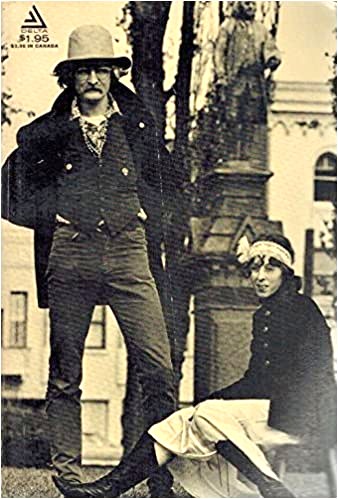
Another writer oddly influential at the time was the San Francisco author Richard Brautigan.  He applied a unique, deadpan yet lyrical style to the reportage of the unimportant.  Like the Liverpool poets, he impressed with unexpected similes and metaphors.  Mostly forgotten now, his book Trout Fishing in America was a late 1960s sensation.

What Barthelme, Brautigan, the Liverpool poets and even Ashbery had in common, at least superficially, was a kind of literary charm--a sly ebullience, a youthful mix of innocence and irony. Part of it came from successfully responding to Pound's dictim of "make it new" resonant with the times, and from that came energy and delight.  Now this work is no longer new and its connection to its times less accessible, but there is still some charm in the use of language, and its evocations of human experience and emotion.

 But to me in Iowa City, it all seemed so distant, so elusive. One of the first conversations I had with another student in the poetry workshop was with a young woman who had been there for at least a year.  It was before the school year started.  She told me that most Workshop students played the game of influence. The point was to get the most influential faculty writers to pave the way to publication, to write stellar recommendations and otherwise advance your career. That's what the Workshop was about, she said, the name of the game was Career.  She said it without bitterness, as a kind of wry report.  I guess she could see this would be news to me.

I don't recall having any choice in my workshop instructors.  The big noise in poetry that year was Ted Berrigan (in his only year teaching at Iowa.)  Anselm Hollo was another.  I drew Jon Silkin, a somewhat older British poet not very well known in the US.  In terms of the kind of poetry I was interested in writing, Berrigan or Hollo seemed a better fit, or at least so I thought at the time.

Robert Coover (far left) with Workshop students in 1967
As I recall, the big noise in the fiction workshop was Robert Coover, then being published regularly in the New American Review.  I'd met Richard Yates at Knox and admired his work, but I think he'd just left the Workshop.  In any case, I was assigned to a workshop run by a writer whose name I have forgotten--that's how unsuccessful that experience was for me.

Given the uncertainty of my tenure due to the draft, and the fragility of my psyche due to ditto, I decided to postpone any qualifying math, science or language course until the second semester, and took a film studies course instead.  I enjoyed it very much, when I attended.

There wasn't anything about the Workshop itself I enjoyed.  I didn't make a friend or even an acquaintance in either of my classes.  I don't even remember how many students there were or anything about any of them in my fiction workshop, and I recall only one student in my poetry workshop, mostly because he symbolized why I felt so out of place.  He was heavy, bearded, with short hair, wore tweed suits, smoked a pipe and never said a word or betrayed any emotion.  Likely in his 20s, he looked much older.

I don't recall a single moment of that fiction class.  All I remember is my first one-on-one meeting with its teacher.  I was supposed to bring 20 pages of fresh writing to it, which I did.  All I recall being said was that I should return next time with 20 more.  This is not a bad approach for instructing a young writer, but given my psychological state, that 20 pages had cost just about all I had.  Absent anything else to go on, I didn't see how to proceed.


In my poetry workshop I liked the teacher Jon Silkin, but I couldn't stand my basically comatose fellow students.  They seemed a staid and self-satisfied, wary, small-minded and highly traditional bunch.  If I had mentioned the Liverpool poets, I was sure, they would have only stared.  But then, that's all I ever saw them do anyway.

Silkin might actually have felt the same way about them. The only moment in class I recall was Silkin asking for a volunteer to read a particular poem aloud.  No one did.  Clearly annoyed, he slid the book across the table to me.  It felt like a challenge, like the coach throwing me the ball, daring me to sink the shot.

I don't remember the poet or the poem, though I do recall it had some French in it. Though it was by an established author,  I'd never read the poem before.  But I surprised no one more than myself by reading it perfectly, including the French.  "You read that with real feeling," Silkin said, with some wonder.  I was embarrassed because the feelings I may have expressed had little to do with the content of the poem.

But the moment that summarizes my Workshop experience came later, on the day when a group of my poems were going to be discussed by the class.  I had deliberately submitted my most daring verses, the craziest ones, including one that ran all over the page, rather than the ones I felt might be the best.  I arrived for that day's class a bit early, and stopped in the nearest men's room to gather myself for the battle.  That one particular fellow student, the bearded pipe-smoker, was also in the men's room.  I smiled at him reflexively.  He looked at me, said nothing, and left.

I proceeded to our assigned classroom, which I saw was empty.  I had somehow confused the start time.  In fact, the class was just over.  I had missed the discussion of my own poems.

Immediately I thought of the pipe-smoker, and how he must have thought I had been too scared to attend this class and had been hiding out in the men's room.  Yet, the worst of it was that he didn't say a word to me.  And all of that said everything to me about my experience at the Workshop.  I don't think I ever went back.

Kenney's bar, the historic Workshop hangout
When I first arrived in Iowa City, I was told the name and location of the bar favored by Workshop students. For decades it had been a place called Kenney's.  I don't think it was the bar I was directed to, though it could have been.  In any case, on my visits to this bar I did see people from the Workshop, including Ted Berrigan, looking like a member of Hell's Angels.  People typically drank beer, ordered in pitchers.  It was pretty lousy, watery beer.  "Born To Be Wild" played on the jukebox repeatedly.  It seemed to be the bar's theme song, expressing the hippie biker ambiance.

Most of the faculty and most of the students were male.  I am not given to a generalized condemnation of the gender I belong to, but it felt oppressive. In any case, for whatever reasons, I was steadily unhappy there.  My notebooks of this period contain almost nothing about my experiences with the Workshop or even in Iowa City--just endless notes for the fiction I wasn't writing.  But there is one scribbled note on a scrap of paper that has somehow survived.  I don't know when I wrote it, but it recorded a moment in that bar, with my glass of  tasteless beer sitting on the pinball machine, fighting off the feeling that I didn't like pinball, or the taste of this beer, or this bar.  "I stood there, with that layer of heat on my skin, trying to like it all."  I failed.

U of Iowa campus 1968
I remember the cold days--even though I was also there in a sunny fall, I remember Iowa City as cold and snow-covered-- going to campus, negotiating the winding pedestrian bridge, sitting with my coffee in the student union that connected buildings, and occasionally seeing one of the few people I knew.  I remember the coffee shop where I sat at the counter and had my pork tenderloin sandwich and coffee before a class, listening to the Moody Blues "Tuesday Afternoon" on the jukebox.  The only social occasion I recall was at Valjean McClenighan's apartment (after graduating Knox a year before me, she entered Iowa's theatre program), where she made me dinner, but which regrettably found me in my characteristic distracted graceless fog.

Otherwise, when I was in Iowa City, I was in my room.  I only remember two of the books I read there.  At the University bookstore I bought a just-published hardback, the first legitimate book about the Beatles, Hunter Davies' The Beatles: A Biography.

And when that wasn't enough to keep me in their world, I found cheap paperback novelizations of the Beatles' films, and sat in my chair by the window correcting the dialogue--penciling in the lines I memorized from the movies when they were different from those in the book.

Other than that, I recall listening endlessly to the new Bee Gees album, Idea.  The Bee Gees were an even more private obsession. Though they would eventually sell more records than any group in history, at the time and for years afterwards, they were dismissed and derided--at this time, as watered-down Beatles.  (Even in the 1970s, my fellow rock critics smiled indulgently at my aberrational appreciation of the Bee Gees.)  I bathed in their pure harmonies, playful melodies, strange arrangements, and ambiguous lyrics with private applications. At least until the Beatles finally released their double White Album just before Christmas.

On the inside of my door I posted a selection of nice things people had said about my writing in official letters and reviews, as encouragement.  But I also taped up that illustration of the Beatles as old men, my version of the skull on the desk I guess, a kind of memento mori, and expression of suspected futility.

University of Iowa Bookstore 1967
Looking back, I made some big mistakes.  I should have confided in George Starbuck, the head of the Workshop who had taken a personal interest in me.  I should have sought out Jon Silkin for private conversation (for I would have learned, as I did later, that he knew the Liverpool poets personally, and they respected him.)  I certainly should have spent more time with Valjean.  Once she brought me to meet some grad students and faculty in the theatre department, and they were friendlier, more interested and more welcoming to me than anyone at the Workshop.  One of the faculty even asked me to try out for a part in a Pinter play. That doing any of this never even occurred to me suggests the weight of my distractions.

Occasionally I would escape to Galesburg.  The first time I hitchhiked there I remember walking up a city street from the highway with my duffel bag, wondering what I was doing there, when I saw the first person I knew.  I'm pretty sure it was Harry Contompasis.  Anyway, somebody who seemed happy to see me.  That kind of welcome declined on subsequent visits, as I became a perhaps too frequent visitor with no real business being there.  But still, I had people to talk with and laugh with.  And I think I actually did some research in connection with my college novel.  My notebooks reveal, by the way, my one good idea: to start it with the JFK assassination in 1963 and end it with the RFK assassination in 1968.  But that idea somehow got lost in the growing complexity of its conception.

Galesburg was often a stop before Chicago, where I visited Joni at the Del Prado Hotel in Hyde Park, not far from the Lake.  At that time the Del Prado was mostly a residential hotel for students, and she and other Knox student teachers lived there.  My visits there were also an opportunity to explore downtown Chicago and the lakefront, even in the cold, sooty wind off the Lake in winter.  Once on the L, I daydreamed my way past my Hyde Park stop and woke up at Stony Avenue, which I had been warned was dangerous territory.  But for some reason I decided to hitchhike back, and got a ride from two young Black men in a sporty car, who were discussing Zeffirelli's new film version of Romeo and Juliet.

This is what the Beatles really looked like in 1968, in portraits
included in the White Album package
I remember listening to the White Album with Joni and her very patient roommates, and I remember on an earlier visit, watching election returns in the hotel bar, smoking a cigar, my cavalier pretense fading when Humphrey came up short and Nixon was elected.  The assassination of Robert Kennedy remained a bitter thing, and for the only time in my life I made the mistake of not accepting that one of the two party candidates was going to be president, either the lesser of two evils or the more evil, and that I needed to choose. Now it was over and I knew enough of Nixon to know the war would go on.  I've been disconsolate on many election nights since, but on this one I was trying to hide a broken heart, even from myself.

What inflected all of this with a patina of the surreal--from Iowa City to Galesburg and Chicago--was its irrelevance to the upcoming life-altering moments of draft induction, and the decisions they would force. Sometimes I felt that to others, having this confrontation in mind was like having a cold--people might recognize it and sympathize once, but then they'd forget it: it wasn't their cold, they weren't saddled with it every minute.

My pre-induction draft physical had been in October, and my induction/appeal physical had been scheduled for early December.  I got a postponement to finish my Iowa semester. Eventually I had my three day physical at Fort Des Moines, and I was finally found unfit for military service.  But I may have already packed up and left Iowa City, without a word to anyone except my near neighbor, who was the only friend I remember making.  Earlier my mother had observed in a letter that she'd heard about a lot of things I didn't want to do, but I didn't seem to know what I wanted to do.  She was right.

Sunday, July 17, 2022

History of My Reading: Vietnam and my (two) draft physicals

As the summer of 1968 ended and I finally worked out the details of attending the Iowa Writers Workshop in the fall, I faced a more formidable test.  I was going to be drafted, at the height of the Vietnam War.

The subject of Vietnam had been a necessary focus of my life and my reading since 1965, growing in urgency as I approached the moment my student deferment ended.  Draft calls were high by then--mine was certain to come soon. 
 
Vietnam in all its aspects wasn't easy to face, and it still isn't.  Benjamin B. Barber begins his essay, which leads off the 1990 compilation The Legacy: The Vietnam War in the American Imagination (Beacon Press): “There is no event in America’s recent history more painful—more memorable yet less remembered—than our long and futile military engagement in Southeast Asia...Vietnam is an invitation only to amnesia—a hard and numb scar we prefer not to notice.”

On a track of Randy Newman’s great 1970 album 12 Songs, the singer describes the promising start of a love affair, except that she wants to talk about the war. “I don’t want to talk about the war” the singer asserts.

 By the time I heard this song I was heartily sick of talking about the war. I had been talking about it, thinking about, bewildered and angry, bitter and immensely sad about it, for what seemed like forever, even if, all told, it took up a wearisome decade. In particular I was aware of how it was poisoning my college life and beyond, my early to mid 20s, with all of its immutable experiences and all of its urgency in determining the course of my life.

For we were shadowed by Vietnam war events until, for a few years we ate, drank, slept, read and talked the Vietnam war, and what it was doing to our personal lives, our generation, our country and humanity, as well as the people living and dying in that faraway land.

Meanwhile it took friends and acquaintances and distant contemporaries, wounding their bodies, minds and lives, and killing them dead, whether they fought in the war, fought against it, or otherwise witnessed it close up. It deformed the country, turning family members, friends and generations against each other.

Knox History prof John Stipp
In college, Vietnam also became an education in itself, and eventually central to my education there. The first event I recall was a “teach-in” on American policy in Vietnam given by a group of Knox College faculty in my first year, probably in the spring of 1965. With lots of competition for attention, it drew only about 100 students (according to history professor John Stipp, one of the two speakers I definitely remember.  The other was another history professor, Gabe Jackson.) But I was one of the students in the audience, and I’ve never forgotten at least the feeling of that event.

Our professors placed the American military presence in the context of the geography and history of southeast Asia and Vietnam specifically, from even before the French Indochina war. They described political and moral implications. They provided facts and sources that already contradicted US official statements.

Their scholarship and analyses (some familiar, some not) were daring to contradict official policy, lambasting the mistaken reasons for a war and its conduct while it was happening. This was academic discourse with a contemporary purpose. It meant something to our lives at that moment. And it was at least a little dangerous for them, as it would be very dangerous particularly for the male students listening, and not listening.

The amount of scholarship and writing on Vietnam already by 1965 is suggested in The Viet-Nam Reader published that year, edited by Marcus Raskin and Bernard Fall. Reporter and scholar Bernard Fall in particular was a respected voice on Vietnam, since he started out a supporter but became a critic. He had been reporting on the region since the early 1950s and warned the US was making the same mistakes as the French. He continued to report on the war, and was accompanying US Marines in Vietnam in 1967 when they were ambushed, and he was among those killed.

That spring of 1965 was when the US became fully involved in a war in Vietnam, with the first ground troops, the first search-and-destroy missions and in particular, the first bombing of North Vietnam. Escalation (a word we were learning) continued through the summer, and so student interest also escalated the following fall.  In 1965 (either spring of my first year or fall of my second) I took a public position against the war in a debate sponsored by the Speech department, but I remember it as a defining moment for me.  

Then by 1966 and 1967, Vietnam was on everybody’s mind. We saw our time, thought and emotions absorbed by meetings, debates, petitions, marches, demonstrations with four or five people or thousands—in hot rooms, in the cold and snow, in the rain, and a broken-hearted poetry reading in the spring sun. Draft calls began to ramp up, which added to the urgency for those of us facing the draft in our near future.

Much of the reading I remember was in pamphlets, booklets and periodicals. We relied on periodicals partly because these events were happening rapidly, and books take a long time. But a lot of the press seemed to be simply repeating government and think tank misinformation and lies. We relied on different periodicals, such as Ramparts and the New York Review of Books, which published, among others, Mary McCarthy’s journalism (collected in Vietnam, 1967) and Noam Chomsky’s analyses.

In The Nation magazine I was particularly reading William Eastlake’s columns from Vietnam, probably before and certainly after he taught a semester at Knox. Esquire under editor Harold Hayes published provocative pieces, as did Harper’s Magazine. I didn’t regularly see the better New York Times reporting while I was at Knox, mostly because the paper didn’t get to the Knox Library for several days by mail. I might read the Sunday Times on Wednesday, if I remembered.

I.F. Stone
Another invaluable resource (when we could find it) was I.F. Stone’s Weekly. It was unique—the product of one man, a veteran Washington journalist who was blacklisted in the 1950s, but refused to be silenced. He became virtually the only journalist to question the official account of the 1964 Gulf of Tonkin incident that LBJ used as a pretext for war. He was later proven correct. His lacerating critiques of US Vietnam policy and the lies the government told were often based on careful reading of public sources including newspaper stories. A wonderful 1970s documentary on Stone showed him literally tearing the New York Times apart, page by page.

There are now several collections of I.F. Stone’s work. The two I have are The I.F. Stone’s Weekly Reader (1974) and Polemics and Prophecies 1967-1970 (1972.) Also in the early 70s, when the poet Celia Gilbert, my colleague and friend at the Boston Phoenix, turned out to be I.F. Stone’s daughter, I got the opportunity to meet him several times.

“It is time to stand back and look where we are going,” Stone wrote in early 1968. “And to take a good look at ourselves.” The students I knew felt this was something we were more or less forced to do just about every day.

Eventually the periodical reporting got into book form. I read Jonathan Schell’s long article in the New Yorker in the summer of 1967 that became the book, The Village of Ben Suc, a detailed account of the destruction of a Vietnamese village by American troops.

But the book that had the most direct and profound effect on me in my college years was an unheralded paperback by an unknown author. It was Air War: Vietnam by Frank Harvey, a factual account of exactly what the title said. I read about it in Robert Crichton’s review in the New York Review of Books, and the excerpts he quoted were so horrifying that, when I read them aloud as part of Bill Thompson’s teach-in in the Gizmo, I had to choke back the tears.

The Bantam paperback was troubling and exhausting, mundane and horrifying—I often had to stop reading, fearful I would fall into a melancholy without end. The incredible damage that this bombing did was almost beyond understanding—I still remember one fact: B-52 bombers—with conventional bombs-- could kill every living thing within a fifty mile radius.

This book led me many years later to Gerald J. DeGroot’s 2005 The Bomb: A Life (about the atomic bomb) and in particular Sven Lindqvist’s A History of Bombing (The New Press, 2002.) I wrote about the latter book in a piece for the San Francisco Chronicle, on the eve of the bombing of Baghdad that began the Iraq war. Lindqvist’s book further deepened my conviction that arose from Frank Harvey’s book in 1967, that all bombing of civilian settlements is fundamentally immoral.

When the internal government documents purloined by Daniel Ellsberg—which later became known as the Pentagon Papers-- began appearing in 1971, they confirmed what some of us already knew or at least strongly suspected. The pattern of official lies was there for all to see. In his 1972 book Papers on the War, Ellsberg used them as a basis for his recollections about Pentagon analysis and how it was used, and misused.

Two of the classic nonfiction books on the Vietnam war appeared near its end. Fire on the Lake: The Vietnamese and the Americans in Vietnam was a nearly 600 page history by scholar and freelance journalist Frances FitzGerald, published in 1972. Some of it had appeared in The New Yorker. It won a Pulitzer.

A year later, former New York Times reporter David Halberstam devoted more than 800 pages to a history of hubris-directed policy on Vietnam in The Best and The Brightest. By then I was the books editor at the Boston Phoenix, and interviewed Halberstam on this book (his first) in the Boston Ritz hotel—his energetic eloquence and intimate buzzsaw voice that made him a talk show favorite for decades were already in evidence.

I also met Frances FitzGerald, when we were both at a futurist convention in Washington on assignment to different magazines, and again in New York. She also had abundant wit and charm, but she was not as much of a media personality as Halberstam throughout a writing career that also resulted in a number of distinguished books on a variety of subjects.

The memoirs and fiction from the Vietnam war mostly came later, towards the end of the war or afterwards, such as Ron Kovic’s Born on the Fourth of July (which exposed the horrors of the medical care wounded veterans received, years before this became a public issue), Michael Herr’s Dispatches (expanding on his work as a Vietnam correspondent for Esquire) and Tim O’Brien’s Vietnam books. In the 1992 book Vietnam, We’ve All Been There: Interviews with American Writers, Herr and O’Brien both had trouble describing the nature of their books—memoir, New Journalism or fiction? It seems these war experiences required hybrid forms.

But in the late 1960s, three of the contemporary novels we were reading that had some bearing on Vietnam were actually about World War II. All three employed black humor to expose the deadly folly. Castle Keep by William Eastlake was about the war in France and later Kurt Vonnegut’s Slaughter-House 5 was about the firebombing of Dresden. But the novel everyone I knew was reading in my later college years was Joseph Heller’s Catch-22.

Here was a war novel unlike any other, especially for young men like me who had grown up on war movies and war comics and playing at war with our friends using World War II surplus and souvenirs.

The main protagonist is an American bomber pilot named Yossarian, who is convinced that the American military is trying to kill him. The novel is a model of the painful humor of the absurd. But that insight wasn’t absurd to me. By its actions, I was convinced that my country was trying to kill me, or at least cynically devaluing my life by using me as an instrument for unjustified ends. And though one could argue whether this was chiefly impersonal or semi-personal, even today I can’t see much evidence that I was wrong.

It was a point of view buttressed by a few other things we were reading and hearing about in the late 60s. One was The Report From Iron Mountain, about a supposed secret government commission that concluded that war was necessary to the US economy and way of life, including the need for combat deaths. Eventually it was claimed to be a satire, that no such commission existed, but its arguments remained.

The other was a Selective Service memo on “channeling”: the use of the draft and draft deferments to channel young men into desired occupations useful to the military, or—in the parlance of the time—to the military-industrial-university complex.  (This language in Selective Service documentation for years has since been confirmed.)

This spoke to the larger context as well as to a specific subject of great moment: namely the draft and what to do about being drafted.

I remember talking with draft counselors in Chicago several times. Some were sponsored by American Friends and other pacifist organizations with religious affiliations. Others were more specifically against the Vietnam War, and offered technical knowledge and advice on laws governing the draft, including our rights as potential and actual draftees.

So I read a lot of associated pamphlets and booklets and books, a few of which survive in my collection, if not specifically in my recollections. One is We Won’t Go: Personal accounts of war objectors, collected by Alice Lynd in 1968 and published, as many of these books were, by Beacon Press.  Another is In Place of War: An Inquiry into Nonviolent National Defense, prepared by a working group of the American Friends Service Committee, and published in 1967 by Grossman. It's a thought-provoking thought experiment in a different kind of civil defense.

1967 poetry reading at Knox College. Leonard Borden photo.
We were also reading—and listening to—poems about the Vietnam War, which were important in both deepening and sorting out my thoughts and feelings. Robert Bly brought his collection,  A Poetry Reading Against the Vietnam War, on one of his Knox visits. We had our own such event on the Old Main lawn, as I described in an earlier post.

Bly’s collection, published by his own Sixties Press, contained some nonfiction excerpts by I.F. Stone and others, appropriate lines from Walt Whitman and Abraham Lincoln, and poems by contemporary poets who participated in group readings. They included Lawrence Ferlinghetti, Robert Lowell, George Hitchcock, James Wright, Donald Hall, John Logan, Louis Simpson, William Stafford, Robert Creeley and Bly.

Denise Levertov visited in the spring of my senior year, and handed out antiwar factsheets as well as her antiwar poems. I was one of the students granted a few private minutes with her, up in Sam Moon’s office. I remember I brought her a cup of tea from the Gizmo, which pleased her. I recall mentioning to her how the barrage of news and necessary decisions relating to the war was becoming overwhelming to “us.” Some wondered, I said, if we could even justify doing anything else. She was startled by this, and quickly affirmed that of course we should still take time to do life-giving things every day, like read, write and “think about your dreams.” It was that think about your dreams everyday that stuck with me.

(Levertov also edited the 1968 Peace Calendar and Appointment Book for the War Resisters League, which interspersed poems among the calendar pages by scores of American poets, including William Stafford, Robert Duncan, Jonathan Williams, Nancy Willard, Galway Kinnell, Sam Hazo, Gilbert Sorrentino and Jim Harrison, as well as these poets who visited Knox while I was there: Robert Creeley, Robert Bly, Gary Snyder, David Ignatow, Mitchell Goodman and Levertov.)

I left Knox in 1968 without a degree, vulnerable to the draft. I kept changing my official address all summer—a tactic recommended by one of those draft counseling handouts or articles—so a draft notice couldn’t find me. In the fall I became a student in fiction and poetry writing at the Iowa Writers Workshop, but I never really settled in Iowa City. I was often in restless transit, to Galesburg, to Chicago where Joni was living in the Del Prado Hotel near the lake on the South Side along with other student teachers for a semester in the Chicago school system. And back again to my narrow winter room, my pork tenderloin sandwich at the lunch counter before class on Tuesday afternoons, with the Moody Blues on the jukebox.

But my every step seemed dogged by the draft. I was sunk into myself and my conundrum. I learned one thing from responses in every place, from family, lovers, friends and other strangers. That no one knew what I felt as I faced what was before me. Only other young men with a draft physical looming at that moment could begin to fathom it.

From Alice's Restaurant (1969)
A draft physical order finally caught up with me.  On one of my preliminary visits to moving to Iowa City, I was warned by Workshop students not to register with the Iowa City draft board, so I remained registered in Galesburg.  That turned out not to be so wise either.

I was called for a pre-induction physical in Chicago. I caught the train from Galesburg, and had my draft physical straight out of a nightmare Alice’s Restaurant movie. I had hearing test results with me that clearly showed I was functionally deaf in one ear, which I’d been assured by a joyful draft counselor would get me out. But it didn’t.

Among the multiple ironies--none of which I was in the mood to savor at the time--was that my fondest ambition at age 11 or 12 was to become a Naval Academy midshipman.  Because Members of Congress could appoint a qualified candidate to Annapolis, I figured I had a chance, since I was known to ours.  But I think I can remember the moment--trotting down the steps made of piled rocks from my house to the street-- when it came to me: I could not meet the Annapolis physical standards because of my deafness, and there was nothing I could do about it.  And so I had to give up that dream.  All that I knew about Army standards now told me my deafness should be disqualifying again.

But standards seemed to be functionally relative. There were quotas to meet, and it was a high draft call that month.  Still, the times were such in the late 60s, and the war so controversial, that substantial disagreement if not dissidence had begun to appear within the military. This was clear at the draft physical. Comparing notes later with others from Knox and Galesburg who had their physical that day, it seemed that its outcome depended more on the luck of the draw than any factual basis. If your line led to a sympathetic doctor, and you wanted out (some even asked), he got you out. If it led to a functionary or an angry true believer, you were in, no matter what. I was unlucky.

There was a written part to the exam. We started out at school desks in rooms set up like school rooms, filling out forms and taking psychological tests, directed by a no-nonsense young lieutenant.

After our humiliating physicals we returned to the same room for further forms. When we finished, the lieutenant closed both doors, and told us what it was really like in Vietnam. It was the most powerful anti-war message I had yet received. He told us that in effect our lives were being thrown away.

Dazed and disoriented, I managed to also get my wallet stolen so I left penniless as well as hopeless. I borrowed a dime for a pay phone to call Joni at the Del Prado.

But I soon went back to the pamphlets and books, wrote letters and got an appeal physical. Unfortunately it was also going to be my induction physical. If I passed, I would be inducted into the army.

I also started the process of obtaining conscientious objector status. I’d been corresponding with William Eastlake, and he cautioned me not to let my perfectly reasonable objections to the Vietnam war become opposition to all wars—a justifiable one might come along any day, he wrote.

At the time, CO status was granted almost always only on religious grounds if you were a member of a recognized church, and only if you were conscientiously opposed to all wars and killing, and not only to killing in this war.

But this was the only war they were going to send me to fight or support. And potentially killing me wasn’t as infuriating as forcing me to kill others I had no reason to harm. The first might kill my body, but the second would definitely kill my soul. To me this was personally and morally clear. It was defining.

Still, I was torn about CO status, but I filled out the forms, and I was prepared to use them if necessary.

And if all else failed, I knew my last step. There would come a moment in which inductees would be asked to take one step forward, indicating they accepted induction.  That was a step I would not take. That would set off another process which could send me to prison, if I didn’t figure out how to survive in Canada first.

My appeal/induction physical was at Fort Des Moines in Iowa. The Obamas stayed at the Fort Des Moines Hotel during his presidency, but it’s a little different from the place where I stayed back then, in the barracks for three nights. My physical lasted three days.

I took a bus alone from Iowa City. As the only person in my “group”, the Army designated me as its leader, and assigned me the responsibility of filling out the forms and keeping the expense accounts.  On the forms I had to keep an accurate count of myself each time I got off and on the bus.

 I got to Des Moines early, and spent a giddy afternoon with a girl I met on the bus, whose name was Trish. She worked at the phone company in a small Iowa town. We walked around in the sunny air and may have gone to a movie. I do remember that we eventually were talking to each other in slight English accents.  It was a time when the practice of youth, freedom, sunshine and innocence was summarized by the Beatles.

I arrived on time at Fort Des Moines, though my actual physical was to be the next day. I was billeted in a barracks for the night with at least a hundred others from all over Iowa, most of them younger and very excited and eager to be leaving Iowa in uniform.

Robert Bly in the 60s
But there were a few, identifiable by age and hair length, who quickly found each other, and found me. One of them knew even more about our rights than I did, the first of which was we were still civilians and the Army had no legal right to hold us there. So we went somewhere for a beer, and I got more valuable advice about the physical itself.

My physical at Fort Des Moines replicated the conflict among the personnel conducting it that I saw in Chicago, but this time more dramatically. My appeal physical was managed by a desk sergeant on the first floor, who was mutely if clearly sympathetic. If I wanted out, that seemed pretty ok to him.

But that decision was to be made upstairs (literally—I think it was the third floor) by a doctor, a young lieutenant who eventually told me that no matter what I brought to him, he was going to pass me. He’d been drafted out of medical school, and if he had to go, I would have to go.

This back and forth, this circuit from downstairs to upstairs with occasional trips to off-base doctors, went on for three days. I caught on to the drill early: maybe because this was an appeal, or maybe because of the desk sergeant, they were duly if not actually examining every claim I made. And so I kept making them, and they kept sending me for more tests and evaluations.

There were a couple of highlights. They sent me to a doctor elsewhere in Des Moines for another hearing test. He was elderly, and had the most primitive equipment I’d seen since my first grade hearing exam. I’d been tested several times since with the latest machinery at the University of Pittsburgh, but this guy’s idea of a hearing test was to stand behind me and ask me to repeat what he said. “One,” he said, and then moved a few feet. “Two...”

Denise Levertov in 1968
So by the time they sent me to see the psychiatrist I was either hallucinating or seeing some odd things, like a film crew following me, and a nurse smiling brightly as she emerged from a broom closet door I’d been staring at as I waited.

Eventually, after three nights in the barracks and three days on the first, second and third floors, the desk sergeant was briskly amused and rather pleased to tell me that I’d essentially worn them out, and that I would be reclassified as unfit. The papers I got in the mail merely stated that my appeal—based on my hearing—had been successful.

My journey back from Fort Des Moines began with hash browns at the bus station eatery, and in the adjoining arcade I bought an old red marching band coat, Sergeant Pepper style.

It sounds like a Joseph Heller story now, but it was hell at the time. I was so traumatized and conflicted by the years and months leading up to the hours and days at Fort Des Moines that I dropped out of the Workshop, left Iowa, and wound up back in Galesburg, fulfilling my own prophecy in a poem published in the Siwasher my senior spring: “I will hide.”

Monday, July 04, 2022

History of My Reading: Summer Reading 1968

My summer of 1968 functionally began with the murder of Senator Robert Kennedy in early June, and ended with the police riot in Chicago at the Democratic National Convention in late August.  In between these iconic indicators of the contextual chaos, I traveled: to Iowa City, Chicago, Galesburg, Greensburg (PA), Boulder (CO), Libertyville (IL) and Hamilton, Ontario--some of these several times.

I flew, drove, rode trains and buses, and hitchhiked.  I was simultaneously trying to arrange my attendance at the Iowa Writers Workshop and its financing in the fall, while dealing with draft boards, doctors and draft counselors.  I was certain to be called for a draft physical soon, which made any other plans as well as my future highly uncertain.

And almost incidentally, I was also completing two independent studies, my last courses at Knox College, in an effort to obtain more credits towards an elusive BA degree. One of them was fiction writing for Robin Metz.  The other--which I'd completely forgotten about until recently reviewing letters from that summer--was a paper on Thoreau for Doug Wilson.  So in all that fraught and frenetic summer, the still point in my churning world was Walden Pond.

I must have done most of the reading and writing in midsummer, when I was back home in Greensburg. While not exactly Walden, it was relatively quiet, and I had hours of solitude.

I now realize that a surviving manuscript I previously thought was for my Emerson/Thoreau course in my junior year must be a rough draft of that summer of '68 paper.  It consists of an introduction and three sections: "Utility As Purification," "Towards an Ecology of Feeling" and "What the Body Thought."  The first section was based mostly on Walden; the following sections on Thoreau's journals--or mostly the journal entries contained in the selection H.D. Thoreau: A Writer's Journal by Laurence Stapleton.

So that summer I re-read Walden and the Stapleton book, if not more.  I apparently began by noting page numbers of journal entries of interest, then marked which ones I would use in the paper. I marked a half dozen references to sound and music, though I didn't use any in the draft I have.

My introduction shows a continuing influence of  my spring reading on philosophy of science, not mandated by any classes but in response to two of the science courses I took (supposedly for non-majors), one in which I got an F and the other an A.  There were also references to the Two Cultures debate from the very beginning of my Knox years.

The relationship of art and science, or more particularly intellect and feeling, as methods of ascertaining reality in Thoreau's exploratory writing was the general topic. "Reason is that faculty which is quite fond of producing reasons," I wrote. But intellect infused with feeling was Thoreau's solution.  Feeling came from the physical (the body's) response to the physical (nature.) Yet feeling was also formed and informed by the mind, by thought.  I'm immediately reminded  now of the work of Jung, James Hillman and others I came upon later, in which intellect and feeling, body and mind, are among the orchestrated elements of the human soul.

Looking at this draft now without the academic fuzz, I see some 1960s concerns, such as revolt against the conventional and the trivial, and against meaning defined by money, as well as countering the cold rationalism that justified the Vietnam War. These included pressing personal concerns, particularly the prospect of a life about to be wasted on the inessential and the ignominious. ("Woe be to the generation that lets any higher faculty in its midst go unemployed," Thoreau wrote.)  I quoted in particular a journal entry that Thoreau wrote on a December night, after he made a fire and "endeavored to return to myself....I wished to ally myself to the powers that rule the universe.  I wished to dive into some deep stream of thoughtful and devoted life..."

In the midst of a highly political year, in which issues of great pith and moment seemed to require group action and engagement,  I was attracted to "live, ah! as far away as a man can think."  To the relative isolation and solitude, the living deliberately of Walden.  And it would turn out that I fled from one of these opposites to the other for the rest of my life.

But what I didn't write about is also interesting.  The Stapleton book is titled "A Writer's Journal," and so it contains Thoreau's thoughts on the practices and purposes of writing, something of particular interest to me, especially at that time. The book itself impressed me enough that years later, when I thought I'd lost my copy, I found a more recent edition (and then the old one turned up.)  But that summer, I also looked to another book for guidance, or at least solace.

After finishing my independent studies I returned to Galesburg and Iowa City in July, and then flew off on a borrowed half-fare card to Boulder to join Joni, who was taking classes at the University of Colorado campus there.  (I must have flown from Iowa City because I remember a short flight in Iowa with so few passengers that I saw one of the young stewardesses--as they were then called-- watching the sunset from a cabin window.)

My digs for those weeks were a couple of rooms drenched with the smell of cement on the first floor of an otherwise unoccupied house still under construction, located conveniently next door to Joni's apartment. (She'd charmed the builder, who was also her landlord, into allowing this.) There I set up my typewriter and tried to write, though I often reverted to reading the book that had been a kind of Bible since my senior year: Richard Ellman's biography titled James Joyce.

Joyce was not much of a naturalist, but "silence, exile and cunning" and his absolute devotion to his work were not terribly far from Thoreau.  Joyce's example was enlarging, focusing and also eventually toxic.  But I kept reading largely because Ellmann's biography is so well written.  (It became the model for literary biographies, at least for awhile.)  And at age 22, the romance of it overwhelmed less salutary aspects.  With my own identity as a writer unmoored, it was a kind of anchor.

I remember other books of a literary nature I read in those years, but only one other I associate with that summer, and I'm not even sure the association has exact basis in reality.  But I'm pretty sure it was that summer that I read Kurt Vonnegut's novel, Mother Night.

Slaughterhouse Five and Vonnegut's rocketing fame were still months in the future, but I'd been hearing about him my senior year from Robin Metz, who was at one time his student at the Iowa Workshop.  Such is Vonnegut's enormous presence in that period that it's a bit startling to be reminded that he became instantly ubiquitous only in the early 1970s, beginning in 1969. His influence--particularly as an anti-war novelist and spokesperson--seems to blow back into 1968 and 67. So when I associate reading Vonnegut's short stories in the collection Canary in the Cat House with my senior year residence on First Street, it may or may not be accurate.

But I'm a little more confident that I read Robin Metz's own hardback copy of Mother Night when I stayed at his house on Broad Street in Galesburg for a time or two during that summer.  It was a compulsive, riveting, powerful reading experience.  Its roots in popular literature were clear, but its voice and point of view were unique.  I looked forward with anticipation to his "big book" rumored to be coming out the following year.

I returned to Chicago in August in time to visit Bill Thompson in Libertyville, and (with Mike Shain) to drive him and his new wife to Hamilton, Ontario, where he would attend graduate school and, not incidentally, be safe from the draft.  Why I did not take the Canada option myself remains a mystery to me, though it probably had something to do with my incompetence at even conceiving of how to survive. Yet it seems now that had I given it seven minutes of consecutive thought, I should have seen it as the best of my alternatives.  But thinking clearly about any of this, and not being overwhelmed by conflicting emotions, was not easy to come by.

Instead I returned to Libertyville with Bill's father's car and trailer, saw the police riot on TV, went to Chicago as described elsewhere.  Then eventually to Iowa City and the famous Iowa Writers Workshop.  However, as it turned out, briefly.  There I finally had to confront the draft--something of the inevitable destination of the past several years and the obsession with the Vietnam War forced upon us, which included several years of the reading I include in my next post, along with an account of my three day physical at Fort Des Moines, Iowa.

Sunday, June 05, 2022

History of My Reading: Graduation 1968 (Part II) RFK

When my class of 1968 marched into graduation, I was not among them, for reasons described in the previous post (Graduation Part 1.) Instead I was on the other side of a wall from the ceremony, in the student union parlor, watching a different kind of ceremony on the television set.

That was Sunday, June 9, 1968. But this story begins on the previous Tuesday, June 4.

We had some big parties at our house on West First Street in the 1967-68 academic year, the place that housemate Bill Thompson dubbed the Galesburg Home for the Bewildered.

In the fall I remember a mid-party appearance by our new Homecoming Queen, the radiant Shirley Kishiyama. Several of the Stoney Mountain Boys—Rick Lindner, Tom Stern and Mark Brooks on tub bass—set up and performed, and I got to play some guitar runs with them on an improvised jam.

Some of our parties were semi-official, like one we had for a blues artist after his concert. I'm pretty sure it was Bukka White. He brought his classic shiny silver National guitar with him, but when people asked him to play he would just look around the room, pick somebody and hand over the guitar. He always found a guitar player, and laughed, claiming he could just tell. It was the only time I ever got to play one of those steel-bodied guitars.

In the spring, we hosted a party for poet Denise Levertov that drew faculty as well as students. We had the cast party for What's Happening, Baby Jesus there.Then our last party of the year—and the last ever for us—was scheduled for Tuesday June 4: primary election day. It was a Victory Party—we just weren’t sure for who. But Thompson had been working since before the New Hampshire primary for Senator Eugene McCarthy. (He’d even made a halfhearted attempt to get “Clean for Gene,” which basically meant kind of a haircut.) I was supporting Senator Robert Kennedy, and hoped I would be working to elect him President that summer and fall. Both were against the war.

For although the world’s imperfections may call forth the acts of war, righteousness cannot obscure the agony and pain these acts bring to a single child.”
Senator Robert F. Kennedy, in the March 1967 Senate speech in which he broke with the Johnson administration on Vietnam.

Robert Kennedy had been the keeper of the flame after JFK’s assassination in 1963, and President Lyndon B. Johnson knew it and resented it. By 1967 RFK was making speeches on the Senate floor questioning American involvement in Vietnam (which—several historians confirm—his brother President John Kennedy had intended to end in his second term.) But the media usually saw everything RFK did as reflecting his animosity towards LBJ or his political ambitions, or both.

It has since been reported that RFK wanted to challenge LBJ for the 1968 nomination, but felt frustrated that it would be seen only as expressing that animosity, and not as a principled opposition on both the war and on his signature domestic issue, racism and the plight of black Americans, especially in the inner cities.

Until early 1968 it looked as if there would be no anti-war alternative in the November election. Then a relatively obscure U.S. Senator from Minnesota, Eugene McCarthy, entered the New Hampshire primary as a candidate opposing LBJ, and the Vietnam War.

Some at Knox responded quickly. Wendy Saul chaired an exploratory meeting in February. I attended either that meeting or a subsequent one, held in the basement of a women's dorm. I remember being depressed by the discussion, and taking a break from it to sit alone nearby, where I could hear the sound of someone taking a shower. I remember the image because I put it in a poem.

I wasn’t enthusiastic about McCarthy or his campaign. I didn’t believe he could win. But of course if he had remained the only alternative, I would have supported him.

McCarthy did shockingly well in New Hampshire, coming in a very close second to LBJ. RFK felt that he could no longer be accused of dividing the Democratic Party: it clearly was already. But reportedly two other factors pushed him. First, that the generals were asking for 200,000 more American troops, and LBJ agreed. Second, that LBJ wasn’t going to even consider the recently announced recommendations of the Kerner Commission to address the causes of racial strife in the cities.

Robert Kennedy announced his candidacy for President on a Saturday morning in March. It was spring break and Joni and I were visiting Mary Azer and her family in West Chicago. Joni and Mary were Post Hall roommates. I think I met them at the same time the previous spring. I remember Mary, red hair, blue eyes, quietly mischievous smile, showing up at West First Street one night that winter in her Navy blue peacoat to go play in the snow.

So I met Mary’s parents and her younger sister, Barbara, then in high school—dark-haired, energetic, direct, pretty, funny. I remember watching RFK’s announcement, probably in their basement rec room. I knew that now I had my candidate. RFK had political and rhetorical strengths McCarthy didn’t. And as became apparent in the remaining primaries, particularly in California, RFK had enthusiastic support in the black and Latino communities.

I was encouraged, wary and dared to be a bit hopeful. I’d followed RFK’s career from the Justice Department to the Senate in 1965. He was running for the Senate in New York as we started our first year at Knox, and I remember lending a paperback book of his speeches and statements (The Pursuit of Justice) to classmate Nina Palmer with whom I shared a class (probably Spanish), because she was from New York. I noted his first Senate speeches, on nuclear proliferation and gun control. My second year I participated in Prof. Dean Torrence’s mock Senate—for that exercise I was Senator Robert Kennedy.

Reading speeches, by the way, had been part of my reading since high school, partly because I was a debater, and partly because John F. Kennedy was President, and his speeches were eloquent and substantive (thanks in part to his main speechwriter, Ted Sorenson.  I say in part because Sorenson never achieved on his own or for anyone else this level of writing.)  I had two books of JFK speeches before I left for college, and the aforementioned one by RFK.  I would add another before 1968.

Not long after RFK’s announcement and his pledge not to attack McCarthy directly, we all heard that LBJ was going to address the nation that night, on April Fool's Day Eve. Joni and I got to the nearest television, which was a few doors down West First at the home of Robin and Lynn Metz. The moment that LBJ announced that he would not run for reelection was surreal and delirious. Now the chances that the war could end had greatly increased. There was dancing in the streets at campuses across America that night. I didn’t see any at Knox, but our hearts were dancing on West First Street.

Then in April, the assassination of Martin Luther King, Jr. RFK was campaigning in a black neighborhood in Indianapolis, and he broke the news to the crowd. He spoke softly, from the heart, mentioning the assassination of his brother. He quoted a line from Aeschylus, his favorite poet, from memory.  Then he expressed what was to become an unusual campaign theme:

"What we need in the United States is not division; what we need in the United States is not hatred; what we need in the United States is not violence or lawlessness, but love and wisdom, and compassion toward one another, and a feeling of justice towards those who still suffer within our country, whether they be white or whether they be black.” He urged everyone to "dedicate ourselves to what the Greeks wrote so many years ago: to tame the savageness of man and to make gentle the life of this world.”

The next day he spoke in Cleveland, on the “mindless menace of violence.” He started with the violence of shootings and riots and the war. “Why? What has violence ever accomplished? What has it ever created?”

But he also spoke of less obvious violence, hidden, persistent and insidious: “For there is another kind of violence, slower but just as deadly, destructive as the shot or the bomb in the night. This is the violence of institutions; indifference and inaction and slow decay. This is the violence that afflicts the poor, that poisons relations between men because their skin has different colors. This is a slow destruction of a child by hunger, and schools without books and homes without heat in the winter.”  Today this would be called a reference to structural racism, as well as structural sexism and poverty.

But he did not stop there.  McCarthy got credit for being intellectual, but RFK had the depth derived from classical literature, and so he spoke in ways no other politician could.  "The question is not what program we should seek to enact.  The question is whether we can find in our own midst and in our own hearts that leadership of human purpose that will recognize the terrible truths of our existence."  

And then, a statement that must strike terror in the hearts of Social Darwinists, consciously or otherwise:  "We must admit the vanity of our false distinctions among men and learn to find our own advancement in the advancement of all.  We must admit to ourselves that our own children's future cannot be built on the misfortune of others."

RFK won primaries in two states, Indiana and Nebraska, that had few elements of his natural constituencies. He lost Oregon to McCarthy however, and so the next big step in the campaign was California, the last and largest primary. A victory there could mean RFK would be the coalition antiwar candidate at the August convention in Chicago. He would be opposed by the establishment candidate, LBJ’s vice president Hubert Humphrey, who supported LBJ and the war.

Our festivities started before the polls closed in the West Coast time zone. It was crowded and loud, with the latest Hendrix, the new Cream on the stereo. But we didn’t have a working television in the house, so every once in awhile Thompson would get on the phone with a friend watching a dorm TV to get the latest speculation and then the vote counts.

I was restless, moving back and forth from the heat and laughter of the party and the cool solitary dark quiet outside. When the call came confirming Kennedy’s victory, I mostly felt relief.

Joni and I rushed down to the Metz house to watch RFK’s victory statement, even though they were McCarthy supporters. Kennedy appeared in the incredibly crowded ballroom of the campaign’s hotel and spoke briefly. He congratulated McCarthy and spoke about their common effort. He thanked his staff and supporters. He saw his victory but also McCarthy’s campaign as a validation: “The country wants to move in a different direction, we want to deal with our own problems within our country and we want peace in Vietnam.”

“On to Chicago,” he concluded, “and let’s win there.”

We went back to the house but I was still restless. Something about that ballroom scene, something about how RFK looked made me anxious. So I went back out almost immediately. I began to walk in the cool humid night, the sidewalks moist from recent rain. I headed away from the streetlights, to dark weedy fields. RFK’s victory in California would signal his appeal to anxious party leaders like Mayor Daley, who was inclined to support him. He’d also won that night in South Dakota, within Humphrey’s midwestern sphere of influence. That also would be noted by party leaders. Could it be that the war was going to end? That there would be a President I could believe in again?

The walk calmed me, and by the time I got to West First I was ready for sleep. Then I saw Joni running up the sidewalk towards me, alarmed, frightened. I stopped in front of the Metz house. She stood still in front of me and said as evenly as she could: “Bob Kennedy’s been shot.”

The Metz house was dark but I banged on the door until the porch light came on. When Robin opened the door, I repeated Joni’s words exactly. We both wondered about it later, that we had called him Bob. He was always Robert, or RFK, he was Bobby.

Later Joni told me how she’d heard. Thompson answered the phone, and through the noise of the party’s remnants she heard him saying: “Who?” and then cry “No! No!” At that moment Joni thought something had happened to me.

We turned on the television coverage. The bedlam at the hotel. The first medical reports—Kennedy was alive, but in critical condition. It went on all night. First Lynn then Robin went upstairs to bed. Joni dozed on the sofa, woke up and walked back down the street to sleep. I stayed there, watching, the rest of the night. Frank Mankiewicz, RFK’s campaign press secretary, announced that the Senator’s vitals were good but doctors were about to begin surgery. He had been shot in the head.

The first two plus hours were filled with anxious talk, facts reported and then rescinded and corrected, about the shooting itself, the number of victims and their condition, and the person or people who had done it. There were interviews with witnesses, a lot of talk about a woman in a polka dot dress who had disappeared. For awhile everyone was obsessed with the woman in the polka dot dress.

I remember the NBC reporter Sander Vanocur trying to look in the camera calmly in the atmosphere of shock and hysteria. At one point he reported that police had a suspect in custody whose last name was Sirhan. They didn’t have a first name. So it became the mystery of the hour, what was Sirhan’s first name. Finally he was able to confirm that they knew the first name now: it was Sirhan. His name was Sirhan Sirhan. Maybe it was the reporter, or maybe it was me, but at least one of us almost lost it at that moment.

At dawn I turned off the set, and probably after stopping at the house, walked over to campus. I had early breakfast in one of the dining halls (the one on the corner that isn't the Oak Room.)There was something eerie about that breakfast, both bleak and comforting--I still dream about it.  In the dream the room is filled with bright gray light, and it seems a miracle, or a mistake, that I am allowed to eat there.

But for a few moments on that morning it seemed possible that none of what I'd seen all night had actually happened, that nothing had happened to me either for the past several months and I was back at the beginning.  But soon I was camped out in the union parlor in front of the television, and it was quickly clear that it all had happened, and was happening now.

Judging from the times recorded in later reporting, it must have been around five a.m. in Galesburg when surgery started. It went on for more than three hours. So I was probably watching the union TV when the coverage was focusing on the medical aspects.

Doctors were interviewed, pointing at charts of the brain. They were not optimistic. Then someone brought new information on the location of the wound. One doctor who saw it got excited. He said if that were true, RFK could be out of the hospital in a few weeks, perfectly okay.

But a few minutes later, that doctor was interviewed again. Pale and shaken, he said that the new information was actually about another victim, Paul Shrade, a California official for the United Auto Workers and a major Kennedy supporter. He’d also been shot in the head, and he did leave the hospital in a few weeks. His was the only apparently serious wound. All five of the other victims survived.

Then the surgery was over, and just past 9 a.m. Mankiewicz said it had gone well, but the next 12 to 36 hours would be critical.

The coverage continued and I kept vigil until I couldn’t stay awake any longer. But after a few hours sleep, I was back again. It was Wednesday evening when Mankiewicz returned to the microphones and said that the doctors were concerned that Kennedy hadn’t show improvement. “Kennedy’s condition is still described as extremely critical as to life.”

So it was now just a matter of time. Time to contemplate, time to look around with different eyes, time to almost forget. Time to relive the nightmarish day that JFK was shot and the weekend that followed. I’d watched it all on television then, too. On that Sunday my family went to church but I stayed home to watch. I saw Lee Harvey Oswald being moved from jail—I was startled by what looked like a gun. But it turned out to be a microphone. And a moment later I heard the shots. I saw Oswald shot on live television.

At four in the morning on Thursday, Mankiewicz stood on the lawn of twisted cables in front of Good Samaritan hospital one last time to make announcement everyone knew was coming: Robert Kennedy was dead.

I must have watched stretches of coverage in the following days—the casket arriving in pools of bright light amidst the darkness of the New York airport, the motorcade of black cars to St. Patrick’s Cathedral. There his mother waited, and his friends took turns attending the casket, and in different parts of the cavernous cathedral, red-faced Mayor Daley and ashen Tom Haden wept.

On Friday the crowds gathered, formed into block-long lines to pass by the casket, to touch the curved cold steel covered in flowers, each with a word of farewell. A reporter noted what words he heard most often: “Forgive us, Bobby.”

Saturday morning was the funeral Mass, with all the dignitaries in attendance. Senator Edward Kennedy gave a brief eulogy: “My brother need not be idealized, or enlarged in death beyond what he was in life, to be remembered simply as a good and decent man, who saw wrong and tried to right it, saw suffering and tried to heal it, saw war and tried to stop it.”

And all day Saturday the funeral train made its slow way to Washington, passing thousands of the unimportant. Many of those gathered, in small groups, families and even alone, or in large groups near the cities, were poor, and many more were black.

Failing to account for the people on the tracks to see the funeral train, the railroad allowed its regular traffic. Several people were killed, including improbably a woman named Antoinette Severini, who died saving her granddaughter. That’s my aunt’s maiden name, though it wasn’t her. Still, given the woman’s name and her location, it’s possible if not likely she was a relative.

Jacqueline Kennedy, her children and her sister
Then in darkness, Robert F. Kennedy was buried in Arlington National Cemetery, next to his brother, President John F. Kennedy.

I’m not sure how much of this I saw as it was happening, but probably quite a lot. Yet I felt compelled to go back to the television on Sunday, to see programs that compiled images of the events.

Having no particular business there I probably should have left campus before graduation weekend, but inertia in packing up to leave was compounded by these paralyzing events. So I was around as families of my classmates arrived. I believe I met Wendy Saul’s father out on the Gizmo patio. I may have seen Barbie Cottral’s parents and her sister Lindsey, who I’d met on a brief visit to Clinton, Iowa the previous summer.

But I believe it was that weekend that I had a singularly memorable experience, so different from the rest of that week. Mary Azer’s parents and sister Barbara were there, and Joni and I probably went out to dinner with them. Joni flew back to Denver on or before graduation day, so this might have been Saturday night.

What I remember is returning with them to their motel in what had to be a prearrangement, because I found myself swimming at night in the motel pool out on the highway somewhere with three lovely young women: Joni, Mary and Barbara. It was heaven, and a little torturous as well. But most of all it was peaceful. The effect was not even completely destroyed when I noticed the black night sky was dominated, not by a silver white moon, but by a large red or orange round neon sign high on a stanchion, probably a Gulf sign.  It reflected red in the pool.

But on Sunday, as the graduates gathered, I was back before the student union television. On that day as on the previous ones there were faces and voices on the dotted screen talking about Bobby. Charles Evers, slain Medgar’s brother, with angry tears insisting Bobby did more for blacks than anyone. A longhaired young man claiming that as news came of Kennedy’s impending California victory, Abbie Hoffman was ready to disband the Yippies and call off the demonstration at the Democratic convention in Chicago.

A young aide said Kennedy behind the scenes was advocating American withdrawal from Vietnam when antiwar leaders were only calling for negotiations. The playwright who said that the day he died, Kennedy praised the Watts Writers Workshop and wanted the federal government to fund others. An American Indian writer spoke of Kennedy’s visits to reservations, said Indians considered him a warrior on their behalf.

A steelworker who said he was the only politician who might end the war and still get the hardhat vote. An historian who said RFK had been the best Attorney General in American history. Another who noted that Kennedy reveled in poetry, and once completed a couplet that Richard Burton forgot when the two were reciting for each other by heart.

People really loved him, they said. And people really, really hated him, they said. He knew he was going to be killed, a few whispered.

And pictures of Bobby, smiling and touching, frenzied hands reaching for him, talking softly to children, joking with campaign crowds, pounding his right fist into his left hand. This is unacceptable, he said. This is not satisfactory, he said. We can do better.

A student at a medical school asking him where the money was going to come from to pay for his programs for the poor. “From you,” he said.

Bobby talking about the war, about “the vacant moment of amazed fear as a mother and child watch death by fire fall from an improbable machine sent by a country they barely comprehend.”

And endless repetitions of his last public words, on the podium in California, with people pressed against him, his victory statement. “...the division, the violence, the disenchantment...whether it’s between blacks and whites, between the poor and the more affluent, or between age groups or on the war in Vietnam...we can start to work together. We are a great country, an unselfish country, and a compassionate country. I intend to make that my basis for running...”

At the funeral, young Kennedy children carrying Communion articles to the altar, while Mahler played, and people wept. The cameras had trouble with the contrasting light, so there were dimly visible pools surrounded by recesses of darkness. An announcer noted that the priest wore violet vestments, not black. But on TV they were gray.

Always present, RFK's wife Ethel Kennedy, pregnant. (There's a label on another of my blogs called "land of guns," for the numbingly frequent stories on gun violence. It comes from a line in a poem I wrote at the time about this week, that ends with the image of Ethel Kennedy "swollen/in the land of guns.")

I do remember that it was Sunday that I saw more of the long surreal funeral train, and the night burial. Of all the images, the funeral train seemed to say the most, rolling slowly, reluctantly past the once again abandoned, for when it stopped, it marked the end of possibilities.

Without Bobby, the war would go on. The mad havoc, the mechanical killing would go on and on in Vietnam, and young men here of my age, boys I’d gone to Catholic schools with or played with in the vacant lots of my home town, sons of salesmen, milk truck drivers, factory workers, cooks for the last rich family in town, as well as young men in my college class, now out there with beaming parents watching, would have to face those awful choices.

I would never have my graduation. But this was my commencement.