Showing posts with label Gary Snyder. Show all posts

Thursday, August 06, 2020

History of My Reading: Presence

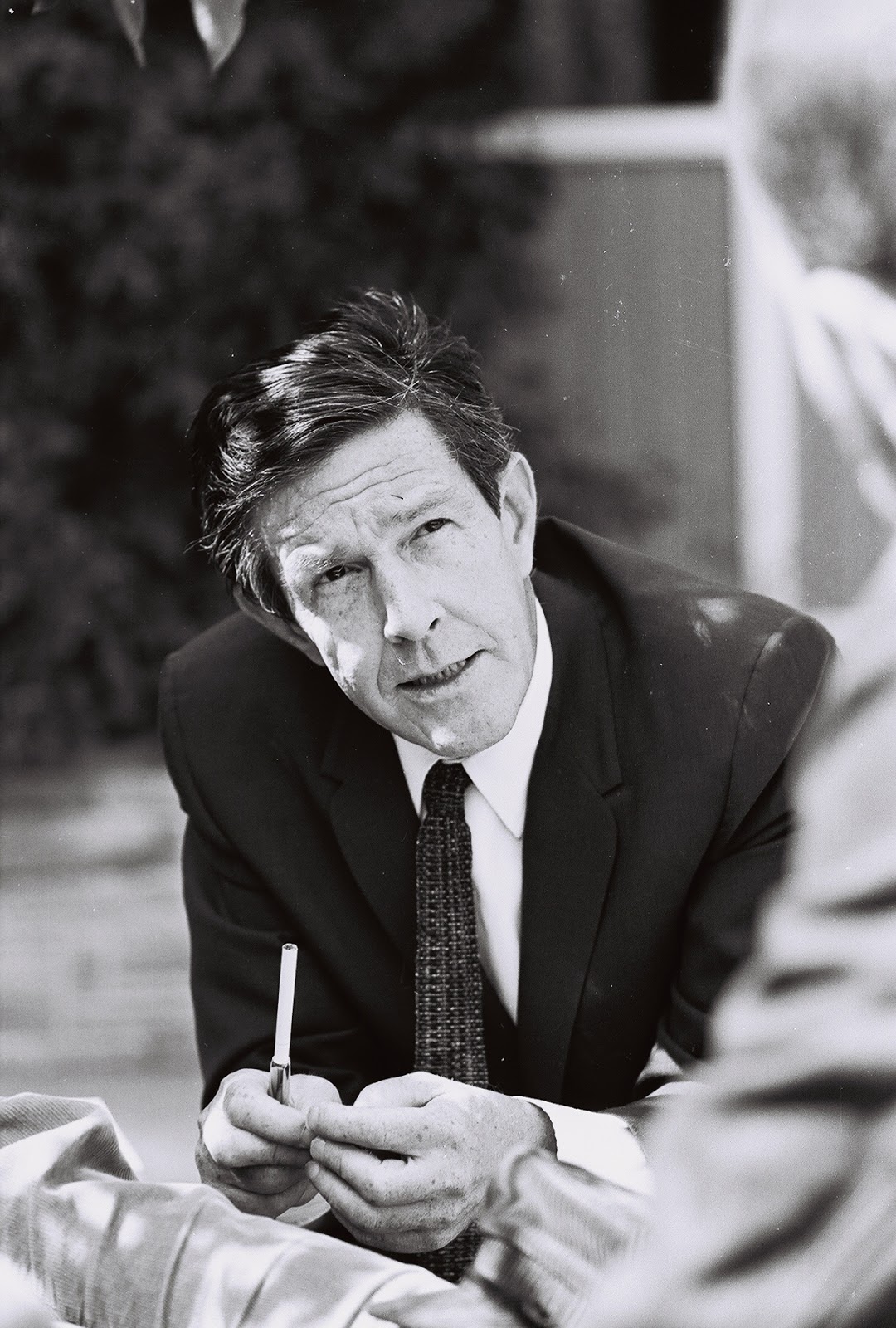
John Cage at Knox College in 1967.  Photo by Leonard Borden.
Of the four years I was enrolled at Knox College, I seem to have the least documentation for my third year, 1966-67: a half dozen Knox Student newspapers, a handful of letters, grade transcripts, papers and relevant notebook entries. There is however enough to nudge memories from that year--for instance, concerning some prominent visitors to campus.  Of some, like perennial Socialist presidential candidate Norman Thomas and UPI White House correspondent Merriman Smith, I have no recollection.  But I do remember the visit of Masters and Johnson.

 Dr. William Masters and Virginia Johnson were the co-authors of the sedately titled Human Sexual Response that nevertheless became an immediate best-seller when it was published in 1966.  The book reported on their studies of volunteers in their laboratory, and some of their conclusions contradicted conventional wisdom.  But their book's impact seemed based mostly on the fact that they were openly and dispassionately discussing aspects of sexual behavior and function that had not been part of acceptable public discourse.  In other words, they'd broken the silence.

 In January 1967, Dr. Master spoke to a capacity crowd of students in the Harbach Theatre and answered questions--some anonymously written in advance, some from the audience.  What I remember is the mood, which was of intense quiet and seriousness that approached reverence.  It seemed as if everybody believed that even a titter of nervous laughter, let alone a rude joke, would instantly send the event into chaos and disrepute.  (Although I do recall curious questions afterwards about the female student who had asked about fellatio and cunnilingus.)

W.H. Auden in New York 1966
From February 7 through 10, eminent poet W. H. Auden was at Knox.  He lectured in the Harbach Theatre, and read from his poetry in Kresge Recital Hall. Sometimes considered one of the 20th century's greatest poets (along with Yeats and Eliot), Auden's greatest influence was in the 1940s and 50s.

 American poetry took other directions by the 1960s, and I knew little about him.  We hadn't read him (as far as I remember) in our poetry classes, with the possible exception of his most famous poem, "September 1, 1939," written as World War II began.

 But he cut quite a figure on campus.  A couple of classmates remembered him wearing carpet slippers as he moved from place to place.  I recall his Hobbit or Tolkien sweatshirt (there was a national undergraduate revival of Tolkien underway.)

  I was among the students who had lunch with him on the balcony of the Oak Room.  This was supposed to be the first of several such lunches with various students, but it was the only one Auden attended.  He found the food inedible.  I was told that, hearing of Auden's penchant for food, the college booked him into the motel to which the Toddle House was attached.  I loved the Toddle House waffles, but it wasn't exactly gourmet dining.

 Classmate Leonard Borden was also at that lunch in the Oak Room.  He was assigned to then walk Auden to his next event, William Brady's Shakespeare class. As they ascended the stairs inside Old Main, Auden turned and offered Leonard this observation: "A poet should never use the word 'I' in a poem until he is over forty."

There was a party for him, at David Axlerod's apartment on Cherry Street downtown, which he shared with Dennis Stepanek.  Auden was there for awhile, pretty much staying in the kitchen.  This was after David got the ever-magical Judee Settipani to recreate a Mondrian design ("Broadway Boogie-Woogie") by painting it on a wall, significantly larger than the original.

 Auden had barely left the Toddle House behind before an entirely different sort of poet arrived, as cutting-edge as Auden was old guard. The second week of February 1967, Gary Snyder came to town.

  In his late 30s then, Snyder had been a presence in American poetry for over a decade.  He was among the poets who read at the famous Six Gallery evening in 1955 that premiered Allen Ginsberg's Howl, and launched the so-called Beat movement.  A student of American Indian cultures and both Chinese and Japanese languages, Snyder interspersed months and years at a Zen monastery in Japan with jobs on an oil tanker, on logging crews and as a fire lookout.

He was recently back from Japan when, just a couple of weeks before his Knox visit, Snyder accompanied Allen Ginsberg in leading the legendary Human Be-In in San Francisco that established the counterculture alliance between hippies and political activists, and prefigured the upcoming Summer of Love.

 The Knox Student lists Snyder's events as a lecture on Tuesday (subject: "What's Going On?") and a reading on Wednesday, both in the Alumni Room of Old Main beginning at 7:30 in the evening.  While Snyder did speak about political, cultural and environmental subjects at one or both of his appearances, I recall him reading a great deal of poetry at both--hours of it.

I'm pretty sure he read from Rip Rap and the completed sections of his long sequence Mountains and Rivers Without End.  He probably read work not yet published in book form; I seem to recall he read a version of "The Circumambulation of Mt. Tamalpais."  ("Circumambulation" is a ritual walk around a sacred object in Buddhist and Hindu traditions, and Mt. Tam near San Francisco is considered a sacred mountain. A year or two later, I participated in such a circumambulation of Mt. Tam with former Knox student Michael Hamrin.)

 Snyder's readings were mesmerizing: poems of simple descriptions in brief bursts of mostly nouns and verbs, and mostly one syllable words (a conscious choice in Rip Rap due to his observation of classical Chinese) that produced a cumulative, incantatory magic.  After awhile the words became mostly sound and you got tired, but then they took you to another level.  I doubt that many audiences anywhere had the opportunity to hear Gary Snyder read for such sustained periods.  

His "talk" was probably similar to observations in his essays "Buddhism and the Coming Revolution" and "Passage to More Than India" published in his 1969 book Earth House Hold (the title is one literal definition for "ecology"), and also reprinted in Allen and Tallman's 1973 The Poetics of The New American Poetry.   I'm certain, for example that he quoted (as he did in "Buddhism and...") the old International Workers of the World slogan, "Forming the new society within the shell of the old."

His emphasis on the ignored value of the non-human and Indigenous cultures struck a chord with me: as he wrote, "In fact, it is my own view that the coming revolution will close the circle and link us in many ways with the most creative aspects of our archaic past."

 Snyder also was an impressive presence on campus.  Jay Matson remembers that he wore an earring, some decades before this became a male fashion.  I recall the bells in his boots: little jingle bells that rang as he walked.  I loved that, and tried it myself for awhile.  But even in the upcoming counterculture it didn't catch on, alas.  Still, I remember sitting in the audience for the second event, alive with anticipation, and hearing those jingling boots tromping down the Old Man hall.

 The party for him was at James Campbell's apartment, which overflowed with students.  I asked him one question.  Though I don't remember what I asked about, it was in the nature of "how do you know?"  He answered that I'd have to "experience it."  I immediately jumped to the erroneous conclusion that he'd advised me to take LSD.  Such were the nerve endings as the wildness of the counterculture approached.  It was in fact a practical as well as a perfectly Buddhist answer to almost anything.

 Wendy Saul remembers telling Snyder at the party that she was writing a paper on witchcraft, and he said "something like, 'Why for God's sake? Just become a witch.' In retrospect that seems like good advice."

 But perhaps the most profound effect of Snyder's visit was felt by a younger student, Peter Overton.  He was so impressed by Snyder's talk that he decided to go to Japan as Snyder had done and study Zen.  Later he read about Tassajara and the San Francisco Zen Center.  He went to the Bay Area instead and began taking instruction at the Berkeley center.  Zen Buddhism in the Bay Area became his life.  Some of his talks are on the Internet.


I heard Snyder read again a few years later at a benefit reading for an ecology organization in Berkeley. He was among his old San Francisco colleagues, including Lew Welch, who read his famous California poem with the refrain "This is the last place/there is nowhere else to go."  Months later Welch disappeared, a presumed suicide.  I spoke with poet Michael McClure in 2003, who read there that day as well as at the historic 1955 event that launched Howl, and he remembered that reading in Berkeley as something special.

 For the next five years Snyder published poems in periodicals, from Look magazine and the New York Times to Poetry and the Hudson Review to Kayak, Caterpillar and Unmuzzled Ox.  His collection Turtle Island (a traditional name now applied to North America) sold something like 100,000 copies and won the 1975 Pulitzer Prize.  It included the prose statement "Four Changes" that set the agenda for a number of environmental groups.

Pretty soon after Snyder's Knox reading I bought the Four Season Foundation printings of RIPRAP and Cold Mountain Poems, and Six Sections from Mountains and Rivers Without End at the Knox bookstore, soon adding the earlier Totem Press edition of Myths and Texts.

For awhile after, I acquired his books haphazardly, mostly as I came across them used, but eventually I had the poetry collections The Back Country (1968), Regarding Wave (1970) Axe Handles (1983), Left Out in the Rain (1986) and the hybrid Turtle Island (1975) as well as the prose collections Earth House Hold (1969), The Old Ways (1977) and The Real Work (1980).

Probably his prose masterpiece is The Practice of the Wild, published in 1990.  It was one of my first acquisitions as a resident of California in 1996.  I saw it in the window of Arcata Books, used.  The bookstore owner sold it to me and said, "I knew it wouldn't last long.  I just put it out this morning."
I had already found Gary Snyder: Dimensions of A Life (probably on a sale table at the U. of Pittsburgh bookstore), a large collection of tributes on the occasion of his 60th birthday. The Haida artist Robert Davidson provided the cover illustration. When I mentioned the book to Davidson in 1994, he was surprised to hear Snyder was still alive.  He thought it was a memorial volume. But when I met the novelist and poet Jim Dodge here in Arcata a few years later, I could recall having read his contribution to this collection.

 For me, living in California brought new dimensions to Snyder's work, both in terms of places he wrote about and the relevance of his writing to our ecology. (He lives most of a day's drive south of me, in the foothills of the Sierras.)

 So I began to acquire his more recent books: the completed Mountains and Rivers Without End (1997), Danger on Peaks (poems, 2004), A Place in Space (new and selected prose, 1995), Passage Through India (1992 edition) and Back on the Fire (essays, 2007.)  I even got his doctoral thesis, He Who Hunted Birds in His Father's Village: The Dimensions of a Haida Myth (1979.)

 Even at that, there are books I missed.  More recently I added The Etiquette of Freedom (2010), a companion book to a film featuring Snyder in conversation with poet and fictionist Jim Harrison, which also includes the film on DVD.  Now I have another experience of Snyder reading his work (which he said "is mostly done") in his late 70s.   In May 2020 Gary Snyder turned 90.

Snyder, Ginsberg chanting, Human Be-In 1967
Allen Ginsberg did not visit Knox in my time there, but he did read at the University of Iowa in Iowa City that spring of 1967, probably in April.

 It was a Midwestern version of a Be-In, called Gentle Thursday.  Ginsberg was beginning his years of greatest fame on college campuses, and his identification with the counterculture.

 I hitched a ride with a group of Knox faculty and students (Doug Wilson was one.)  I remember it as a huge event in bright sunshine, with Ginsberg reading and leading his "Om" chants.

 Leonard Borden remembers that he read his poem "Kral Majales (King of the May.)"  We, as I recall, were pretty far away. ( Leonard reports however that some Knox classmates wound up at Ginsberg's table in the University of Iowa cafeteria.) When the official events were over, we heard about a big party that night that would feature a pig roast.  Some of our group stayed, but I was among those who returned before then.  Later we learned that a number of people at the party became ill from under-cooked pork.

  John Cage visited Knox for a few days in the spring of 1967, though I have no documentation on exactly when.  Leonard Borden has some photos however, that suggest the weather was sunny and warm.
Photo by Leonard Borden (cropped): Dennis Parks, David Axelrod, Tad Gilster, Don Hanson, Bill Kowinski and John Cage on the Gizmo Patio, Knox College 1967. Click photo to enlarge .
Leonard borrowed Jack Herbig's Leica to capture these shots on the patio. That's me in the Lennon cap and sunglasses.  The person we're all focused on is John Cage.

I remember this day.  I came outside from the Gizmo counter with my paper cup of coffee in hand, and saw John Cage sitting alone on the patio.  I immediately asked if I could join him, eager to take advantage of this opportunity for a one-on-one.  Unfortunately, once I sat down I couldn't think of anything to ask him, or to talk about.
 For some reason--or out of sheer befuddlement-- I brought up the subject of the New York World's Fair, which I had visited one hot afternoon.  That Fair was notorious for the long lines to the major exhibits.  In fact, Dave Altman and I had walked around to check out the lines, and realized that there wouldn't be time to get into anything before we had to go. So I asked John Cage what he thought of the Fair.  "I liked the lines," he said.

 It was such a perfect John Cage response that I dined out on this story for decades--including an actual dinner with a group from Carnegie Mellon University, where I got to tell it to monologist Spalding Gray.  And just after writing this I chanced across some black and white film footage of a younger Cage (in a biography of dancer Merce Cunningham) advising that people stuck in lines could be entertained by hearing the sounds around them as music, and seeing the movement around them as dance.

 But that brief exchange was about all the solo time I had with Cage, as a stream of other students (and one faculty member) saw us and clustered around.  In these photos by Leonard Borden, you can see ceramics prof Dennis Parks, and students David Axelrod, Jack Herbig, Tad Gilster and Don Hanson.  Others came and went.

For his event (or events) at Knox, Cage likely read from his book Silence (perhaps the "Lecture on Nothing") and newer work that would be collected in A Year From Monday -- maybe "How To Improve The World (You Will Only Make Matters Worse.")

In any case, it is from this latter piece that I extracted two statements that have stayed with me over the years.  I can only approximate his line breaks: "They ask what/the purpose of art is.  Is that how/things are?  Say there were a thousand/artists and one purpose, would one/artist be having it and all the nine/ hundred and ninety-nine others be missing the point?" "The truth is that everything causes/everything else.  We do not speak therefore/ of one thing causing another.  There/are no secrets.  It's just we thought they/said dead when they said bread." This piece also contains a speculation that seems to have come true: "Relevant information's hard to come/by.  Soon it'll be everywhere, unnoticed."

This lecture and others were replete with references to McLuhan, Buckminster Fuller and others who would form the backbone of 1970s futurism, a forgotten story.  Since I was well into my unguided and somewhat solitary immersion in McLuhan, this was pretty exciting.

 Cage talked about making creative choices based on "chance procedures," mostly throwing the stalks or coins of the I Ching.  I believe he selected some of what he read at Knox based on chance procedures.  I also seem to remember there was a performance of his most famous work, called 4' 33,'' which basically consists of musicians in a concert environment doing nothing for four minutes and 33 seconds.  The sounds that arise naturally in the room and from outside it during that time constitute the music.

 John Cage, born in 1912, had quite a life-- in California, Europe, the Pacific Northwest, New York etc.-- before his period of greatest international fame began in the 1960s, and his ideas found resonance in new intellectual movements as well as the growing counterculture.

John Cage at Knox 1967 by Leonard Borden
His music and his ideas could confuse and infuriate people, but John Cage himself was such a calming, good-humored and seemingly guileless presence, that the word "disarming" could have been coined just for him.

 He was that way at Knox, and he charmed everyone with his storytelling, and with a simplicity that encouraged receptivity to the complexities and paradoxes of his ideas. Formally dressed, with his cigarette holder, he was almost courtly. He listened.  But he wasn't stuffy.  We got to experience that frequent and legendary laugh. He seemed to enjoy Knox and its surroundings, including the mushroom-hunting he loved.  Wendy Saul remembers picking mushrooms on the Old Main lawn with him, and I recall overhearing on his second visit to Knox his rapturous description of a local mushroom expedition, probably at Green Oaks.

 On that second visit (probably the following year), Cage brought Merce Cunningham and dancers, so Knox got the rare opportunity to see these dances in intimate surroundings, with the artists available before and after the performances. (My memory is meeting them in the rehearsal lobby outside the Studio Theatre.)

 As I recall, these dances were also governed to some extent by indeterminate means and chance procedures that decided what each dancer would do in a particular space for each interval of time, so that every dance was a unique event. It's worth noting that the Merce Cunningham dance troupe worked in obscurity for more than a decade, from 1953 to 1965. They started to achieve recognition, especially within the dance world, no more than three years before their appearance at Knox.  Cunningham's stellar career stretched over 50 years.  He died in 2009 at the age of 90.

There are several threads that link these people together, other than their appearance at Knox in 1967.  One would run through Allen Ginsberg, who knew them all, including W.H. Auden.  But the most meaningful thread linking Snyder, Ginsberg and Cage is Zen Buddhism, and specifically the man who largely introduced Zen to America, D.T. Suzuki.

 This common starting point is described at the beginning of Kay Larson's wonderful 2012 book Where the Heart Beats: John Cage, Zen Buddhism, and the Inner Life of Artists.  The book is mostly about Cage but it starts with Gary Snyder in 1951, sitting by the side of the road while waiting for rides through Nevada to school in Indiana, reading Suzuki's essays.  Before long he would be meditating five hours a day in a Zen monastery in Japan.

A couple of years later, Allen Ginsberg picked up a different book by Suzuki in the New York Public Library, and decided to check out Suzuki's classes at Columbia. He didn't go for long but this first foray into Eastern modes would bear fruit in later years.

 Meanwhile, John Cage was already interested in Eastern modes of thought when he first heard Suzuki lecture on Zen in 1950.  When Suzuki's regular classes began in 1953, Cage was there.

 To some extent, Zen came naturally to Cage.  The basis of Buddhist meditation is attention; to be fully present in the moment.  That was his approach to music and living.

 Indeterminacy comes from Zen, Larson writes, in which there is no fixed identity but only process. Ego and other, inner and outer, life and death and other foundational dualities in western thought are questioned in Buddhism, which, if nothing else, liberates the individual to question other assumptions and behavior.

 Cage also found the essential humor in the apparent paradoxes and the odd wit of masters such as D.T. Suzuki, S. Suzuki (founder of the San Francisco Zen Center) and the Dalai Lama. According to Larson (a veteran art critic for New York Magazine and afterwards a practicing Buddhist), one element that the artistic innovators of the 1940s onwards had in common is that they'd just talked to John Cage.  For them and for us, Cage provided two attitudes: encouragement to be open to new ideas and one's own way, and his own openness to others, even when their work was very different from his.  Our "proper business", he said, is "curiosity and awareness."

Cage and Merce Cunningham, maybe 1950s
Larson also observes something especially relevant to these Knox years: that while postwar existentialism expressed alienation and suffering, the long tradition of Buddhism was meant to liberate individuals and alleviate suffering.  She structured her book in part to show how Cage found a way out of his own suffering by the means presented to him in Buddhist teachings. Cage presented alternatives to approaches and attitudes underlying our academic programs.

  There was a period when I made some decisions using chance procedures, to see what happened.  I used them in some writing, even in the 1970s.

Ultimately there is the question of how to sustain a life with this commitment.  But just having Cage's ideas and example in the mix was valuable.

 One of Cage's Knox trips was the occasion for an anecdote in his later book M:Writings 67-72, about Sam Moon picking him up at the airport. Cage became more of an international globe-trotter in the 1970s, but he did return to Knox for a performance in 1983, and was interviewed in the student magazine Catch.  This was shortly before Moon retired, which is a reminder that the other common thread here is that Sam Moon brought them all to Knox. John Cage died in 1992, weeks before his 80th birthday, which was set to be celebrated around the world.

Wednesday, May 08, 2019

Happy Birthday, Gary Snyder


Gary Snyder, American poet, essayist and teacher, is 89 today. In celebration of his birthday, I'm posting the poem that comes last in his 1991 collection, No Nature: New and Selected Poems. It's become one of my favorites.

 RIPPLES ON THE SURFACE

 "Ripples on the surface of the water--
were silver salmon passing under--different
from the ripples caused by breezes"

 A scudding plume on the wave--
a humpback whale is
 breaking out in air up
 gulping herring
                  ---Nature not a book, but a performance, a
 high old culture

 Ever-fresh events
 scraped out, rubbed out, and used, used, again--
 the braided channels of the rivers
hidden under fields of grass---

 The vast wild
             the house, alone.
The little house in the wild,
           the wild in the house.
 Both forgotten.

                                  No nature

            Both together, one big empty house.


I first heard Gary Snyder read when I was a student at Knox College in Galesburg, Illinois in the spring of 1967. In his late 30s then, Snyder had been a presence in American poetry for over a decade.  He was among the poets who read at the famous Six Gallery evening in 1955 that premiered Allen Ginsberg's Howl, and launched the so-called Beat movement.  A student of American Indian cultures and both Chinese and Japanese languages, Snyder interspersed months and years at a Zen monastery in Japan with jobs on an oil tanker, on logging crews and as a fire lookout.

He was recently back from Japan when, just a couple of weeks before his Knox visit, Snyder accompanied Allen Ginsberg in leading the legendary Human Be-In in San Francisco that established the counterculture alliance between hippies and political activists, and prefigured the upcoming Summer of Love.

 The Knox Student lists Snyder's events as a lecture on Tuesday (subject: "What's Going On?") and a reading on Wednesday, both in the Alumni Room of Old Main beginning at 7:30 in the evening.  While Snyder did speak about political, cultural and environmental subjects at one or both of his appearances, I recall him reading a great deal of poetry at both--hours of it.

I'm pretty sure he read from Rip Rap and the completed sections of his long sequence Mountains and Rivers Without End.  He probably read work not yet published in book form; I seem to recall he read a version of "The Circumambulation of Mt. Tamalpais."  ("Circumambulation" is a ritual walk around a sacred object in Buddhist and Hindu traditions, and Mt. Tam near San Francisco is considered a sacred mountain. A year or two later, I participated in such a circumambulation of Mt. Tam.)

 Snyder's readings were mesmerizing: poems of direct descriptions in brief bursts of mostly nouns and verbs, and short, often one syllable words (a conscious choice in Rip Rap due to his observation of classical Chinese) that produced a cumulative, incantatory magic.  After awhile the words became mostly sound and you got tired, but then they took you to another level.  I doubt that many audiences anywhere had the opportunity to hear Gary Snyder read for such sustained periods.
 
His "talk" was probably similar to observations in his essays "Buddhism and the Coming Revolution" and "Passage to More Than India" published in his 1969 book Earth House Hold (the title is one literal definition for "ecology"), and also reprinted in Allen and Tallman's 1973 The Poetics of The New American Poetry.   I'm certain, for example that he quoted (as he did in "Buddhism and...") the old International Workers of the World slogan, "Forming the new society within the shell of the old."

His emphasis on the ignored value of the non-human and Indigenous cultures struck a chord with me: as he wrote, "In fact, it is my own view that the coming revolution will close the circle and link us in many ways with the most creative aspects of our archaic past."

 Snyder also was an impressive presence on campus.  One attendee remembers that he wore an earring, some decades before this became a male fashion.  I recall the bells in his boots: little jingle bells that rang as he walked.  I loved that, and tried it myself for awhile.  But even in the upcoming counterculture it didn't catch on, alas.  Still, I remember sitting in the audience for the second event, alive with anticipation, and hearing those jingling boots tromping down the Old Man hall.

 The party for him was at a student apartment.  I asked him one question.  Though I don't remember what I asked about, it was in the nature of "how do you know?"  He answered that I'd have to "experience it."  I immediately jumped to the erroneous conclusion that he'd advised me to take LSD.  Such were the nerve endings as the wildness of the counterculture approached.  It was in fact a practical as well as a perfectly Buddhist answer to almost anything.


I heard Snyder read again a few years later at a benefit reading for an ecology organization in Berkeley. He was among his old San Francisco colleagues, including Lew Welch, who read his famous California poem with the refrain "This is the last place/there is nowhere else to go."  Months later Welch disappeared, a presumed suicide.  I spoke with poet Michael McClure in 2003, who read there that day as well as at the historic 1955 event that launched Howl, and he remembered that reading in Berkeley as something special.

 For the next five years Snyder published poems in periodicals, from Look magazine and the New York Times to Poetry and the Hudson Review to Kayak, Caterpillar and Unmuzzled Ox.  His collection Turtle Island (a traditional name now applied to North America) sold something like 100,000 copies and won the 1975 Pulitzer Prize.  It included the prose statement "Four Changes" that set the agenda for a number of environmental groups.

Pretty soon after Snyder's Knox reading I bought the Four Season Foundation printings of RIPRAP and Cold Mountain Poems, and Six Sections from Mountains and Rivers Without End at the Knox bookstore, soon adding the earlier Totem Press edition of Myths and Texts.

  For awhile after, I acquired his books haphazardly, mostly as I came across them used, but eventually I had the poetry collections The Back Country (1968), Regarding Wave (1970) Axe Handles (1983), Left Out in the Rain (1986) and the hybrid Turtle Island (1975) as well as the prose collections Earth House Hold (1969), The Old Ways (1977) and The Real Work (1980).

Probably his prose masterpiece is The Practice of the Wild, published in 1990.  It was one of my first acquisitions as a resident of California in 1996.  I saw it in the window of Arcata Books, used.  The bookstore owner sold it to me and said, "I knew it wouldn't last long.  I just put it out this morning."
I had already found Gary Snyder: Dimensions of A Life (probably on a sale table at the U. of Pittsburgh bookstore), a large collection of tributes on the occasion of his 60th birthday. The Haida artist Robert Davidson provided the cover illustration. When I mentioned the book to Davidson in 1994, he was surprised to hear Snyder was still alive.  He thought it was a memorial volume. But when I met the novelist and poet Jim Dodge here in Arcata a few years later, I could recall having read his contribution to this collection.

 For me, living in California brought new dimensions to Snyder's work, both in terms of places he wrote about and the relevance of his writing to our ecology. (He lives most of a day's drive south of me, in the foothills of the Sierras.)  So I began to acquire his more recent books: the completed Mountains and Rivers Without End (1997), Danger on Peaks (poems, 2004), A Place in Space (new and selected prose, 1995), Passage Through India (1992 edition) and Back on the Fire (essays, 2007.)  I even got his doctoral thesis, He Who Hunted Birds in His Father's Village: The Dimensions of a Haida Myth (1979.)  Even at that, there are books I missed.

More recently I added The Etiquette of Freedom (2010), a companion book to a film featuring Snyder in conversation with poet and fictionist Jim Harrison, which also includes the film on DVD.  Now I have another experience of Snyder reading his work (which he said "is mostly done") in his late 70s.  In honor of his 89th birthday, I just purchased a recycled copy of No Nature: New and Selected Poems.  

Gary Snyder's writings led me beyond his own books to a wide network of others, too numerous and involved in their connections to describe here. They helped define my attitudes and activities in relationship to forests and non-human life in general, and they were checkpoints along the way.  To some degree, they led me to far northern California, where I've lived for more than 20 years now.

So I celebrate his work, and the fact that he is among us now to celebrate his own 89th birthday.

Monday, May 28, 2012


The Etiquette of Freedom: Gary Snyder, Jim Harrison, and The Practice of the Wild
Edited by Paul Ebenkamp
Counterpoint

Poet and eco-elder Gary Snyder grew up on a farm in Washington state. When he was a boy he asked his Sunday school teacher if he would meet a beloved and recently dead heifer in heaven. The clergyman said no. “Then I don’t want to go there!” said novelist Jim Harrison from across the dinner table, listening to Snyder tell this story. “That’s exactly what I said!” Snyder exclaimed, explaining that this exchange inspired his interest in other cultures that included the non-human in their moral universe.

It’s a moment in the DVD of a documentary film directed by John Healey that is conveniently tucked in a plastic envelope at the back of this book. So to the music CD/concert DVD packages and all the other hybrids, add the book-with-the-movie. The book is marketed as conversations between “old friends” Snyder and Harrison, but in fact it is culled from the making of a film that is essentially about Gary Snyder, in which Harrison (a co-producer) participates. Also interviewed are poet Michael McClure (recalling Snyder from both the Beat and Summer of Love eras in San Francisco), poet (and Snyder's first wife) Joanne Kyger, academic Scott Slovic and others.

The film was keyed to the 20th anniversary of Snyder’s landmark book of essays, The Practice of the Wild. (I got that book when I spotted a used copy shortly after it was placed in the window of the old Arcata Bookstore. “I knew it wouldn’t stay there long,” the owner said.) This book includes a transcript of the movie, but also a lot more, including Snyder-Harrison conversations in which Harrison comes off a lot better than he does in the film. It finishes with some Snyder poems and a chapter from The Practice of the Wild.

Snyder seems aware that the movie allows him to correct the record on some things.  Jim Harrison suggests that what distinguishes Snyder's early poems, especially in Rip Rap (his first book) is the reality and rhythm of work.  (Snyder worked as a fire lookout, a logger and earlier as a merchant seaman.)  This insight apparently is not exclusive to Harrison--in the book Snyder mentions a doctoral thesis he's read about the relationship of his poems and work, which he thinks is overblown. In the movie he allows that "part of it was the work," but that he had a literary purpose.  He'd been studying classical Chinese which is "strongly monosyllabic" and decided to experiment with monosyllabic English words that came before the Norman influence.  He wanted to use this "old style language," these words that are as hard as rocks, to build "a little rock trail" of language.  One can add that this particularly fit his subject for that book.

The title of the film was the same as the book The Practice of the Wild, and the movie has an interesting moment when Snyder brings the conversation back to the book, as if that purpose seemed to be slipping away.  In any case he mentions that certain distinctions he made in that book have not caught on, even with environmentalists: nature as the totality of what exists, wild as the natural process, and wilderness as the place where the wild predominates.  It's a point that Jack Turner later made in his book, The Abstract Wild,  especially as it relates to Thoreau's famous statement, "In wildness is the preservation of the world."

The book and movie discuss Snyder's experiences with Zen and Asian thought.  He talks about his Zen training in Japan, and quotes one of those great paradoxical Zen guides: "The perfect way is without difficulty.  Strive hard!"  In the book Snyder mentions having tea with Shunryu Suzuki, who started the San Francisco Zen Center.  Suzuki thought his students were too serious--he wanted them to have a sense of humor.  I laughed reading this, because I love Suzuki's books (and books about him) for their wonderful humor.

However, despite extolling Snyder's Pulitzer Prize winning book, Turtle Island (a name among some Native Americans applied to North America, which has since become an accepted name), there is nothing in the movie--and only a little in the "outtakes" of the book--about his work on Native American beliefs and cultures, which is a somewhat controversial subject (some Native writers, notably Leslie Marmon Silko, criticized him for appropriations) but still is an important element in any discussion of America and its natural world.  There also was mention of the bioregionalism movement in the movie, but not enough--especially in relation to The Practice of the Wild.

The DVD also has extras, including more from the interviews, and more of Snyder reading his poems. All this is good, because the movie itself is on the thin side. Still, the DVD provides the sense and sound of these people, and you get a little companionship along with the substance that is primarily available in the handy form of readable words in the book. And there are those filmed moments, like the one that begins this review, that really help illuminate Gary Snyder and his work.

But the book as a book is a little too much like an adjunct to the movie.  There is no index, no bios for the other people quoted in it, and the introductions are about making the movie, not about what's in the text. There is a list of books by Snyder (I've got something like 17) in the back, but the only book about him I've got isn't mentioned:  Gary Snyder: Dimensions of a Life, edited by Jon Halper (Sierra Club Books) which is a generous collection of essays about him by friends and family. (The cover is a painting by Haida artist Robert Davidson, who thought he was contributing it for a memorial volume.  When I saw it at his studio and reassured him that Snyder was still alive, he joked "I mourned for nothing.")

 For those interested in his prose on subjects that whiz by in this movie and book, there's of course The Practice of the Wild (1990) but also Earth House Hold (a founding document of the ecology movement in the 50s and 60s--the word "ecology" can be translated as Earth household), The Old Ways (1977), The Real Work (1980) and A Place in Space (1995) as well as parts of more recent books.

Still, in the end this book/movie is a garden of delights: interesting conversation, recollections, images and Gary Snyder reading his poems, which may not be essential to appreciating them but it adds a special dimension. I once had the privilege of hearing him read for several hours at a time, several days in a row, a revelatory experience. Now I can pop this into the DVD any time I want! Thanks to this book.

As I mentioned, this book is marketed as a conversation between Gary Snyder and Jim Harrison, which made me curious for so long that I finally bought it.  Though it isn't that, I'm not really disappointed.  I wouldn't mind reading the transcripts of those conversations, though.  But a conversation I'd really like to overhear would be between Gary Snyder and another writer who taught at the University of California at Davis at the same time as he did: Kim Stanley Robinson.

Thursday, April 22, 2010


Earth Day #40: Classics

Stewart Udall, Secretary of Interior in the Kennedy and Johnson administrations, died last month. A pioneer in environmentalism before and after the first Earth Day (and a major voice in the excellent PBS American Experience docu, Earth Days), he was the author of a mostly forgotten but very important book, The Quiet Crisis (1963). Following only a year after Rachel Carson's expose of chemical pollution, Silent Spring, Udall's book took a more historical view--chronicling American conservation efforts--and a wider view of the present: "In a great surge toward 'progress,' our congestion increasingly has befouled water and air and growth has created new problems on every hand. Schools, housing, and roads are inadequate and ill-planned; noise and confusion have mounted with the rising tempo of technology; and as our cities have sprawled outward, new forms of abundance and new forms of blight have oftentimes marched hand in hand."

Some books of bygone decades describe problems which the subsequent environmental movement addressed in America, while others--like Paul Ehrlich's The Population Bomb--dealt in terms now obsolete with problems that are still with us, and have even grown worse. But there are other books, like Udall's, that are of more than historical interest: they are classics both in the sense of being among the first to break new ground, and of enduring value to us now, including as reading experiences. They are classics, not only or not specifically of "environmentalism," but of all that pertains crucially to Earth, and Earth Day.

Udall's book was one of the first public policy books to recognize the importance of Aldo Leopold and his essay on "the land ethic," in the now classic book, A Sand County Almanac. Another writer of that era was Loren Eiseley, and to pick out probably his best known title--The Immense Journey--is to give only one example of his enduring writing, in a number of books.

The next generation of indispensible writers begins with Gary Snyder, in his poems but also in his prose statements, especially the landmark The Practice of the Wild (1990) but also The Old Ways (1977), The Real Work (1980) and A Place in Space (1995.)  These helped to inspire the bioregionalism and rehabitation movements that were and are especially influential in the western U.S.
One of the most important figures in establishing the breadth and depth of the ecology movement--and one of the most forgotten, was Paul Shepard. His essay, "Ecology and Man, A Viewpoint" was a foundation document. Many of the ideas now entering the mainstream through newer authors were even more fully and gracefully articulated in his books, considered radical in their time, particularly the crucial importance of nature to childhood and human development (Nature and Madness) and the idea that "animals made us human" (even the phrase is originally his) in Thinking Animals, The Tender Carnivore and the Sacred Game, The Others and other books.

Today we pursue a deeper understanding of the Earth through the ideas that coalesce around the powerful image of Gaia. Various elements of that understanding come out of books that are still classics, such as the best-selling essays of Lewis Thomas in Lives of A Cell, and Gregory Bateson's Steps Towards An Ecology of Mind. Learning more about the ways in which our human ancestors related to the natural world (another major subject for Paul Shepard), is informed by a deeper understanding of surviving Indigenous peoples. A classic in this regard is Make Prayers to the Raven by Richard Nelson, who used this experience with the Koyukon elders to inform his own intense experiences in The Island Within.

We all have our favorite authors and their books describing their experiences in the natural world, but among the essential authors who combines description of experiences with a greater context, Gary Snyder is one of my favorites, and I revere especially his book, The Practice of the Wild.

Another book that was particularly important to me but which I feel is a classic that fills in an important conceptual area is the relatively unknown Ceremonial Time by John Hanson Mitchell. It is the history of a single square mile of New England, over 15 thousand years. It gives the dimension of time to place, and vice versa.

Finally, there are much more recent books on the most important topics concerning the Earth and its future, particularly in two areas. First is biodiversity and our understanding of both the deep interrelationship of life and the understanding of other species, particularly as we overcome the bias of the mechanistic interpretation of Darwinian evolution. I don't know if there are any classics in these areas yet, though landmark books would likely include Acquiring Genomes by Lynn Margulis and Dorion Sagan, and Evolution in Four Dimensions by Eva Jablonka and Marion J. Lamb. Books like Beast and Man by philosopher Mary Midgely and books by Elaine Morgan like The Acquatic Ape and The Descent of Woman are exciting to read and shake things up.

The other topic is the climate crisis, and in this area I have more definite choices: An Inconvenient Truth by Al Gore remains the classic survey of the subject, Forecast by Stephan Faris is the best account of the present consequences, while Down to the Wire by David Orr is the best book so far on the climate crisis future.

And now that I've been so definite, I have to take it back--these are my choices, books I would recommend as classics, but I haven't read everything so I'm sure I'm missing plenty.

Saturday, May 16, 2009


For Pleasure (Spring 2009): Danger on Peaks, Gary Snyder's 2004 book of poems from Shoemaker Hoard, which immediately and maybe eccentrically became my favorite. It begins with a wonderful pairing of old and new poems about Mt. St. Helen's and our human power and apparent passion to destroy the world and ourselves, with a wise symmetry that continues throughout. Short, late poems and a group of recent poems with prose contexts are also wise and a joy.

I've also been re-reading William Irwin Thompson, preparing to review his latest. I read for the first time his book with David Spangler, Reimagination of the World (Bear & Co.), and Thompson's autobiographical riffs in that volume sent me to his only novel, Islands Out of Time (also Bear & Co.), his sci-fi allegory of the New Age set in Atlantis. I don't know enough about the New Age scene of the 70s and 80s to get more than his own more familiar obsessions, but I enjoyed the novel as a novel. A guilty pleasure was another in the Winston juvenile s/f series, and one I know I read as a pre-adolescent, Trouble on Titan by Alan E. Nourse. Although I remember reading it from the title I didn't remember the story, so it was new, and pretty good. It's this kind of book I like to read as I'm dropping off to dreamland. This spring I even read one of the Flash Gordon novels--terrible but a great giggle.