Showing posts with label Indigenous peoples. Show all posts

Monday, August 26, 2013

Of Africa
By Wole Soyinka
Yale University Press

Wole Soyinka is a Nobel Prize winning playwright and writer from Nigeria (the first writer of African descent to win the Prize for literature), who has spent  many years in the U.S. and England, often in political exile.  But he has not detached himself from Africa, returning there to teach and be involved when political conditions permitted.  He is well qualified both in knowledge and the ability to communicate to a western audience, still mystified by an entire continent.

This ignorance is mostly self-imposed, arising in part from the resistance to learning the deep history of cultures different enough to question western assumptions, as well as resistance to accepting the later history that implicates the west in exploitation and oppression.  Perhaps most of all, resistance to the consequences of that history.

My first impression of this book was its refreshing eloquence.  Soyinka uses the English language with increasingly rare precision and imagination.  He begins by musing on Africa as a literary concept, in actual literature as well as in common belief and actual practice--for instance, the creation of countries and boundaries that have nothing to do with Africa itself or the differences among its people.  "Africa remains the monumental fiction of European creativity."

Ignorance of the effects of history--of in some ways the lingering continuity--hampers western efforts to understand contemporary Africa.  Soyinka is especially illuminating on specific patterns of the slave trade that continue to shape events, incorrectly understood without this insight.  "It is short-changing the power of history to pretend that the events in the Sudan are not based on a perception that dates back to a relationship rooted in the history of slavery..."

Establishing these perspectives, Soyinka narrates some recent history that takes on different meaning.  Later he discusses the "spirituality of a continent" in illuminating terms, with relevance to existing conflicts.  This section of this book seems highly valuable if not indispensable to understanding the worst conflicts and problems in Africa today.

It is unusual--maybe even disconcerting at times--to read such informed and cogent analysis on important aspects of the real world, couched in glittering prose that sometimes stops the reader in admiration.  He somewhat playfully suggests that suppressing complex truths through political correctness is as distorting as denying them through ideology or dictatorship, capping the discussion with a phrase of brilliant music as well as meaning:   "Shall we appropriate the coy scissors of censorship?"

In words and number of pages this is a relatively brief book.  Yet it is dense with meaning, requiring careful attention from those with little knowledge of Africa--that is, most of us.  It is also a painful subject, and cowardice as well as denial are additional reasons for our willed ignorance.  But for those who appreciate fine writing--who in fact miss it--this book may contain difficult truths that are hard to assimilate, while the reading itself is revelatory.

The Obamas visiting cells for slaves on their recent trip to Africa

Monday, December 17, 2012

Gifts of Art


Rene Magritte: Newly Discovered Works
Edited by Sarah Whitfield
Yale Press

This is the season for coffee table art books, which have apparently outlived coffee tables.  Rene Magritte is one of a handful of modern artists who also fascinates a popular audience with his playful juxtapositions and enigmatic images.  Over the past couple of decades a number of works have surfaced purporting to be Magritte's.  This volume publishes color images of many that have been authenticated as true Magrittes.

For the Magritte aficionado, the imagery of many will be familiar--not only did Magritte often mix and match his imagery, but he created exactly (or almost exactly) the same imagery in different media (here it seems to be most often gouache versions of oil paintings.)  Still, there are enough new variations and several spectacular new images to delight even the casual admirer of Magritte's work.  This is a handsome volume indeed, with some images filling a large page.  The scholarly notes are precise but don't overwhelm the images.  Like many famous Magritte paintings, they delight--they make you smile, but also often with that air of mystery and melancholy.  I've always liked his skies, which seem to be between night and day.  Dawn or dusk--or both.  That's Magritte.

Here are three more of my favorites from Yale:


Ezra Stoller: Photographer
Edited by Nina Rappaport and Erica Stoller

Ezra Stoller's photographs of the work of modern architects helped make them famous.  This volume of his mostly black-and-white photography from the 1940s to the 1970s includes these photos, but also photos of other characteristically modern exteriors and interiors--everything from inside the United Nations to inside a Sears store.  The photos often concentrate on what's most interesting about a building: the play of light and shadow, for instance, or its particular place in the landscape (a small modern house at the top of a formidable rocky hill.)  A few of the interiors include people, which at this point help to place them in time, but most of the images are recognizably from the modern age--the pre-post-modern age, that is.

The selection and arrangement of images is excellent for browsing as well as study, and there are several introductory essays on the biographical, historical and formal background.  "My father was a storyteller," Erica Stoller writes, and this volume is like a collection of visual short stories.  It should please readers beyond those involved in either architecture or photography, but will be of special interest to them.

 Ancestral Modern
by Pamela McClusky, Wally Caruana, Lisa Graziose Corrin, and Stephen Gilchrist
 
Artists and others have long been fascinated with the imagery of Australian aboriginal art, both ancient and contemporary.  But beyond their interest as abstract images, there is often a specific relationship of the images to actual landscape, animals and historical events.  This volume matches images with the aspects of the real world that inspired them.  It should appeal to the wandering eye, open to color and pattern and to their relationship to nature, but there is also the scholarly support by two Australian and two American curators that adds another level of satisfaction as well as a permanent contribution to knowledge.


Roy Lichtenstein
James Rondeau and Sheena Wagstaff; With contributions by Clare Bell, Yve-Alain Bois, Iria Candela, Harry Cooper, Sara Doris, Chrissie Iles, James Lawrence, and Stephen Little.

Lichtenstein's images also combine popular fascination with artistic stature.  This volume expands on the familiar with a more complete view of the artist's work, plus previously obscure drawings and collages.  The contributors place Lichtenstein in art history and his own time, while the wealth of images (some 130 works) presented in this large format may fascinate and delight on their own.  

Thursday, April 22, 2010


Earth Day #40: Classics

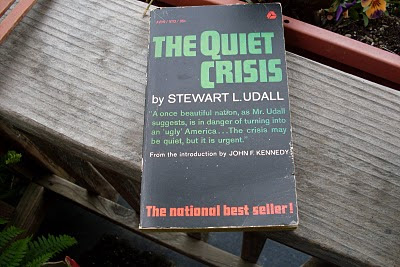
Stewart Udall, Secretary of Interior in the Kennedy and Johnson administrations, died last month. A pioneer in environmentalism before and after the first Earth Day (and a major voice in the excellent PBS American Experience docu, Earth Days), he was the author of a mostly forgotten but very important book, The Quiet Crisis (1963). Following only a year after Rachel Carson's expose of chemical pollution, Silent Spring, Udall's book took a more historical view--chronicling American conservation efforts--and a wider view of the present: "In a great surge toward 'progress,' our congestion increasingly has befouled water and air and growth has created new problems on every hand. Schools, housing, and roads are inadequate and ill-planned; noise and confusion have mounted with the rising tempo of technology; and as our cities have sprawled outward, new forms of abundance and new forms of blight have oftentimes marched hand in hand."

Some books of bygone decades describe problems which the subsequent environmental movement addressed in America, while others--like Paul Ehrlich's The Population Bomb--dealt in terms now obsolete with problems that are still with us, and have even grown worse. But there are other books, like Udall's, that are of more than historical interest: they are classics both in the sense of being among the first to break new ground, and of enduring value to us now, including as reading experiences. They are classics, not only or not specifically of "environmentalism," but of all that pertains crucially to Earth, and Earth Day.

Udall's book was one of the first public policy books to recognize the importance of Aldo Leopold and his essay on "the land ethic," in the now classic book, A Sand County Almanac. Another writer of that era was Loren Eiseley, and to pick out probably his best known title--The Immense Journey--is to give only one example of his enduring writing, in a number of books.

The next generation of indispensible writers begins with Gary Snyder, in his poems but also in his prose statements, especially the landmark The Practice of the Wild (1990) but also The Old Ways (1977), The Real Work (1980) and A Place in Space (1995.)  These helped to inspire the bioregionalism and rehabitation movements that were and are especially influential in the western U.S.
One of the most important figures in establishing the breadth and depth of the ecology movement--and one of the most forgotten, was Paul Shepard. His essay, "Ecology and Man, A Viewpoint" was a foundation document. Many of the ideas now entering the mainstream through newer authors were even more fully and gracefully articulated in his books, considered radical in their time, particularly the crucial importance of nature to childhood and human development (Nature and Madness) and the idea that "animals made us human" (even the phrase is originally his) in Thinking Animals, The Tender Carnivore and the Sacred Game, The Others and other books.

Today we pursue a deeper understanding of the Earth through the ideas that coalesce around the powerful image of Gaia. Various elements of that understanding come out of books that are still classics, such as the best-selling essays of Lewis Thomas in Lives of A Cell, and Gregory Bateson's Steps Towards An Ecology of Mind. Learning more about the ways in which our human ancestors related to the natural world (another major subject for Paul Shepard), is informed by a deeper understanding of surviving Indigenous peoples. A classic in this regard is Make Prayers to the Raven by Richard Nelson, who used this experience with the Koyukon elders to inform his own intense experiences in The Island Within.

We all have our favorite authors and their books describing their experiences in the natural world, but among the essential authors who combines description of experiences with a greater context, Gary Snyder is one of my favorites, and I revere especially his book, The Practice of the Wild.

Another book that was particularly important to me but which I feel is a classic that fills in an important conceptual area is the relatively unknown Ceremonial Time by John Hanson Mitchell. It is the history of a single square mile of New England, over 15 thousand years. It gives the dimension of time to place, and vice versa.

Finally, there are much more recent books on the most important topics concerning the Earth and its future, particularly in two areas. First is biodiversity and our understanding of both the deep interrelationship of life and the understanding of other species, particularly as we overcome the bias of the mechanistic interpretation of Darwinian evolution. I don't know if there are any classics in these areas yet, though landmark books would likely include Acquiring Genomes by Lynn Margulis and Dorion Sagan, and Evolution in Four Dimensions by Eva Jablonka and Marion J. Lamb. Books like Beast and Man by philosopher Mary Midgely and books by Elaine Morgan like The Acquatic Ape and The Descent of Woman are exciting to read and shake things up.

The other topic is the climate crisis, and in this area I have more definite choices: An Inconvenient Truth by Al Gore remains the classic survey of the subject, Forecast by Stephan Faris is the best account of the present consequences, while Down to the Wire by David Orr is the best book so far on the climate crisis future.

And now that I've been so definite, I have to take it back--these are my choices, books I would recommend as classics, but I haven't read everything so I'm sure I'm missing plenty.

Monday, September 14, 2009


"Conservation Refugees" highlights a conflict and a situation that may be surprising: efforts to save wilderness by evicting the Indigenous peoples who live there. This informative and provocative book is reviewed below.
Conservation Refugees: The Hundred-Year Conflict Between Global Conservation and Native Peoples
by Mark Dowie
The MIT Press

It's become common to think of Indigenous peoples as the first environmentalists, but while the reality is more complex, the basic link between the land and the people who have long been part of its ecologies is strong and true. In the late 1980s, when the South American rainforests were a global environmental concern, one of the celebrities making the case--Sting, who started the Rainforest Foundation--made common cause with Indigenous tribes, particularly the Kayapo of Brazil, and stated the principle: the way to save the rainforests is to save the Indigenous peoples who live in them.

Some twenty years later, this is still something of a radical principle, according to the history that journalist Mark Dowie relates in this book. Citing situations in Africa and Asia as well as South and North America, large environmental organizations in league with international development powerhouses have too often attempted to save wilderness areas by moving Indigenous peoples out. The repeated result has been to impoverish and destroy these peoples (with countless individual tragedies) while often enough also failing to really preserve a healthy ecology.

Dowie doesn't dismiss the problems. He acknowledges harmful practices of some Indigenous groups, but argues that it is better to negotiate changes in these practices than to arrogantly dispossess entire peoples, creating these "conservation refugees." It is that arrogance--including that of a largely white environmentalist establishment--that contributes to the misunderstanding and suspicion that has divided two groups that should be natural allies: Native peoples and environmentalists. Dowie argues as well that the idea of wilderness as meaning human-free is another cause of these conservation tragedies.

"One can only wonder what Yosemite would look like today were the descendants of Tenaya still thriving in the valley, sharing the native wisdom accumulated over 4,000 years in the ecosystem, and sharing, as equal partners in the stewardship and management of the park," he writes. "What would be the state of its biotic wealth? Would the grizzly bear and bighorn sheep still roam its meadows and canyons?"

Such observations are backed by reporting in that difficult midrange between the specifically descriptive and the generally conclusive. Readers have to be willing to navigate the acronyms and statistics, but the cumulative effect is a compelling history of global failures and successes in saving the last natural ecosystems, and saving the last Indigenous peoples. The stories are complex as reality, and as human.

Economic development, national and international politics all come into play. But for all the tragedy there is also growing awareness, and sophistication in finding common ground and developing partnerships. There is also the assertion of principle, such as the UN Declaration on the Rights of Indigenous Peoples, the text of which is included in this book.

Conservation Refugees is informative, enlightening and provocative, highlighting a key but neglected feature of a crucial set of problems of planetary significance.