Showing posts with label for pleasure. Show all posts

Sunday, July 14, 2024

Reading Mason & Dixon


I like reading long novels. Often they are among my favorites of  favorite authors, like Jonathan Lethem's Chronic City or Richard Powers' Goldbug Variations and The Time Of Our Singing, Don DeLillo's Underworld (though my absolute favorite of his is the somewhat longish Ratner's Star), and Jim Harrison's The Road Home (nearly 500 pages on its own, it is also a kind of sequel to the shorter Dalva.) I've had stretches of taking on long classics all in a row: Moby Dick, War & Peace, Anna Karenina.  In the first few years of my retirement I read several long Dickens' novels, though I admit I haven't attempted the longest, Martin Chuzzlewit.  

I didn't come to this naturally (but that's a longer story) and I don't get through them all--I have yet to sustain interest in the world of Middlemarch, though I appreciate the skill of the writing.  I do need to be involved in the world of the novel, but what grabs me and holds me is the rhythm of the prose.  The pleasures of that are enough to keep me going, even when (as frequently happens) I'm not all that sure what's going on.  I've turned to plot guides, and in the case of Dickens, a good BBC/PBS film adaptation, to help me sort out the characters and events.

The writing, the mesmerizing rhythms of it have especially been the attractions of several of Thomas Pynchon's long novels.  I read V twice and had a pretty good idea of what was going on the second time.  I started Gravity's Rainbow several times, I loved the first section a lot (same with the first section of Ulysses) but couldn't get past it.  Then I read it through in the 1980s (when I noticed that the movie The Adventures of Buckaroo Banzai stole the name of Yoyodine Propulsions from this book.)  After my retirement in 2016 I read it again, this time with a guidebook or two.  That added to the pleasure.


Gravity's Rainbow
is very likely Pynchon's masterpiece, but I have a special fondness for the 1085 pages of Against The Day.  If it has a plot I don't know what it is.  I experienced it as a compendium of early twentieth century genres, including the western and especially boy's adventures. The group of boys as a kind of Starfleet in dirigibles is just perfect.

The occasion for all of this is that I have finally finished another long Pynchon, Mason & Dixon.  I read its 773 pages over several years--so many I can't remember when I started it, but probably two or even three this time.  I've had a copy since it was published in 1997, but I was always stopped in my reading tracks by the strange 18th diction and spelling, and especially the rampant Capitalizations of nouns and their modifiers, and perhaps more. 

  This still slowed me down in this recent attempt, and this hefty volume would drift to the bottom of the pile next to me.  But I'd dip into it every once in awhile, if only for a shot of Pynchon energy in a dismal verbal world.  Then I would get rolling for awhile.  But since I seldom understood what was going on beyond the particulars of a scene, I couldn't sustain the momentum.  Until I did, and read the last two or three hundred pages in a long series of consecutive evenings.  

In general, the novel really is about Mason and Dixon--before, after and especially while they were embarked on the one job for which they are remembered, fixing the border between Pennsylvania and Maryland that by the 19th century became the border between North and South.  Other characters in the novel have historical counterparts as well (George Washington and Samuel Johnson have cameos, and Ben Franklin comes across as a wily crank who keeps getting people to electrocute themselves.)  I suppose I actually did learn things about the 18th century , but basically I was just along for the ride.

Besides--as Eileen Ecklund notes in a contemporary review I chanced upon after writing this piece, "...the most basic of my Pynchon reading lessons: you will not be tested on this later."

Instead of plot developments I noted little allusions, buried anachronisms and jokes.  Several titles of other Pynchon works appear in the prose, like "inherent vice" (p. 272) "against the day" (p.683), and a brief appearance of a family name (Bodine--p.566) that appears in other Pynchon novels, notably in V and Gravity's Rainbow.  There are allusions that perhaps only a Doctor Who fan would know (a Coach designed by the Jesuits--the scientist/magicians of the day--is "bigger on the inside" (p. 354) and a structure decaying in the woods also suspiciously akin to the TARDIS (412.)  And then there's the Kabbalistick sect that flashes a strange hand sign while uttering, "Live Long and Prosper." (485)  

The Reader's Fortitude is rewarded with Pynchon elegance and eloquence, such as on the subject of slavery.  Stories of new scientific technologies and of magic intermingle, especially on the Pennsylvania frontier (including country I know from my own boyhood)  and there is plenty of the Fantastic (a Robot Duck and a Talking Dog for starters.) The futility of the frontier mentality--in which perfection is finally just beyond the next ridge, until it always isn't--and the fluidity of actual and metaphorical border areas, all appear to be themes. But I mention all this less to explain the book, than to celebrate the fact that I read it.

I had just about finished reading it in fact when I learned of the imminent publication of the Mason & Dixon Companion, out next month, which presumably suggests more than I discerned about the plot, themes etc. as well as the many allusions I'm sure I missed.   But as much as I enjoyed this book, I'm not quite ready to start it all over again, Companion at my side.  But maybe someday.  For now, I am comforted by noting that it took 27 years for anyone to write a Companion to Mason & Dixon.

Wednesday, March 25, 2015

For Pleasure Winter 2014-15

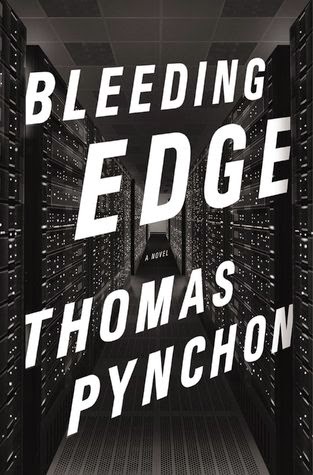
Thomas Pynchon's Bleeding Edge demonstrates his mastery of the early 21st century zeitgeist, to go along with the many other decades he's illuminated.  As usual, the closely observed blends disconcertingly well with the fictional.  When recognized it's funny, as in his hilariously cast series of biopics about famous golfers.  So much of it is in the digital realm, and there it was harder for me to discern the imaginative projections from the dizzying reality.  For example, I thought the "dark web" was a brilliant if typically paranoid Pynchon invention, though I learned that it essentially isn't--that is, in some sense it actually exists.

Pynchon selected a particular New York City voice that to my mind tended to limit the novel's eloquence, though he couldn't always hold back the bon mot.  I grew a bit tired of the voice--but that's also to say that it confirmed in me my overall feeling--despite a short residency it saddened me to end--that I'm glad I don't live in New York.  As for its prophesy, one character talks about omnipresent surveillance potential that people giddily accept with every new device they covet.  He refers the wrist devices that are rumored in today's news to be the next hot product as "the handcuffs of the future."

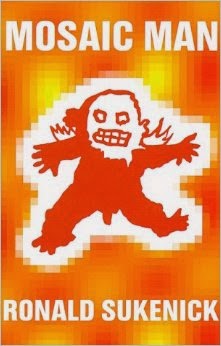
Briefly intercut with that novel in my reading was Mosaic Man by Ronald Sukenick.   Sukenick was a kind of Pynchon who never made it.  He once said he had about twelve readers, but they adored him.  I happened on his Death of the Novel and Other Stories and his first novel Up in a tiny public library in Stony Creek, Connecticut in 1969 or 1970, and was fascinated.  He was doing what later would be called metafiction or postmodern, but with intelligence and a lot of wit.  (I was later to discover his book on Wallace Stevens, Musing the Obscure, which is still my skeleton key to that mesmerizing and difficult--or let's just say mysterious-- poet.)

Sukenick kept publishing, through small presses and the Fiction Collective, in which he was a principal, and I bought them when I ran across them: Out, 98.6, Long Talking, Bad Condition Blues; Blown Away, Doggy Bag.   But it was just this winter that I caught up to his 1999 novel, Mosaic Man.  Once again, the act of storytelling is itself the plot, though this time there's a clear central concern of assembling an identity out of that mosaic of stories.  That seems more to the point than the rough form of books of the Bible (each very different yet somehow parts of the same story), though the pun of Moses-iac Man does suggest something that I don't recall from his earlier books, which is factoring in his Jewish identity.

Anyway, this is clearly a mature work, though still lively and with many of the impulses (and tics) of earlier works.  There are parts of it--the childhood sections especially--that are flat out brilliant.

This book ends in New York, and the Twin Towers and terrorism figure in, although it is not yet 9/11, which happens in the course of Pynchon's book (though it seems to me more a background part of the world than a major element of the narrative.)  However, Sukenick's next novel is about 9/11 and the Twin Towers, near where he lives at the end of this book and in that book.  I've just ordered it.  Sadly, it was his last novel.  He died in 2004.

I read another of Northrup Frye's shorter books based on a lecture series--this one called Creation & Recreation.  But I also very deliberately read a longer collection of essays, The Stubborn Structure, all the way through.  Some essays were of broad concern, and some were more specific, and more specifically literary criticism, as in the chapters on Blake and Yeats.  Frankly I thought I might skip those, no longer being in the academic framework, but I really enjoyed them.  In a way they put me back in touch with my 20s self, but I was also aware I was understanding more than I had then, not because of any increase in intellectual capacity (probably the reverse) but possibly of experience, or maturity.

Of the re-reading: Crooked Cucumber: The Life and Zen Teaching of Shunryu Suzuki by David Chadwick is a biography of the man who founded the San Francisco Zen Center and finally brought Zen meditation to the United States in the 1960s.  I'd forgotten or perhaps not appreciated as much how skillfully Chadwick wrote about Suzuki's life in Japan, which is really the bulk of the book, beginning in 1904.  The first time I read it, during my research for a San Francisco Chronicle article on Buddhism in the Bay Area, I had concentrated on the U.S. chapters.  Suzuki is a fascinating figure, with such profound humor--that also dominated my first impression.  This time I marveled at Chadwick's writing ability, though he was not previously a professional writer--he was a monk at the Zen Center.

Another re-read: Ray Bradbury's The Martian Chronicles.  I'd forgotten what variety there is in this collection of stories, since several of the early ones were so indelible.  Bradbury became a kind of grandfatherly figure but here he is still the young firebrand.

Finally, I'm giving up the pretense that this blog is any longer principally reviewing new books.  When I wrote reviews more regularly for publication, I could afford to do that.  But even in my many years of reviewing new books, I have always needed to write about books that were new to me regardless of when they were first published, or books that became new in re-reading--or maybe more accurately, revealed new facets the way old friends do.

So henceforth I will no longer need to categorize my reading here as "for pleasure" as opposed to new book journalism.  It's all going to be for pleasure now, or at least to respond principally to other needs.

Friday, November 28, 2014

For Pleasure, Fall 2014

My reading for pleasure in the past few months included some very different kinds of science fiction.  Kim Stanley Robinson writes science fiction of the future and of the past.  His latest book Shaman is set in the deep past.  It follows the fortunes of a young man some 30,000 years ago, when glaciers still formed a northern border and some Neanderthals (the Old Ones) were still around.

The story follows a boy (named Loon) beginning with his "wander" or initiation.  This is something of a hunter-gatherer era of small tribes, with specific skills and knowledge of the natural world that supports and endangers them, which calls upon KSR's skills as a preeminent nature writer.

Reviews tell me the place is Europe, for the cave paintings described are based on some found in recent years in France.  But because KSR is also a preeminent California writer, I kept imagining it as a proto-CA, perhaps encouraged by the feeling that these people would not be too unfamiliar to the folks in Pacific Edge, one of the futures he created in his "Three Californias" books. Less unfamiliar to them than to us.

KSR always astonishes me in finding a language for people in the past, even this deep past.  How does he do it?  He doesn't use "primitive" talk (grunts, monosyllables or stiff sentence constructions) nor does he make them sound unbelievably contemporary.  But he gives them a pretty large vocabulary, with a little silliness (I like the various exclamations of "Mama mia!"  Maybe it means they're really in Italy.)

His books set in the past usually have another dimension--the futuristic subplot of Galileo's Dream, the spiritual dimension (the bardo, reincarnation) of Days of Rice and Salt.  Here he has a kind of narrator called the Third Wind, an animating spirit that shows up when needed, but seems also to be always watching.  So it's another triumph, a book that was a pleasure to read, and worth revisiting.    

I also went back to the future--way back, to an early series that pioneers the galactic civilizations/space opera form.  I read nearly the entire Lensmen series of novels by E.E. "Doc" Smith, considered classic texts in the science fiction field.   The only novels I didn't read were Triplanetary (the first) and Galactic Patrol (the third).  But I read First Lensmen in paperback, and the hardback "Chronicles Vol. 2" (a county library discard) which contains Gray Lensman, Second Stage Lensman and Children of the Lens.  That adds up to around a thousand pages.

The core idea of the series is that an extremely advanced planetary civilization provides the "lens" that allows its wearers to communicate telepathically and confers other powers, because this wise but old civilization foresees the need for younger civilizations in an epic battle with an evil civilization from another galaxy that is almost its equal.

But the content of the series is an escalating series of immense space battles, punctuated by intrigues, undercover espionage, sabotage etc.  as the earth-centered galactic forces battle one enemy after another, trying to get to the ultimate power behind them.  These stories were written before, during and after World War II--and the organization of information to manage a space fleet in battle was actually modeled by the US Navy to defeat Japan. They were then published in book form in the early 1950s, as the Soviet Union became the immense new enemy in the Cold War.

There were several sections, some absurd battles and especially when extolling the need for utter ruthlessness in killing enemies, that almost stopped me.  But the narrative drive was enough to keep me going.  I knew I was reading one of the pioneer science fiction series, and one in which the aliens are really alien, and imaginatively drawn.  Also it posits that the ultimate power in the universe is the power of mind, which both the good and bad super-civilizations understand and use.  There's also some questionable genetic theory bordering on eugenics in the mix.

Even older than this series are the Captain Future novels by Edmond Hamilton.  I read a couple more of these, in particular Planets In Peril, easily the most impressive so far.  It is skillfully done, with a nice if not unfamiliar twist, and does its best with the physics of the time, though it does fudge some of it in a pretty essential way (namely that a human civilization could survive the collapse of the universe before it expands again.)  And of course there is still atomic everything.

  Hamilton later said that he was paid so little for the first several Captain Future novels that they were essentially first drafts, and he began taking more care with later ones as his rates went up.  This has to be one of the later ones (1942.)

Beyond science fiction,which is also a kind of research project, I did a re-reading that was remarkable and yet not unprecedented.  It turns out to be for me a kind of advertisement for re-reading, for several reasons.

In a chain that probably began with an old episode of Foyle'War on DVD and a resulting conversation on the seemingly odd absence of poison gas in the Second when it was so often used in the First,  I recalled that my aunt once told me that my grandfather had been gassed in the Great War, and suffered effects from it for some years.  This was contrary to my grandmother's stories about his army experience in Italy, which tended towards the reassuring.  I never heard him talk about it at all.

During this conversation I realized that I'd never researched this warfare.  I knew in general he was posted in the north, and indeed, this is where the fighting was--in the mountains, principally with Austria and later with German troops.  I found an expansive description on the net, which was eye-opening.  Hundreds of thousands of Italians died in years of fighting, either directly or from illnesses.  It could not have been the quiet my grandmother implied, even if (as she said) he was kept back from the lines because he tailored the officers' uniforms.

This reminded me that this warfare was the setting for Ernest Hemingway's A Farewell to Arms.  It was where Hemingway served as an ambulance driver and was wounded and hospitalized, and where he fell in love with a nurse, who he lost.  All of this happens to his protagonist.

I hadn't re-read this novel in more than 30 years, and so the first thing is that it's a different novel, almost completely from the one I first read.  The basic story is the same of course, and I remember being enthralled by the tone of it, but so much of it came to me as new.  Much of that effect comes from intervening experience, not only of "the world," but of a few of the actual places he writes about, in Milan.  I hadn't been there when I first read it.  In a general way of course--the Cathedral, the Galleria area, not the specific places, but enough to give me a sense of it I didn't have the first time I read it.  (I find that in audience reaction after readings by fiction writers I've attended, this impresses people--that they recognize places.)

Re-reading can be dangerous.  Books you loved can fall apart, or not be there anymore the way you felt them.  But this time I admired it again but in a different way, for different reasons. Which is even better than confirming those long-ago impressions.

Part of the difference is suggested by scholar Robert Weeks in his introduction to the Prentice-Hall volume on Hemingway (this lit crit series was a favorite of the English department in my college years, and it's the only commentary on Hemingway I still have.  Most of it is too academic for me now, but I read this introduction after re-reading the novel.)  He mentions the effect of vital, life-changing things (often tragic things) happening to the protagonist, that few if any others note, or even notice.  In life, I've noticed this is quite true.

But what I noticed when I re-read this book is the apparently random happenings, the particularity of subsidiary characters that don't necessarily "pay off" for the main story.  Hemingway is so famous for his pared-back prose, his terseness and economy.  Yet he can crowd the story with unpredictable people and events, until major and minor moments collide, as they do in life.  Everybody's in their own story.  So it becomes of a piece that they don't notice the protagonist's heroism (in other books) or their worlds don't end or even tremble when his does.

Then there was one of those weird serendipitious things.  I had just finished re-reading this book when I looked online at the middle film in David Hare 's Worrwicker triology on PBS.  There in the opening scene was Bill Nighy as Worrwicker on the beach, reading A Farewell to Arms.  Later we see his former (and future) lover (played by Helena Bonham Carter) on the London tubes reading a different Hemingway paperback, but presumably the same title.

Say, maybe Shaman takes place in northern Italy!  Okay, too much symmetry for one post.

I will bookend this books chronicle with a book I've begun, though I'm not sure pleasure would be an apt description for either my reason for reading it or its effect.  To be sure, the first chapters of Apocalyptic Planet: Field Guide to the Everending Earth by Craig Childs are excellently written, among the best chapters of any book I've read in years.  But the subject is framed by the apocalyptic future of the climate crisis.  It must be faced, but it is not a pleasure.

I'm sure I'll have more to say about this book, though it may take me some time to finish it as I am reading it in small doses.  But it occurred to me as I started it that, first of all, its first-person treatment of the natural world is akin to KSR's.  And if Shaman is the alpha of our civilization, then Apocalyptic Planet is in some senses the omega.

Friday, August 22, 2014

Print Vs Digital in the Summer of 2014

Evidently it's a trend: forsaking printed books for digital readers.  Will it last?  It seems to me that's an open question still, partly because there are yet only a few ways to "acquire" digital books (and books from Amazon for their Kindle are apparently still under Amazon's control, so it's not clear to me who actually owns them.)  On the other hand, there are many ways to see and acquire physical books, as just some of my summer's reading demonstrates.

Publishers and authors would prefer books purchased at full price when they are newly published .  Lots of books are in fact purchased that way, even if some time has elapsed since the pub date.  Right now local bookstores are busy selling books assigned in college and university classes, as well as the latest selections of local book clubs.

But the ecology of printed books is larger and more various, though book publishers and authors eventually benefit.  That ecology includes libraries (public and school,) used book stores (physical and online) and "sale books" (often remainders) that can often be found on a table in and outside regular bookstores.

When I lived in Cambridge I bought a high percentage of my books from the many sale tables.  These included books I bought because of magazine stories I was working on.  In fact, I found books I would never have seen otherwise, that became important to what I was writing.  Even The Malling of America benefited--sometimes providing me with names of people in relevant fields I then sought out and interviewed.  It's uncanny how the right books would turn up, or really that I would notice them, so that I often began researching at the sale tables. Serendipity was one of my main research techniques.  And it happened again recently--I have been acquiring apocalyptic tales for a project about the future and had been looking in vain for a copy of J.G Ballard's The Drowned World.  Then one day there it was, on the Northtown Books sale table.

This summer however, my sale table book I acquired for pleasure--Diane Keaton's autobiographical Then Again, that one of my old Boston colleagues (Janet Maslin, now reviewing for the NYTimes) picked as one of her ten best of the year.  I'm enjoying it, not only for the content but for the perspective it suggests on my family and life.  (Cats are characters in this book, and it reminded me that around the time of Annie Hall,  I once stopped to observe a cat and her kittens in the unlikely location of Greenwich Village, only to look up and see Diane Keaton next to me.  By the time I turned to the two women I was with--both chattering away about Village Voice stuff, neither having noticed her--she and her male companion had fled across the street and were gone...)


I've been using "Captain Future" as my Internet screen name since I began fooling around online a decade or more ago, so I naturally got interested in the Captain Future stories by Edmund Hamilton (which I was not specifically aware of when I invented the screen name.  Of course I assumed I wasn't the first to think of it.  It was just appropriate--playful yet pointed.)  A few years ago I bought a facsimile of a 1942 issue of the Captain Future pulp magazine.  But when I was browsing for something else entirely at a local used bookstore I noticed that somebody had sold their collection of Captain Future paperback reissues.

These were originally published from 1939 to 1942.  Popular Library reissued them as paperbacks, probably several times. (Without the original cover illustrations alas.)  The ones I found were from the late 1960s.  There were seven, and (thanks in part to credit accumulated by selling other books there) I got them all.  I've read four now, including Calling Captain Future (which records that in 1940, a quarter century before Star Trek, Captain Future had a stun setting on his ray gun.)  The prose is shaky, the stories are more like murder mysteries in space, but they have their moments, and the characters Hamilton invented would presage many science fiction icons of later decades.  They are historically interesting too for the kinds of technologies they posit, including all kinds of variations on "atomic," which provide a certain nostalgic hilarity.

Libraries were my first resource for finding and reading books, and they are still important to me, particularly now the university library.  Though I got my copy of Northrop Frye's The Educated Imagination as a used paperback years ago, I reread it again recently and was stunned by the breadth, perception and elegance of this book on contemporary society as well as literature.  So I looked to the university library for any Frye books I didn't have or hadn't read, especially any that weren't only about literary matters, and found The Modern Century.  It's another short book composed from talks, in this case on the occasion of Canada's centennial in 1967.

Another astonishing book!  So I looked online and found a used copy, ordered it, and now have my own: a first edition hardback of The Modern Century with dust jacket.

 After I read that, I tried the library again.  Among the books I took out was a collection of Frye's book reviews and short pieces called Northrop Frye on Culture and Literature.  I saw pretty quickly that it was another book that would repay ownership.  So I again found an online copy, and here the library and the used books store come together, though with a melancholy twist.

The copy I acquired is a 1978 hardback, formerly from a library.  This is pretty common for used books purchased online.  This copy--a very good one--has a somewhat sad history.  It is from the Barat College library.  I looked Barat up, and found that it was a small college in a leafy and wealthy suburb of Chicago, but the college had gone bankrupt and eventually dissolved in 2005.  This particular book seems to have been taken out of circulation somewhat earlier, in 2003 (though it had gone bankrupt by then.)

 Barat was a Catholic college that evidently emphasized the arts.  But not, it seems, literary criticism. The reason that this book is in such very good shape is that it appears never to have been taken out in its quarter-century stay.  There is not a single mark on the Date Due sticker in the back.  Assuming it was acquired in 1978 (from the University of Chicago press), that's 25 years without a borrower, and perhaps without a reader--this book by one of the great minds of the 20th century.  However it's unread no more, because now it's mine.

A happier book story involving a library is a book I read with great pleasure this summer.  It is a novel for children called The Tune Is In The Tree by Maud Hart Lovelace, an author I didn't know.  She's an American writer of historical fiction but mostly children's fiction, from the late twenties into the sixties.  She's most famous for her Betsy-Tacy series.

This novel of nearly 200 pages, published in 1950 (by Thomas Crowell), is about a little girl, probably in the first decades of the 20th century, who is inadvertently left at home when her mother goes to seek after her missing aviator father. They live in the country and while they're away Annie Jo is adopted into the local society of birds.  A magical hummingbird shrinks her down to bird size.  It is a very charming tale (the title is from Emily Dickinson) that builds fancifully on the knowledge of specific bird species that a little girl must have had in that time and place, but would be foreign to children today.

This book has been around me for decades.  I'm pretty sure I scooped it up from my childhood home when I took away the rest of my own books there before the house was sold.  It may have belonged to one of my sisters, especially since the markings indicate it came from the school system that they (but not I) attended.  However, it's possible that I acquired it myself at a used book store in the area--the title would have appealed to me, and it is why I've kept it.  But I only read it this summer.

Books are physical objects that can last a long time, that can be passed around from library to bookstore, from sibling to sibling,  from Illinois to California, and from one decade to another.  It's hard to see how digital books will match that utility and magic.

Friday, April 25, 2014

For Pleasure: Winter, Spring 2014

Reading for pleasure during these months has mostly been re-reading.  One exception was A Man of Parts, David Lodge's novel about H.G. Wells.  Even this was in a sense re-reading since I had read many of his sources, including Wells' autobiography, over my past decade of interest in Wells and the future.  However I had tended to skip over the sexual relationships, which is Lodge's chief subject, although he's pretty good on Wells' ideas and literary accomplishments--on Wells as writer as well as lover.

Despite the mock- titillating cover art and naughty advert quote about Lodge being specialist in "intellectuals behaving badly in bed," it's a fair treatment that balances Wells' views with those of the women involved (all very willing to start) though the point of view is basically HG's.  I did appreciate that a novel not based on a real subject would probably have left a few of these relationships out because the parade did get tiring.  But as usual Lodge found ways to overcome the problems inherent in the subject and keep the book interesting if not always involving, though it often was that as well.  It did give me a more comprehensive view of Wells.  And as a description of Wells or this book,  the "behaving badly in bed" is tripe.

In volume my biggest sustained re-read was a collection of three early novels by William Eastlake.  I'd read them individually a long time ago, in college, shortly before Eastlake came to teach fiction writing for a term.  I was babysitting for a lit teacher who had the hardbacks, and I read one or two that night, and I believe I borrowed the third, but it could be that I read only one of them and parts of the others.  They were collected into one volume in the early 70s (3 by Eastlake) to capitalize on the movie version of his best known novel Castle Keep (set in World War II Europe) and the publication of his Vietnam novel, The Bamboo Bed.

The three novels are set in New Mexico, with different versions of the same family involved.  Eastlake later edited them to form a kind of cycle, published as Lyric of the Circle Heart.  I pulled that earlier paperback collection down from my shelf.  I admired Portrait of the Artist with 26 Horses and The Bronc People a lot, but thought the first novel, Go in Beauty, was a little too Hemingwayesque.

Eastlake was a unique voice in the 60s and 70s, and rereading these books he remains so.  I took his fiction course and corresponded with him for a few years afterwards.  (This photo--that's Eastlake in profile--is from an interview he gave at around the time I knew him.) Two things he said have always remained with me.  One was in an interview for our Knox College newspaper, and I can only paraphrase: "Writers are born, and shaped by rejection."  Shaped by rejection turned out to be absolutely true.

The other was a laconic line he uttered in class, so softly that I'm not sure how many at that long table of my fellow testosterone-inflamed big talkers heard it.  I happened to be sitting next to him so I did.  "All the great writers have one thing in common," he said. "They wrote their books."

I just finished re-reading William Irwin Thompson's 1989 book, Imaginary Landscape: Making Worlds of Myth and Science. I have nearly all his books (including his novel but excluding poetry volumes) and reading them always prompts new thoughts, even when I can't completely follow.  His thought--his synthesis-- is still so far in advance of other writers I'm familiar with, it's a shock to see in this book contemporary references to the Soviet Union and South Africa during apartheid.  He has a web page which includes a most unusual and well-written blog of reflections.  This time I wonder: he has developed upon McLuhan's work and insights, among others.  But who is developing upon his?

Finally I need to mention re-reading Northrup Frye's The Educated Imagination.  This thin volume based on six radio talks is succinct and profound, beyond technical matters of literature to philosophy, psychology, etc. with application to the political world and society in general, especially at this point in history.  I hope to write something more on the content of this book elsewhere.  But here I note that I am grateful to have rediscovered this book, which now assumes a central place. 

Now I can't end without saying that my reading for pleasure has included bits and pieces of other books as well as indulgence in favorite genres, including re-reading a couple of Hardy Boys novels (one of them modern, the other from the original series) and Sherlock Holmes stories.


Sunday, December 08, 2013

For Pleasure: Fall 2013

In his new book, How To Read Literature, Terry Eagleton asserts that "given the brilliance of the novel and the billions of English-language readers in the world," it is likely that at any given moment, someone is reading Jane Austen's Emma.

My math may be inadequate but somehow I doubt this, though I'm willing to agree that Austen's novel is being read every year, and even every month.  I may be on safer ground however in asserting that this year I may have been the only non-graduate student or historian to have read all 934 pages (plus notes) of Roosevelt and Hopkins: An Intimate History by Robert Sherwood.

Sherwood, a Pulitzer Prize playwright, was a speechwriter in FDR's White House, and got access to lots of documents, memos and correspondence, including Hopkins' diaries.  This book makes full and fulsome use of those documents, so it is in the most specific sense a documentary.  It begins where other books about Hopkins end: when he stopped being the chief architect and administrator of the New Deal.  It chronicles his later and much different roles as FDR's private diplomat, and Hopkins comes across in Sherwood's telling as a key figure, a man uniquely trusted by key wartime partners such as Churchill and Stalin.  He was trusted because he immediately grasped what was needed, and was an honest broker.  They seemed fond of him personally as well.

Sherwood writes of Hopkins' "passionate hopefulness" that made him a positive force in the two greatest dangers that confronted the U.S. in his time, the Great Depression and World War II.  At the same time, he was a trenchant analyst and adviser.  This book reproduces my favorite Hopkins' quote.  At the beginning of  the FDR administration when the Depression was most acute, someone proposed a project to help the unemployed  that would take a lot of time to prepare but would do so in the long run.  "People don't eat in the long run," Hopkins snapped.  "They eat every day."

Hopkins was also a lightning rod for opposition to FDR, much of it hateful.  Because FDR was so popular, critics focused on Hopkins and hounded him the entire time he served the U.S. and the Allied cause with such dedication that he fatally ruined his health in the process.

Sherwood makes succinct observations about FDR as well, calling him "one of the greatest geniuses as an administrator that ever lived."  He also documents time after time when Roosevelt's political instincts--particularly on how to communicate with the public--went against advice but were most often right.

But the overall effect of this book is accumulated through the details--the numbers of ships and planes England or Russia needed, the timing of various but huge strategic moves, the detailed descriptions of the meetings, all the decisions involving immense resources and numbers of lives.  As Sherwood himself observes, "...one can hardly read these cold, dry minutes without sensing the Homeric awfulness of the responsibility imposed upon the few who were compelled to decide so much."  Through these details a sense of what the war was really like, and what these people were like, emerges with more power and authenticity than through any briefer summary.

The other reading I did was principally related to theatre.  The plays I was seeing as local theatre columnist weren't very inspiring for awhile, so I turned to reading David Hare's plays, mostly those collected in David Hare: Plays 2.  I'd watched some interviews etc. with him on Youtube and I wanted to read some of his prose as well, so off the same library shelf I took his account of performing his own one-person play, Via Dolorosa, a book called Acting Up.  Hare writes with very definite views of the process (which change along the way) and he offers a wealth of observation about theatre and its relationship to society.  As I knew I wanted to read it again and refer to it, I bought a copy.

Reading plays is a special skill most of the time.  I can read Tom Stoppard's plays for their language but without a very good idea of their structure or how they might look on stage.  But some playwrights are easier to read than others, and Hare is one.  Partly because his descriptions and stage directions are so clear and specific, but mostly because the narrative is clearly in the dialogue.  Another playwright who is a particular pleasure to read, I found, is A.R. Gurney.  I read Volume IV of his Collected Plays with great pleasure and admiration.

Sunday, August 18, 2013

For Pleasure: Spring and Summer 2013


My major spring project was reading all twelve of the novels by Robert Heinlein in his Scribners series of juvenile science fiction.  I write more about them here.  These were originally published from 1947 to 1958.  Though I recall the Winston Science Fiction series from my youthful library prowling, I may well have read some of these in my teen years, since our public library held on to their books.  And though this spate of reading began with a library reject of the final novel in the series, I also found earlier ones in a university library's children's section, in their first editions.

Of this series Heinlein said somewhat slyly, "...my books for boys differ only slightly from my books for adults--the books for boys are somewhat harder to read because younger readers relish tough ideas they have to chew, and don't mind big words--and the boy's books are slightly limited by taboos and conventions imposed by their elders."  That discipline turned out to be good for Heinlein's writing actually.

After I finished these, I read several of Heinlein's stories in his "future history" series, collected in The Past Through Tomorrow (1967.)  The consistent future universe of these stories is pretty much the same as in the juvenile novels.

I read H.G. Wells novel Tono-Bungay, a first person account of the rise and fall of a great commercial venture based on a popular tonic that basically does nothing.  An early (1908) and lively fictional analysis of the advertising-driven consumer economy that became so predominant in the second half of the 20th century. I continue to be impressed by Wells as a wordsmith, and in this novel he is actively inventing a way to tell the story he wants to tell by expanding at least the rhetorically reach of the novel, and a little of the form.  Perhaps in the light of Dickens etc. and the amazingly predatory practices of the 19th century (when for example much of the forests of Europe and America were finally cut down) it shouldn't be surprising that the rhetoric of Wells' narrator in 1908 sounds so contemporary a theme:  "It is all one spectacle of forces running to waste, of people who use and do not replace, the story of a country hectic with a wasting aimless fever..."

Other reading was in connection with projects or new books.  I've already written here about re-reading Steinbeck's Travels With Charley.  I investigated several books about World Fairs, and carefully read an unusual one: 1939: The Lost World of the Fair by David Gelernter.  This combines journalistic research (presented as such) on the 1939 New York World's Fair, the famous "Building the World of Tomorrow" extravaganza, wrapped around a central love story that is fictional but (the author says) based pretty closely on fact.  Both stories are interesting--the fair and the affair--but I didn't get a sense of each being dependent on the other.  A hybrid that I enjoyed, even if I didn't see how it quite makes a whole.  It also led me to E.L. Doctorow's novel World's Fair which I've begun.

But apart from the very valuable sense of texture about the Fair, Gelernter's point of view on its utopian aspects (he concludes that we have no more utopias because by the 1960s we were living in the one the Fair proposed--namely, prosperity and suburbia) and particularly his evocation of the 1930s (especially the later years, the "high thirties") and what makes them unique, is strongly expressed, pretty convincing and certainly memorable.

Since this Fair and its historical context was my main interest, I read more about the thirties, particularly the account of the world situation and the 1936 U.S. presidential election in one of my favorite references, William Manchester's The Glory and the Dream.   (I still have the two volume deep blue covered hardbacks I bought for 10 cents each at a library sale in the early 80s.)  This led happily to a new book, Susan Dunn's 1940, which I write about in the post just previous to this one.  Dunn's book--and her particular praise for the playwright and FDR speechwriter Robert Sherwood--led me to a book I am currently reading, Sherwood's Roosevelt and Hopkins.  Most of this book concerns the World War II years, so it follows nicely from this previous reading.  (I'm also planning to read one of Sherwood's Pulitzer-winning plays.)  In the accounts of the 1936 and 1940 elections, and the surrounding politics, I found several disconcerting parallels to more recent elections and politics.  I suppose that was somewhat comforting, if fatalistic in effect.

Apart from new books for review, a few D.H. Lawrence short stories, the beginning chapters of Arthur Zajonc's intriguing Catching the Light and some chapters on Shakespeare plays in conjunction with a production review, I think that's about it.

Thursday, January 10, 2013

For Pleasure: Fall into Winter


The DVDs of the BBC Sherlock series and my continuing interest in the Granada Sherlock Holmes series (with Jeremy Brett) inspired me to read (and re-read) Sherlock Holmes stories in my The Illustrated Sherlock Holmes Treasury (Crown 1984) which has many of the original illustrations as well.  Especially when re-watching various Granada episodes (based most closely on the actual stories), I would go to the stories themselves to see how they differ.  Fun and enlightening.  I came to prefer Holmes stories for bedtime.

I happened to see a recent video interview with J.K. Rowling.  She was asked the question: what writer would you most like to be compared to?  I think it was specific to the Harry Potter books.  As the question was asked the name E. Nesbit leapt into my mind.  And so it was with a shiver that I heard her say that same name, E. Nesbit.

English author Edith Nesbit is best known for her children's novels and stories, though she wrote other works and had an otherwise fascinating and dramatic life.  At some point at the old family home, I happened on a couple of her books that had belonged to my younger sisters.  I read them and was enchanted.  When I read the first Harry Potter book much later, the first author I thought of was E. Nesbit.

So I revisited one of those books, The New Treasure Seekers, and for the first time read the original, The Story of the Treasure Seekers.  It was a different reading experience but I wasn't disappointed.

I've also been reading (or re-reading) juveniles from the time of my youth or before.  I've mentioned some before, mostly the science fiction stories but also some sports fictions.  In a box of somebody's giveaways I came across one that I either read or could have read back then: Grand-Slam Homer, a Bronc Burnett story by Wilfred McCormick (1951.)  It did remind me that, next to listening to radio play-by-play of Pittsburgh Pirates games, I learned the most about the finer points of baseball from books like this one.  I learned very little from my own coaches--much more from coaches like Cap'n Al in this book.

Also inspired by viewing a DVD collection of Chekhov plays, I read A New Life of Anton Chekhov by Ronald Hingley.  But with no televisual prompting at all, I also read Michael Billington's 1987 Stoppard, on the plays of Tom Stoppard to that point. Billington is always interesting.  I found myself yearning for the music of James Joyce's sentences, so I began reading the stories in Dubliners, but specifically in the Illustrated (and annotated) Edition by John Wyse Jackson and Bernard McGinley (St. Martins) which I'd been given as a gift many years ago.  For similar reasons, I've reread portions of Gravity's Rainbow by Thomas Pynchon.

Arthur Conan Doyle, Edith Nesbit and H.G. Wells were contemporaries in the late 19th and early 20th centuries.  They all appeared in The Strand Magazine, sometimes in the same issues.  Wells has been a particular interest in recent years, so it was for an ongoing project involving his work as well as my Sherlock phase that I also read Arthur Conan Doyle by Don Richard Cox (1985) and The Doctor and the Detective by Martin Booth (1997.)  I'm evolving my own theory about Conan Doyle's influence on Wells.

Finally, as part of that ongoing writing project, I dipped into several books on and by Wells, and I've been reading with great pleasure as well as interest: Margaret Atwood's In Other Worlds, Robert A. Heinlein by H. Bruce Franklin, and particularly Alien Encounters by Mark Rose.

Saturday, July 21, 2012

For Pleasure: Summer


The pleasure of the summer so far is Nicholson Baker's novel The Anthologist (Simon & Schuster), which I picked up at--of all places--the Dollar Tree.  It helps that I'm interested in what a friend used to call "the poetry biz," although I haven't followed it since those days I was on the fringe of it, in the 1970s. (On the other hand one of the poets named, Ed Ochester, did hire me to teach a course in 1990 or so.)   Part of the book's charm for me is that while not a lot happens, Baker's novelistic skill makes a lot out of only a few dramatic questions: will our hero actually ever write his anthology's introduction?  Will he get back with his lady love, or find a new one (maybe next door)?   Baker is such a fine and funny writer that this book is delightful.  There is real human feeling in it, too (what writer can't identify with those tears at dreams unfulfilled) and his exegesis on the music of poetry makes a lot of sense. It probably also helps that I read part of it on a trip down the coast to Menlo Park, in sunny 80 degree afternoons and a morning outside at Cafe Borrone.  Pleasure doubled.

It seems summer wouldn't be the same without at least one 700 page book, and this year's is The Seven Basic Plots by Christopher Booker (Continuum International Publishing Group, paperback.)  You would think a book of that title would be slim and handy, or at least of a length easily amenable to writing classes and groups.  Indeed, Booker does get through his basic discussion of his seven plots (Overcoming the Monster, Rags to Riches, The Quest, Voyage and Return, Comedy, Tragedy and Rebirth) in about 200 pages, which is about as far as I've read so far.  But I'm not worried--the book is so cogently written, without jargon or "theory," and with frequent revelations that I have full confidence in the author to continue making this an enjoyable and illuminating reading experience, regardless of where I might agree or differ with his points.  I am in fact in awe of his disciplined yet almost conversational writing.  It was 34 years in the making (1969-2003), and 34 years well spent.  I look forward to the remaining 500 pages.

Other books I've read or am reading this summer not for review or for a direct writing purpose: Working the Soul: Reflections on Jungian Psychology by Charles Ponce (North Atlantic Books), Your Favorite Seuss (a "baker's dozen by the one and only Dr. Seuss," published by Random House) and Bookless in Baghdad: Reflections on Writing and Writers by Shashi Tharoor (Arcade Publishing, and another Dollar Tree acquisition.)

Earler, in the spring, I read and very much enjoyed Chronic City, a novel by Jonathan Lethem (Faber & Faber.) 

Thursday, February 23, 2012

For Pleasure: Winter

Since I happened to finish several books I've been slowly reading for the past few months, it seemed like time for an update.  My bedtime reading was mostly Robert D. Richardson's Henry Thoreau: A Life of the Mind (University of California Press, 1986.)  It looks like I've saved his first biography for last, after starting with Emerson and then William James.  In this book, Richardson is perhaps less ambitious but just as successful, although it may be that Thoreau's quiet life lends itself to a quieter treatment.

The book relies a great deal on Thoreau's journals, and it is chiefly a chronological treatment.  It's quite an achievement to retain reader interest in a life that was so solitary, but that's one reason I keep reading Richardson--he's a beguiling writer.  But there is a sense of the real world Thoreau lived in, like his involvement in his father's pencil-making business, for which Henry made several important (and profitable) innovations.  Or the reality of Walden Pond, skirted on a side near Thoreau's cabin by railroad track, and the regular passage of steam engine trains.  The suddenness of the book's end mirrors the suddenness of Thoreau's death at a comparatively young age.  It seems he was becoming more of a systematic naturalist, yet had he lived a few decades longer, there's no telling what further visionary literature he might have produced.


I also finished Kim Stanley Robinson's novel, The Years of Rice and Salt.  Having been pleasantly surprised by his science fictional historical novel on Galileo, I moved on to this one, which is an alternate history of no less than human civilization, based on the "what if" of the Black Death effectively wiping out Europeans rather than killing a third. Over the centuries the civilizations contending for world power are Islamic and Chinese, then India and the civilizations of the New World, the South American tribes (Inka) and the North American tribes united in the Iroquois confederation. 

Robinson tells this sweeping story with an intriguing device--he adopts the metaphysics of Eastern religions, particularly Buddhism, that posit reincarnation.  So he follows essentially the same group of characters, as they are reincarnated in different countries and cultures, their fates yoked together.  In between they meet in "the Bardo," a kind of limbo where they are assigned their next incarnations, and where they discuss whether they (or humanity) are actually making any progress at all.

History in its broadest sense doesn't turn out too differently--there are struggles for empire, technological advances linked to trade or war or both, as well as the struggles of individuals to pursue science, justice and humanity's best potential.  There's something like the Great War, though it lasts a generation, and the possibility of atomic bombs is discovered, but perhaps the reality is avoided.  Within the story there are utopian visions for which Robinson is rightly noted.  I read this long and complicated novel in spurts--it was just too much to handle continuously, as I had read his other novels.  But I knew all along the way that this is a true literary milestone,  perhaps his most impressive novel as literature of any kind.  It's his best written, virtually without the slackness that sometimes rolls by as I race through the story.     

I also just finished Jim Harrison's most recent collection of novellas, The Farmer's Daughter (Grove, 2010,) which I acquired in hardback upon its ascension to sale book status.  I actually read the first two novellas (the title one, and "Brown Dog Redux") pretty quickly, but deliberately decided to save the last one for later ("The Games of Night," a story which apparently uses Harrison's research on lycanthropy for his script of the Jack Nicholson movie, Wolf.)  I look forward to the Brown Dog novellas being collection in one volume.  Otherwise these have the usual rewards of Harrison's fiction, which are considerable.

After "always meaning to," I finally read We, the classic dystopic novel by Yevgeny Zamyatin.  I see why it is a literary classic as well as an historical one, coming before Orwell's Nineteen Eighty-Four and Animal Farm,  and Huxley Brave New World , but after H.G. Wells and The Time Machine.  I also read some of Zamyatin's essays, including the very perceptive one about Wells--it is among the best short summaries with insight into the full range of Wells' fictions.

But I didn't stay so high minded, indulging in several Star Trek novels (which I usually save for traveling, but...) and my first Captain Future novel.  I didn't even know there were Captain Future stories when I adopted this as my Internet screen name (though I thought there must be.)  Then I found online articles about Edmond Hamilton's novels published in pulp magazines, and copies of their covers.  So I finally ordered a facsimile copy of the Summer 1942 issue of Captain Future: Man of Tomorrow with the "novel" The Comet Kings.  It's actually a long story, which takes up about half of the magazine. (Though the cover has nothing to do with the story.)  The whole magazine is great fun, with a vision of the future that includes "radium lamps" for lighting!  There's also an origin story for Captain Future and his Futuremen (a floating brain, a robot and a cyborg, plus a couple of pets) that's a frontiersman saves Indians from thieving white traders set on Mars.  But it does establish Captain Future as a hero of the downtrodden, a hero template set by Superman, Flash Gordon, etc. in the 30s and 40s.  And thank god for that. Despite the populated solar system planets, there are interesting elements in the cosmology of Captain Future's universe that are curiously similar to certain theoretical models derived from quantum theory.  Hmmm.


Tuesday, October 25, 2011

Hallie Flanagan
For Pleasure: Early Fall

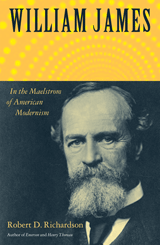
Apart from books I've read or am reading for review: I've almost finished Robert D. Richardson's biography, William James: In the Maelstrom of American Modernism (Houghton Mifflin.)  Richardson is truly a pleasure to read, and he sets a very high bar for biographies.  He's an example to be emulated, and I simply don't know of a better biographer.  Having read his two books on Emerson, I've purchased his biography of Thoreau.


Sherwood Anderson

I've also been reading Poor White, a novel by Sherwood Anderson, and The Colossus of Maroussi by Henry Miller. Both are interesting for the writing and for the sense of the times they portray.  I'm not sure I'm going to finish either of them soon, however.


Sinclair Lewis
 The 75th anniversary of a singular event in American history--the production of It Can't Happen Here, the stage version based on the novel by Sinclair Lewis, in 18 U.S. cities simultaneously by the Federal Theatre Project--is being marked this week by readings of that play by 23 existing theatres.  I was part of the Dell'Arte Theatre's reading, and introduced it with some words about the Federal Theatre.  I'd been astounded to learn about Federal Theatre several years ago, and took this opportunity to read more about it.  In addition to the books from my shelves I'd consulted previously (John Houseman's first memoir, Run-Through, and Mark Schorer's biography, Sinclair Lewis: An American Life) I found Gerald Rabkin's valuable essay in a 1967 anthology edited by Warren French, The Thirties: Fiction, Poetry Drama,  which I had purchased as a library discard.

But that same library still had some other books on the topic, including Arena, the memoir by the Federal Theatre Project's heroic administrator, Hallie Flanagan.  We've had our reading, I made my speech, and posted a lot on Federal Theatre on my Stage Matters site, but I'm still reading Arena.  A couple of other books I found very valuable are Voices From the Federal Theatre (Bonnie Nelson Schwartz and the Educational Film Center, published by the U. of Wisconsin, and which includes a DVD of a television documentary) and Free, Adult, Uncensored: The Living History of the Federal Theatre Project, edited by John O'Connor and Lorraine Brown (New Republic Books, 1978.)  This latter book, which I purchased used, has a wealth of wonderful illustrations, some but not all of which can be found online.  This is a disturbingly neglected subject--few people know about the Federal Theatre and what it accomplished, including theatre people.  But the audience last night was very interested.

I also read most of the novel It Can't Happen Here (Lewis co-wrote the play for the Federal Theatre, and later rewrote it himself for several commercial runs.)  The novel is much more wrapped up in its time, stated as happening in 1936, and using some names of real people. The character I read has three important scenes throughout the play, but in the novel I saw that he's referred to just once, as being sent to a concentration camp.  That's where I stopped reading.  How like an actor already!  The play is virtually unknown now, but despite some dated language and its melodramatic qualities, it's worthy of revival, especially for uncomfortable similarities to today.

Finally, in a bookstore I saw a new edition of F. Scott Fitzgerald's Tender is the Night, emblazoned with the words "Vintage Fitzgerald."  Well, what other kind is there?  Anyway, I picked it up and read the first paragraph, and now I'm reading one of the copies from my shelves--though not the one I marked up in college, which I still have.  Fitzgerald was a particular favorite and writing model then, though I haven't re-read him in years, maybe not since then or shortly after.  So I'm looking forward to it.  And resuming my voyage through Vonnegut.

Thursday, August 25, 2011

For Pleasure: Galileo's Dream

Of the summer reading I outlined, I did complete that lovely volume of Margaret Atwood's stories (Moral Disorder,) and a number of James Hillman essays in Puer Papers as well as in Picked Up Pieces--more on those in a later post.  I also read Vonnegut's Cat's Cradle and Mother Night, but I'll probably take a break in my journey through his novels to read a forthcoming biography of him I've received.  But the major read was Kim Stanley Robinson's Galileo's Dream. 


As a fan of his science fiction and near-future fiction (the Mars trilogy, Three Californias, Science in the Capital) I’ve been reluctant to tackle Kim Stanley Robinson’s alternate histories. But I started his latest novel, Galileo's Dream (Spectra), and more than 500 pages later I finished it, wondering what my problem was.

Part of my reluctance was the historical dialogue choice between two equally awkward alternatives: does everybody sound hopelessly antique and false, or do these characters from remote times talk like they’ve got smartphones in their togas?

Robinson opts for a contemporary vocabulary, though with a minimum of anachronisms plus appropriate historical touches and maybe some subtle Italian rhythms. He makes it work mostly because he creates a complex, believable and likeable Galileo, clearly the result of impressive research, but also a literary character—a kind of Italian Falstaff (Galileo and Shakespeare were contemporaries) with a quick and penetrating intelligence.

Galileo’s intellect and insights are formidable, but his ego, impatience and appetites cause him as much humiliation as his battles with the Church over how the solar system works. He’s got marital, family and money problems, devoted friends and dedicated enemies. Plus he keeps getting sent to the moons of Jupiter in the year 3020.

That’s the science fiction part of the story, and some readers have found those scenes and characters less satisfying because less complete. I like the way the problems of the future feed back into the historical story, and manage to even create suspense about Galileo’s ultimate fate. (There are hints that the past of this future is different—even the solar system has a few more planets. And that this future may depend on Galileo being executed. ) That the future characters have mythological names adds another layer of mystery. In terms of how humans react to new knowledge that humbles them, past and future stories correspond.

The future segments allows Robinson to describe a fascinating new cosmology based partly on contemporary theory. (This also makes Galileo’s means of transport credible, and there are other impressive technologies in this future.) Galileo’s scientific attitude and curiosity lends credibility to how easily he accepts what he sees and learns.  The idea of a greater consciousness is not new--Lem's Solaris has a living sea, and the great Olaf Stapledon built up to conscious star systems--but here the importance would seem to be how future humans respond to something that seems to reduce their centrality in the universe, much as people in Galileo's day did to the implications of what he saw through his telescope.

In other ways the interaction not only provides perspective from the future viewing the earth's past, but the other way around. About the inhabitants of these moons, Galileo observes: “Surely living out here must make you all a little bit mad? Never to sit in a garden, never to feel the sun on your neck? We were never born for this.”

Though Robinson (who teaches down the coast at Davis) is just shy of 60, this novel expresses a notably mature perspective, both in content and forthright expression. This gives Galileo’s aging observations even more resonance.

Ultimately this is the story of the first scientist (though the word “scientist” didn’t arrive until the 19th century), and the meaning of his insights as well as the fullness of his life. There’s humor and incident within the framework, and towards the end of his life, when Galileo sees something different in one of his daughters, there’s a feeling of possibility as well as elegy. That’s even stronger when you figure out the identity of his last visitor.

Sunday, July 03, 2011


For Pleasure: Summer Reading
So I noticed on several newspaper and magazine sites this weekend a feature about books that people (usually famous people) are reading this summer, usually accompanied by a photo like the one above (the pipe stem is a nice if unintended touch--I used to smoke it many years ago, and now I keep it around for the occasional phantom pipe tobacco taste, but mostly as decor.)

So in addition to my never-dwindling pile of books to review (many still to go from this past spring), my summer reading so far is this pile of books.  I wish I could say it was a considered literary program, but all of them were recent finds in used bookstores and a big bookstore sale (except the Vonnegut and the James Hillman, which I've had for years and am re-reading; I generally do a Hillman around my birthday, especially big ones.)

I've just completed reading (for the first time, I'm ashamed to say) Memories of My Melancholy Whores, so far the last published novel by Gabriel Garcia Marquez.  It's better than the reviews I remember.  I kept waiting to find a proper hardback used or remaindered, but at this late date I settled for this new paperback.  It was also an interesting book to read around my birthday (though still a quarter century from my 90th, which is the narrator's age.)

I've been re-reading Vonnegut's novels more or less in order.  I read Player Piano and The Sirens of Titan last month and started Cat's Cradle, only to realize I re-read this one last year.  But it has been years since I've read the rest.  I'm also intrigued by the idea of re-reading J.D. Salinger.  I haven't re-read any of those books in decades.

I've started Margaret Atwood's Moral Disorder collection of stories. The voice is very similar to that in the occasional pieces in Writing With Intent--same sort of humor, of little leaps and connections, but with more literary qualities.  The first story in the collection, "The Bad News," is an absolute masterpiece, the best apocalyptic in everyday life story I can recall since one by Charles Baxter many years ago.  I'm enjoying this a lot--come on, Nobel Prize committee!

I've started Kim Stanley Robinson's latest novel, Galileo's Dream. I've been a little wary of his historical/alternate history novels, though I can't exactly explain why.  I guess I couldn't see how they could be as good as his s/f and future vision novels.  And Galileo has always seemed more of a symbol to me--he seems to be treated that way in several plays about him--and not my choice for someone I'd like to see Doctor Who visit.  But he's a real character here, and not at all stiff or stuffy.  I am enjoying this, and I sense there's more to it in regard to the contemporary world than noted in reviews or descriptions.

Earlier this year I had a chance to buy a remainder copy of Jack Kornfield's The Wise Heart, and passed on it.  Though I went back to get it, I'd lost my chance.  Faced with it again as a sale paperback, I couldn't pass it up again. I tend to start but not finish his books, though I don't know why.  I started reading it as a spiritual balance to the soul concerns of Hillman (Hillman makes a big distinction between soul and spirit, and it makes a lot of sense.)  Its subtitle is "A Guide to the Universal Teachings of Buddhist Psychology" which is of great pith and moment.

That's the summer so far, though I'm likely to roam through my library (and probably a few more bookstores) in search of another kind of moment, another reading experience, as the spirit (and the soul) moves.