Showing posts with label R.I.P.. Show all posts

Wednesday, June 05, 2024

The Greatest Unknown American Writer: K.C. Constantine


 This is the second of two posts on K.C. Constantine.  The first looks at origins of his fictional town of Rocksburg in Greensburg, Pa., where we both lived, partly at the same time, including some years that are those in the novels.

His publisher once called him the greatest unknown writer in America.  It's a logical impossibility, of course: if the writers are truly unknown, how would you know which is the greatest?  But it makes a point anyway.  K.C. Constantine's obscurity is not based on merit, and should not last.

 “K.C. Constantine’s crime novels are among the best in American literature,” said a San Diego Union-Tribune review.  An Los Angeles Times Book Review piece called him “A superb writer and social chronicler,” and the New York Times “ a marvelous writer.” Washington Post Book World claimed he “writes some of the best American regional fiction appearing today.”  Of these novels main protagonist, a Boston Globe reviewer wrote: "Balzic is one of the great characters in contemporary fiction.”  Notice the lack of qualifier--not mystery or police procedural fiction, just "contemporary fiction."

 Over the years the reviews in major US and UK publications have praised Constantine’s novels as not only as among the best in crime fiction, but for their literary style and quality.  Yet relatively few readers know about him, even after more than fifty years since his books began, and now a year after his death, as well as shortly after his last novel was published.

  Part of the reason has to be that for most of his career he insisting on remaining no more than a pseudonym.  In this publicity-crazed age, there were no book jacket photos, interviews, book tours, television appearances or feature stories. (There were stories about how zealously he guarded his identity, and some of them may even have been true.) An anonymous author living in an obscure and culturally isolated little town, in an unlauded and decidedly unromantic part of America—not a recipe for fame.

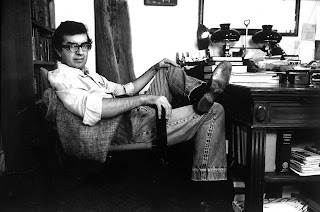
 After nearly forty years publishing his Rocksburg series of police procedural novels under the pseudonym K.C. Constantine, and stubbornly protecting his real identity from just about everyone, Carl Kosak showed up for his first book signing in 2011, at the Festival of Mystery in Pittsburgh, an annual event that attracted mystery writers from around the country (Louise Penney attended as well that year.) But it’s only been after his death last year in 2023 that anything much has been known about his life, due principally to the efforts of his son Christopher.

 Carl Constantine Kosak was born in 1934, and grew up in the Bottoms neighborhood of McKees Rocks, a small town within the Pittsburgh metro area. His father, an immigrant probably from modern-day Latvia, was an artist and founding member of the Pittsburgh Artists Guild.  He painted murals and also did commercial work and design for clients such as the Kaufmann department store family in Pittsburgh, including on their famous Frank Lloyd Wright house, Fallingwater.

 But the dominant figure in the Kosak household was Carl’s grandfather, according to some cryptic comments the writer offered in an afterword to a paperback edition of his first novel, The Rocksburg Railroad Murders. Carl developed a “murderous hatred” of him.  He died when Carl was 12. After asking to see the body to make sure, “I danced around chanting ‘He’s dead, he’s dead’ until I fell down exhausted.  When you hate someone and he dies, it’s a wonderful feeling.”

  Carl was an honor student at Stowe Township High School, as well as a star baseball player, good enough to be offered a minor league contract.  He played for several teams in the South before returning to Pennsylvania to attend Westminster College, a small liberal arts college affiliated with the Presbyterian Church in New Wilmington, a town about 50 miles north of Pittsburgh. 

 He got in some unspecified trouble with police, and was given the choice of jail or enlisting in the military.  He joined the Marines.  I haven’t run across any further information on his military service, but if he graduated at 18 and played ball for even a couple of years, the Korean War would have been over when he enlisted. 

 After his stint in the Marines, Kosak returned to Westminster College, where he met Linda Tweedy, who grew up in Greensburg.  They married in 1962.

 While in the Marines, Kosak had begun to write seriously.  He did well enough to be accepted at the Iowa Writers Workshop (this had to be the early to mid 60s, a crucial half decade or so before I was there.)  Kosak and his wife could afford to be there only a year, but his son said he kept in touch with some of his teachers.  I’m curious who they were. R.V. Casill? Richard Yates? Kurt Vonnegut? He mentions writer and California teacher Robert V. Williams several times in his afterword, so he must have encountered him somewhere.  In any case, he seems to have gotten more out of the Iowa workshop than I did.

 Their son was born in 1964, and at some point they moved to Greensburg, where Carl worked construction, and eventually taught English and/or Creative Writing at Seton Hill College for four years, reputedly forced to leave because he wouldn’t pursue an advanced degree.

 He became a proofreader/copy editor at the Greensburg Tribune-Review for an unknown period.  He may have been able to write full time after 1993.  He believed in the craft of writing, passing on his copy of Strunk and White’s Elements of Style to his son. (They also enjoyed conversations about Star Trek.)  He and Linda lived in Greensburg and remained married until her death in 2018.

 That’s about all that I’ve found in the public record (the K.C. Constantine wikipedia page is currently a disgrace.)  There seem actually to be more biographical details about his wife available, thanks to the obituary that Carl obviously wrote.    


Beginning with The Rocksburg Railroad Murders in 1972, the main character of Constantine’s first eleven novels was Mario Balzic.  In this book he’s in his mid-forties, and has already been on the Rocksburg police force for a quarter century, the last eleven years of which he’s been Chief of Police. Balzic would be the protagonist of 13 novels in the series total, and made at least an appearance in all 18.

 Some aspects of Balzic’s biography and the character itself would change slightly as the series went on (he went from drinking beer to enjoying wine), while other elements were clarified and augmented, but from the start it’s Mario Balzic who caught the attention of readers, and particularly in the many laudatory reviews. 

 Right away, Balzic was unusual.  For one thing, he didn’t carry a handgun, because “cops kill too many people, if you ask me.”  But he takes his modified Springfield rifle to the range every week to practice bringing down a man without killing him.  He’s restrained his officers as well, with the result that nobody has been shot by any of them since he became Chief.  “I’m prouder of that than anything.”

 Balzic isn’t idealistic and he’s also not entirely cynical, nor he is totally innocent, or erudite and all-knowing.  He curses a lot and screw up pretty badly at least once in every story.  But he knows people.  He knows that a 90 year old old woman calls police headquarters once a month to demand an officer take her complaint in person, so that she can eventually persuade him to go to the market for her because she can’t get around herself anymore, or the reason that an old man insists on complaining in police headquarters about his garbage pickup rather than walk to the second floor of City Hall to the right department is that he’s not supposed to climb stairs.

 These daily details surround some twisted crimes, and painful investigations.  But beginning with this first novel, usually something psychological is involved—in this case, a killer with a serious but concealed mental illness.

 Gradually we learn that Mario Balzic was born in or around 1926, joined the Marines out of high school (eventually named as Central Catholic) and saw horrific combat on the island of Iwo Jima in the late stages of World War II in the Pacific.  He joined the Rocksburg Police immediately after returning.

 Mario had a Serbian father who was killed in a coal mining accident, and in the first few novels, his Italian mother lives with him and his wife, Ruth. They have two daughters. As is common in at least western Pennsylvania marriages of mixed ethnicity that include an Italian, it is the Italian side that is the family culture. 

 Where did Mario come from?  He’s almost a decade older that the author, who had no daughters.  Despite Balzic’s dominant Italian heritage, Carl Kosak had none.  This is intriguing to me, what with the many Italian American characters in the novels, and even the adoption of a pen name that suggests Italian (I knew of Italian American families in Greensburg named Constantine—I think I am vaguely related to one.)

 K.C. Constantine asked the general question about Balzic’s origins and answered it at length and very indirectly in the aforementioned afterword.  The short answer is that Balzic is a predominantly imagined character, drawing some qualities from authority figures the author admired (possibly in the Marines) but also reacting against qualities in authority figures (mostly in law enforcement) he detested.  

 Although I suspect the author might have denied it, that “Balzic” is only a letter away from “Balzac” probably isn’t a coincidence.  The 19th century French novelist is known for creating complex characters from all segments of society in a realistic portrait of his time and place.  In his own way, K.C. Constantine has done the same in this series of novels.  Though at times it seems to me the character’s name could just as well have been Mario Dickins. 


For my own convenience if nothing else, I’ve divided these books into three phases.  The early third were fairly short and came out a year or two apart. The Man Who Liked To Look At Himself (1973) is told mostly in pitch-perfect dialogue, as Balzic is present when a body buried for years is exposed, and must follow the twisted trail of an unsavory murder while dealing with the petty bureaucratic and political demands of being Chief. His character still has some jagged edges that get smoothed later on.  In particular, he tells (for effect presumably) a story with racist language that would have been shocking even in the early 1970s. 

The Blank Page (1974) shifts milieu slightly to a community college, especially a teacher/poet and his protégé, that perhaps draws on the author’s experience at the Iowa Workshop and maybe his teaching gig at Seton Hill.  The murder of a young woman student who was traumatized by an earlier event is especially poignant. It calls to mind a somewhat similar childhood trauma suffered by Linda Kosak, as described in her published obituary as a form of PTSD. “Despite the best efforts of well-trained and well-meaning therapists, that emotional hand grenade…exploded as many as three times a month for the next 65 years.”

 A Fix Like This (1975) settles into the family and neighborhood violence that characterizes the series, including the desperation of people on the edge of survival.  The coal mines have mostly closed, and as the series continues the jolt of jobs and entire industries disappearing to distant lands that began in the mid-70s begins to contribute its devastating effect.

 Critics often make much of this aspect, which tends to make Constantine seem like an anthropologist examining an alien culture. But as someone who grew up and lived for a time in this part of the country, other cultural—and human--elements are at least as important in these stories.

 Another theme that’s here from the start is Balzic’s battles with a casually corrupt political establishment, which includes law enforcement.  Balzic has made his own compromises as well.  Through the “connected” Dom Muscotti, he’s set rules to keep the illegal numbers games clean, and in exchange for allowing that gambling enterprise to persist, the crime bosses will keep drugs and prostitution out of his jurisdiction.

 When I first read The Man Who Liked Slow Tomatoes (1982) I was especially impressed by a dialogue of several pages in which the reader is taken step by step through the delicate intricacies and strategies Balzic employs to extract information, while simultaneously presenting a portrait of a psychologically abused working class woman who is slowly bringing to consciousness all her repressed feelings and motives. This is when I knew a literary artist was at work.

 Always a Body To Trade (1983) was longer and maybe a bit more ambitious while still taut and fast-moving, using the innocence of a young and too eager new Mayor to reveal more complexities and corruption—another reason that Balzic affirms his belief in the rights of the accused. But to me it was his next novel, Upon Some Midnight Clear (1985) that gave Constantine’s a larger canvas for his next several novels, without moving the focus away from Rocksburg.

 By this time, Hill Street Blues was into his network run, with Homicide: Life on the Streets just ahead. Some of the police headquarters chaos described in this novel reminds me of some of the qualities of those shows.  The story he tells, with some major characters based on Greensburg people I knew about, took on the twisted fairy tale quality of its Christmastime setting. There’s more description of place, and more of Balzic’s inner life.


Joey’s Case (1988), his first novel with Mysterious Press, the publisher of the rest of the series, was also his most formally recognized, nominated for the Edgar Allen Poe Award for best mystery novel of the year. By this time, the Constantine novels had collected high praise in Great Britain as well as North America.  But his anonymity probably hurt his chances for a wider readership in this celebrity-centered age.  Still, if it enabled him to write and do so more freely, it was probably worth it to him, and now to us.  Because we have these books.

 Sunshine Enemies (1990) involves the death of Mario’s mother, who his wife Ruth considers her best friend.  This first whiff of mortality and change in Balzic’s private life is a foretaste of more to come.  There’s change in Rocksburg, too, as Dom Muscotti admits he has no say anymore over organized crime in town, and a new day is heralded by a sad little porn shop out on the highway. (I remember one just like it appearing in the 1980s outside Greensburg.) 

With Bottom Liner Blues (1993) time is getting to be a theme.  Though cues of the year in which each novel takes place are scattered through previous books, they basically seem to be set in a timeless present, with Balzic a timeless presence—only vaguely described, with his age barely implied.  With this book, Balzic is thinking about his age—he admits he’s 64--and the year it takes place is stated: the brutally hot summer of 1990, the first record-breaker that became known for awhile as Greenhouse Summer.

  For more than a decade, Rocksburg’s downtown has been hollowed out, mostly due to the two shopping malls on the highway just east and west of city limits, while city committees spin their wheels with loopy ideas for revival.  (Again, exactly Greensburg’s situation. One such organization, called Go Greensburg!, debated saying something nasty to me for what I wrote about the town in my book The Malling of America.

 The resulting cratering of tax revenue has led to a vastly reduced Rocksburg police force, and an aging Chief Balzic finds himself doing the work of a patrolman to cover for the summer vacations of the few officers left. Out at Rocksburg’s version of Greensburg’s Greengate Mall, he has a flashback in the parking lot, suddenly taking him back to Iowa Jima.  It’s not the last such episode in the book.

 There is of course a spiraling crime story, but this novel is notable also for a couple of other things.  First is the poignant plight of Mario’s wife Ruth, who wants a life and an identity outside the house, but is stunned to find she has no readily identified job skills.  The other is the very long dialogue between Balzic and one of Rocksburg’s colorful barflies named Myuskin, who turns out to be a respected and translated novelist with nine books almost nobody in Rocksburg knows about, and he’s broke and nearly broken.  Myuskin goes into a long complicated rant about how unfair it is for libraries to lend out his books without compensation.  It has dramatic impact, since he’s doing it with a gun in his hand, but it’s hard not to hear the author’s voice.

 Cranks and Shadows (1995) involves something I vaguely remember from Greensburg: the Fire Chief (here called Ed Sitko) who organizes a privately funded paramilitary group in response to 1980s terrorist incidents.  While Chief Balzic deals with more budget cuts and the prospect of laying off more officers, he learns more about the politics of power and money in his little town.  He learns it up close and personal when he is forced into retirement, after 24 years as Chief.

 The novel and Balzic’s career ends with two supposed retirement dinners. One is an ill-attended and insulting testimonial by the very public officials and private powers that forced him out, which he quickly observes is meant to humiliate him, and which he just as quickly leaves.  The other is a huge, raucous party given by the people of the neighborhoods he served, with food and drink all donated in appreciation.  This party adds a rare and surprising note to the series: unmitigated joy.   (The author also namechecks some actual well-known western Pennsylvania musicians of the time, including Kenny Blake, who played saxophone on my one and only record—but that’s another story.) 

 Judging from the book sleeve copy, even the publisher expected this to be the last of the series.  It did end a major part of it, but there was a third phase yet to come, with six more novels in the late 1990s and early 2000s, and a final one published in 2024.


 A now-retired Mario Balzic is the protagonist of two of them.  In Family Values (1997), Balzic is hired by the Commonwealth of Pennsylvania to look into a crime in a very rural county some distance from Rocksburg.  The back cover summary mentions “Balzic must enter his own heart of darkness,” and there is some of that quality to it, as well as grotesque characters that could be out of the horror genre, especially when Balzic faces a psychopathic and truly corrupt police chief who made a practice of abusing the power they both had. 

 Blood Mud (1998) finds Balzic employed by lawyer Panagios Valcanas (one of the handful of characters that appear in most of the Balzic novels) to investigate thefts at a mall gun store (chronicling as well the deterioration of the soon-to-be defunct Greengate Mall) for an insurance company.  This seemingly quick job gets much more complicated, especially when Balzic has what he’s told is “a cardiac event.”  This is meticulously described, including his treatment at the county hospital (based on the same hospital where my brother-in-law got similar treatment just a few days before I read this account), and his edgy feelings of vulnerability and mortality afterwards.

 Balzic seems to be sinking in fear and guilt, certain he’s damned for what he failed to do, but one of his daughters is giving him books, including some on meditation, and he’s becoming an advocate. (Besides the Strunk and White, the other book the author gave to his son was Zen and the Art of Archery.) 

 As far back as A Fix Like This, a promising young officer named Ruggiero Carlucci (called “Rugsy” at first, and then “Rugs”) was introduced, and as a detective he soon became essential to Balzic’s investigations.  After Mario’s retirement, he was the main protagonist of three novels: Good Sons (1996), Brushback (1998)—which involves a minor league pitcher, perhaps drawing on Carl Kozak’s youthful memories—and Grievance (2000.) 

 In 2002 came Saving Room for Dessert which follows three protagonists from the Rockburg police: Robert Canoza, James Reseta (on the force in Balzic’s time) and William Rayford, Rocksburg’s first black police officer, who Balzic met and formally recommended in Blood Mud.

 By this time, Constantine’s fictional world dominated over any real world resemblances.  These characters worked out their fates within it, with distinct elements of classical tragedy—tragic flaws and all.  They are different from the Balzic books, yet just as compelling. (Balzic appears in the Rayford section, does him another favor and says that it will mean Rayford has to forever “listen to my stories,” a perfect distillation of both elder behavior and elder Balzic’s function in these last books.)

 And the rest was silence, or so it seemed.  The books stopped coming, and Carl Kozak finally revealed himself as the author, and signed a few books in 2013.  But at that time, he complained that while he was still writing, he wasn’t getting published. 

 Yet he must have persisted because the manuscript for his final book emerged from the editing process, and was signed, sealed and delivered just days before he unexpectedly passed away in 2023.


 Published earlier this spring (of 2024), Another Day’s Pain centered on Rugs Carlucci for the fourth time.  Like the previous novel, Mario Balzic puts in some spectral appearances as a (maybe) slightly addled sage. By this time, Carlucci himself is on the brink of retirement, but apart from dealing with the petty violence and twisted personalities he must confront on the job, he is dealing with the fallout of tragic circumstances in the present and the past.

 Psychological issues emerge in all of these novels, but mental health is never more central than in this, the last one.  Over the course of the Carlucci novels, his increasingly violent mother goes from being a kind of deluded harpy in his home, torturing him with a past neither of them can fully deal with, to a very violent threat who inflicts serious injury, to a mental patient who enacts one last violent revenge.

 If this was not enough to shatter Carlucci, he is hit with suddenly resurrected memories of abuse by a priest in his own youth, as well as the breakdown of the one person who gave his life hope, his girlfriend, the beautiful Franny Perfetti.  The novel ends with both of them making slow progress towards normality, but far apart. There are words about how you don't have to be in a war to get PTSD that are similar to words in his wife's obituary.  The story at times edges perilously towards the Gothic, but the writing is just as hypnotic, and the artistry is intact. In his late 80s, K.C. Constantine still had it.

 What did he have?  I can’t make comparisons with other police procedurals.  Apart from Raymond Chandler, a dash of Hammett, most of Sherlock Holmes and Poe’s original detective, the only such series I’ve read are Tony Hillerman’s Navajo Nation Police novels and Donna Leon’s Commisario Brunetti in Venice.  And it’s very obvious I can’t detach from the variations on Greensburg. 

 But I can say this much.  In that afterword, Constantine wrote about the importance of getting the tone right.  Call it tone, flow, music, voice—it keeps you reading with forward momentum, and it keeps you comfortable reading, even when the stark hardness of many of those lives and the people living them are hard to take.  There is humor, though mostly black, and there are moments of warmth and hope.  The protagonists—Mario Balzic, Rugs Carlucci—are flawed and conflicted but above all they are earnest—and so you root for them, even when what they are up against is themselves.      


Meanwhile, in the real Greensburg, the Rialto bar --at least in the 70s and 80s-- was never quite as populated and lively as Muscottis, and didn’t look much like it, except for the ancient restrooms in the basement, which might have been built by the Romans if their empire had extended that far.  The last time I was there was on a 2019 visit with family and friends, when I had a plate of overcooked spaghetti in the restaurant half, learned that there was different management, and that the new bartender didn’t know that the famous bartender of Dom's day (named Vinnie in the novels) was called Baldy, now the name on the pizza shop next door.  Since then, the place fell on darker days, with a shooting and then a stabbing.  The state closed it, though new owners plan to reconstitute it as something called a gastropub.

 Greensburg also lost an actual police chief when he was arrested for dealing drugs. Another descendant of the real fire chief called Ed Sitko in the books is the new fire chief, at least the third generation, and the town experienced a murder more horrendous than any in Constantine’s books. 

Seton Hill is now a university and has spread itself through downtown, which is looking less bedraggled, if not more lively.  There still seems to be no recognition of these novels, and the Kosak home was put up for sale.

Wednesday, May 15, 2024

K.C. Constantine: The Mysteries of Greensburg

by William Severini Kowinski 

Every December I resolve that this year I won’t expend the time and effort to look up notable deaths of the past twelve months to write about the people I remember, as I have for some years past on various blogs.  Failing that, I tell myself, I will restrict my research to the more prominent names assembled by major newspapers and magazines.  

But every December, including in 2023, I still find myself trolling through Wikipedia’s comprehensive rolls of hundreds of deceased soccer stars and those in other fields around the world who made the cut.  I do so partly because every year, a name surprises me—someone whose death means something to me, but I had not known of it until then.

  Last December, that was the writer K.C. Constantine.  His series of 18 police procedurals began in 1972 with The Rocksburg Railroad Murders, and concluded with the just published Another Day’s Pain in April 2024.  All of them are set in his fictional Rocksburg, Pennsylvania.

 Despite consistently laudatory reviews in the New York Times, Washington Post and other prestigious places, he was never very well known (and therefore, his death was not noted in their year-end summaries.)  A blurb on the back of his final novel by mystery writer Ken Bruen sums it up: “…a great and ferocious talent who was unjustly ignored.” 

 K.C. Constantine was a pseudonym, and for most of his career his real name was not generally known.  But for part of that time I knew it.   Carl Constantine Kosak died at the age of 88 in Greensburg, Pennsylvania, where he’d lived while writing this book series, and where I was born, grew up, and returned as a visitor and temporary resident. 

I hasten to add that I did not know him, and even after I knew who he was, I never met him.  I learned of his books in the 1980s, fittingly enough, in the very bar he immortalized as Muscotti’s in the novels.  A newspaper reporter friend told me of the series, and that it was basically set in Greensburg, though I didn’t get the impression he’d read many himself.

  I found five or six of his novels in the Greensburg Public Library.  I was excited by what I read, and amazed that nobody in town—including my otherwise well-connected acquaintances-- seemed to know about them, and therefore, about him. And it was very clear from those novels that it was Greensburg he was chiefly writing about.

 The Wikipedia entry on Constantine asserts the novels are set in a version of McKees Rocks, another western Pennsylvania town, where Kosak grew up. There are elements of McKees Rocks represented—notably the neighborhood of the Bottoms, called the Flats in the novels, as well as other places, real and imaginary.  But basically, it’s Greensburg. That fact is now acknowledged in the author’s bio with the last novel. 

 That an author who is known elsewhere could remain unknown in Greensburg was not exactly news to me, but that Constantine was writing police procedurals about the very city that was blind to him did seem strange. So I continued my search for the author’s identity, and eventually found my answer, once again, at the model for Muscotti’s.

 Facing Pennsylvania Avenue (called State Street in the novels), on a downhill slope of West Otterman St., there was a bar and grill called the Rialto since 1933. (It’s name possibly had something to do with the long gone Rialto movie theatre nearby.) This had been the location of one tavern or another for much longer, going back to when it was close to the trail between Fort Pitt on the Point in Pittsburgh to the west and Fort Ligonier in the mountains to the east. The place that became Greensburg was a rest or overnight stop , so it was at first a settlement of taverns and inns. According to a town history, one early tavern on the precise location of the Rialto had walls three feet thick to repel arrows from hostile Indians.  Later the trail became the stagecoach road, and still later, the railroad right of way.

 Into the early 1980s, the Rialto was owned by a man named Dom, just as Muscotti’s is.  It so happened that one of his daughters was a high school classmate of mine. After Dom died, she renovated the place (which had become pretty seedy) and I happened to see her there one day after it had reopened as more of a cafe restaurant.  I mentioned the novels and she said that she had recently met the man who’d written them, after her father’s funeral.  He tried to explain how much her father meant to him.  He’d introduced himself as Carl Kosak.

 By then I was living in Pittsburgh and writing a column for an alternative weekly there.  Talking to the paper’s CFO who coincidentally was a friend from Greensburg, I proudly confided that I learned K.C. Constantine’s identity but wasn’t going to reveal it, when she laughed and said, “Oh, you mean Carl Kosak.”  It turns out that she had been a babysitter for his son (and once kept him up late to watch Hitchcock’s “The Birds” on TV.) 

 So I wrote a column about the books of K.C. Constantine titled “The Mysteries of Greensburg.”  (The Mysteries of Pittsburgh had been a recent best-selling novel for Michael Chabon.)  I described my search for the author but, true to my word, did not divulge his name.

 Some days later I received a letter from Carl Kosak, thanking me for keeping his secret, and correcting me on a few points, notably on the quality of his previous publisher, which he’d abandoned.  His new book—Joey’s Case— would be nominated by the Mystery Writers of America for best novel of the year, the closest Constantine got to official recognition.

Along the way I learned that Kosak had taught at Greensburg’s Seton Hill College (though only for a few years, it turns out) and worked at the Greensburg Tribune Review (as a copy editor, I learned later.) Beyond that I knew nothing.

 I soon moved more than 3,000 miles away, but over the years I kept an eye out for new K.C. Constantine titles as well as copies of older ones.  After learning of his death I began reading from what I had, and my rekindled enthusiasm inspired me to complete my collection with what I could find online, and read them all, more or less in order.

 My collection reflects an interesting publishing history of both obscurity and interest.  I have seven hardback first editions (though one is a discard from the Burlingame CA Public Library), but also a couple of editions from England: The Man Who Liked To Look At Himself (1973) in an Allison & Busby American Crime Series paperback (I acquired this at a university bookstore sale—back when university bookstores actually sold books), and a Coronet paperback Double Detective combo of The Blank Page (1974) and A Fix Like This (1975), which claims to be the first appearance of these books in the UK.  (However I also have an apparently rare hardback of The Blank Page from Saturday Review Press, its US publisher.)

 I’ve got a David Godine paperback of The Rocksburg Railroad Murders (1972) with a 1983 afterword by the author, a Penguin paperback of Always A Body To Trade (1983), Warner Books/Mysterious Press paperbacks of Bottom Line Blues (1993) and Family Values (1997), an advanced reading copy of Brush Back (1998) and a Thorndike Press large print edition of Blood Mud (1998.)

 This recent reading of the Rocksburg series—one after the other, over the first months of the year—reinforced two impressions of that 1980s reading of the first half of the group.  We all know the cliché of “the page-turner,” the book you can’t put down.  In my many years of all kinds of reading, this cliché has seldom been as true for me as it was reading Constantine.  I almost invariably found myself blowing past the time I’d expected to read at one sitting—and it was seldom because I needed to know whodunit.

 The second is the eerie reading experience of knowing exactly where many of these places are that I’m reading about, and even the people particular characters seem based on, or are meant to represent.  This knowledge, while not absolutely unique, has to be rare. I mean, I’m not having an experience in common with millions of New Yorkers, or thousands familiar with southern California or the Bay Area.  I personally know no one who has read this series and knows Greensburg, especially from the 1970s and 80s.  The fictional and the real universe keep crossing in and out of each other, but this is not an experience I can readily share.

 Of course, Rocksburg exists only in the pages of Constantine’s novels. Its placement in western Pennsylvania is somewhat different, and somewhat impossible. But the Greensburg I know is clearly there as a model and a source, giving physical form to many of the scenes I am reading and imagining, as well as supplying aspects of varying proportions of some characters.

S. Main St. Greensburg 1977
 It’s there from the beginning, in the Rocksburg Railroad Murders. The locations of the county court house, city hall and police headquarters are the same as in downtown Greensburg.  The location and layout of the train station is the same, though by 1970 (when this novel takes place, by the internal evidence of the outcome of the National League baseball playoffs that becomes a plot point) this grand old station had been long closed, though trains still stopped in Greensburg (I took many Broadway Limiteds from there to New York in the 1980s.) 

 Even the location of the hippie store on “State Street” (Pennsylvania Avenue) suggests the health food store that was still there in the early 80s, in the below- ground floor of the old Rappe/Greensburger/General Greene hotel.  

Some Greensburg history with which I was personally familiar also appears.  In The Blank Page (1974), Constantine conflates several local coal barons families, but writes about the one that maintained their sumptuous residence in “Rocksburg” after all the others moved on, (some far away, some to Pittsburgh and some in estates east towards Ligonier, where they had a hand in causing the great Johnstown Flood.)  The remnants of that family, called the “Summers” in this novel, held on to its façade of wealth into the 1950s, but suddenly that pretense vanished.  The first sign, Constantine writes, was that the chauffeur was dismissed.  I remember tales of such a family in Greensburg (the Jamisons), because that chauffeur lived next door.  I'd even seen the car.

 Recognizable Greensburg people also form the basis for characters in these novels.  The combination of characters and locale got downright dizzying in Upon Some Midnight Clear (1985): Westmoreland Hospital, Greengate Mall and the cinder block bunker that housed the Greensburg Tribune-Review newspaper, are all given different names but accurately described. Some downtown street names are exactly the same, so I knew the precise location where a mugging is alleged to have occurred.

 Meanwhile, three major characters seem closely based on well-known Greensburg figures of the time: There’s  “hard charging and outspoken” fire chief Ed Hutchinson (as described in another Greensburg history) who is the model for fire chief Ed Sitko in this and several other Rocksburg novels.  Ruth Love (called Mary Hart) was a prominent and controversial columnist for the Greensburg Tribune Review, particularly in the early days after it was bought by Richard Scaife, known then and now for his wealth and hard right wing politics.  Besides purported news stories, she wrote the rambling and often scurrilous and self-righteous column Lovelines (called Hartbeats in the novel.)

 Constantine provides a more sympathetic portrayal of that newspaper’s veteran editor, called Tom Murray in the novel.  I’m almost certain he is based on Tom Aikens, the editor of that era who I met and admired.  In pre-Scaife days, in the late 60s or early 70s, I recall Aikens actually writing an editorial opposing the American war in Vietnam.  Aikens, like Murray, died young. In researching him for this post, I found very little available on the Internet.  Constantine’s portrait of him thus becomes his most lasting memorial. 

In review excerpts dotting the novel covers, Constantine is praised for his mastery of dialect in dialogue.  This has several components, or layers.  There’s ethnic dialogue of typical western Pennsylvania immigrants and their descendants, mostly Italian. This I find familiar, though probably disappearing, if not a 20th century artifact.

  Black dialogue seems more urban to me.  But there is a western Pennsylvania way of talking common to all ethnic and racial groups—at least in these decades—that is accurate, if somewhat exaggerated.  It reminds me of playwright August Wilson, widely praised for his dialogue, though actor Roscoe Lee Browne mused that neither he nor the other black actors in a Wilson play recognized its talk from their own communities.  I'd guess it's a specifically western Pennsylvania approach to language as spoken in the black community of Wilson's youth (for as New Orleans-bred Branford Marsalis noted, black argot is regional) plus the playwright's artful stylization.  It’s writing, after all, and this seems true also of Constantine.

 Western Pennsylvania retains some words and expressions that other places don’t—like “nebby” (meaning nosy)  and "slippy" (meaning slippery) which are still used in at least northern England (if the ITV series Vera is anything to go by) , and “redd up” (lightly clean up, usually the house) which I ran across in Dickens.

  But there are differences even within the region.  Pittsburgh, currently proud of its unique expressions, has made a fetish of the word pronounced “yinz,” which means the plural “you.”  But to my ear Greensburg (just thirty or so miles away) harbored a slight variation: the pronunciation was more like  "yunz"-- closer to "you-uns" and so more clearly derived from “you all.”  And sure enough, in Constantine’s last novel, Another Day's Pain (2024) he gave the Greensburg version, which he spelled “youns.”  He casually employs a number of other expressions rooted in this region, just as a matter of course in the dialogue.   

 Some of the plots also have familiar elements from vaguely recalled news stories, but as a whole the series makes me feel I led a sheltered life there. There was a certain harshness as well as warmth to the place, and I recognize the meanness and excesses of some characters, but fortunately I didn’t have to deal with very many as extreme as appear often in these pages. 

Still, I feel a kinship with the author as well, based on those shared streets and people.  In his 1983 afterword to his first novel, The Rocksburg Railroad Murders, Constantine describes its origin: buying a newspaper one Sunday morning at a particular newsstand, he saw rows of paperback mysteries, which the proprietor told him just about fly off the racks.  He’s been struggling with his attempts at literary fiction, and wonders if he could write one of those and actually be read.  On his drive home he passed the train station, and he had the idea for this novel that starts the series.

 I know exactly what newsstand he’s talking about—on Otterman Street in Greensburg—and I’ll bet he was there to pick up the Sunday Pittsburgh Press and maybe the New York Times, for it was the only place it could be obtained in the pre-Internet days (though whether it was even there in the early 70s I'm not sure.  In any case, that’s where I got my Sunday Times later in the decade, and eventually signed up for a reserved copy.  Maybe Kosak did, too.  When I came for it every Sunday, it was on a separate stack, possibly with names attached. If so, considering how close the names Kozak and Kowinski are in the alphabet, there’s a chance that for at least a few years my copy was just on top of his. Which is only one of the ways our ships may have passed in the night, on the streets and buildings of Greensburg, PA.  

 All of this adds another dimension to my reading experience, which is a delight but also has some weight for me. What I share with all readers however is even greater: the experience and appreciation of a unique literary voice in K.C. Constantine.  That’s the subject of my next post.    

Tuesday, February 20, 2024

N. Scott Momaday 1934-2024


 N. Scott Momaday, poet, novelist, playwright, artist, essayist, scholar and teacher, died in January.  He is best known for his first novel, House Made of Dawn, which won the 1969 Pulitzer Prize for Fiction.  His father was Kiowa, as a child he was given a Kiowa name and identified as Kiowa, although he lived among and studied other American Indian peoples.

House Made of Dawn concerns a mixed blood Indian returning from the multiple traumas of World War II to the pueblo, trying to find his place in the modern and traditional worlds.  In telling this journey, Momaday uses both his knowledge of the written literary tradition and the traditional ways and stories of an oral culture. 

With this novel, Momaday revealed and defined a central dilemma of contemporary Native people: how to make a life in the often contradictory "two worlds" of modernity and their traditions.  This would become the model and inspiration for a slightly younger generation of Native writers who burst on the scene in the late 1970s through the early 1990s.  Each in their own way would also employ this dynamic of modern literary approaches and traditional storytelling and beliefs, in part to explore and honor traditional Native cultures and its point of view, particularly towards the natural world. 

  Leslie Marmon Silko is the most obvious heir: her debut novel Ceremony also follows an Indian soldier, this time a Vietnam vet, coping with the difficulties of returning home and finding himself. Others were direct and indirect beneficiaries of Momaday's example and success, including novelists Louise Erdrich, Linda Hogan, James Welch and Michael Dorris, as well as poets and storytellers Joy Harjo, Simon Ortiz, Paula Gunn Allen, and many others.

These explorations are multiple: using literary form and traditional content, expanding literary forms to include traditional forms--all sorts of combinations beyond categories to create new stories that honor and expand the old.  The past is never left out, it is (as Faulkner articulated) always present.  The Native tradition is particularly important for its living attitudes towards the natural world and its relationships to human beings and culture.  Those attitudes and beliefs can be adapted and absorbed in our contemporary world--in fact, they must be, if the past and the present and the eternal itself are to have a future.

Momaday was a champion of the Native oral tradition, and he taught the subject for many years at various universities.  But he was also steeped in written literature, particularly American fiction and poetry of the 19th and 20th centuries.  His detailed descriptions of the landscape use literature (including modern) in expressing and interpreting what the indigenous senses observe.   

Momaday believed in the spoken word today as well, and he read several times at the Humboldt State University near me.  I've seen the tape of one such reading and attended another one.  He had a bearing of great dignity, a precise pronunciation and an uninflected voice of great depth and power.

  The reading I attended was in one of the larger venues on campus, with Momaday at a lectern on a stage. He had hardly begun when the power suddenly went out.  He paused, calmed the crowd and continued anyway, so that deep, deliberate voice came out of the semi-darkness with no need for amplification, and with dramatic effect.  

Afterwards he signed my copies of The Names, (A Memoir) and The Man Made of Words, a collection of essays, stories and poems.  The essays touched upon the work of Jorge Luis Borges and Emily Dickinson (he studied her poems for a year, in manuscript), Teilhard de Chardin and Lewis Thomas, Georgia O'Keefe and Jay Silverheels, as well as his grandmother's stories.  He included observations from his travels in Russia and Germany as well as the American West.  

I think my favorite of his books that I've read is his second novel, The Ancient Child.  It uses his lifelong fascination with the legends of Billy the Kid to explore planes of myth of the past and the contemporary world.  It is at once a traditional novel with contemporary and semi-historical characters, a kind of personal anthology and an exploration of storytelling itself.  It has humor, too.  Momaday identified with the bear, saying he had bear power and occasionally turned into a bear.  But there was some Coyote in him, too.

Tuesday, January 02, 2024

R.I.P. 2023 Review


When I was spending a fair amount of time in Manhattan in the 1980s, Martin Amis was a name I heard a lot.  My friend Michael Shain, then a reporter for the New York Post, designated a different Amis novel for each of his friends. (Mine was The Information, which I still have not read.)  I followed the Amis career without ever really becoming engaged with his novels.  But in interviews he would often say something that hit me directly, as when he mentioned being ambushed by memories that were accompanied by searing regret, just walking down the street and thinking of something else.  This was an experience I often had, but which I’d never heard anyone else confess.

 When Amis died last May I noticed how he was almost universally praised as a literary eminence.  (He was Sir Martin by then.)  So I went back to his more famous novels (Money, London Fields), neither of which I could finish once again, and I read entirely his last novel (Inside Story) and his collection of essays and reviews, The War Against Cliché.  In both I responded to gems of insight and stylish writing, but on first reading I couldn’t experience Inside Story as a whole novel, for all its shining parts.  So I remain a frustrated reader of a writer with whom I nevertheless felt an odd bond, as much for many differences as for similarities and sympathies.  The tension of that seems productive and affectionate.  

 Another novelist much talked about in the 1980s was Milan Kundera, principally for one book: The Unbearable Lightness of Being, now a classic of the era.  I read it with fascination, and found his previous novel, The Book of Laughter and Forgetting, published in English through the auspices of Philip Roth and his series of works by Eastern European authors.  More recently I read Kundera's Slowness, and wrote about it here.

 With the paradox of its title, The Unbearable Lightness of Being seemed to become fashionable mostly because of the sex, though Italo Calvino pointed out that its virtues were the liveliness and intelligence of the writing.  I doubt I understood or endorsed a lot of it, but I liked its rhythms and it did feel like something I hadn’t encountered before in fiction.  I better understood the meditations on the speed of life today and the paradoxes of memory in Slowness.   

 Cormac McCarthy was a controversial and respected novelist over several decades. Though his fifth novel in 1985, Blood Meridian, became recognized over time, his first commercial success was All the Pretty Horses in 1992.  Probably his biggest and most enduring literary, cultural and popular success was the haunting post-apocalyptic tale, The Road.  

some of the books by Garcia Marquez translated by Edith Grossman

 Harold Bloom called Edith Grossman “the Glenn Gould of translators,” because she too was a precise virtuoso.  Her translations of Latin American authors, together with those of Gregory Rabassa, helped fuel the boom for these novelists in the 1970s and 80s.  In particular she translated seven books by Gabriel Garcia Marquez, who once said that he preferred reading her English translations (and Rabassa’s) to his Spanish originals.


Russell Banks was a prolific American novelist and story writer who detailed working class lives but also wrote about Jamaica and Haiti and The Magic Kingdom.  He was especially beloved by fellow literary writers.

 Robert Brustein was a titan of modern theatre in America, founding both the Yale Repertory Company and the American Repertory Company at Harvard. He backed his work as a producer, director, actor and playwright with essays and books from The Theatre of Revolt (1964) and Who Needs Theatre? (1987) to Winter Passages (2014.)  He engaged in many controversies, such as his debates with playwright August Wilson.

 British Jungian psychologist Anthony Stevens wrote several books on Jung and his theories, particularly on archetypes and dreams.  I remember reading with pleasure Ronald Steel’s sterling biography of journalist Walter Lippmann, and D.M. Thomas’ novel The White Hotel.  I recall enjoying Francois Gilot’s reminiscences of her uneasy life with Picasso when I read them in the 1970s, and Jonathan Raban’s Old Glory: An American Voyage in the 1980s.

 As the last veterans of World War II fade away, so do the authors who examined aspects and outcomes of that war.  Japanese author Kenzaburo Oe wrote about the legacy of the atomic bomb in Japan, while Selichi Moriura exposed Japanese wartime atrocities. Marga Minco wrote about the ramifications of the Holocaust and the war in postwar Europe.   

 Also among the writers who passed on in 2023 were poets Louise Gluck, Charles Simic, Naomi Replansky, Robert Pack, Benjamin Zephaniah, David Ferry, Saskia Hamilton, Park Je-chun, Amy Utematsu, Trienke Laurie, Antonio Gala, Asad Gulzoda, R.H.W. Dillard, Robin Mathews, Maria Laina and Wendy Barker; playwrights Tina Howe, Megan Terry, Robert Patrick, John Mairai and Ama Ata Aidoo; eminent screenwriter Bo Goldman; novelist/playwright Fay Weldon, story writer Edith Pearlman, novelists AS Byatt, Herbert Gold, Ted Morgan, Eve Bunting, Meir Shalev, Martin Walser, David Benedictis, and Amy Schwartz.

 In genre fiction: Carol Higgins Clark (mystery), K.C. Constantine (master of the police procedural--more about him later), John Dunning (detective fiction and books on old time radio), John Jakes (historical), Julie Garwood (romance); Michael Bishop, Michael A. Banks and Richard Bowes (science fiction.)

 Artist and writer Linda Salzman Sagan, sociologist and communitarian visionary Amitai Etzioni, historians Emmanuel LeRoy Ladurie, Eugenio Riccomini and Marceli Kosman; feminist scholars Dale Spender and Jean F. Yellin, psychologist Alice K. Ladas, philosophers Harry Frankfurt and Ian Hacking; crime writers Anne Perry and Mary Willis Walker; satirist Dan Greenberg.

 Writers William Howarth, Gail Tremblay, Phillipe Sollers, Luca di Fulvia, Doris Gregory, Michael Denneny, Zaleka Mandela, Echo Brown, Minnie Bruce Pratt, Ramzi Salame, Darchhawna and Ronald Blythe.

 Journalists Betty Rollin, Kevin Phillips, Victor Navasky, Michael Parkington, Paul Bradeur, Warren Hoge, James Reston, Jr., Bernard Kalb, Hugh Aynesworth, Eva Hauseserova, Howard Weaver, Edwin Wilson, Michel Ciment, Jack Anderson, Colin Spencer, Bill Shipp, Mandy Jenkins, Ian Black.

 Apologies for misspellings and misappropriations.  May they and all the writers who died last year rest in peace—their work lives on. 

Saturday, December 31, 2022

R.I.P. 2022


I first knew of Barbara Ehrenreich from a mutual acquaintance as another freelance writer struggling to get published and especially to get paid.  This puts additional light on her most cited work, Nickel and Dimed: On (Not) Getting By in America, in which she documented her own experiences working at minimum wage jobs. 

 But she was also well-educated and well-connected, and was published in the best newspapers and periodicals.  Besides her single subject books, like the aforementioned 2001 volume, her periodical pieces were collected. For instance a volume covering the 1980s, which was for her (and many others) a grim and disenchanting decade, as reflected in her title: The Worst Years of Our Lives: Irreverent Notes from a Decade of Greed.  Her 1995 collection is titled The Snarling Citizen. All of these essays exhibit her wit as well as insight. She spotted important destructive trends which unfortunately still pertain. Throughout the decades, she wrote with great acuity about the conditions and injustices women face (and she faced some painful ones herself), and for that and her lively if uncomfortable reporting on both gender and class, she deserves to be read and remembered, learned from and imitated. 

 Greg Bear was a productive and insightful science fiction writer who I met at a Star Trek convention in Seattle, where he was based.  I especially admire his visionary novel Darwin’s Radio

Hazel Henderson

I once saw Hazel Henderson essentially take over a World Future Society convention.  As a futurist, environmental activist and economist, she was most dynamic in person, but she reached wider audiences with her books, including Creating Alternative Futures and Building a Win-Win World.

 Suzi Gablik was an artist who wrote about art.  In 1970 she published the first in- depth book on Rene Magritte (and helped make him the highly visible artist he is today), after living with the artist and his wife. In the 1990s she broadened her conception of art to include Indigenous and other worldviews, publishing The Reenchanment of Art. As she became more concerned about self-destructive civilization, she published Conversations before the end of time, a collection of amazing interviews. Both I consider to be landmark books.

 Ted Mooney’s day job was editing Art in America (so he may have edited Suzi Gablik.)  But his contribution to literature is his individual vision in four novels, the first being the best known: Easy Travel To Other Planets in 1981, which an American literary critic placed on his list of the best 100 novels of the twentieth century. 

Roger Angell was best known for his writing on baseball in the quintessential New Yorker style, but he also wrote fiction and other non-fiction (plus the witty annual New Yorker Christmas rhymes), as well as serving as the New Yorker’s fiction editor for many years.  In that capacity he wrote me the most flattering and most heart-breaking (literary) rejection letter of my life, in which he said the New Yorker “could hardly bear not to publish” my story.  History shows they all managed pretty well. Angell was 101.

  Doris Grumbach wrote novels and was known for literary criticism in the New Republic and other periodicals.  Among those she reviewed (approvingly) was novelist Maureen Howard, a writer I also enjoyed.

I admired Nancy Milford’s biography of Zelda Fitzgerald. Hilary Mantel wrote various kinds of novels and stories but is most famous for her historical fiction. Nicholas Evans was a British broadcaster and writer whose best-known book is The Horse Whisperer.

 Larry Woiwode published much-praised fiction, essays, biography and poetry from 1969 to 2022. Besides writing some 18 books, he taught writing and ran university writing programs, so his students got the benefit of somebody who walked the walk.  

Before he was a familiar narrator for historical and nature documentaries, David McCullough was a prize-winning author on mostly historical subjects.  Educated at Yale and a model of aristocratic culture, he was born and raised in Pittsburgh, which may have given him particular perspective on the subject of his first book, the Johnstown Flood.

Mike Davis wrote penetrating books about cities and their future, especially Los Angeles. From 1971 to 2012, Todd Gitlin wrote about mass media and politics. Peace activist Staunton Lynd wrote and edited books on political action and nonviolence. William Rivers Pitt is best known for his reporting and political analysis of the American war in Iraq.  P.J. O’Rourke wrote from the other end of the political spectrum, though he started out as just a funny guy. 

Then there are those who are prominent for reasons other than writing, but also published useful books. The latest name added to this year’s rolls is Barbara Walters, whose death was announced on December 30.  She was 93.  She was a television news pioneer and an expert interviewer, and she was famous.  Though I never met her, I once interviewed her on the phone for a piece on Hugh Downs.  Because of her schedule she had to call me, and I didn’t know when she would.  When she called—evidently in the makeup chair for some television appearance—I was in the shower.  So I in fact interviewed Barbara Walters while naked.

 Others who authored books in addition to their day jobs were former Secretary of State Madeleine Albright (whose penultimate book was titled Fascism: A Warning), Mikhail Gorbachev, last leader of the Soviet Union; and for all I know, Pope Benedict and Queen Elizabeth

Scientist James Lovelock saw Earth as a living system, developing (with others) the Gaia Theory, and warned of the dire consequences to the planet of the climate crisis in a series of popular books.  He had 102 years of a remarkable life. Environmentalist and writer David Foreman founded Earth First!


 Revered Zen monk Thich Nhat Hanh reached millions with his lectures, audio meditations and his many books. Stage director Peter Brook wrote several important books about theatre.  Before he made films, Jean-Luc Godard wrote about them, and continued to talk about filmmaking at book length.

 Print and television journalists who published books (and some who didn’t) but passed in 2022 include: film critic Sheila Benson, Mark Shields, Bernard Shaw, Bill Plante, Jim Angle, Michael Gerson, John DiStasio, Francis X. Clines, John Hughes, Ann Garrels, Richard Lopez, Shelby Scott (who I remember from WBZ in Boston), and Robert Herman.


Chronicled in books and other media, the legendary work of World War II and fashion photography Tony Vaccaro, and of the photos of Tim Page in Vietnam and afterwards.

 Some subjects of journalistic and other writing that should be mentioned but haven’t fit into previous categories include General Charles McGee, last of the Tuskegee airmen of World War II, and Holocaust survivor Edward Mosberg; American Indian activist Clyde Bellecourt, artists Claus Oldenberg and Margaret Keane (those big-eyed figures popular in the 60s); sportscaster Vin Scully, men’s basketball great Bill Russell and women’s basketball great Lusia Harris; legal scholar Lani Guinier, co-founder of the Environmental Defense Fund Art Cooley.

 In general, writers don’t get a lot of respect in America, though they may be celebrated locally or within a profession.  So whatever degree of success or failure, fame or obscurity these following writers had in their lifetimes, as long as they have a book or a periodical piece in a library somewhere, or something buried in the depths of cyberspace, there’s a chance some stranger may read it, and their words will live again.

 Also passing away in 2022 were: Andre Leon Talley, Anne Harris, Barbara Love, Geoffrey Asche, Terry Garrity (The Sensuous Woman), Carleton Carpenter, Bruce Duffy, Valerie Boyd, Leonard Kessler, Paul Cantor, Shirley Hughes, Sally Watson, Bethany Campbell, Thomas F. Staley, Sydney Shoemaker, Francois Bott, Tom Maddox, Julia Powell, Sharon Presley, JFK conspiracy theorist David Lifton, Stuart Woods, Joanna Clark, Raymond Briggs, Andrew Hubner, Helen Potrebenko, Terrance Green, Mark Girouard, Michael Malone, Antonin Bajaja, Sue Hardesty, Luis Agular, Jean Franco.

 Poets Gerald Stern, Peter Landborn Wilson, Simon Perchik, Dennis Wilson, Noah Eli Gordon. Editor and publisher Jason Epstein, and literary agent Sterling Lord (I was once represented by his esteemed agency.) Let this list also honor the writers whose deaths were unnoticed.  May they all rest in peace.  Their work lives on.

Wednesday, December 29, 2021

R.I.P. 2021

American poetry and the lives of poets since the middle of the 20th century would be inconceivable without Robert Bly.  I heard Bly read twice in the 1960s, in a relatively small room on our college campus.  He was theatrical, enthralling, mesmerizing. He above the few others who got poets reading in public again popularized the practice. Poetry readings are now everywhere, and provide another income stream and contact with the public for contemporary poets.

 Bly organized and led poets against the Vietnam war, and they gave group readings. I heard him again years later in a reading in Pittsburgh with his good friend, James Wright, in one of the last appearances of Wright’s life.

 With his magazine The Fifties (later The Sixties), his translations and his proselytizing at his readings, Bly introduced previously ignored poets from Europe and especially Latin America.  He especially championed Pablo Neruda.  In one of his last interviews in 2011, Bly acknowledged that these activities brought new poets to the attention of American writers, and that attention “changed American poetry and made it less rigid and more playful.”  He favored a more imaginative poetry “which allows the unconscious to come in with its various ignorances and brilliances.”

 In the late 1980s and early 90s, Bly reached a larger audience through his participation in a series of Bill Moyers programs on poetry and then in Moyers’ program “A Gathering of Men,” the first national exposure of a series of workshops for men, which were  joined by psychologist James Hillman and scholar Michael Meade.  At roughly the same time, his book Iron John was published, which explored an ancient tale for insights into modern men.  It became a best seller. 

This so-called men’s movement and Bly’s participation in it have been willfully distorted from that time to this.  Bly, who organized the annual Great Mother conference in the 1970s, used myth and poetry to illuminate common and unspoken challenges for contemporary American men.  His emphasis was not on their relationship to women but on their damaged relationships to their fathers, those “bad moods behind the newspaper” which were many boys’ experience of their fathers in childhood.  Bly, Hillman and Meade later edited an excellent anthology of poetry they used in these retreats and conferences, The Rag and Bone Shop of the Heart (a line from a Yeats’ poem.)

 In later life Bly became an example of articulate aging, as he became more humble and his poems became even more playful, with some of his most incisive lines.

   I first encountered Bly at the age of 19 or so, and all along the years since. (He was also one of the few established poets who responded to poems I sent him, though he had no reason to.)  Now that I have entered old age and recognize some of his changes, I expect I will continue to look into his work for the rest of my life.

 American poetry since 1950 would also be very different without Lawrence Ferlinghetti, who died in 2021 at the age of 101.  Though his own exuberant and playful poems were important, it was his role as publisher and leading light of the fabled City Lights Bookstore in San Francisco that provided access to a number of poets outside the mainstream at the time, but who later became major figures in American literature.

 Joan Didion operated in a different sphere, as evidenced by the many tributes published in major newspapers and magazines in the short time since her death, especially in contrast to the absence of attention to Bly.  She was a writer of the public world, of current mostly urban landscapes (particularly California, when California was still something of a mystery to New York publications) and events in larger contexts. 

I valued her especially in two areas.  First, contemporary writing, the writing biz and Hollywood. In particular I absorbed what she and her husband John Gregory Dunne said and wrote about the movie biz.  I think it was in one of their dual interviews their tip for writers in story conferences with executives was to bring a conspicuously large legal pad and take notes.  They claimed that executives found this so disconcerting that they suddenly had little to say. Even if it doesn’t actually work, it says all you need to know.

 Didion once called writing a hostile act, which means (as she explained in her Paris Review interview) that “you’re trying to make somebody see something the way you see it.”  She seems to have done that partly by defining herself as part of stories, so readers could identify with her perspective.  She learned journalism the old fashioned way, by doing it.  But Hollywood helped, and she was already unusual simply by being a woman in a then male dominated trade. The skillful deployment of intriguing and attractive photos of herself added to the mystique. She became a name, and that became part of her professionalism.

 Didion said that one way she learned to write was by typing out some of Ernest Hemingway’s fiction.  The famous Hemingway sentences are of course pertinent to her writing style, but it was the typing out that interested me—that the knowledge was physical.  This is both a neglected aspect of writing and another key to Didion’s style. 

Her writing applied a unique point of view to matters important to me in the 1960s and 70s.  I must have been reading Didion in the New York Review of Books for I acquired her first several books as soon as they came out in paperback.  The title song in her The White Album begins with the sentence that has since become the title of a omnibus of her nonfiction, “We tell ourselves stories in order to live.” Yet in the penultimate essay of that book, “On the Morning After the Sixties,” she admits she found no narrative in that decades events, especially not the conventional ones.  Her own reporting emphasizes the specific, the contrary, the fragmentary.  I was in the generation that identified with the 60s and our narratives, but I valued her observations that questioned them, for it added to and validated my own questioning observations.  She was a bit more than a decade older, but I got at least a whiff of what college was like for her (which, she wrote, formed her perspective) from some of my professors, who also drilled us in Pound and Yeats and existentialism.

 That of course included the lines from Yeats that provided her with one book title, and with a central sense of apocalyptic breaking apart.  And we’ve had searing reasons to recall multiple lines from “The Second Coming” during the Bush years and most emphatically in the Trump era, which still seems to be the gyre that’s widening. 

I’ve written extensively earlier in the year on the death of Larry McMurtry.  Other prominent writers include journalist and literary critic Janet Malcolm, and novelists Ved Mehta and Roberto Calasso.

 Speaking of the 60s, Gene Youngblood wrote the definite book on that era of filmmaking dreams in Expanded Cinema, and Morris Dickstein one of the first evaluations of the decade in The Gates Of Eden.  We remember Ed Ward’s music coverage in Rolling Stone.  And speaking of California, Eve Babbitz was famously infamous as a commentator and exemplar of LA.  In defining the black experience of the era, especially of women, bell hooks was the measure. 

 The theatre world—which generates books as well—saw the deaths of lyricist and composer Stephen Sondheim, credited with changing the American musical and theatre in general.  In his era, playwright Arthur Kopit was also revolutionary. Other prominent playwrights who died in 2021 include Ed Bullins and Robbie McCauley.  Novelist Jean-Claude Carriere wrote classic movie scripts for Bunuel and other European directors.  Veteran actor for the world stage and screen Christopher Plummer also wrote a graceful and informative memoir, In Spite Of Myself.

 2001 Pulitzer Prize poet Stephen Elliot Dunn died in 2021, as well as poets Martin Greenberg, Al Young and Jack Hirshman.  Denis Donaghue wrote extensively on literary authors.  Vartan Gregorian was an effective advocate for book culture, and savior of the New York Public Library. 

Other prominent names—including world icon Desmond Tutu, Apollo astronaut Michael Collins, veteran talk show host Larry King, comedian Mort Sahl, and television reporter Roger Mudd—also generated books.

 2021 lost beloved children’s books authors Beverly Cleary, Joan Walsh Anglund and Norman Juster (The Phantom Tollbooth). Gary Paulsen wrote adventure stories for young adults and children, Bill Johnston wrote young adult novels and Lois Ehlert wrote for children.

 Harry Mark Petrakis wrote fiction about Greek immigrants in Chicago, and Gerald Haslam wrote about working class communities in the California Central Valley.  Margaret Warner Bonanno, Anne Wingate, Sally Miller Gearhart, William F. Nolan, Patricia Kennealy, Graham Dustan Martin and Storm Constantine, wrote science fiction or fantasy or both.  Dewey Lambdin wrote nautical novels, Michelle Serott wrote romances, Margaret Maron wrote mysteries and Jason Matthews wrote spy novels.

 Literature also lost literary biographer Jonathan Fryer, and translators Harriet Weaver and Thomas Cleary. 

In the multiple areas of non-fiction, I want to draw attention to a few authors whose deaths were not widely noted.  Jerome Kagan was an eminent American psychologist who wrote a series of books in his last years that questioned current methods and directions in psychology, including An Argument for Mind (2006), Psychology’s Ghosts (2012) and On Being Human (2016.)  I get the sense that they were politely ignored within the current mainstream, but they are the kind of books that current and future rebels may well discover.

 Mary Catherine Bateson first came to my reading attention as co-author of Angel's Fear, the posthumous book by her father Gregory Bateson that she completed.  Later I read her fascinating book about her famous father and even more famous mother, Margaret Mead.  Trained as an anthropologist (her opus, with Richard Goldsby, was on race), she wrote perceptively about contemporary culture and thought from the perspective of her own life.

 Lee Marmon photographed Laguna Pueblo and other Native American life for some 60 years.  He was particularly known for his portraits of elders, creating lasting art and giving faces to memory and tradition. (I reviewed one of his books here.)

 John Naisbitt wrote best sellers such as Megatrends. Hans Kung had a long career writing on theological matters which often got him in trouble with the Catholic Church.  Journalist James Ridgeway exposed far right American movements when more people should have been listening.

 Writers in the field of history include Mary Matsuda Gruenwald (on U.S. World War II internment camps for Japanese-Americans), Frank J. Cappa, Stuart Woolf (English-Italian historian), Leon Litwack, Robert Middlekauff (American revolution), Lyn McDonald (World War I.)

 E.O. Wilson wrote prolifically and often dubiously about biological matters.  Bruce Berger wrote about American deserts.  W. Royal Stokes was a music writer and historian, Peter G. Davis was a classical music critic.

  Apologies for omissions and misspellings.  May they rest in peace: their work lives on.