Showing posts with label Northrup Frye. Show all posts

Wednesday, March 25, 2015

For Pleasure Winter 2014-15

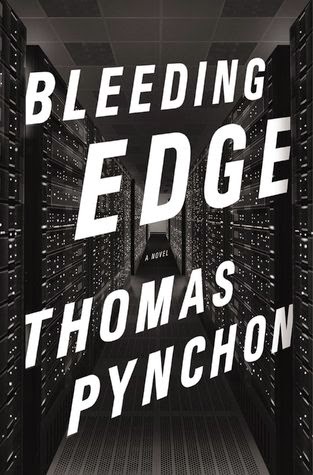
Thomas Pynchon's Bleeding Edge demonstrates his mastery of the early 21st century zeitgeist, to go along with the many other decades he's illuminated.  As usual, the closely observed blends disconcertingly well with the fictional.  When recognized it's funny, as in his hilariously cast series of biopics about famous golfers.  So much of it is in the digital realm, and there it was harder for me to discern the imaginative projections from the dizzying reality.  For example, I thought the "dark web" was a brilliant if typically paranoid Pynchon invention, though I learned that it essentially isn't--that is, in some sense it actually exists.

Pynchon selected a particular New York City voice that to my mind tended to limit the novel's eloquence, though he couldn't always hold back the bon mot.  I grew a bit tired of the voice--but that's also to say that it confirmed in me my overall feeling--despite a short residency it saddened me to end--that I'm glad I don't live in New York.  As for its prophesy, one character talks about omnipresent surveillance potential that people giddily accept with every new device they covet.  He refers the wrist devices that are rumored in today's news to be the next hot product as "the handcuffs of the future."

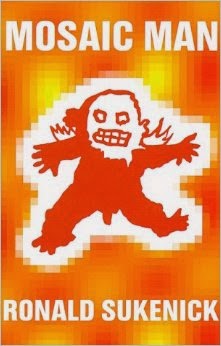
Briefly intercut with that novel in my reading was Mosaic Man by Ronald Sukenick.   Sukenick was a kind of Pynchon who never made it.  He once said he had about twelve readers, but they adored him.  I happened on his Death of the Novel and Other Stories and his first novel Up in a tiny public library in Stony Creek, Connecticut in 1969 or 1970, and was fascinated.  He was doing what later would be called metafiction or postmodern, but with intelligence and a lot of wit.  (I was later to discover his book on Wallace Stevens, Musing the Obscure, which is still my skeleton key to that mesmerizing and difficult--or let's just say mysterious-- poet.)

Sukenick kept publishing, through small presses and the Fiction Collective, in which he was a principal, and I bought them when I ran across them: Out, 98.6, Long Talking, Bad Condition Blues; Blown Away, Doggy Bag.   But it was just this winter that I caught up to his 1999 novel, Mosaic Man.  Once again, the act of storytelling is itself the plot, though this time there's a clear central concern of assembling an identity out of that mosaic of stories.  That seems more to the point than the rough form of books of the Bible (each very different yet somehow parts of the same story), though the pun of Moses-iac Man does suggest something that I don't recall from his earlier books, which is factoring in his Jewish identity.

Anyway, this is clearly a mature work, though still lively and with many of the impulses (and tics) of earlier works.  There are parts of it--the childhood sections especially--that are flat out brilliant.

This book ends in New York, and the Twin Towers and terrorism figure in, although it is not yet 9/11, which happens in the course of Pynchon's book (though it seems to me more a background part of the world than a major element of the narrative.)  However, Sukenick's next novel is about 9/11 and the Twin Towers, near where he lives at the end of this book and in that book.  I've just ordered it.  Sadly, it was his last novel.  He died in 2004.

I read another of Northrup Frye's shorter books based on a lecture series--this one called Creation & Recreation.  But I also very deliberately read a longer collection of essays, The Stubborn Structure, all the way through.  Some essays were of broad concern, and some were more specific, and more specifically literary criticism, as in the chapters on Blake and Yeats.  Frankly I thought I might skip those, no longer being in the academic framework, but I really enjoyed them.  In a way they put me back in touch with my 20s self, but I was also aware I was understanding more than I had then, not because of any increase in intellectual capacity (probably the reverse) but possibly of experience, or maturity.

Of the re-reading: Crooked Cucumber: The Life and Zen Teaching of Shunryu Suzuki by David Chadwick is a biography of the man who founded the San Francisco Zen Center and finally brought Zen meditation to the United States in the 1960s.  I'd forgotten or perhaps not appreciated as much how skillfully Chadwick wrote about Suzuki's life in Japan, which is really the bulk of the book, beginning in 1904.  The first time I read it, during my research for a San Francisco Chronicle article on Buddhism in the Bay Area, I had concentrated on the U.S. chapters.  Suzuki is a fascinating figure, with such profound humor--that also dominated my first impression.  This time I marveled at Chadwick's writing ability, though he was not previously a professional writer--he was a monk at the Zen Center.

Another re-read: Ray Bradbury's The Martian Chronicles.  I'd forgotten what variety there is in this collection of stories, since several of the early ones were so indelible.  Bradbury became a kind of grandfatherly figure but here he is still the young firebrand.

Finally, I'm giving up the pretense that this blog is any longer principally reviewing new books.  When I wrote reviews more regularly for publication, I could afford to do that.  But even in my many years of reviewing new books, I have always needed to write about books that were new to me regardless of when they were first published, or books that became new in re-reading--or maybe more accurately, revealed new facets the way old friends do.

So henceforth I will no longer need to categorize my reading here as "for pleasure" as opposed to new book journalism.  It's all going to be for pleasure now, or at least to respond principally to other needs.

Friday, August 22, 2014

Print Vs Digital in the Summer of 2014

Evidently it's a trend: forsaking printed books for digital readers.  Will it last?  It seems to me that's an open question still, partly because there are yet only a few ways to "acquire" digital books (and books from Amazon for their Kindle are apparently still under Amazon's control, so it's not clear to me who actually owns them.)  On the other hand, there are many ways to see and acquire physical books, as just some of my summer's reading demonstrates.

Publishers and authors would prefer books purchased at full price when they are newly published .  Lots of books are in fact purchased that way, even if some time has elapsed since the pub date.  Right now local bookstores are busy selling books assigned in college and university classes, as well as the latest selections of local book clubs.

But the ecology of printed books is larger and more various, though book publishers and authors eventually benefit.  That ecology includes libraries (public and school,) used book stores (physical and online) and "sale books" (often remainders) that can often be found on a table in and outside regular bookstores.

When I lived in Cambridge I bought a high percentage of my books from the many sale tables.  These included books I bought because of magazine stories I was working on.  In fact, I found books I would never have seen otherwise, that became important to what I was writing.  Even The Malling of America benefited--sometimes providing me with names of people in relevant fields I then sought out and interviewed.  It's uncanny how the right books would turn up, or really that I would notice them, so that I often began researching at the sale tables. Serendipity was one of my main research techniques.  And it happened again recently--I have been acquiring apocalyptic tales for a project about the future and had been looking in vain for a copy of J.G Ballard's The Drowned World.  Then one day there it was, on the Northtown Books sale table.

This summer however, my sale table book I acquired for pleasure--Diane Keaton's autobiographical Then Again, that one of my old Boston colleagues (Janet Maslin, now reviewing for the NYTimes) picked as one of her ten best of the year.  I'm enjoying it, not only for the content but for the perspective it suggests on my family and life.  (Cats are characters in this book, and it reminded me that around the time of Annie Hall,  I once stopped to observe a cat and her kittens in the unlikely location of Greenwich Village, only to look up and see Diane Keaton next to me.  By the time I turned to the two women I was with--both chattering away about Village Voice stuff, neither having noticed her--she and her male companion had fled across the street and were gone...)


I've been using "Captain Future" as my Internet screen name since I began fooling around online a decade or more ago, so I naturally got interested in the Captain Future stories by Edmund Hamilton (which I was not specifically aware of when I invented the screen name.  Of course I assumed I wasn't the first to think of it.  It was just appropriate--playful yet pointed.)  A few years ago I bought a facsimile of a 1942 issue of the Captain Future pulp magazine.  But when I was browsing for something else entirely at a local used bookstore I noticed that somebody had sold their collection of Captain Future paperback reissues.

These were originally published from 1939 to 1942.  Popular Library reissued them as paperbacks, probably several times. (Without the original cover illustrations alas.)  The ones I found were from the late 1960s.  There were seven, and (thanks in part to credit accumulated by selling other books there) I got them all.  I've read four now, including Calling Captain Future (which records that in 1940, a quarter century before Star Trek, Captain Future had a stun setting on his ray gun.)  The prose is shaky, the stories are more like murder mysteries in space, but they have their moments, and the characters Hamilton invented would presage many science fiction icons of later decades.  They are historically interesting too for the kinds of technologies they posit, including all kinds of variations on "atomic," which provide a certain nostalgic hilarity.

Libraries were my first resource for finding and reading books, and they are still important to me, particularly now the university library.  Though I got my copy of Northrop Frye's The Educated Imagination as a used paperback years ago, I reread it again recently and was stunned by the breadth, perception and elegance of this book on contemporary society as well as literature.  So I looked to the university library for any Frye books I didn't have or hadn't read, especially any that weren't only about literary matters, and found The Modern Century.  It's another short book composed from talks, in this case on the occasion of Canada's centennial in 1967.

Another astonishing book!  So I looked online and found a used copy, ordered it, and now have my own: a first edition hardback of The Modern Century with dust jacket.

 After I read that, I tried the library again.  Among the books I took out was a collection of Frye's book reviews and short pieces called Northrop Frye on Culture and Literature.  I saw pretty quickly that it was another book that would repay ownership.  So I again found an online copy, and here the library and the used books store come together, though with a melancholy twist.

The copy I acquired is a 1978 hardback, formerly from a library.  This is pretty common for used books purchased online.  This copy--a very good one--has a somewhat sad history.  It is from the Barat College library.  I looked Barat up, and found that it was a small college in a leafy and wealthy suburb of Chicago, but the college had gone bankrupt and eventually dissolved in 2005.  This particular book seems to have been taken out of circulation somewhat earlier, in 2003 (though it had gone bankrupt by then.)

 Barat was a Catholic college that evidently emphasized the arts.  But not, it seems, literary criticism. The reason that this book is in such very good shape is that it appears never to have been taken out in its quarter-century stay.  There is not a single mark on the Date Due sticker in the back.  Assuming it was acquired in 1978 (from the University of Chicago press), that's 25 years without a borrower, and perhaps without a reader--this book by one of the great minds of the 20th century.  However it's unread no more, because now it's mine.

A happier book story involving a library is a book I read with great pleasure this summer.  It is a novel for children called The Tune Is In The Tree by Maud Hart Lovelace, an author I didn't know.  She's an American writer of historical fiction but mostly children's fiction, from the late twenties into the sixties.  She's most famous for her Betsy-Tacy series.

This novel of nearly 200 pages, published in 1950 (by Thomas Crowell), is about a little girl, probably in the first decades of the 20th century, who is inadvertently left at home when her mother goes to seek after her missing aviator father. They live in the country and while they're away Annie Jo is adopted into the local society of birds.  A magical hummingbird shrinks her down to bird size.  It is a very charming tale (the title is from Emily Dickinson) that builds fancifully on the knowledge of specific bird species that a little girl must have had in that time and place, but would be foreign to children today.

This book has been around me for decades.  I'm pretty sure I scooped it up from my childhood home when I took away the rest of my own books there before the house was sold.  It may have belonged to one of my sisters, especially since the markings indicate it came from the school system that they (but not I) attended.  However, it's possible that I acquired it myself at a used book store in the area--the title would have appealed to me, and it is why I've kept it.  But I only read it this summer.

Books are physical objects that can last a long time, that can be passed around from library to bookstore, from sibling to sibling,  from Illinois to California, and from one decade to another.  It's hard to see how digital books will match that utility and magic.
Friday, April 25, 2014

For Pleasure: Winter, Spring 2014

Reading for pleasure during these months has mostly been re-reading.  One exception was A Man of Parts, David Lodge's novel about H.G. Wells.  Even this was in a sense re-reading since I had read many of his sources, including Wells' autobiography, over my past decade of interest in Wells and the future.  However I had tended to skip over the sexual relationships, which is Lodge's chief subject, although he's pretty good on Wells' ideas and literary accomplishments--on Wells as writer as well as lover.

Despite the mock- titillating cover art and naughty advert quote about Lodge being specialist in "intellectuals behaving badly in bed," it's a fair treatment that balances Wells' views with those of the women involved (all very willing to start) though the point of view is basically HG's.  I did appreciate that a novel not based on a real subject would probably have left a few of these relationships out because the parade did get tiring.  But as usual Lodge found ways to overcome the problems inherent in the subject and keep the book interesting if not always involving, though it often was that as well.  It did give me a more comprehensive view of Wells.  And as a description of Wells or this book,  the "behaving badly in bed" is tripe.

In volume my biggest sustained re-read was a collection of three early novels by William Eastlake.  I'd read them individually a long time ago, in college, shortly before Eastlake came to teach fiction writing for a term.  I was babysitting for a lit teacher who had the hardbacks, and I read one or two that night, and I believe I borrowed the third, but it could be that I read only one of them and parts of the others.  They were collected into one volume in the early 70s (3 by Eastlake) to capitalize on the movie version of his best known novel Castle Keep (set in World War II Europe) and the publication of his Vietnam novel, The Bamboo Bed.

The three novels are set in New Mexico, with different versions of the same family involved.  Eastlake later edited them to form a kind of cycle, published as Lyric of the Circle Heart.  I pulled that earlier paperback collection down from my shelf.  I admired Portrait of the Artist with 26 Horses and The Bronc People a lot, but thought the first novel, Go in Beauty, was a little too Hemingwayesque.

Eastlake was a unique voice in the 60s and 70s, and rereading these books he remains so.  I took his fiction course and corresponded with him for a few years afterwards.  (This photo--that's Eastlake in profile--is from an interview he gave at around the time I knew him.) Two things he said have always remained with me.  One was in an interview for our Knox College newspaper, and I can only paraphrase: "Writers are born, and shaped by rejection."  Shaped by rejection turned out to be absolutely true.

The other was a laconic line he uttered in class, so softly that I'm not sure how many at that long table of my fellow testosterone-inflamed big talkers heard it.  I happened to be sitting next to him so I did.  "All the great writers have one thing in common," he said. "They wrote their books."

I just finished re-reading William Irwin Thompson's 1989 book, Imaginary Landscape: Making Worlds of Myth and Science. I have nearly all his books (including his novel but excluding poetry volumes) and reading them always prompts new thoughts, even when I can't completely follow.  His thought--his synthesis-- is still so far in advance of other writers I'm familiar with, it's a shock to see in this book contemporary references to the Soviet Union and South Africa during apartheid.  He has a web page which includes a most unusual and well-written blog of reflections.  This time I wonder: he has developed upon McLuhan's work and insights, among others.  But who is developing upon his?

Finally I need to mention re-reading Northrup Frye's The Educated Imagination.  This thin volume based on six radio talks is succinct and profound, beyond technical matters of literature to philosophy, psychology, etc. with application to the political world and society in general, especially at this point in history.  I hope to write something more on the content of this book elsewhere.  But here I note that I am grateful to have rediscovered this book, which now assumes a central place. 

Now I can't end without saying that my reading for pleasure has included bits and pieces of other books as well as indulgence in favorite genres, including re-reading a couple of Hardy Boys novels (one of them modern, the other from the original series) and Sherlock Holmes stories.