Showing posts with label enviro. Show all posts

Wednesday, December 07, 2022

Books That Matter 2022


 Lots of books are published each year, and many of them contribute in some way: they inform, remember, correct the record, advance a new idea, edify, inspire and/or entertain.  But there are a smaller number of books that matter.

Though what matters can mean different things.  Some books matter because of their consequences over time.  Novels (like plays, movies and songs) can become beloved, or in the overused term, "iconic" or even "classic." Typically they speak to different people in different ways, saying different things to each.  Yet they remain memorable for many, and eventually become cultural touchstones that nearly everyone knows at least a little.  

However, identifying such books is best accomplished years afterwards.  Less time needs to pass perhaps to see a novel's influence in the world.  For example, Kim Stanley Robinson's The Ministry of the Future, published almost two years ago,  has clearly become a book that matters.  Not only is it the author's best-selling novel but it has entered into, and in some ways focused, discussions on how to address the climate crisis future, not only in the U.S. but perhaps even more strongly in Europe and internationally.  Richard Powers' two most recent novels, The Overstory and Bewilderment, have also exerted strong responses and focused emotions, inquiry and discussion on a range of related topics: not just forest issues, but questions of what constitutes life and intelligence, and the relationships of humans to the rest of life--what is increasingly called the "more than human world."   


Nonfiction books can perhaps be more easily identified more quickly as books that matter.  Published nearly a decade ago now, Thomas Picketty's Capital in the Twenty-First Century is clearly a book that matters.  Applying contemporary economic and historical analysis to very basic questions, Picketty both inspired and coalesced important thinking about basic changes in economic structures needed to make a stable and better future.  Its analysis of the failures of today's economic order and prevailing conservative philosophy, particularly showing the dangers of the huge gaps between the few at the top and everyone else, has become influential even to approaches less radical than Picketty might favor, such as a simple return to the Keynesian economics that prevailed in the U.S. from FDR until Reagan.  That analysis which shows that prosperity is attained by supporting the middle class and public sector investment is becoming U.S. policy again under the Biden administration, in what journalist Michael Tomasky is calling Middle-Out Economics, the title of his new book: perhaps a candidate for a book that matters. (In the meantime, this Politico piece and interview is a good summary.)

But books can matter before their influence is measured simply by being crucial contributions on crucial topics. They are groundbreaking in important ways, though not necessarily unique.  Their importance depends as well on how riveting they are to read.  I have several candidates for books that matter on this basis, published in the past year or so.  It's not an exhaustive list; perhaps the minimum.  The order in which I present them does not imply rank.  What links them is that they present in a generous if not full way a dramatically new synthesis that tells us something startling about our world that upends conventional wisdom and offers a new framework for perceiving and acting in the world.  In that sense, they bring the news.

The Dawn of Everything: A New History of Humanity

by David Graeber and David Wengrow


Published towards the end of last year, this book is already influencing newer work.  Its scope is enormous: nothing less than the human story.  The linear story of development (or evolution of society) is a comfortable one for many reasons.  It simplifies textbook categories, and it leads logically and inevitably to contemporary "advanced" societies, the apex of it all: from caveman to capitalism.  Who loves this story?  The same type folks who extracted "Social Darwinism" from the complexities of Darwinian evolution.  Robber barons like John D. Rockerfeller and Andrew Carnegie saw that it was good, and gave it their monied blessings.

According to the two Davids, both archaeologists, the story is wrong, right from the beginning. Modern humans weren't the sole apex of evolution--other humanoids had real societies, too, with all the elements of intelligence and expression.  We carry some of their genes. 

Society did not develop or even change from hunter-gatherer to agricultural to urban.  All these forms coexisted and intermingled, and there were many hybrids.  There were urban societies without kings or rulers, and tyrannical hunter-gatherers.  The Davids may be a little judgey in their descriptions of the varieties of Native (North and South) American societies, but they make their point--they were not simple or primitive or identical; they were often sophisticated, complex, various and sometimes large.  

This book emphasized an historical point that has since been taken up by others: that the form of democracy that governed the Six Nations Confederacy (the Haudenosaunee) that lasted longer than our democracy has so far, was patiently explained to Benjamin Franklin and others by some of its leaders, and informed the formation of the non-Native American democracy.  Too bad it didn't also adopt the Prime Directive of the  Haudenosaunee: in all decisions take into account the seventh generation to come.

This book of 692 pages is replete with examples, written with verve and wit, so it can read like a wonder book.  We don't really need Marvel or the other purveyors of outsized fantasies:  it's there in the histories that have either only recently discovered or studied, or conveniently ignored because they complicate or contradict the main story--the one that has gone a long way towards the fix we're in, on the brink of destroying it all.

An Immense World: How Animal Senses Reveal the Hidden Realms Around Us

by Ed Yong 


In Richard Powers’ novel The Overstory, the character that most readers noted and remembered is a woman scientist who discovers that trees in a forest communicate with each other, and help each other chemically to ward off disease.  She is ridiculed by scandalized scientists and forced out of academia until her research is vindicated, and she becomes a kind of folk hero.

 This character is based on a real life researcher, Suzanne Simard, whose book Finding the Mother Tree subsequently became popular.  But even more popular was a book on the same theme published a few years earlier by forester Peter Wohlleben, with the more arresting title The Hidden Life of Trees: What They Feel, How They Communicate.

 That book’s success, expanding on revelations about the complex life of the forest, led to a series of similar books by Wohlleben and many others, with titles often beginning with “The Hidden Life of” or “The Secret Life of” various animals, plants and other natural phenomena, including ice.  These books reflected new research but also observations that had gone unnoticed or derided because they contradicted established views on the natural world as comprised of simple if sometimes mysterious living objects, of interest mostly as exploitable for human ends.

 All of this helped prepare readers for the June 2022 publication of An Immense World by the much praised science journalist Ed Yong. It turns out that everything has a life hidden to humans, partly because our current preconceptions block awareness, but also because other lifeforms experience the world in vastly different ways.

 The key concept here is umwelt, named by early 20th century zoologist Jakob von Uexkull.  It refers to the sensory world of animals, determined by what senses they have and what they can do.  As Yong demonstrates through scientists he visits, these vary considerably.  Some creatures taste with their feet, others hear ultrasound or see into the ultraviolet. They may sense electromagnetic waves.

   Senses that we share with other animals are used in different ways, and the balance among them can be radically different.  Dogs smell and hear better than they see—so their world is one of aroma trails.  Even their color vision is different, and one of the more startling illustrations in this book compares the colors in a typical room that we see, and how dogs see them.

Though sometimes based on dismissed and forgotten insights, most of the research is new, as scientists use new technologies to dispel old assumptions.  That birds can’t smell is one of them, but there are many more.  Some of these discoveries are astonishing:  for instance, the vocalizations and communication that goes on out of human hearing range.  We can detect only a fraction of whales’ songs, and it turns out that mice sing to each other.  At some points this book starts to sound like Douglas Adams’ humorous takes in The Hitchhiker’s Guide to the Galaxy (that mice actually run experiments on humans, that dolphins can escape human catastrophe) may have more substance than expected.

 Apart from the wondrous details, there are larger points here.  Humans assumed a lot about other life based on their own sensorium, but we’ve missed quite a lot.  “Our Umwelt is still limited; it just doesn’t feel that way.  To us, it feels all-encompassing.  It is all that we know, and so we easily mistake it for all there is to know.  This is an illusion, and one that every animal shares.”

 But science and other forms of observation at the service of human imagination can help us see not only some of the ways other lifeforms live and communicate, but how our own activities disrupt their lives.  Light pollution wreaks havoc on various birds and other animals; noise pollution in the oceans endangers whales and other sea creatures.  

Despite the book's length, Yong's precise but informal voice and his flourishes of wit make it eminently readable, yet the science reporting itself is admirable. Even the footnotes are interesting reading. It helps that what the science is reporting remains continuously fascinating. 

 This research has greatly complicated human conceptions of what other lifeforms are, and expands the notions, extent and range of sentience and intelligence. It is this theme that James Bridle takes up in his book.

 Ways of Being: Animals, Plants, Machines: The Search for Planetary Intelligence

By James Bridle 

Bridle writes and thinks chiefly about technologies, and his disquiet about the direction and limitations of artificial intelligence sent him to explore other kinds of intelligences in the natural world.

 Again, the concept of Umwelt is evoked. Bridle also refers to both Richard Powers’ The Overstory and Kim Stanley Robinson’s The Ministry for the Future as starting points for his own explorations.  He ranges far and wide, from our humanoid ancestors to the intelligence of slime mold, and applies his observations to the new machines.  “The idea of forming new relationships with non-human intelligence is the central theme of this book,” he writes.  “It emanates from a wider and deeper dawning: the increasingly evident and pressing reality of our utter entanglement with the more-than-human world.”

 Bridle’s cogent and provocative musings apply not only to the possible futures of machine intelligence but, as Yong’s book does, to the endangered life of this planet and the necessity to actively preserve it.  As we discover and admit the extent of intelligent life and its beautiful complexity, we are close to destroying it.

 The singular and expressive organization of information and the inspired insights more than compensate for some slackness and an editorial lapse or two. Bridle's ideas and their expression in this book merit serious attention.

This recent run of books on non-human life, culminating so far in Yong and Bridle, should end any credibility given to the traditional notion of animals as natural automatons, important only as they are useful to humans, with no feelings to consider or intelligence to respect and learn from.  Gaia expanded the definition of life, and now we grapple with kinds of intelligence not only in familiar animals but plants, microbes and other life. We'd better start learning.

 One of the ideas that Bridle interrogates is the notion promoted by digital industries and other enthusiasts that intelligence is primarily based on calculation.  That is a theme in the latest novel by Dave Eggers.

 The Every: Or At Last A Sense of Order, Or The Final Days of Free Will, or Limitless Choice is Killing The World

A novel by Dave Eggers 

The Hollywood pitch for this novel might be Alice in Wonderland meets Nineteen Eighty-Four, or perhaps Brave New World would be a closer match to its onrushing dystopia.

 In this stand-alone sequel to Eggers’ The Circle, the Facebook-like corporation has merged with Amazon (referred to here as the Jungle) to form a monopolistic continuum, not only of business, not only of culture, but of shared reality.  Welcome to The Every.

 Delaney is a young woman intent on destroying The Every from the inside.  She is intelligent, intuitive, creative and acutely observant, but the plot hinges on her also being repeatedly naïve about the outcome of her efforts, as she proposes a series of outrageous changes that turn out to be big hits with The Every users, which seems to include Everyone.

 Eggers is not shy about stating his theme early in the novel: “the war on subjectivity.”  Everything is objectified to decision by calculation. (This includes the maximum number of allowable pages in a readable novel, which is 577—as it happens, the exact length of this book.) Ironically this also results in the disappearance of actual objects and authentic life, in favor of digital imagery and ideological judgments.  The result is a society caught in self-referential stasis, that punishes difference. 

 The novel does not fall easily into political categories. It exposes corporate conformism, but also its effect of cancel culture. The reasons (or excuses) given for much of the social pressure to conform are to save the environment and promote social justice.

 Delaney is a former forest ranger, so it may have seemed natural to her to organize an outing of The Every employees to visit Pacific Coast seals, but it was a disaster from start to finish, especially when they were confronted with the realities of these animals and their lives.  This incident is outrageously exaggerated and yet totally believable, and ultimately dystopic, especially given what these previous books tell us.

 It’s also funny, as is the novel generally, in a Dr. Strangelove sort of way. It has some characteristics of a satire of a monomanical corporate culture becoming a monoculture at large. Delaney’s best friend and fellow skeptic is the first to succumb to The Every’s embrace, supplying a horror movie vibe (think Invasion of the Body Snatchers.)  Delaney’s own fate involves a confrontation with the head of The Every, who was the naïve young woman protagonist of The Circle.

 There are many other related issues raised in the novel, in an entertaining narrative context that feels real right now.  The story is in development for a TV series, but right now this is a book that matters.

These four books matter because they give us crucial new information that creates a new context of how we see the world, our society and ourselves.  Right now there is no more important context that the relationship of humanity to the rest of life, and secondarily to the digital life humans are creating (for if we don't solve the survival problems associated with the first, the second won't much matter.)  They are robust enough to generate further discussion, and they cry out for action. 

Monday, June 15, 2015

A World of Falling Skies

For me, reading Apocalyptic Planet: Field Guide to the Everending Earth by Craig Childs felt like the end of a sequence of books I've read (and often written about) over the past decade or so--books specifically about the climate crisis.

The pre-history of this sequence begins in the late 1980s, when several very hot summers in the eastern US coincided with the first extended revelations of what were then called the Greenhouse Effect and Global Warming.  Bill McKibben claims to have written the first book on the subject in The End of Nature, but there were others at about that time, as well as After the Warming, James Burke's excellent television treatment (which included describing history that had been determined by climate, then a novel idea but now much more accepted.)  Science writer Jonathan Weiner devoted several chapters of his 1990 book The Next One Hundred Years to global heating research to that point, and its likely dramatic effect on the future.

After writing Earth in the Balance in 1992, then running for President without much mentioning these issues in 2000, Al Gore gave the climate crisis its highest profile to that point in 2006 with his film and book, An Inconvenient Truth.  Unfortunately, those needing political cover to oppose efforts to address the climate crisis so as to please fossil fuel billionaire donors, found it in a former Democratic presidential candidate--especially hated since they all knew he'd actually been elected.

 But for my purposes here, I note An Inconvenient Truth as representing other books and articles of the period, in that they made the substantial case for global heating caused by carbon pollution, and warned of future consequences.  Gore in particular talked about how there was still time to "solve" the climate crisis.  How do you solve a crisis?  You don't--you address a crisis, you solve a problem--but it did convey the idea that action now could mean there would be no climate crisis.

Other works generally followed this line.  Then came Forecast by Stephan Faris, in which the author reported on consequences already happening.  The bigger ones were far away (Darfur, where climate caused scarcity that fed warfare), South Asia, South America and the good news for some/bad news for others of Arctic warming.  More subtle effects felt in the US included changes in the California wine industry as the best climate for grapes was moving northward.

 Faris' book was largely ignored, however.  The idea of present consequences didn't follow either the rabid right line (move along, nothing will ever happen here) or the left line (we still have time to pass cap & trade or a carbon tax and solve this.)

  The Vanishing Face of Gaia: A Final Warning by James Lovelock (2009) was not the first to say it is basically too late, but Lovelock (co-originator of the Gaia theory) was both revered and considered a bit radical by environmentalists.  Bill McKibben gave this book a respectful review but found fault with main conclusions.  Lovelock wrote that perhaps only 200 million people on the entire planet would survive the climate crisis and related phenomena, all living in polar regions. There wasn't sufficient evidence for that, McKibben said.

But then something happened.  Scientific observations--particularly of polar melting--were showing consequences not predicted to happen for decades under worst case scenarios for global heating.  The change in tone was immediate.  For me the first and still most powerful was David Orr in Down to the Wire (2009.)  The evidence that global heating was causing grave consequences--and due to lag times in effects, would continue into the near future--became a guardedly accepted premise, it seemed almost overnight.

  As Orr wrote, "The news about climate, oceans, species, and all of the collateral human consequences will get a great deal worse for a long time before it gets better.  The reasons for authentic hope are on a farther horizon, centuries ahead...The change in our perspective from the nearer to the longer term is, I think, the most difficult challenge we will face."

So no longer were we going to solve the climate crisis.  We were going to have to deal with its effects, while at the same time attacking its causes, not to save ourselves or even our grandchildren, but the ultimate future of human civilization and perhaps the human race. (Al Gore eventually joined in this view.)

 This presented two basic problems that are both intellectual and emotional.  One is: how do you work up the hope and resolve to attack and try to solve these problems when you'll never see the better outcome, but you will see things get worse?  The other--and perhaps emotionally the first--how do you deal with what's to come, that (somewhat depending on where you are) may look a lot like apocalypse?

Both of these became the grim and delicate subjects of such books as Bill McKibben's Eaarth (2010), the title indicating that the planet has already changed and won't change back, and the best we can do is "manage our descent."

Paul Gilding's The Great Disruption (2010), while suggesting that the climate crisis will mean "we'll tragically lose a few billion people," maintained that humanity will rise to the occasion and save itself from extinction, thus providing this book's rep as "optimistic."  In his third book on the climate crisis and related matters, James Gustave Speth mixed the same dire assumptions and hope with a plan in  America the Possible (2013.)

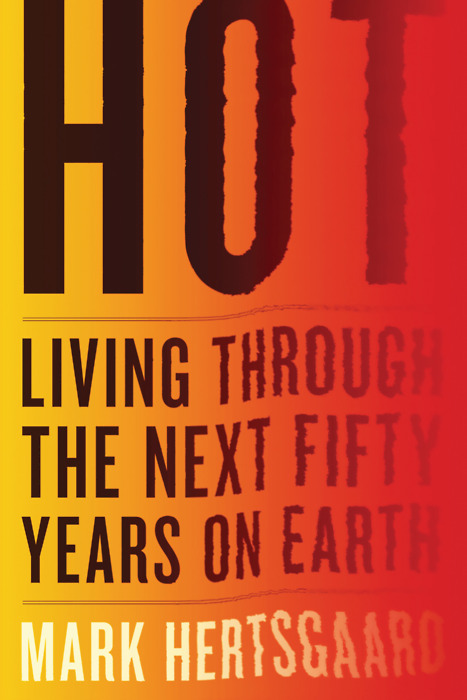
Mark Hertsgaard, who got onto the time lag consequences early, wrote clearly on the two time frames and what they mean in Hot: Living Through the Next Fifty Years on Earth (2011.) Since then, the news of effects has been--as Orr predicted--increasingly bad.  Though the far future looks a little better, with the rise of clean energy and new carbon regulations (both fostered by the Obama administration), and with hopes for a meaningful global treaty later this year, we still must deal with those two basic problems, conceptually and emotionally.

That all leads to Apocalyptic Planet (published in hardcover in 2012, and in paperback in 2013.)  Dealing emotionally with the apocalyptic possibilities is an ongoing process, with lots of changes in perspective and feeling.

 What Craig Childs did was to visit places where apocalypse is visible in various ways: where climate crisis consequences are visible and tangible and ongoing, and to extreme places where apocalypse already happened, perhaps a very long time ago, and in a sense is still happening.  Although I discovered this book late, it also took me a long time to read it all.  I could only handle so much apocalypse at a time.

Childs begins in the desert and moves on to the glaciers.  It's clear from these first two chapters that his writing is vivid, economical and eloquent.  He describes his own single set of experiences and those of companions in these extreme landscapes.

 The combination of beauty and fear in these places produces a complex awe.  As his party of documentary filmmakers finds one astonishingly fast-melting glacier after another, several couples find crevices in the ice where they have sex.

 These places are indicators of apocalypse. The extreme and alien landscape of the Mexican desert is inexorably expanding into Arizona, as drought deepens and consolidates.  Scientists in his party are astounded by the speed with which the glaciers they observe can melt and drain away--feelings echoed more recently in statements about melting in Antarctica.

 He goes to Alaska with his intrepid mother to look at consequences of sea level rise. He returns to his birthplace of Arizona to explore the rise and fall of civilizations, where he talks with an archeologist.  "As dark came on, Wright and I talked about how civilizations tend to fall, common themes you see throughout time: environmental decay, failure of top-heavy infrastructure, resource depletion, loss of social egalitarianism, disease, conflict." He asked Wright what such an apocalypse would look like.  It would start out looking like Phoenix today, with decay beginning at the edges.  Apocalypse can be a slow process in human time.

 Childs grapples with the twin sense that apocalypse simply happens over and over, and every civilization that has risen so far has fallen, but that once anticipated some of these fates may be avoidable. Or apocalypse can happen relatively quickly.  In Greenland he discusses with a climate scientist the possibilities of rapid climate change.  It's happened before, without human help--and this is one of this book's contributions: it deals in different time frames, including a multi-billion year perspective.

A major figure in this long Greenland chapter is Koni Steffans, an European climate expert whose research camp Childs is visiting.  From time to time, government officials and others visit the camp for updates.  "What he tells people who visit is not that the sky is falling but that we live in a world of falling skies and it is best not only to know your options but to make moves ensuring the worst does not happen." [p.176]

 Childs does not limit his explorations to consequences of the climate crisis.  He looks at tectonics in Tibet, volcanoes in Hawaii (a monster volcano eruption is probably the best candidate for near-instant, near-total apocalypse.) The Tibet chapter includes a daring ride down an uncharted river, a surprising release from the book's main tensions.

 But for me the scariest landscape he describes is a corn field in Iowa--genetically modified corn to resist predators is combined with chemical killers of all non-modified life.  The crops themselves are depleting the soil without regenerating it: they are killing the future they are feeding. This environment of deliberate industrialized death is the occasion for discussion of species extinction (the specific subject of Elizabeth Colbert's 2014 book The Sixth Extinction.)

 This somehow is the most emotionally powerful aspect of apocalypse, perhaps because there is nothing of awe and terror in it.  It is indirect but conscious destruction, invisible and hollow.  A scientist points out that individual animals of species about to disappear are mostly not ill or weak.  Their environment, their breeding grounds, makes following generations smaller and then impossible.  So one day they are just not there anymore.

 Childs and his companion spend days and nights in these corn fields, searching for any life at all--insects, birds, grass.  They find little, but the little they do find is a source of some hope.

 Time scales and the constituents of apocalypse, including the climate crisis, come together in the final chapter, as Childs searches out the limits of life in the severest desert he could find, in South America.  He looks beyond what we define as the living to find the life of the planet.  "The earth is a seed planting itself over and over."

 There is no easy solace, or easy despair.  This book expands the usual view of the Earth, in time and space, in levels and variety.  It becomes a little like contemplating the realities we suppress, of what happens over time in our own lives, in the inevitability of death and the mysteries of life changing and continuing.

 This book helps to provide a different perspective for thinking and feeling through future prospects as shaped by global heating.  But it doesn't simplify those thoughts and feelings into a philosophical complacency. Its strongest message is to experience fully what we are privileged to be part of in our own brief time on Earth, in all its dimensions.  It also supports hope as an operating principle, as a kind of responsibility that comes with being alive.  The responsibility is to contribute to a better future--even if that means a less awful future that it might otherwise be-- together with our responsibilities to people and communities and places in our present.  

Wednesday, March 05, 2014

The Sixth Extinction: An Unnatural History
 by Elizabeth Kolbert
 Henry Holt

 I have to confess that I had an advance copy of this book for months before I could bring myself to begin reading it. Over the past few years I’ve read and reviewed a stunned procession of books on the climate crisis (most of them after Kolbert’s Field Notes from a Catastrophe: Man, Nature, and Climate Change in 2006) and I wasn’t looking forward to another voyage circling the abyss.  Fortunately, Elizabeth Kolbert is an engaging, absorbing writer, and given this subject, she pretty much has to be.

 It also helped me in particular that after an introductory chapter of reporting on the extinction of frog species in central America, she deftly summarized the history of extinction as a scientific concept, focusing on the 18th and 19th century, a period in the earth sciences I find fascinating.

 These first chapters establish two key facts: that the reality of extinction—the relatively sudden erasing of entire species—has only recently been recognized (there were doubters even 50 years ago), and that actual extinctions are normally very rare: new species appear more often than one goes extinct. “Probably one amphibian species should go extinct every thousand years.” But the scientist she follows has seen several, and she herself has essentially witnessed at least one.

 Life forms adapt to their environment, and in the normal course of things, they have time to adapt to environmental changes. “...conditions on earth change only very slowly, except when they don’t.” When something big and unusual happens fast, extinctions occur, and the bigger and more lethal the event, the more extinctions. The asteroid collision that led to the dinosaurs’ demise in the Fifth Extinction is the most dramatic.  Sometimes they are slower but inexorable, affecting one species after another.

 Kolbert chronicles the five known mass extinctions, though their causes are not all understood. The general cause of the ongoing Sixth Extinction is the human species and what it is doing to planet Earth. On our present track, global heating alone could easily cause the extinction of half the species on the planet, sealing their fate before this century is half over. A more optimistic estimate is one fourth.

 But that’s not the only ongoing cause. By transporting species to places they could not normally go (deliberately, as Europeans did when they brought plants and birds to America, or accidentally in the holds of ships and jumbo jets) humans can introduce a foreign species that eradicates the native plants or animals, eventually causing the local ecology to crash and other dependent species to go extinct. Or they bring diseases that local life can’t resist, such as the infestations currently killing off those frogs in central America, and bats by the millions in New England.

 Species have been hunted to extinction, their forest environments cut down, and now more often so fragmented by development that they can’t survive. Some of the same industrial age changes in the atmosphere responsible for the climate crisis are implicated in changes in the chemistry of the oceans, perhaps the most dangerous threat of all. Even when there is not a causal link, there is a “dark synergy” with climate change that amplifies mortal threats to life forms well beyond individual species.

 Kolbert travels to scientific research stations, interviews and experiences and writes very well about it all. She’s prolific with apt similes and observations, and doesn’t shy from setting up a giddy turn of phrase, like “rickety spelunkers.” Within the broad effects she describes differences and specifics that scientists study, fascinating as the best nature writing can be.

 She follows extreme efforts to save the last remnants of some species, even as the evidence grows that humans were responsible for killing off entire species long before the first cotton gin, including other humans whose genes we still carry, such as the Neanderthal.

 Scientists know of key species such as corals that face extinction (threatening an estimated nine million other species), but there are some that are not understood but still may eventually lead to ecologies crashing. The list of species going extinct range from the very small (some of which will not even be catalogued by science before they disappear forever) to trees, amphibians and mammals, including all the great apes, “except us,” at least for the foreseeable future.

 A Sixth Extinction might become as profound as the Fifth, in which case the planet will someday be populated by the descendants of the few species that might survive (rats are a good candidate.) In geological time, that may not mean much. “...a hundred million years from now, all that we consider to be the great works of man—the sculptures and the libraries, the monuments and the museums, the cities and the factories—will be compressed into a layer of sediment not much thicker than cigarette paper.” But it's something else to know it is happening now, and will become increasingly obvious during the lives of our immediate descendants.  (Though the book's illustrations are few, they are helpful.  That there aren't more and glossier could be considered a blessing.)

 Whether the human species will outlive the Sixth Extinction it caused is an open question, with lots of doubters. What is even more likely to end is the 10,000 year old experiment called civilization, and the potential for it to redeem recurrent slaughter, mindless cruelty and oppression by growing into consciousness as well as knowledge, in time to save itself and the life of this world. I don’t know if civilization’s achievements are any solace, any more than good writing redeems this subject. But we’re grateful for it now.

Thursday, January 16, 2014

Two Books on the Future

The Future of Nature
edited by Libby Robin, Sverker Sorlin, Paul Warde
Yale Press

This is an anthology that traces prediction and other aspects of anticipating future consequences and possibilities applied to the natural world.  It presents essays from the past--from Thomas Malthus and Alexander von Humboldt to Rachel Carson and mostly less familiar names--and appends contemporary commentaries by the editors and others.  Meant to "promote conversations," it includes a trenchant introduction that sets the current framework.

The essays and commentaries are divided into sections (population, natural resources, technology and climate among them) that also serve as a rough chronology of issues as they arose in the western world from the late 18th century to now.  Some of these are fairly broad agenda-setting essays, and many are more technical.

As with any anthology, one can argue with the selection.  I found the total absence of Paul Shepard especially troubling for a sufficient perspective.  But the major problem may be suggested by the commentary to Alva Mydral's 1972 essay "To Choose A Future."  Arne Kaijser rightly notes that this period of the early 70s was the heyday of Future Studies, and the attempt to bring together discipline and constituencies to focus on the future.  What it doesn't say is that future studies as an enterprise soon faded, especially in the U.S. but probably in Europe as well.  The future turned out to be a big and complex place, the computer technology of the time wasn't up to dealing with all the categories and data, and political winds shifted.  Academic approaches moved on as well.  Aspects of it continued but focused on more specific areas.

So the broader readership that might enter into this conversation is probably otherwise engaged, or more likely otherwise unengaged.  That's not these editors' fault certainly.  The limitations of this volume are made up to a degree by specificity, and its heartening to know that at least European academics are thinking even this contextually.  This is a solid contribution which should provoke meaningful conversations on the future of nature, which it demonstrates is also the future of the future.

The Future Is Not What It Used To Be:
Climate Change and Energy Scarcity
By Jorg Friedrichs
MIT Press

Author Freidrichs teaches in the department of International Development at Oxford, and his previous books have been on terrorism and international relations theory.  So this book focuses on geopolitical consequences of climate change and energy scarcity.  But in doing so he is focusing on the survival of civilization, and its "core values."

The future is first of all not going to be a continuation or slight variation of the present.  While in the short term industrial countries can "easily mitigate some of the social and political effects of climate change," as the climate crisis becomes more serious, industrial civilization may not be able to "bail out places in mayhem," and will find itself under internal pressures from its own catastrophes.  And once underway (which it is) the nature of climate change leads to unpredictable consequences.  That's due to its dual nature: a set of gradual changes, punctuated by large and sudden disasters.  And that's the best case scenario.  Sudden and extreme climate change overall is still and always possible.  Nobody's done this to the planet before.

I believe his key point is this: "the durability of industrial society cannot be taken for granted in a turbulent world."  He employs arguments and statistics to shake the complacency of those who believe otherwise.  But though he notes in his introduction "Facing the future is not for wimps,"  he believes that facing the consequences of the climate crisis is necessary.  In his final chapter he promotes "resilience" (the latest climate crisis buzzword, and possibly the only good one) and "transformability."  He writes that the human ability to control its environment is an essential feature of civilization, but he doesn't opt for a particular technological solution. He notes that when all is said and done, our civilization depends on qualities such as "goodness." To realize how non-simplistic this is may require reading what comes before it in this book, about the extent and likelihood of future dangers.   He principally argues against the many forms of denial that prevent even approaching this most profound challenge.

Incidentally, the expression "the future is not what it used to be" ( or "ain't what it used to be") I associate with Arthur C. Clarke, but the Internet tells me its earliest known appearance in English is from Laura Riding and Robert Graves in the 1930s.  It's often attributed to Yogi Berra (along with almost everything else) and is the title of a song recorded by, among others, Meatloaf.  It's also been the title of several previous books.  But then, so has The Future of Nature.

Wednesday, August 21, 2013

Books for the Future

In new nonfiction books I have a prejudice: I look for books that may tell me the future.  Books that might contribute to a better understanding of the most important factors likely to govern the future, and that suggest action and attitudes to make a better future, and certainly to forestall a much worse one.

Environmental topics are prominent among them.  I've reviewed here and elsewhere some of the major and also some of the lesser known but worthy books specifically on the climate crisis.  Here are glimpses of several more pertinent books:

Small, Gritty and Green: The Promise of America's Smaller Industrial Cities in a Low-Carbon World by Catherine Tumber (MIT Press) is a model of the most valuable books for the future: it is on a specific but under-appreciated topic, it is very current and above all it is a laudable combination of thorough and relevant research (and reporting on such research), and it is well-organized, well written and readable, with useful notes, bibliography and index.

Millions of people live in these smaller cities, mostly in the northeast and midwest, that have rich histories but are neglected and generally ignored.  Tumber makes the case that these cities can not only be saved, but can be vital elements in the low-carbon future we must have if civilization is to have a continuous future at all.  These are cities like Syracuse, Youngstown and Hartford, but some of her findings and ideas can apply to the larger industrial cities now in various stages of confusion or deterioration.  Tumber stresses that this is a personal and even idiosyncratic book, involving personal experience as well as history and journalism.  Yet she comes up with very specific ideas on how these cities can contribute to a clean energy economy.


Earthmasters: The Dawn of the Age of Climate Engineering by Clive Hamilton (Yale). However they reflect the moment, some of these books are destined to become reference works for the near future.  This is certainly one, for intentional climate engineering (as opposed to the unknowing kind that has been going on for more than a century, and still goes on even as we know better)  is still mostly a set of early ideas.  Yet because those ideas and research are being funded largely by the loose billions of fossil fuel and related companies, there is much impetus behind the scenes.  At the same time, Hamilton writes, "There is almost no information on public attitudes to geoengineering for the simple reason that almost no one has yet heard of it."

 This current research is apparently intended to offer technological fixes that won't require a switch from fossil fuel energy. Geoengineering projects are roundly criticized for their ineffectiveness and especially the foolhardy dangers they pose to the global environment.  Hamilton divulges who is doing what right now, and raises the practical and ethical issues involved.  Because such powerful interests are behind geoengineering, and also because some aspects of it may not require much technology or expenditure (and could even become a form of terrorism), this is a necessary book, a primer for the near future.

The Incidental Steward: Reflections on Citizen Science by Akiko Busch (Yale)  For a long time the observation and even experimentation applied to the natural world was conducted by amateurs, by monks in gardens and part-time naturalists.  They were motivated by curiosity and wonder, and often by an intense involvement and fierce love for the nature in the place they lived.  Busch updates this impulse to the computer age, in the course of describing her involvement with her home grounds of the Hudson river valley.  As a physical book it feels good in the hand, with paper and print meant to last.  Therefore it serves the savoring kind of reading it deserves.  Her fundamental point is itself important: it is the citizen scientist--like indigenous ancestors--who are vital to the future of nature, and therefore to the future.

Birthright: People and Nature in the Modern World by Stephen R. Kellert (Yale).  Kellert is something of an expert in the relation of humans to the rest of nature, and in this book he explores ways in which humans at various stages in their lives are naturally affiliated with nature, borrowing E.O. Wilson's term of biophilia.  His observations are wide-ranging, and the book includes personal observations of nature and scenarios of possible futures.  This relation of humans to the rest of nature is essential to our well-being, to who we are.  But we are in danger of destroying our own birthright.  Kellert makes a comprehensive case for why we must be conscious of this and act with it in mind to make sure future generations can claim this birthright.

Those who assume an apocalyptic future often do so based on an interpretation of evolutionary science and natural selection.  It is true that the dominant interpretations have stressed individuals engaged in a selfish survival of the fittest, and those manifest aspects of animal life that counteract this dominant view have been ignored and under-studied.  But new research is redressing the balance.

Two new books from MIT Press are good examples of these newly robust areas of study.  From Groups to Individuals: Evolution and Emerging Individuality, a collection edited by Frederick Bouchard and Phillippe Huneman  reviews research within the context of the move away from organisms as the primary agent of evolution, taking into consideration however not only constituents of what we describe as organisms, but groups.  What makes individuality turns out to be a lot more complicated in biology as philosophers, psychologists and other social scientists have found applied to humans.  This is a nice sized book, sturdy and illustrated with drawings and charts.  This seems an exciting academic field right now, with important implications for our general understanding, and our approach to our future.

The same may be said of Cooperation and Its Evolution, a collected edited by Kim Sterelny, Richard Joyce, Brett Calcott and Ben Fraser.  Topics range from microbiology to human philosophy, and while animal cooperation is explored, the emphasis is on the human.  With more than 500 pages of text in a hefty but easy to handle volume, many current issues and arguments are explored.  This is the latest contribution to bringing research together to see where we stand.  In general, the idea that there is an evolutionary basis for cooperation is becoming more and more acceptable, and freed from the constraints of seeming heresy, how cooperation and conscious decision-making for a better common future can be achieved is an exciting area for creative research and theories.

Within the world of political action, there are books about under-appreciated elements of the present that are forming and in some cases threatening the future.  Occupy the Future, a Boston Review volume published by MIT Press, is a group of essays edited by David Grusky, Doug McAdam, Rob Reich and Debra Satz.  It emerged from the Occupy Wall Street movement, but the book is not about the movement itself.  It describes the current major income inequality in America--the vast proportion of wealth in the hands of a very few--and its current and future implications.  It looks at the causes and effects, and suggests remedies.  In nearly 250 pages of text, it goes into some detail, and at the very least is informative about today's workplace and the effects of computerization, globalization etc.  The breakdown of chapters is well organized, and some individual chapters go into detail.  It's longer than the Boston Review books I've seen, but it's still a handy paperback size, though a sturdy hardback.

Finally, there's the impact of the still evolving universe of computing and cyberspace on the future that is becoming the present every day.  The latest history to provide some perspective is On Computing: The Fourth Great Scientific Domain by Paul S. Rosenbloom (MIT).  But this is more than a history--the author is arguing that computing joins the physical sciences, life sciences and social sciences as a separate domain: information transformation.  The incredible growth of computing has regularly been accompanied by outsized claims that turn out to be both less and more than the truth.  This is a provocative thesis, which will likely occupy speculation and study for awhile to come.

An occupational hazard of books about the fast-changing world formed by computing is instant obsolescence.  Still, reports such as Crowdsourcing by Daren C. Brabham (MIT) are valuable as snapshots of the present (or recent past) and especially as indications of direction for the immediate future, and expression of potential uses.  This is a well organized and thorough treatment of the phenomenon and related research, in a handy-sized volume, a paperback with the publishing quality of a hardback.

Then there are books that reflect an emerging field that makes particular use of computing potential and behavior while advocating for it.  Digital Humanities (MIT) by Anne Burdick, Johanna Drucker, Peter Lunenfeld, Todd Presner and Jeffrey Schnapp is creative description and manifesto for a view and a field that conceptualizes computing as a transformational technology within the traditional area of study called the humanities. The book includes a "short guide" that defines digital humanities as "an array of convergent practices that explore a universe in which print is no longer the primary medium" for the production and dissemination of knowledge. The book, about the size of many children's picture books, contains many examples of such current research as well as directions for future inquiry.

An open version of this book is also available as a free digital download.

Tuesday, April 09, 2013


The Man Who Planted Trees: Lost Groves, Champion Trees, and an Urgent Plan to Save the Planet
 By Jim Robbins
 Spiegel & Grau

 Jim Robbins is a science writer who has been frequently published in the New York Times. Ten years ago he began seeing the dense pine forest surrounding his Montana home die off, killed by the mountain pine beetle infestation enabled by warmer winters that is still destroying northern forests. It’s evidence of how global warming is adding to centuries of deforestation.

 By then he’d met David Milarch, a hard-living Michigan farmer whose life was changed by a near-death experience and a subsequent visit by angels who gave him his mission: clone the oldest, largest, hardiest “champion” trees before it’s too late. Scientists, not necessarily convinced by angelic instructions, were surprised they hadn’t thought of this themselves. If it turned out to be possible (and often it did), it made sense. This time-tested DNA might provide a better chance for survival.

 Robbins chronicles the ups and downs of Milarch’s efforts. One of his major successes was finding and cloning ancient sequoias in an unusually dry region of central California, conditions that global warming may well replicate elsewhere. But Robbins also writes about trees themselves, their barely understood wonders and the ways in which they nurture the planet, with clear objectivity but in a more complete way that mirrors the combination of standard and frontier science and so-called mysticism in Milarch’s world.

 Even scientists admit we know dangerously little about the trees and forests we’ve been relentlessly destroying. Robbins quotes Werner Heisenberg that “what we observe is not nature itself but nature that responds to our questions.” “As we look into the world of trees," he wrote, "we begin to realize that there are many important questions that haven’t be asked by scientists.” But Milarch’s quest is not some feel-good exercise.  He makes use of what knowledge does exist.  For example, he and others involved realize that just planting a lot of trees everywhere is not enough--planting the right trees in the right places is crucial.

 Along the way Robbins updates the exploits of Michael Taylor, the Humboldt State University grad who, while working at a Radio Shack in Arcata, discovered several of the largest redwoods in the world in the Jedediah Smith Redwood State Park, together with HSU forestry and wildlands professor Steve Sillett. Taylor (who moved to Hyampom, an isolated town of 261 people in Trinity County) expanded his search for champion trees to other species and countries, searching for them partly by intuition. His incredible record improved even more when he teamed up with Milarch. “When I travel with David Milarch, we really find trees. It’s beyond coincidence,” he said.

 But Taylor helped Milarch most by finding champion stumps on private land, where only the owner’s permission is required to obtain the cuttings to clone, not a lot of government red tape. They started with the immense Fieldbrook Stump just outside Redwood State Park. From the stump and the redwood already growing out of it they hoped to grow hundreds and then thousands of copies. “We can use this tree as a symbol of the reforestation of the world,” Milarch said. “This stump is back from the dead, same as I am.”

The debates and the science of global heating tend to stick to the air--the atmosphere and its direct effects on the climate.  Then come the effects on land, humans and animals.  Usually left out are two huge and hugely important factors: the health of the oceans and the health of the forests.  When it first started to function as Gaia, the self-regulating organism of Earth, it was a planet of seas and trees.

I've done just enough research on forests for a couple of articles and a documentary video to be horrified by the self-destructive mania of humans who have cut down their forests and destroyed the ecology that sustains them.  In the few places on the planet where it hasn't happened centuries ago (from Greece to Ireland), it is happening now.  This book quotes Milarch and others noting that the remaining American forests are mostly second and third growth, often of different species than dominated the landscape before Europeans arrived with their axes to grind, and are therefore less resilient individually to any extra threat.  In most places, there are only forest remnants, not large enough to provide the resilient ecology.

There are plenty of threats to forests coming from global heating--beginning with the kind of destruction represented by the mountain beetle infestations.  Without the carbon-cleansing of the trees, among other essential benefits, humans are toast.

Monday, May 28, 2012


The Etiquette of Freedom: Gary Snyder, Jim Harrison, and The Practice of the Wild
Edited by Paul Ebenkamp
Counterpoint

Poet and eco-elder Gary Snyder grew up on a farm in Washington state. When he was a boy he asked his Sunday school teacher if he would meet a beloved and recently dead heifer in heaven. The clergyman said no. “Then I don’t want to go there!” said novelist Jim Harrison from across the dinner table, listening to Snyder tell this story. “That’s exactly what I said!” Snyder exclaimed, explaining that this exchange inspired his interest in other cultures that included the non-human in their moral universe.

It’s a moment in the DVD of a documentary film directed by John Healey that is conveniently tucked in a plastic envelope at the back of this book. So to the music CD/concert DVD packages and all the other hybrids, add the book-with-the-movie. The book is marketed as conversations between “old friends” Snyder and Harrison, but in fact it is culled from the making of a film that is essentially about Gary Snyder, in which Harrison (a co-producer) participates. Also interviewed are poet Michael McClure (recalling Snyder from both the Beat and Summer of Love eras in San Francisco), poet (and Snyder's first wife) Joanne Kyger, academic Scott Slovic and others.

The film was keyed to the 20th anniversary of Snyder’s landmark book of essays, The Practice of the Wild. (I got that book when I spotted a used copy shortly after it was placed in the window of the old Arcata Bookstore. “I knew it wouldn’t stay there long,” the owner said.) This book includes a transcript of the movie, but also a lot more, including Snyder-Harrison conversations in which Harrison comes off a lot better than he does in the film. It finishes with some Snyder poems and a chapter from The Practice of the Wild.

Snyder seems aware that the movie allows him to correct the record on some things.  Jim Harrison suggests that what distinguishes Snyder's early poems, especially in Rip Rap (his first book) is the reality and rhythm of work.  (Snyder worked as a fire lookout, a logger and earlier as a merchant seaman.)  This insight apparently is not exclusive to Harrison--in the book Snyder mentions a doctoral thesis he's read about the relationship of his poems and work, which he thinks is overblown. In the movie he allows that "part of it was the work," but that he had a literary purpose.  He'd been studying classical Chinese which is "strongly monosyllabic" and decided to experiment with monosyllabic English words that came before the Norman influence.  He wanted to use this "old style language," these words that are as hard as rocks, to build "a little rock trail" of language.  One can add that this particularly fit his subject for that book.

The title of the film was the same as the book The Practice of the Wild, and the movie has an interesting moment when Snyder brings the conversation back to the book, as if that purpose seemed to be slipping away.  In any case he mentions that certain distinctions he made in that book have not caught on, even with environmentalists: nature as the totality of what exists, wild as the natural process, and wilderness as the place where the wild predominates.  It's a point that Jack Turner later made in his book, The Abstract Wild,  especially as it relates to Thoreau's famous statement, "In wildness is the preservation of the world."

The book and movie discuss Snyder's experiences with Zen and Asian thought.  He talks about his Zen training in Japan, and quotes one of those great paradoxical Zen guides: "The perfect way is without difficulty.  Strive hard!"  In the book Snyder mentions having tea with Shunryu Suzuki, who started the San Francisco Zen Center.  Suzuki thought his students were too serious--he wanted them to have a sense of humor.  I laughed reading this, because I love Suzuki's books (and books about him) for their wonderful humor.

However, despite extolling Snyder's Pulitzer Prize winning book, Turtle Island (a name among some Native Americans applied to North America, which has since become an accepted name), there is nothing in the movie--and only a little in the "outtakes" of the book--about his work on Native American beliefs and cultures, which is a somewhat controversial subject (some Native writers, notably Leslie Marmon Silko, criticized him for appropriations) but still is an important element in any discussion of America and its natural world.  There also was mention of the bioregionalism movement in the movie, but not enough--especially in relation to The Practice of the Wild.

The DVD also has extras, including more from the interviews, and more of Snyder reading his poems. All this is good, because the movie itself is on the thin side. Still, the DVD provides the sense and sound of these people, and you get a little companionship along with the substance that is primarily available in the handy form of readable words in the book. And there are those filmed moments, like the one that begins this review, that really help illuminate Gary Snyder and his work.

But the book as a book is a little too much like an adjunct to the movie.  There is no index, no bios for the other people quoted in it, and the introductions are about making the movie, not about what's in the text. There is a list of books by Snyder (I've got something like 17) in the back, but the only book about him I've got isn't mentioned:  Gary Snyder: Dimensions of a Life, edited by Jon Halper (Sierra Club Books) which is a generous collection of essays about him by friends and family. (The cover is a painting by Haida artist Robert Davidson, who thought he was contributing it for a memorial volume.  When I saw it at his studio and reassured him that Snyder was still alive, he joked "I mourned for nothing.")

 For those interested in his prose on subjects that whiz by in this movie and book, there's of course The Practice of the Wild (1990) but also Earth House Hold (a founding document of the ecology movement in the 50s and 60s--the word "ecology" can be translated as Earth household), The Old Ways (1977), The Real Work (1980) and A Place in Space (1995) as well as parts of more recent books.

Still, in the end this book/movie is a garden of delights: interesting conversation, recollections, images and Gary Snyder reading his poems, which may not be essential to appreciating them but it adds a special dimension. I once had the privilege of hearing him read for several hours at a time, several days in a row, a revelatory experience. Now I can pop this into the DVD any time I want! Thanks to this book.

As I mentioned, this book is marketed as a conversation between Gary Snyder and Jim Harrison, which made me curious for so long that I finally bought it.  Though it isn't that, I'm not really disappointed.  I wouldn't mind reading the transcripts of those conversations, though.  But a conversation I'd really like to overhear would be between Gary Snyder and another writer who taught at the University of California at Davis at the same time as he did: Kim Stanley Robinson.

Tuesday, December 06, 2011

The Roof at the Bottom of the World:
Discovering the Transantarctic Mountains
By Edmund Stump
Yale University Press

Don't mistake this for a glitzy product of the new Arctic and Antarctic tourism.  These photos were taken over a period of some 40 years by a geologist who has explored the entirety of this mostly unknown but titanic system of mountains that spans the continent of Antarctica.  Together with his text, this is not only an amazing book for armchair adventurers, it is a real contribution to knowledge.

The text is largely comprised of accounts of the major explorations (including excerpts from diaries and notes), with maps of the routes and coordinated photos, but the author weaves in his experiences and observations.  The text takes more space than the photos, so this is a substantial work.  But the photos are excellent and well presented. As a book it's got the heft and size of old-fashioned geography books, and it's published to last.  So it will not only repay many hours of reading and perusing, it will stand up to use.  The prose is clear and without frills.  There will be no doubt that Stump is a geologist.

There is inevitably some sense of elegy as well as history, as this was the last frontier on the planet, and because the effects of global heating are changing the continent. The explorations were not only discoveries of what is there, but of the illusions of what some thought was there.   But the wonder of these unimaginable mountains and the other outsized sights of Antarctica are on every page. 

Wednesday, November 16, 2011

I’m With the Bears: Short Stories from a Damaged Planet
Edited by Mark Martin
Verso

As noted in Bill McKibben’s introduction, this collection of 10 stories arrives in the growing shadow of the Climate Crisis. But these are not stories primarily about the Climate Crisis, and only a few mention specific manifestations. Instead they are meant to illuminate (as McKibben says), “not to push us in some particular direction.” Still, sales of this book benefit 350.org, McKibben’s advocacy organization dedicated to reducing the still-climbing output of greenhouse gases.

The book starts with T.C. Boyle’s account of an environmental action in Oregon, and the complex emotional lives of participants. Lydia Millet’s story, “Zoogoing” concerns a man’s response to animals and the animal in himself. It’s not as potent as Michael Ventura’s novel, The Zoo Where You’re Fed to God, but it does illuminate. Kim Stanley Robinson contributes a chapter from one of his Climate Crisis trilogy novels (though it’s about a hike in the Sierras.) In Robinson and Millet, characters contemplate the already visible implications of the destruction of the natural world as we know it, which the Climate Crisis may well complete.

Nathaniel Rich contributes a fantasy that illuminates the inadequate smallness of our scientific approach to nature. Then there are several post-apocalyptic stories—a disturbingly popular genre. Helen Simpson and Toby Litt provide their variations on the breakdown of society. David Mitchell’s “The Siphoners” that combines futuristic horror with a teaching folk tale is more like traditional apocalyptic stories, which tended to be cautionary tales, saying basically that if we let this or that aspect of our society or technology play out to its logical conclusion, this catastrophe will result. There’s conspicuously little of that here.

Wu Ming’s story depicts persistent human and cultural qualities in post-apocalyptic circumstances, while Paolo Bacigalupi suggests a culture of survival in an ongoing ecological catastrophe that the previous stories imply.

When I saw Margaret Atwood’s name as a contributor, I immediately anticipated her contribution might be “The Bad News” from her most recent story collection. It’s the best story that subtly illuminates our current condition that I’ve read since Charles Baxter’s “Through the Safety Net” in the 1980s, only then it was nuclear war while today it is the slower specter of the Climate Crisis. But Atwood is instead represented by a shorter 2009 piece, “Time Capsule Found on a Dead Planet,” a trenchant elegy for Earth, and fatal human hubris.

These stories speculate on a variety of fates for the Earth. We could use more stories that explore how to best navigate the major and painful changes that probably are ahead. This provocative collection is a start, and it’s for a very good cause.

Thursday, July 28, 2011

What works, what doesn't?  Eventually the public dialogue will get to this, once all the denial and posturing about energy and the Climate Crisis comes to naught.  Actually, at least two groups are looking closely at these questions: ordinary people who need to watch their energy costs closely and are open to alternatives, and the researchers, policymakers and journalists professionally involved in the technical and policy questions.

What doesn't work?  Michael J. Graetz in The End of Energy: The Unmaking of America's Environment, Security, and Independence (The MIT Press) looks at the U.S. policymaking history over the past 40 years, and sees that just about nothing at that level has been effective, and much of what was done (and not done) has made matters worse.  It's not an unfamiliar story--especially the machinations of the fossil fuel industries--but it's all here, in scholarly detail, though with particular interpretations.  It seems to support the suggestion by David Orr and others that the last best chance to avoid the fall into the horrors of the likely future were in the 1970s.  Graetz offers the ray of hope that the events of the near future could create enough public pressure to force needed changes in energy policy.


Why public policy so far has by and large not worked gets another answer from Brendon Larson in Metaphors for Environmental Sustainability: Redefining Our Relationship with Nature (Yale).  That scientists and the technicians that tend to lobby for environmental laws use metaphors may be the first revelation of this book, especially to them.  That their choices of metaphors has been largely lame and hurt their cause is perhaps another.  I've long been frustrated with the predominantly tin-eared choices they've made, even in the labels and names, as well as other terminology--all of which are basically metaphors. The Greenhouse Effect, for instance, is neat scientific shorthand for a process, if you know what greenhouse effect you're talking about.  But for the general public, greenhouses are pretty good places--plants grow in them.  Global warming sounds very pleasant and inviting, especially in winter; happiness is a warm puppy, after all.

Words that become technical terms and then become cliches can be so confusing and mind-numbing that they become worse than meaningless.   For example, there are two distinct sets of actions needed to confront the Climate Crisis: dealing with the causes, and dealing with the effects.  Those two categories go by the names of mitigation and adaptation.  Do you know which is which?  Truth is, either could mean the other.

Larson asserts that metaphors employed until they become standard (or "naturalized") begin to limit critical thinking and establish a view that passes for scientific, foreclosing other interpretations and even other evidence. The standard interpretation of Darwinian evolution, favoring competition over cooperation with such ferocity that evidence to the contrary is dismissed is more than a metaphor problem, but it may be news to a lot of scientists that their metaphors (for instance, the selfish gene) become literalized, and dangerous.

"Environmental scientists may also have little opportunity to develop an appreciation for the power of language," Larson writes.  Maybe they should have taken a literature course or two?  I applaud this book for centering on this subject and for its insights and the issues it raises, though it's heavy going in places for non-academic readers.  But if that's what it takes for environmental and other scientists to take this problem seriously, it serves the future.    


Okay--so what does work? I've long felt that the best hope for a clean renewable energy future was in solar.  It's virtually unlimited energy, delivered by technologies that can be scaled from the very large to the solar cells on your house or your wrist, or maybe even in the paint on your car.  In Switching to Solar: What We Can Learn from Germany's Success in Harnessing Clean Energy (Prometheus Books), Bob Johnstone provides a history of the solar industry with most of the attention focused on Germany, where much of the action has been.  Just the fact that Germany has done so much, as counterintuitive as that is (sunny Italy, sunny Brazil, even sunny California---but sunny Germany?) suggests what the potential for this source of power might really be.  His account is full of characters and companies, and it is a business as well as a technology story.  If you're looking for something positive, try this account of entrepreneurial spirit and a sense of opportunity combined with ecological awareness and commitment,  resulting in technological, business and policy innovations.  And maybe even in something like a future.

Thursday, July 07, 2011


The Fate of Greenland: Lessons from Abrupt Climate Change by Philip Conklin, Richard Alley, Wallace Broecker and George Denton, with photographs by Gary Comer
The MIT Press

In late June, U.S. government scientists announced that more of Greenland’s ice melted in 2010 than in any year since comparable measurements were first made in 1958. Melting of the vast ice sheets of Greenland and Antarctica are major determinants of how high the oceans will rise along the world’s coasts. But as this book shows, that’s only one reason that Greenland is key to our understanding of climate change.

Greenland’s history of habitation during a climate shift, its peculiarly sensitive location amidst temperature zones and ocean currents, and the deep history of climate changes over eons available by analyzing samples from its deep ice, are all part of its central story. Research suggests that warming in Greenland propagates globally.

Beginning in 2002, Land’s End billionaire entrepreneur Gary Comer took selected leading researchers (the co-authors of this book) on several scientific expeditions to Greenland, before succumbing to cancer in 2006. By combining these expeditions with narratives of the relevant scientific history and the science itself, this book creates a compelling story of both Greenland and the sciences involved. It ranges from the 19th century geologists dawning understanding of ice ages, to how to drill an ice core. It does so with remarkable narrative momentum. Despite some jargon and awkward constructions, the writing has a calm conversational cadence, but organized with the logic of a master storyteller.

This is the kind of physical book that ebooks and Kindle can never replace. Not only are Comer’s photographs of Greenland's landscapes and icescapes beautiful in themselves, but they are well placed in a well-designed book, down to the subtle color scheme and typography. The book is a size and weight that craves being held and carried.

All that is important to the reader’s morale, considering the message. The news is not all bad: the danger of melting waters changing the major moderating ocean currents—the abrupt climate change scenario of The Day After Tomorrow movie and Kim Stanley Robinson’s climate crisis novels—seems less likely than was first feared.

But their findings basically confirm that global heating is happening and will continue, with more bad than good effects. The chances are much greater that its future extent and damage have been underestimated than overestimated. The researches chronicled here confirm that past climate changes can be explained only when taking into consideration changes in the amount of carbon dioxide in the atmosphere. They also support the roles of feedback effects and tipping points—in other words, the science in the United Nations reports, and those of other major scientific organizations on the climate crisis.

This research adds particular support to the idea that the climate can change radically and abruptly—in the past, as fast as in a few years. Though that now seems unlikely in the near future, it’s still possible, especially if we keep increasing greenhouse gases.

But this book’s calm narrative of the science lends reassurance to its sense that the climate crisis can be addressed, although the impact of effects already in the pipeline are outside this book’s purview. The beauty of Greenland it shows, the intrepid scientific adventure it chronicles, make it a valuable contribution to the now.