Showing posts with label future. Show all posts

Monday, June 15, 2015

A World of Falling Skies

For me, reading Apocalyptic Planet: Field Guide to the Everending Earth by Craig Childs felt like the end of a sequence of books I've read (and often written about) over the past decade or so--books specifically about the climate crisis.

The pre-history of this sequence begins in the late 1980s, when several very hot summers in the eastern US coincided with the first extended revelations of what were then called the Greenhouse Effect and Global Warming.  Bill McKibben claims to have written the first book on the subject in The End of Nature, but there were others at about that time, as well as After the Warming, James Burke's excellent television treatment (which included describing history that had been determined by climate, then a novel idea but now much more accepted.)  Science writer Jonathan Weiner devoted several chapters of his 1990 book The Next One Hundred Years to global heating research to that point, and its likely dramatic effect on the future.

After writing Earth in the Balance in 1992, then running for President without much mentioning these issues in 2000, Al Gore gave the climate crisis its highest profile to that point in 2006 with his film and book, An Inconvenient Truth.  Unfortunately, those needing political cover to oppose efforts to address the climate crisis so as to please fossil fuel billionaire donors, found it in a former Democratic presidential candidate--especially hated since they all knew he'd actually been elected.

 But for my purposes here, I note An Inconvenient Truth as representing other books and articles of the period, in that they made the substantial case for global heating caused by carbon pollution, and warned of future consequences.  Gore in particular talked about how there was still time to "solve" the climate crisis.  How do you solve a crisis?  You don't--you address a crisis, you solve a problem--but it did convey the idea that action now could mean there would be no climate crisis.

Other works generally followed this line.  Then came Forecast by Stephan Faris, in which the author reported on consequences already happening.  The bigger ones were far away (Darfur, where climate caused scarcity that fed warfare), South Asia, South America and the good news for some/bad news for others of Arctic warming.  More subtle effects felt in the US included changes in the California wine industry as the best climate for grapes was moving northward.

 Faris' book was largely ignored, however.  The idea of present consequences didn't follow either the rabid right line (move along, nothing will ever happen here) or the left line (we still have time to pass cap & trade or a carbon tax and solve this.)

  The Vanishing Face of Gaia: A Final Warning by James Lovelock (2009) was not the first to say it is basically too late, but Lovelock (co-originator of the Gaia theory) was both revered and considered a bit radical by environmentalists.  Bill McKibben gave this book a respectful review but found fault with main conclusions.  Lovelock wrote that perhaps only 200 million people on the entire planet would survive the climate crisis and related phenomena, all living in polar regions. There wasn't sufficient evidence for that, McKibben said.

But then something happened.  Scientific observations--particularly of polar melting--were showing consequences not predicted to happen for decades under worst case scenarios for global heating.  The change in tone was immediate.  For me the first and still most powerful was David Orr in Down to the Wire (2009.)  The evidence that global heating was causing grave consequences--and due to lag times in effects, would continue into the near future--became a guardedly accepted premise, it seemed almost overnight.

  As Orr wrote, "The news about climate, oceans, species, and all of the collateral human consequences will get a great deal worse for a long time before it gets better.  The reasons for authentic hope are on a farther horizon, centuries ahead...The change in our perspective from the nearer to the longer term is, I think, the most difficult challenge we will face."

So no longer were we going to solve the climate crisis.  We were going to have to deal with its effects, while at the same time attacking its causes, not to save ourselves or even our grandchildren, but the ultimate future of human civilization and perhaps the human race. (Al Gore eventually joined in this view.)

 This presented two basic problems that are both intellectual and emotional.  One is: how do you work up the hope and resolve to attack and try to solve these problems when you'll never see the better outcome, but you will see things get worse?  The other--and perhaps emotionally the first--how do you deal with what's to come, that (somewhat depending on where you are) may look a lot like apocalypse?
Both of these became the grim and delicate subjects of such books as Bill McKibben's Eaarth (2010), the title indicating that the planet has already changed and won't change back, and the best we can do is "manage our descent."

Paul Gilding's The Great Disruption (2010), while suggesting that the climate crisis will mean "we'll tragically lose a few billion people," maintained that humanity will rise to the occasion and save itself from extinction, thus providing this book's rep as "optimistic."  In his third book on the climate crisis and related matters, James Gustave Speth mixed the same dire assumptions and hope with a plan in  America the Possible (2013.)

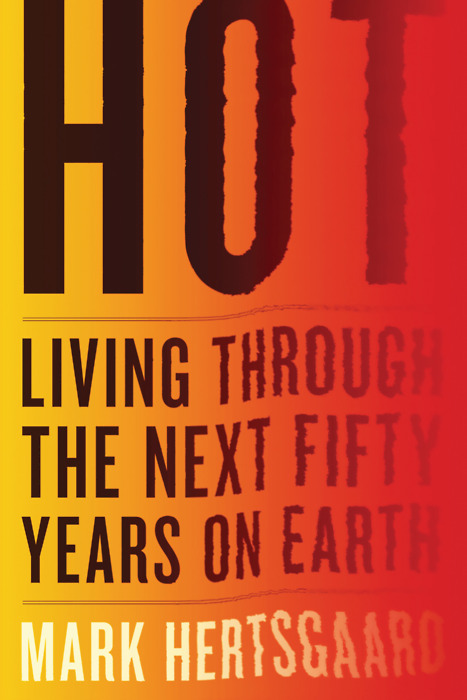
Mark Hertsgaard, who got onto the time lag consequences early, wrote clearly on the two time frames and what they mean in Hot: Living Through the Next Fifty Years on Earth (2011.) Since then, the news of effects has been--as Orr predicted--increasingly bad.  Though the far future looks a little better, with the rise of clean energy and new carbon regulations (both fostered by the Obama administration), and with hopes for a meaningful global treaty later this year, we still must deal with those two basic problems, conceptually and emotionally.

That all leads to Apocalyptic Planet (published in hardcover in 2012, and in paperback in 2013.)  Dealing emotionally with the apocalyptic possibilities is an ongoing process, with lots of changes in perspective and feeling.

 What Craig Childs did was to visit places where apocalypse is visible in various ways: where climate crisis consequences are visible and tangible and ongoing, and to extreme places where apocalypse already happened, perhaps a very long time ago, and in a sense is still happening.  Although I discovered this book late, it also took me a long time to read it all.  I could only handle so much apocalypse at a time.

Childs begins in the desert and moves on to the glaciers.  It's clear from these first two chapters that his writing is vivid, economical and eloquent.  He describes his own single set of experiences and those of companions in these extreme landscapes.

 The combination of beauty and fear in these places produces a complex awe.  As his party of documentary filmmakers finds one astonishingly fast-melting glacier after another, several couples find crevices in the ice where they have sex.

 These places are indicators of apocalypse. The extreme and alien landscape of the Mexican desert is inexorably expanding into Arizona, as drought deepens and consolidates.  Scientists in his party are astounded by the speed with which the glaciers they observe can melt and drain away--feelings echoed more recently in statements about melting in Antarctica.

 He goes to Alaska with his intrepid mother to look at consequences of sea level rise. He returns to his birthplace of Arizona to explore the rise and fall of civilizations, where he talks with an archeologist.  "As dark came on, Wright and I talked about how civilizations tend to fall, common themes you see throughout time: environmental decay, failure of top-heavy infrastructure, resource depletion, loss of social egalitarianism, disease, conflict." He asked Wright what such an apocalypse would look like.  It would start out looking like Phoenix today, with decay beginning at the edges.  Apocalypse can be a slow process in human time.

 Childs grapples with the twin sense that apocalypse simply happens over and over, and every civilization that has risen so far has fallen, but that once anticipated some of these fates may be avoidable. Or apocalypse can happen relatively quickly.  In Greenland he discusses with a climate scientist the possibilities of rapid climate change.  It's happened before, without human help--and this is one of this book's contributions: it deals in different time frames, including a multi-billion year perspective.

A major figure in this long Greenland chapter is Koni Steffans, an European climate expert whose research camp Childs is visiting.  From time to time, government officials and others visit the camp for updates.  "What he tells people who visit is not that the sky is falling but that we live in a world of falling skies and it is best not only to know your options but to make moves ensuring the worst does not happen." [p.176]

 Childs does not limit his explorations to consequences of the climate crisis.  He looks at tectonics in Tibet, volcanoes in Hawaii (a monster volcano eruption is probably the best candidate for near-instant, near-total apocalypse.) The Tibet chapter includes a daring ride down an uncharted river, a surprising release from the book's main tensions.

 But for me the scariest landscape he describes is a corn field in Iowa--genetically modified corn to resist predators is combined with chemical killers of all non-modified life.  The crops themselves are depleting the soil without regenerating it: they are killing the future they are feeding. This environment of deliberate industrialized death is the occasion for discussion of species extinction (the specific subject of Elizabeth Colbert's 2014 book The Sixth Extinction.)

 This somehow is the most emotionally powerful aspect of apocalypse, perhaps because there is nothing of awe and terror in it.  It is indirect but conscious destruction, invisible and hollow.  A scientist points out that individual animals of species about to disappear are mostly not ill or weak.  Their environment, their breeding grounds, makes following generations smaller and then impossible.  So one day they are just not there anymore.

 Childs and his companion spend days and nights in these corn fields, searching for any life at all--insects, birds, grass.  They find little, but the little they do find is a source of some hope.

 Time scales and the constituents of apocalypse, including the climate crisis, come together in the final chapter, as Childs searches out the limits of life in the severest desert he could find, in South America.  He looks beyond what we define as the living to find the life of the planet.  "The earth is a seed planting itself over and over."

 There is no easy solace, or easy despair.  This book expands the usual view of the Earth, in time and space, in levels and variety.  It becomes a little like contemplating the realities we suppress, of what happens over time in our own lives, in the inevitability of death and the mysteries of life changing and continuing.

 This book helps to provide a different perspective for thinking and feeling through future prospects as shaped by global heating.  But it doesn't simplify those thoughts and feelings into a philosophical complacency. Its strongest message is to experience fully what we are privileged to be part of in our own brief time on Earth, in all its dimensions.  It also supports hope as an operating principle, as a kind of responsibility that comes with being alive.  The responsibility is to contribute to a better future--even if that means a less awful future that it might otherwise be-- together with our responsibilities to people and communities and places in our present.  

Sunday, September 28, 2014

In 100 Years
Leading Economists Predict the Future
Ignacio Palacios-Huerta
MIT Press

A 1930 essay by legendary economist John Maynard Keynes made predictions for the next 100 years, mostly optimistic ones (especially considering the 1929 crash and ensuing start of the Great Depression.)  This 2014 book, following the economic smashup of 2008 and ensuing Great Recession, gets analyses and predictions from ten contemporary economists for the next 100 years.

These economists teach at the most prestigious institutions of MIT, Princeton, Yale, Harvard and the London School of Economics, with a lone rep from University Pompeu in Spain.  Among them are two winners of the Nobel Prize for Economics, and five past or present members of the Econometrics Society.

Often from the perspectives of their particular expertise, they discuss the issues of wealth and work, institutions, health, education and technology. (Notably there is little discussion of population, which used to be at the top of the list of the future's economic determiners.)

  Since the Keynes essay posited that increased total wealth will lead to more leisure and a less selfish society, some discuss ethics and human nature.  Most of the essays don't rely on jargon, so they can be read by non-economists.  On the other hand, it is painfully obvious that these are economists writing.  Their concerns, both abstract and narrow, don't adequately address the fullness of the future.  Nor are they up to the vision and writing of Keynes in his essay, "Economic Possibilities for Our Grandchildren."

People read these books of "predictions" basically to learn whether the future is brighter or darker, but there isn't much guidance here.  Most are guardedly optimistic, though mostly because they believe that present good trends will continue, change won't be overwhelming, and the challenges that scare everybody else will be somehow met.

For example, eight of the ten at least mention climate change, but only two call it the biggest threat and four minimize it as a problem.  Even the economist who devotes the most attention to it (Martin L. Weitzman of Harvard) ends up asserting a technological solution (sunshades.)  A review essay by Charles C. Mann in the September 2014 Atlantic suggests this is a pretty universal attitude among economists.  It also happens to (a) support the wealth of today's wealthy and (b) it runs counter to the findings of physical scientists and just about everybody else, who would consider this wishful thinking at best, or more pointedly, complacent ignorance and willful blindness.

Six mention income inequality as a problem, and five see it as an important one: a threat to democracy, for one thing.  But none puts these two together, climate crises and income inequality, which are likely to be happening at the same time, and will markedly affect each other.

They do attempt to at least summarize major factors and suggest how they might interact, but (with some exceptions) generally and blandly.  They mostly seem to apply conventional modes of thinking to a future that requires more imagination than this. Their discussions of technology are remarkably abstract and simplistic.  Even apocalyptic fiction, so prevalent these days, is more sophisticated in seeing how such factors might combine to affect the future.

Editor Ignacio Palacios-Huerta, who had the idea for this volume and solicited contributions, takes pains to discuss why he did so.  Apparently this is a very daring enterprise.  But the only precedent isn't 1930.  Such books were fairly common in the 1960s and 1970s, and even involved economists like Robert Theobald.  Back then (and in the more recent The Next One Hundred Years by Jonathan Weiner in 1990) such attempts acknowledged the folly of restricting the portrait of a complex future to the assumptions, observations, theoretical matrices and prejudices of a single discipline.

Perhaps I am unjust to the attempted breadth and subtlety of argument in these essays.  But all they basically seem to say is that, on balance, for their clients the future is a fairly good investment.

 That seems to be what economics is about now, and perhaps why economists by and large have a really bad record in predicting a year or even a month into the future.  Economics has possibly the least legitimacy of any claimant to actually being a science, though behavioral psychology gives it a run for its money.  

There was little or no awareness in these "predictions" that real scientists are demonstrating that humanity is using up the Earth and its resources at a much faster rate than replenishment.  Half the non-human vertebrae population of the planet that existed in 1970 was gone forty years later, in 2010, says the World Wildlife Federation study noted in the Washington Post.  Just about all of that depletion is a result of humanity.  We're destroying what sustains our lives, and ignoring that we're doing it--and we pay people handsomely for that ignorance, and we read their tedious books.  Until we realize that today and certainly for future the environment is the economy, all we'll have in one hundred years is the certainty of terminal solitude.

Thursday, January 16, 2014

Two Books on the Future

The Future of Nature
edited by Libby Robin, Sverker Sorlin, Paul Warde
Yale Press

This is an anthology that traces prediction and other aspects of anticipating future consequences and possibilities applied to the natural world.  It presents essays from the past--from Thomas Malthus and Alexander von Humboldt to Rachel Carson and mostly less familiar names--and appends contemporary commentaries by the editors and others.  Meant to "promote conversations," it includes a trenchant introduction that sets the current framework.

The essays and commentaries are divided into sections (population, natural resources, technology and climate among them) that also serve as a rough chronology of issues as they arose in the western world from the late 18th century to now.  Some of these are fairly broad agenda-setting essays, and many are more technical.

As with any anthology, one can argue with the selection.  I found the total absence of Paul Shepard especially troubling for a sufficient perspective.  But the major problem may be suggested by the commentary to Alva Mydral's 1972 essay "To Choose A Future."  Arne Kaijser rightly notes that this period of the early 70s was the heyday of Future Studies, and the attempt to bring together discipline and constituencies to focus on the future.  What it doesn't say is that future studies as an enterprise soon faded, especially in the U.S. but probably in Europe as well.  The future turned out to be a big and complex place, the computer technology of the time wasn't up to dealing with all the categories and data, and political winds shifted.  Academic approaches moved on as well.  Aspects of it continued but focused on more specific areas.

So the broader readership that might enter into this conversation is probably otherwise engaged, or more likely otherwise unengaged.  That's not these editors' fault certainly.  The limitations of this volume are made up to a degree by specificity, and its heartening to know that at least European academics are thinking even this contextually.  This is a solid contribution which should provoke meaningful conversations on the future of nature, which it demonstrates is also the future of the future.

The Future Is Not What It Used To Be:
Climate Change and Energy Scarcity
By Jorg Friedrichs
MIT Press

Author Freidrichs teaches in the department of International Development at Oxford, and his previous books have been on terrorism and international relations theory.  So this book focuses on geopolitical consequences of climate change and energy scarcity.  But in doing so he is focusing on the survival of civilization, and its "core values."

The future is first of all not going to be a continuation or slight variation of the present.  While in the short term industrial countries can "easily mitigate some of the social and political effects of climate change," as the climate crisis becomes more serious, industrial civilization may not be able to "bail out places in mayhem," and will find itself under internal pressures from its own catastrophes.  And once underway (which it is) the nature of climate change leads to unpredictable consequences.  That's due to its dual nature: a set of gradual changes, punctuated by large and sudden disasters.  And that's the best case scenario.  Sudden and extreme climate change overall is still and always possible.  Nobody's done this to the planet before.

I believe his key point is this: "the durability of industrial society cannot be taken for granted in a turbulent world."  He employs arguments and statistics to shake the complacency of those who believe otherwise.  But though he notes in his introduction "Facing the future is not for wimps,"  he believes that facing the consequences of the climate crisis is necessary.  In his final chapter he promotes "resilience" (the latest climate crisis buzzword, and possibly the only good one) and "transformability."  He writes that the human ability to control its environment is an essential feature of civilization, but he doesn't opt for a particular technological solution. He notes that when all is said and done, our civilization depends on qualities such as "goodness." To realize how non-simplistic this is may require reading what comes before it in this book, about the extent and likelihood of future dangers.   He principally argues against the many forms of denial that prevent even approaching this most profound challenge.

Incidentally, the expression "the future is not what it used to be" ( or "ain't what it used to be") I associate with Arthur C. Clarke, but the Internet tells me its earliest known appearance in English is from Laura Riding and Robert Graves in the 1930s.  It's often attributed to Yogi Berra (along with almost everything else) and is the title of a song recorded by, among others, Meatloaf.  It's also been the title of several previous books.  But then, so has The Future of Nature.

Wednesday, August 21, 2013

Books for the Future

In new nonfiction books I have a prejudice: I look for books that may tell me the future.  Books that might contribute to a better understanding of the most important factors likely to govern the future, and that suggest action and attitudes to make a better future, and certainly to forestall a much worse one.

Environmental topics are prominent among them.  I've reviewed here and elsewhere some of the major and also some of the lesser known but worthy books specifically on the climate crisis.  Here are glimpses of several more pertinent books:

Small, Gritty and Green: The Promise of America's Smaller Industrial Cities in a Low-Carbon World by Catherine Tumber (MIT Press) is a model of the most valuable books for the future: it is on a specific but under-appreciated topic, it is very current and above all it is a laudable combination of thorough and relevant research (and reporting on such research), and it is well-organized, well written and readable, with useful notes, bibliography and index.

Millions of people live in these smaller cities, mostly in the northeast and midwest, that have rich histories but are neglected and generally ignored.  Tumber makes the case that these cities can not only be saved, but can be vital elements in the low-carbon future we must have if civilization is to have a continuous future at all.  These are cities like Syracuse, Youngstown and Hartford, but some of her findings and ideas can apply to the larger industrial cities now in various stages of confusion or deterioration.  Tumber stresses that this is a personal and even idiosyncratic book, involving personal experience as well as history and journalism.  Yet she comes up with very specific ideas on how these cities can contribute to a clean energy economy.


Earthmasters: The Dawn of the Age of Climate Engineering by Clive Hamilton (Yale). However they reflect the moment, some of these books are destined to become reference works for the near future.  This is certainly one, for intentional climate engineering (as opposed to the unknowing kind that has been going on for more than a century, and still goes on even as we know better)  is still mostly a set of early ideas.  Yet because those ideas and research are being funded largely by the loose billions of fossil fuel and related companies, there is much impetus behind the scenes.  At the same time, Hamilton writes, "There is almost no information on public attitudes to geoengineering for the simple reason that almost no one has yet heard of it."

 This current research is apparently intended to offer technological fixes that won't require a switch from fossil fuel energy. Geoengineering projects are roundly criticized for their ineffectiveness and especially the foolhardy dangers they pose to the global environment.  Hamilton divulges who is doing what right now, and raises the practical and ethical issues involved.  Because such powerful interests are behind geoengineering, and also because some aspects of it may not require much technology or expenditure (and could even become a form of terrorism), this is a necessary book, a primer for the near future.

The Incidental Steward: Reflections on Citizen Science by Akiko Busch (Yale)  For a long time the observation and even experimentation applied to the natural world was conducted by amateurs, by monks in gardens and part-time naturalists.  They were motivated by curiosity and wonder, and often by an intense involvement and fierce love for the nature in the place they lived.  Busch updates this impulse to the computer age, in the course of describing her involvement with her home grounds of the Hudson river valley.  As a physical book it feels good in the hand, with paper and print meant to last.  Therefore it serves the savoring kind of reading it deserves.  Her fundamental point is itself important: it is the citizen scientist--like indigenous ancestors--who are vital to the future of nature, and therefore to the future.

Birthright: People and Nature in the Modern World by Stephen R. Kellert (Yale).  Kellert is something of an expert in the relation of humans to the rest of nature, and in this book he explores ways in which humans at various stages in their lives are naturally affiliated with nature, borrowing E.O. Wilson's term of biophilia.  His observations are wide-ranging, and the book includes personal observations of nature and scenarios of possible futures.  This relation of humans to the rest of nature is essential to our well-being, to who we are.  But we are in danger of destroying our own birthright.  Kellert makes a comprehensive case for why we must be conscious of this and act with it in mind to make sure future generations can claim this birthright.

Those who assume an apocalyptic future often do so based on an interpretation of evolutionary science and natural selection.  It is true that the dominant interpretations have stressed individuals engaged in a selfish survival of the fittest, and those manifest aspects of animal life that counteract this dominant view have been ignored and under-studied.  But new research is redressing the balance.

Two new books from MIT Press are good examples of these newly robust areas of study.  From Groups to Individuals: Evolution and Emerging Individuality, a collection edited by Frederick Bouchard and Phillippe Huneman  reviews research within the context of the move away from organisms as the primary agent of evolution, taking into consideration however not only constituents of what we describe as organisms, but groups.  What makes individuality turns out to be a lot more complicated in biology as philosophers, psychologists and other social scientists have found applied to humans.  This is a nice sized book, sturdy and illustrated with drawings and charts.  This seems an exciting academic field right now, with important implications for our general understanding, and our approach to our future.

The same may be said of Cooperation and Its Evolution, a collected edited by Kim Sterelny, Richard Joyce, Brett Calcott and Ben Fraser.  Topics range from microbiology to human philosophy, and while animal cooperation is explored, the emphasis is on the human.  With more than 500 pages of text in a hefty but easy to handle volume, many current issues and arguments are explored.  This is the latest contribution to bringing research together to see where we stand.  In general, the idea that there is an evolutionary basis for cooperation is becoming more and more acceptable, and freed from the constraints of seeming heresy, how cooperation and conscious decision-making for a better common future can be achieved is an exciting area for creative research and theories.

Within the world of political action, there are books about under-appreciated elements of the present that are forming and in some cases threatening the future.  Occupy the Future, a Boston Review volume published by MIT Press, is a group of essays edited by David Grusky, Doug McAdam, Rob Reich and Debra Satz.  It emerged from the Occupy Wall Street movement, but the book is not about the movement itself.  It describes the current major income inequality in America--the vast proportion of wealth in the hands of a very few--and its current and future implications.  It looks at the causes and effects, and suggests remedies.  In nearly 250 pages of text, it goes into some detail, and at the very least is informative about today's workplace and the effects of computerization, globalization etc.  The breakdown of chapters is well organized, and some individual chapters go into detail.  It's longer than the Boston Review books I've seen, but it's still a handy paperback size, though a sturdy hardback.

Finally, there's the impact of the still evolving universe of computing and cyberspace on the future that is becoming the present every day.  The latest history to provide some perspective is On Computing: The Fourth Great Scientific Domain by Paul S. Rosenbloom (MIT).  But this is more than a history--the author is arguing that computing joins the physical sciences, life sciences and social sciences as a separate domain: information transformation.  The incredible growth of computing has regularly been accompanied by outsized claims that turn out to be both less and more than the truth.  This is a provocative thesis, which will likely occupy speculation and study for awhile to come.

An occupational hazard of books about the fast-changing world formed by computing is instant obsolescence.  Still, reports such as Crowdsourcing by Daren C. Brabham (MIT) are valuable as snapshots of the present (or recent past) and especially as indications of direction for the immediate future, and expression of potential uses.  This is a well organized and thorough treatment of the phenomenon and related research, in a handy-sized volume, a paperback with the publishing quality of a hardback.

Then there are books that reflect an emerging field that makes particular use of computing potential and behavior while advocating for it.  Digital Humanities (MIT) by Anne Burdick, Johanna Drucker, Peter Lunenfeld, Todd Presner and Jeffrey Schnapp is creative description and manifesto for a view and a field that conceptualizes computing as a transformational technology within the traditional area of study called the humanities. The book includes a "short guide" that defines digital humanities as "an array of convergent practices that explore a universe in which print is no longer the primary medium" for the production and dissemination of knowledge. The book, about the size of many children's picture books, contains many examples of such current research as well as directions for future inquiry.

An open version of this book is also available as a free digital download.

Friday, March 09, 2012


Searching for Utopia: The History of An Idea
by Gregory Claeys
Thames & Hudson

When I saw this book displayed at Northtown Books here in Arcata, it reminded me that while the once promising field of Future Studies has waned, there’s a curious new interest in Utopia Studies. In this era of dire predictions and popular fictions of apocalyptic futures it seems counter-intuitive, but it is precisely in dark times that utopian visions flourish.

This volume is one in a series of illustrated histories, but the pictures are less impressive than the prose. Claeys debunks several persistent mischaracterizations about the literature of utopia, first and foremost, that “utopia” necessarily means a perfect world. Most utopian stories are about a “radically improved” society. Like the story that gave the idea its name—Thomas More’s Utopia—it often responds to what we might call the tyranny of the 1%, and depicts a more egalitarian society.

But utopian stories vastly predate More’s 16th century work, and appear around the world, from indigenous cultures to Chinese, Hindu and Muslim civilizations.  Many have religious roots and hark back to a mythical Golden Age. That changes with H.G. Wells and other modern writers who begin locating utopia in the future, now the dominant notion.

Utopia was often located on an island or a hidden place, like Shangri-la. In Thomas More’s time, America was the hoped for place where utopia could happen, and utopian ideals drove many actual political and social experiments, from the founding documents of the United States to hundreds of communities organized on utopian lines in the 19th century.

Some utopias turned very dark, especially when linked with scientific pseudo-theories (like eugenics) and technology. When attempted by murderous dictatorships, the catastrophic results poisoned the very idea of utopia. And so psychology as well as politics enters the utopian story. External change is not enough; self-knowledge becomes a utopian endeavor.   This survey of course can't include everything, but it should be noted that among psychologist writers who addressed this matter of approaching a better society through individual self-knowledge were Carl Jung and his American successor, James Hillman.  From another point of view, the Dalai Lama has spoken and written about this subject specifically.

Claeys’ survey of science fiction—the chief generator of utopian fictions in modern times—is cursory and not particularly insightful.  It brushes by the particular contributions of Ursula LeGuin, George Zebrowski, Greg Bear, Bruce Sterling, William Gibson and other contemporary science fiction and fantasy writers, but in particular Kim Stanley Robinson, who is especially known for his utopian concerns, and who edited a volume of utopian stories.  But worst of all, the world’s most widely known utopian saga of the past half century isn't even mentioned: Star Trek. This is a glaring omission, even for a Brit.  Then again, he ignores the most recent incarnation of Doctor Who, which confronted this topic in a number of stories, including one which involved the quest for a mythical planet called Utopia.

The eloquent final chapter examines the present, when the response to onrushing ecological disaster caused by our civilization is to shop harder. He concludes: “The old ideal worlds can lend us hope, inspiration, a sense of what to aspire for as well as what to avoid. But our ideal world must be very much our own creation, and a serious reckoning with the fate we face if we fail to create it.”

Utopia, like hope, is an activity of the present.  Zebrowski and Kim Stanley Robinson are particularly insistent on utopia as a process, which is an analogue to President Obama's goal of a perfecting what can never be perfect, that "more perfect union."  Utopia is a process of imagination and effort, motivated by basic human impulses, including love for future generations and our planet.

Thursday, February 16, 2012


Indra’s Net and the Midas Touch: Living Sustainably in a Connected World
By Leslie Paul Thiele
The MIT Press

Why do we glorify the “Midas Touch” and forget the rest of the story? That everything King Midas touched turned to lifeless gold, including his daughter? Leslie Paul Thiele points out that this is a cautionary tale about unintended consequences, which pretty much characterize what we’ve done to our society and our planet.

With many painful examples, Thiele describes how unintended consequences of clear-eyed altruism as well as stupefied greed have characterized our era, because we treat the world like a machine that needs a technological fix or two. A more realistic metaphor is Indra’s Net, a figure of interdependence and interpenetration from Eastern religions which ecology and systems theory confirm.

With William Ophuls’ Plato’s Revenge (reviewed last time), this is a notable attempt to think through the climate crisis future. “Sustainability is inherently interdisciplinary” Thiele writes, so like Ophuls he covers a lot of ground and many important authors, in chapters on ecology, ethics, technology, economics, politics, psychology, physics and metaphysics. He also mines western classics and other wisdom traditions (just as Ophuls also mentions the Indra’s Net metaphor.)

But Thiele brings a younger point of view, and a very disciplined, trenchant and elegant style as well as wide-ranging scholarship. There are no wasted words in his sentences, and no wasted sentences in this book. He goes beyond the usual questions and conclusions to tougher applications and more subtle synthesis. He integrates fresh concepts from the front lines, such as safe-to-fail experimentation, cascade effects, resilience, ecosophic awareness. But he also finds new relevance in dismissed principles, like courage, respect and gratitude, and the determinative roles of imagination and story. Sustainability requires a new understanding of soul.

My favorite guiding quote on thinking about the future is from H.G. Wells: “The end of all intelligent analysis is to clear the way for synthesis.” This book is the best exemplar of such a synthesis I’ve encountered in awhile. The individual ideas may not be shockingly new, but the logic of the connections is revelatory. He ranges from Sophocles to systems theory and the remarkable knowledge of squirrels. An entire curriculum could profitably be based on this book—a curriculum to save the future. But even by itself, this book is a handbook of conceptual tools for making a better future. Or for reading about the future that could be. I may question some of his assertions, but at least he’s providing sturdy transport for the journey. One message in both Thiele and Ophuls is that individuals and small groups can make ultimately large differences. “Hope is our greatest resource in these troubling times,” he writes. “But the hope we claim and cultivate must come from decidedly new ways of thinking and acting.”

Sunday, October 25, 2009

William Irwin Thompson's studies in the evolution of culture, Self and Society, reviewed below.
Self and Society: Studies in the Evolution of Culture
by William Irwin Thompson

Imprint Academic 184 pages

Self and Society is an oddly vanilla title for the guy who wrote At the Edge of History, Evil and World Order, Coming Into Being and The Time Falling Bodies Take to Light. William Irwin Thompson burst on the scene in the early 1970s as a counter-cultural intellectual and later a boundary-crossing New Age synthesist of history and future, art and science, media and Gaia. For almost forty years, Thompson has been one of those few writers and speakers that an intelligent and otherwise eclectic and self-defined public looks to for illuminating ideas about what’s really going on in this mixed-up world, and therefore what’s to come. This new and expanded edition of Self and Society is a cumulative summary of his latest thinking.

This book expresses his transition from cultural historian to cultural ecologist, he writes. He spells out this personal journey in more detail in talks recorded in Reimagination of the World (Bear & Company). He elsewhere refers to himself as primarily a poet, and reimagined his own career in Europe, where he wrote a science fiction novel, Islands Out of Time (Bear & Co.) His foreword to that book asserts that character and story are old fashioned delusions (“People who believe in egos write novels with characters.”) Maybe I’ve got a warped sensibility, but I enjoyed this novel for its characters and story.

Though he continues to find guidance in that Old Master, Marshall McLuhan, Thompson adopted ideas and vocabularies from chaos theory and the new physics, as well as the new biology of Lynn Margulis and James Lovelock (Thompson edited two anthologies, Gaia: A Way of Knowing and Gaia 2: Emergence, both from Lindisfarne Press.) Maybe it’s just because I’m not clear on the significance of such concepts as “attractors,” but the vocabulary sometimes gets in the way, and sounds like jargon. Still, Thompson’s use of these new approaches in science is far from the trendy appropriations (and distortions) of some popular New Age authors. They guide him into some profound possibilities.

Though sometimes maddeningly sketchy or abstruse, his ideas are bracing, especially for those immersed in the supposed intellectual mainstream. For example, though he writes about physical and cultural evolution, he finds a lot of trendy evolutionary psychology reductive and misleading. But in this brief review I want to concentrate on what he sees as today’s nascent patterns, moving into the future.

Thompson sees the growth of a planetary culture over the past century, still defining itself. It involves the arts, belief systems and cultural values as well as economics, politics and science. But this is not some gauzy New Age vision. “So when I am writing about the emergence of a new post-religious spirituality that is resonant with science” (exemplifed by the Dalai Lama)...”I am perfectly aware that I am living in the ‘sunset effect’ time of Osama bin Laden and Jerry Falwell.”

Cultural transformation is complicated not only by conflict but by the tendency to “become what we hate,” (for instance, torturers.) Thompson concludes that “if we’re lucky” we may avoid a downslide into a dark age “that could last for centuries” before the new “noetic” future might emerge. That luck would be in avoiding self-annihilation by any combination of ecological and economic catastrophe and weapons of mass destruction.

At times he sees this “luck” as very unlikely, and seems resigned to a civilizational apocalypse. Even in our gigabite-giddy, electronic denial, he’s hardly alone in this analysis, especially in the darkening decades from Reagan through G.W. Bush.

But in his last chapters--blog entries about the 2008 presidential campaign-- his hopes are raised by the election of Barack Obama. Of Obama's speech in Chicago's Grant Park on election night, Thompson writes: “he stood in the moment in which yesterday becomes tomorrow as an entire epoch comes to an end...So yesterday is an age ago, and if tomorrow is filled with new challenges and crises, at least the whole world can now look to them with a new face.”

Friday, March 06, 2009

CO2 Rising by Tyler Volk is a book no climate crisis denier can afford to read. It and another MIT Press book are noted below.
CO2 Rising: The World's Greatest Environmental Challenge
by Tyler Volk
The MIT Press

Global Catastrophes and Trends: The Next Fifty Years
by Vaclav Smil
The MIT Press

These are two data-rich books. CO2 Rising is the one book climate crisis deniers do not want to read, because it lays out the data in detail, embedded in narrative and expressed clearly. You may or may not be charmed by the story of a carbon atom named Dave, but you will no longer have an excuse for denying the science behind the reality of a climate crisis caused by what humans have done and are doing in this industrial age so far.

Global Catastrophes and Trends is a different matter. It covers not a single phenomenon in depth, but many in relation to each other, to forecast the fate of nations and the planet. Smil selects and evaluates lots of data, and forms conclusions based on that. To decide what the future outcomes might be of what may be quantifiable in the past and present requires judgment, and a book like this must persuade you of the author's judgment as well as the soundness of the data. Alot depends on the selection of what's relevant and his appropriate use of the data he selects.

The data is often fascinating and sometimes eccentric, and Smil's conclusions aren't always the conventional ones, so the proof is in the reading. Frankly there is so much data, and so many kinds of it, that the journey can be overwhelming. Another problem with this kind of prediction is timing--and this book was finished before the current global economic mess and the responses, or even the election of President Obama, which can cast a new meaning on data, supporting different patterns. Whether Smil's approach is any better than past attempts to forecast probabilities quantitatively won't be known for fifty years I suppose, but there's probably something here to cheer, alarm or provoke everyone right now.

Tuesday, December 30, 2008

Earthrise: the Apollo 8 photo that changed how humans view their planet, and also the title of a fascinating new book by Robert Poole, reviewed below.
Earthrise: How We First Saw Ourselves
By Robert Poole

Yale University Press

On Christmas Eve forty years ago, Frank Borman looked out the window and saw something no human had ever seen before. He saw the Earth rise.

At the time Borman was in a space capsule, with the first crew to orbit the Moon. They were on the dark side, in their fourth orbit of looking down at shades of gray on the lunar surface, set against the black of space. And then suddenly, the blue and white Earth dawned over the edge of the Moon. Apollo 8 astronauts Borman, James Lovell and Bill Anders scrambled to take pictures through the small window with their hand-held cameras. Anders color photo became the iconic image dubbed “Earthrise,” splashed across magazine pages and posterized on classroom and dorm room walls all over the world.

Those who’ve grown up with this image (and the later full-Earth portraits) may not realize that “What does the Earth really look like?” was a mystery for thousands of years. We had photos of Mars long before a picture of our own planet. Philosophers, poets, visionaries and a few visionary scientists suggested how profound such an image might be, as Poole recounts.

Plato tried to imagine seeing the earth from high above, and envisioned a planet of bright colors. This fantasy viewpoint suggested philosophical conclusions: Romans like Cicero and Lucian pictured the puniness of earthly empires in the immensity of space, while Seneca saw the ridiculousness of “the boundaries set by mortals.” Medieval thinkers saw Earth as insignificant among greater planets (“Contrary to popular myth,” Poole writes, “the world was not widely believed in the Middle Ages to be flat…”), while 16th century artists emphasized the Earth’s grandeur. In more recent times, 1930s social reformer David Lasser thought the sight would end racial divisions, and in 1951 astronomer Fred Hoyle was among those who thought it would expose the futility of war and nationalism.

While universal peace and brotherhood did not immediately ensue when Earthrise became a spectacularly popular image, Poole believes it did have important impact. It contributed to the power of new metaphors, from Spaceship Earth to Gaia, which changed attitudes, however slow and subtly.

Yet NASA hadn’t given much priority to such a photo. “We had been trained to look at the Moon,” said Anders. “We hadn’t been trained to look at the Earth.”
But later it was that first view of Earthrise that these astronauts remembered most clearly: the Earth in the context of space, the whole Earth with all the visible color and life in one fragile body.

This fascinating little book packs a lot of provocative cultural history in 200 pages. It looks back before the Apollo missions and at how the Earthrise and subsequent photos of Earth from space fit into cultural changes, and may well have helped prompt and form them.

The Apollo program is itself worth remembering. Its spaceflights lasted a mere four years (1968 to 1972): 11 missions, nine voyages to the Moon and six moon landings. While Neil Armstrong’s first step on the Moon in Apollo 11 is best remembered, Apollo 8 was the most significant and the most awe-inspiring of the era. It was the first time a spacecraft left Earth orbit, traveled that far into space, and the first to orbit the Moon. It performed a number of complex technical achievements for the first time, requiring split-second timing: all with an on-board computer that was “tiny in comparison with modern pocket calculators.” The details of this mission are astounding, and full of amazing ironies.

For instance, it wasn't supposed to go to the Moon. Apollo 8 was scheduled to orbit the Earth and test aspects of the lunar lander, attached to the main spacecraft. Only the lander wasn't ready when Apollo 8 was--and there were rumors the Russians might be ready to orbit the Moon first. So Apollo 8 became a mission to orbit the Moon but not land. In a strange way, it was this fact that led to the Earthrise photo. If the lunar lander had been attached, the astronauts view of the Earthrise would have been blocked. They wouldn't have seen it, or photographed it.

Cultural history, especially in the popular press, has tended to be pretty cynical about Apollo and about President Kennedy, whose challenge to send astronauts to the Moon and return them before the 1960s ended was its impetus. It was all about the Cold War has become the conventional wisdom. But Poole rightly points out that there were always elements of the transcendent. "Kennedy's goal was not simply to beat the Russians, or even to appear to be racing them, "Poole writes, " but to do something spectacular to rise above it all." It was Apollo's success, Poole suggests, that led to international cooperation in space, and to the 1967 treaty that declared space off-limits to weaponry.

But for NASA, looking back at the Earth was mostly an afterthought--and the surprise was that it led to a lot of thought afterwards, beginning with the astronauts. Their view of their home planet remained the most persistent memory for many, and for some it was transformative. Gene Cernan, the last man to stand on the Moon, felt "My destiny was to be not only an explorer, but a messenger from outer space, an apostle for the future." Michael Collins returned determined "that I would do all I could to let people know what wonderful home we have—before it is too late." Edgar Mitchell thought about "beneath the blue and white atmosphere was a growing chaos...that population and conscienceless technology were growing rapidly way out of control."

The Earthrise photo had some of the same influence. Apollo 8 astronaut Bill Anders later suggested that it caused people to "realize that we’re all jammed together on one really kind of dinky little planet, and we better treat it and ourselves better, or we’re not going to be here very long."

Poole fits Earthrise and the astronauts into the heady 60s and 70s, along with Bucky Fuller and Stewart Brand (The Whole Earth Catalog), the 80s of Carl Sagan and the Gaia theory of James Lovelock and Lynn Margulis. Poole rightly reminds us that the Earthrise photo (and the “Blue Marble” whole Earth photo of 1972) gave visual support and impetus to holistic thinking and the ecology movement that blossomed in that period, leading to a certain credibility for some sense of Gaia: the planet as an interdependent organism. “The sight of the whole Earth, small, alive, and alone, caused scientific and philosophical thought to shift away from the assumption that the Earth was a fixed environment, unalterably given to humankind,” Poole concludes, “and towards a model of the Earth as an evolving environment, conditioned by life and alterable by human activity.”

That this was not Apollo’s purpose makes it all the more powerful. This book is (he writes) “the story of how the mightiest shot in the Cold War turned into the twentieth century’s ultimate utopian moment.”

Poole writes persuasively and mostly well. The only factual error I caught was attributing John XXXIII's landmark encyclical "Pacem in Terris" to another pope, and otherwise totally forgetting this most unforgettable leader of the early 60s.

Poole finds these space missions fascinating, but dismisses the possibility of finding other life out there. "Humankind now appears to be both the product and the custodian of the only island of intelligent life in the knowable universe," he writes. Whether that's true or not, his conclusions is apt: "Whether that vision has been timely enough, and powerful enough, for homo sapiens, the most successful of all invasive species, to reverse its own devouring impact on the Earth, will probably become apparent before too long."

After Apollo, no one has gone where no one had gone before , and NASA seems to be in a confused state. But the study of the Earth from space became one of their priorities in the 90s, and that's likely to continue in the Obama administration. While the new president is a Star Trek fan, he is also committed to addressing the Climate Crisis, and NASA is likely to be recruited for that mission.

Poole quotes Apollo astronaut Michael Collins as noting that as his space capsule turned, he looked both into space and back at Earth. “We saw both,” he told Congress, “and I think that is what our nation must do.”

Sunday, October 12, 2008

Buckminster Fuller, a "comprehensive anticipatory design-science explorer," famous long ago, but still a voice for the future.
Buckminster Fuller: Starting with the Universe
Edited by K. Michael Hays and Dana Miller
Whitney Museum of American Art/Yale U. Press

I’m making a list of people who helped me ruin my life. Marshall McLuhan convinced me that in this high tech age you can live anywhere and be a successful writer. Not really: constant on-site ass-kissing in NYC or LA is still required. Buckminster Fuller convinced me to try writing about large-scale connections and trends. Bad idea: when successful books are about toothpicks or salt, such writing is harder to get published than it is to finish. On the other hand, Fuller could start talking about salt and end up with the universe, the way you’d never thought about it before.

McLuhan was briefly big-time famous, but Fuller was a quieter force for decades, with his greatest fame on college campuses in the 60s and 70s. (I heard him and observed him closer up at M.I.T. in ’73 or so.) Talks of that time were excerpted in Hugh Kenner’s still classic book, Bucky, and in Calvin Tompkins New Yorker profile, which is reprinted in this book. The Tompkins essay is as good an intro to Fuller as anything you'll find.

These days Fuller is best known for the geodesic dome, and one of the essays here is on his contribution to architecture. There are lots of illustrations and photos, since it’s basically an exhibition catalog. But Fuller also introduced the concept of “synergy,” (the whole unpredicted by the parts before they work together) long before corporate consultants pounded it into fairy dust. His ideas on computers and information were practically a blueprint for Google and Wikipedia. And he gave us “spaceship earth.”

The thing about that is he meant it literally, and on many levels. The key to Fuller is that basically he was a sailor. His spaceship earth wasn’t some airy metaphor: earth is a ship that depends on efficient design to stay afloat and keep everyone aboard alive on the food etc. it carries. Ships are designed to make the best possible use of the space within them, as well as of the basic forces of the planet and the universe. (Hence another of his influential ideas: “doing more with less.”) Most technology originated because ships used it (or wars did, or both.)

Which is why he coined the phrase, “utopia or oblivion.” The planet has to be ship-shape or it will sink. It’s an either/or choice.

Fuller was unique. He started not only with first principles, but by re-thinking first principles. He accepted nothing as axiomatic, though he developed his own axioms--and almost his own language. Reading him raw is a very different experience, but having it done it, very worthwhile. The fullest Fuller for me was his Ideas and Integrities.

Kenner makes much of Fuller's childhood experiences as a boy with very bad (and for a long while, uncorrected) vision, whose main relationship was with boats and the sea on a small island. Because he could see only shapes and he had to figure out how those shapes functioned and related to each other, he developed his kind of logic, and his intuition for basic forces and big patterns. Having grown up partly deaf, this rings true to me. Kenner also maintains that Fuller was able to mesmerize large crowds for hours at a time because he was very responsive to the mood, even to individual moods in the audience.

I hope this book helps revive interest in Fuller, particularly when computers and the Internet are providing tools that his vision could guide to profound purposes. This book provides reevaluation and solid overviews of his influence, especially in how he related to both scientists and artists, but it’s just an appetizer for the depth and breadth of his ideas. Though an essayist here writes that he “remained at heart a traditional humanist,” Fuller called himself “a comprehensive anticipatory design-science explorer.” We need more of those.

Saturday, July 26, 2008

My Summer Reading

Summer for me is more a time for writing than reading. Still, so many books, so little time. So far this site has been devoted mostly to formal book reviews but that's meant posts are few and far between. So I'm going to try to add more "notices" of new books I receive, and books that pique my interest based on what other reviewers say about them. And I'm going to experiment with these little reports on what I've been reading, which will include new books and old, and re-readings. This summer's reading so far has been such a mix.

I reviewed (below) the third volume of Kim Stanley Robinson's climate crisis trilogy, Sixty Days and Counting. In June, I went back and re-read all three volumes in order, starting with Forty Signs of Rain and Fifty Degrees Below before re-reading Sixty Days and Counting. When I finished, I had to keep myself from starting them all over again. I loved being in that world. I was especially surprised that I liked the second volume best, at least for the story, since sometimes that's a kind of bridge volume in a trilogy. Then again, wasn't The Empire Strikes Back the best of the Star Wars trilogy of movies?

I'm glad I re-read Sixty Days, too. The first time through I focused on the characters and story. The second time, I found more provocative and useful information and ideas about the climate crisis. If I happen to run into Barack Obama (which is really unlikely, since I live in California) I would recommend reading these books for a good sense of the issues, challenges and possibilities in dealing with the climate crisis.

Science fiction is my preferred genre reading, although selectively: of what I call the science fiction of consciousness. Also last month I read Greg Bear's Moving Mars, an excellent work of sci-fi storytelling. Intelligent about the future, too. His Darwin's Radio is one of the most remarkable s/f novels I've read; a contemporary classic in many ways. And now I'm reading a volume of George Zebrowski's short stories, Swift Thoughts. It doesn't seem to have the story that started me searching out and reading his work, though, which was about Jesus Christ appearing on the Tonight Show. So right there I've named three of my favorite contemporary s/f of consciousness authors: Robinson, Bear and Zebrowski.

I also re-read three classics from the original s/f of consciousness author, H.G. Wells: The Invisible Man, The First Men In the Moon, and In the Days of the Comet. "Invisible" and "Moon" are wittier than I remembered, and "Comet" is mostly a realistic novel about Wells' own youth, kind of transition out of his scientific fantasy phase. It's easy to see why at the time Wells was taken seriously simply as a novelist who happened to write about these unusual subjects, like Joseph Conrad wrote about ships and Africa. He describes the practical difficulties of being invisible--he had to be naked, people who can't see him keep stepping on his feet, etc. (James Whale's movie version follows the story more faithfully than I remembered, though adding the love interest, but his emphasis is more on the adventure of it.) "Moon" offers its social critique, but it's an absorbing story, with enough physical detail to see it. Same goes for "Comet." I enjoyed these.

Before I leave genreland, I should report that several years ago my partner Margaret and I started reading the Harry Potter books aloud to each other. We eventually did it for all 7 volumes, and in between we tried some other books but somehow nothing else took. Then we were alerted to Philip Pullman's His Dark Materials Trilogy (we heard about both series' from different friends in the university drama department.) We finished the third volume in early June. This triology deserves all the praise it's gotten. Some of the writing is so gorgeous I laughed out loud as I read it. We also saw the film made of the first volume, The Golden Compass, and enjoyed that. Why wasn't it more popular? It will be interesting to see if the second two are made into movies as well.

Speaking of drama, I also read plays. Most recently a lesser known one by Noel Coward called Quadrille. Like Wilde and the early Stoppard, Coward is fun to read for the verbal wit. I enjoyed it.

In the department of old books read mostly for pleasure, a library discard of The Living Novel, a series of essays by novelists edited by Granville Hicks and published in 1957. It was in response to the "death of the novel" which preceded the death of the author as a popular topic. The contemporary novelists include some now forgotten, but also Saul Bellow, Ralph Ellison, Wright Morris, Flannery O'Connor and Herbert Gold. It's a fascinating volume. Though the problems faced by novelists and contemporary novels that these essays discuss are still familiar, and arguably are worse, I couldn't help thinking as I read of the novels and novelists that were about to burst on the scene anyway.

The best essays for my interests were by Bellow and Ellison. Bellow's analysis was often astute, and his observations epigrammatic. For instance, "A novel is written by a man who thinks of himself as a novelist. Unless he makes such an assumption about himself he simply can't do it." "By refusing to write about anything with which he is not thoroughly familiar, the American writer confesses the powerlessness of the imagination and accepts its relegation to an inferior place." He suggests the impulse, the questions behind novels and the compulsion to write them: "Why were we born? What are we doing here? Where are we going?"

Ellison's essay is impressively scholarly, especially on the American novel. Since the novel reflects change, "..if the novel had not existed at the time the United States started becoming conscious of itself as a nation...it would have been necessary for Americans to invent it." He also suggests questions that the novel addresses: "What is worth having and what worth holding? Where and in what pattern of conduct does true value, at a given moment, lie?"

Summer is also a time to assuage a guilty conscience and catch up with at least a few books that arrived new and sat patiently waiting past their season. For instance, Nobility of Spirit: A Forgotten Ideal by Rob Reimen (Yale.) I liked the theme, I enjoyed entertaining ideas from Whitman, Thomas Mann and others, and I felt the book's narrative strategy succeeded in terms of keeping you reading, although in the end I'm not sure what the central ideas are. It begins with a personal narrative of a dinner the author had with a daughter of Thomas Mann, Elisabeth Mann Borgese, who was his longtime friend, and Joe Goodman, an old friend of hers who also escaped from Germany in 1938. (Oddly they--and Thomas Mann-- came to the U.S. on the same ship without realizing it in advance, the New Amsterdam, which was also the name of the ship my grandfather came over on from Italy in the early 1920s, but it could not have been the same ship, as his was broken up in 1932.)

In New York, Joe was an eccentric composer and Whitman devotee who worked in bookstores. He arrives at the New York restaurant in November 2001 with his Cantata on the theme of the Nobility of the Spirit. Later we learn of intriguing elements of it, but also that he never finished it, and indeed burned all his notes before he died. When Elisabeth tells Reimen of Joe's death, he says that Joe was a great man. Elisabeth disagrees-- he was not truly great because he did not have the endurance to finish his great work. That's an interesting point of view, but then, Thomas Mann was her father. Nevertheless, Joe is a haunting character.

The rest of the book deals with philosophical and political ideas through dramatic dialogues, some among characters in Mann's novels and other works, some imagined or partly imagined among historical characters. The ideas are provocative and the dialogues are absorbing, and I wanted to remain sympathetic to his central championing of nobility of spirit, but Reimen's arguments against intellectual caricature falter when he ignores political and social history in his dogmatic statements about 9-11, and he oversimplifies the concept of utopia only as the absolutely perfect society envisioned by Hitler and Lenin. None of this is disqualifying, but there remains a feeling of dogmatism and yet vagueness, although there are many interesting passages.

Then it seems like the wheels come off in the final dialogue in the book, which to me came off as just inexplicable. Perhaps the Nazi priest's harsh indictment represents all that threatens nobility of spirit today, and the tortured dissident has that spirit. (A bit ironic, given that torture has most recently been inflicted and championed by the government based on the same black and white view as the author.) This last dialogue is also troubling because it's not clear what it is supposed to be--a fictional account of a possible nightmare, or what. That and other aspects of it aren't sourced, and because of it, the general lack of sufficient sourcing calls into question the accuracy of all previous dialogues, including the events in the restaurant. So if it is a work of fiction--postmodern or not--it is often an absorbing read, but possibly a diabolical book.

Thursday, April 10, 2008

Posted by Picasa
Sixty Days and Counting
By Kim Stanley Robinson
Bantam Dell paperback

This is the third and concluding volume of Kim Stanley Robinson’s trilogy about an alternate present or near future when the world is forced to face a catastrophic climate crisis. But this isn’t another apocalyptic dread-feast. Extraordinary events shape and bend the everyday, but they don’t break it.

Robinson is known as a science fiction writer (his Red/Green/Blue Mars triology, etc.) and a futuristic California writer (the Three Californias series). In this volume in particular, he is also an evocative nature writer, describing the wilds of the California Sierras, Maine and Washington, D.C. That he finds wilds in Washington is part of the story.

This trilogy is centered in Washington and follows a group of scientists and politicians as the climate crisis gets real: Antarctic melting leads to massive flooding in Washington and elsewhere, inundating whole island nations. Plus a threatening “Day After Tomorrow” scenario of rapid climate change resulting in the paradox of a monster winter, with worse to come. In the midst of all this, there’s a presidential election.

Forty Signs of Rain introduces scientist Anna and politico Charlie Quibler, and their children. Through them and other characters, Robinson writes realistically of the various responses to the growing knowledge that the world is in deep climate trouble.

Fifty Degrees Below shows the climate crap hitting the fan. It’s told mostly through scientist Frank Vanderwal (a close friend of the Quiblers), and juxtaposes the big picture with the effects on his life, as he loses his home to the floods, and experiments with living off the urban land. His interest in primate behavior suggests he’s partly a tribute to real scientist Frans B.M. De Waal, a contemporary pioneer in the study of primates, especially their peaceful conflict resolution.

Vanderwal gets involved with the Buddhists who live on the fictional island of Khembalung, becoming inhabitable because of flooding. He’s also has a romance with a woman at work (National Science Foundation), and falls for a strange woman he meets on an elevator, who gets him involved in foiling a plot to fix the presidential election.

By the time this third novel begins, the Bush clone candidate has been defeated, and the U.S. has a new President committed to confronting the climate crisis: California Senator Phil Chase, a looser West Coast version of Al Gore, but with Obama’s communication skills. The story follows his efforts and thoughts (he has his own presidential blog called “Cut to the Chase”), and those of the scientists in the actions they propose and begin to take.

But except for the fallout of the failed attempt to fix the election in a not very distinguished but still apropos Washington paranoia-thriller plot (surveillance, proliferating intelligence agencies spying on each other etc.), this novel flows with the lives of those characters. Frank is at the front lines of the scientific efforts, but also living on the grounds of the Khembalung embassy with an elderly Buddhist monk as his roommate. He continues to monitor his friends “living feral” in Washington’s parks and abandoned buildings, as well as the animals flooded out of the zoo, also living feral in the extensive parklands in the D.C. area.

In many ways this is the opposite of the conventional science fiction dominated by technology, even if scientists are the heroes. On his computer, Frank subscribes to “Emerson for the Day,” and both Emerson and Thoreau are guiding spirits. So is Buddhism—in fact, the Dalai Lama appears as a character.

Even President Phil Chase is a philosophical blogger (he gets five million responses to his first post.) By the end he’s musing about reclaiming imagination as the human tool to create a dynamic culture that can be permanently sustained, a culture “in which no one is without a job, or shelter, or health care, or education, or the rights to their own life. Taking care of the Earth and its miraculous biological splendor will then become the long-term work of our species. We’ll share the world with all the other creatures. It will be an ongoing project that will never end.”

This is a very smart novel—on politics, economics, science and those underlying matters of soul. Things happen, that it wouldn’t be fair to reveal. But perhaps most surprisingly, it feels like a kind of pastoral: valuing the real Earth and real life that makes keeping humankind from destroying the planet worthwhile. In a technical Shakespearian sense it’s even a comedy, because it ends like As You Like It: good people restoring the state, gathered in nature, for weddings.

A slightly different version of this reviews appears in the North Coast Journal.

Sunday, December 11, 2005

Holiday Gift Books from 2005: Design & the Future

The Things of Shapes To Come
by William S. Kowinski

SHAPING THINGS
by Bruce Sterling
Mediawork Pamphlet Series
The M.I.T. Press

I tend to see the future in terms of story, while real professional futurists see it in terms of design. (Then there’s Star Trek, which sees it as both. I know, you don’t want to hear about Star Trek.)

As a science-fiction writer and a futurist, Bruce Sterling also sees it as both. This particular slim but very full of pith and moment book (under 150 pages) is about designing---and redefining---things, as leading the design of the future.

Things, as created objects, and more. “Properly understood, a thing is not merely a material object, but a frozen technosocial relationship. Things have to exist in relationship with an organism: the human being.” Though this book comes pre-underlined and highlighted, that’s a quote I lifted all on my own.

But things are not generic. They are, for example, artifacts, machines, products, gizmos, spimes and arphids. My spell-check doesn’t like spimes and arphids, they come pre-underlined in red, but that’s because these are new words Sterling coins to extend the technosocial relationships into the present and future characterized by new proportions of physicality and information.

This is all pretty fascinating, especially when Sterling links the design future to the sustainable society he understands as the only lengthy future possible for civilization, though he assumes this more than makes a case for it. There are real designers referenced---the section on Raymond Loewy, for example, is informative and entertaining. I like the brisk elegance and wit of Sterling’s prose, so I went along for the ride even when I wasn’t quite sure where I was going, or even where I’d been.

Of the stuff I understood, I found some revelatory, some reassuringly what I believe is so, and some I’d like to argue about. Oddly, for a book that articulates the changes and possibilities of the Internet and information technology, the book doesn’t name a website for the discussions this book prompts. (However, Sterling is a principal of Viridian Design , with a website where more of his entertaining commentary can be found.)

Here’s one of the parts I like: “ A SYNCHRONIC SOCIETY sets high value on the human engagement with TIME…we are not objects, but processes. Our names are not nouns, but verbs.” Though Sterling disses Buckminster Fuller later in his book without naming him (specifically Fuller's “Utopia or Oblivion” choice, which he topples partly by constricting the definitions), I seem to recall that it was Fuller who famously said, “I seem to be a verb.”

Anyway, before this becomes longer than the book, Shaping Things is a highly recommended read, and a great gift for “designers and thinkers, engineers and scientists” (I’m copying the cover now) and anyone on your list interested in how information technology is changing us, and its role in designing the future. Because that’s what's on these folk's minds, that’s what the buzz is going to be, and besides it’s, you know, short.


MAKING THINGS PUBLIC: Atmospheres of Democracy
Edited by Bruno Latour and Peter Weibel
M.I.T. Press

As Shaping Things is short, this book is long---really, really long. Well over a thousand pages. But at only fifty bucks, it’s a truly great deal. It’s a compendium of fascination, an anthology of great photos, illustrations and pieces of prose you are unlikely to find anywhere else.

My first browsing foray took me to Richard Powers describing his process on his novel about the personhood of technology’s freak child, the corporation, and its relationship to the personhood of people; a chronicle of the role of photography in the human-Great Ape relationship, and another about the contemporary obelisks of Stockholm, attractive, oddly iconic and mysterious objects which also visually monitor urban water quality. And an essay on Northwest Coast Native art (which I actually know something about---and recognized people in the photo.)

I’m sure that the editors have a carefully worked out progression of arguments about making, unmaking, remaking, assembling (as in assembly lines and also the state assembly), disassembling and dissembling, of things as they define public relationships. But at least for the first many hours, my guess is this book’s main appeal is in its gorgeous variety, a browser’s paradise, a dilettante’s delight, a playground of ideas and images ultimately relating to contemporary and future design and technosocial meaning, including especially the political---a different emphasis of Sterling’s schema.

More than a hundred writers are represented (including relevant excerpts from the likes of Melville, Hobbes and Jonathan Swift)—philosophers, scientists, political scientists, anthropologists, sociobiologists, artists and scholars. And the illustrations are very well done, probably worth the price alone. Making Things Public is related to a show at the ZKM Center for Art and Media, where co-author Peter Weibel is Director.

IN THE BUBBLE: Designing in A Complex World
by John Thackara
M.I.T. Press

So this makes a trifecta for MIT Press, but design and the future is clearly a major theme for this publisher. The people involved are all over the world---a lot from Europe-- but as a group it's probably a small world (this book comes with a plug from Bruce Sterling on the cover.)

Still, I believe this is an important book, at least as much as Sterling's, and it's also fascinating to read. So it's a highly recommended choice from earlier in the year.

Thackara skewers conventional wisdom and many guiding delusions of the digital revolution with pungent facts, while noting contrarian trends and suggesting greater possibilities with all the elusive precision of aphorism. His intent goes beyond analysis. Director of a design firm called Doors of Perception, headquartered in Amsterdam, Thackara uses 10 principles to organize his ideas about "sustainable and engaging futures and the design steps we need to take to realize them."

The tech revolution didn't lead to the paperless office, nor to eradicating business travel or product transport (in fact, it created much more), and many plans for future uses, such as implanting computers in appliances and "smart" buildings, seemed doomed to equally dour unintended consequences. Nor does technology exist in a valueless vacuum. For all its vaunted efficiencies, like most consumer products it involves vast waste: It takes 15 to 19 tons of energy and materials to make one desktop computer. Cyberspace may seem ethereal but Internet computing alone may soon use as much power as the whole U.S. economy did in 2001. "We've built a technology-focused society that is remarkable on means," Thackara writes, "but hazy about ends."

The ends are near, though Thackara is not so indelicate to say so, but he does point out that we're using up the planet with incredible rapidity, even as we refuse to face the greatest threat that may very well dominate human history for the next century: the climate crisis. Instead, he accentuates the positive. Some 80 percent of environmental impact is determined by design, and "If we can design our way into difficulty, we can design our way out. ... Designing is what human beings do."

"Sensitivity to context, to relationships, and to consequences are key aspects of the transition from mindless development to design mindfulness," he writes. This includes paying "close attention to the natural, industrial, and cultural systems," and material and energy flows. It means focusing on services over things, and treating place, time and cultural difference as positive values rather than obstacles. " 'Out of control' is an ideology," he writes, "not a fact."

As much influenced by Italian literary artist Italo Calvino as by visionary American architect William McDonough, Thackara brings a refreshingly European perspective, not only in examples from societies consciously grappling with social implications and solutions, but in an ability to bring the macro and micro, the big picture and life as it is lived, into a more capacious and balanced perspective. His principles include lightness, conviviality, smartness and flow. "Our machines are disturbingly lively," he points out, "and we are frighteningly inert." He calls passive acceptance of technology "borg drift."

"In the Bubble" is often delightful, stimulating and surprising. Thackara may well emerge as a visionary voice for the wired era. For planners, designers and anyone with an interest in the future, this book is a rich resource of inspiration, ideas, and guiding principles as well as sharply observed cautionary tales. It suggests that what the tech revolution most needs, and may already be moving toward, is a sense of purpose.

If you search for new or used books from the Powell's Bookstore box on this page, and buy something after linking from here, this site gets a cut. Thanks.