Showing posts with label Buddhism. Show all posts

Thursday, August 06, 2020

History of My Reading: Presence

John Cage at Knox College in 1967.  Photo by Leonard Borden.
Of the four years I was enrolled at Knox College, I seem to have the least documentation for my third year, 1966-67: a half dozen Knox Student newspapers, a handful of letters, grade transcripts, papers and relevant notebook entries. There is however enough to nudge memories from that year--for instance, concerning some prominent visitors to campus.  Of some, like perennial Socialist presidential candidate Norman Thomas and UPI White House correspondent Merriman Smith, I have no recollection.  But I do remember the visit of Masters and Johnson.

 Dr. William Masters and Virginia Johnson were the co-authors of the sedately titled Human Sexual Response that nevertheless became an immediate best-seller when it was published in 1966.  The book reported on their studies of volunteers in their laboratory, and some of their conclusions contradicted conventional wisdom.  But their book's impact seemed based mostly on the fact that they were openly and dispassionately discussing aspects of sexual behavior and function that had not been part of acceptable public discourse.  In other words, they'd broken the silence.

 In January 1967, Dr. Master spoke to a capacity crowd of students in the Harbach Theatre and answered questions--some anonymously written in advance, some from the audience.  What I remember is the mood, which was of intense quiet and seriousness that approached reverence.  It seemed as if everybody believed that even a titter of nervous laughter, let alone a rude joke, would instantly send the event into chaos and disrepute.  (Although I do recall curious questions afterwards about the female student who had asked about fellatio and cunnilingus.)

W.H. Auden in New York 1966
From February 7 through 10, eminent poet W. H. Auden was at Knox.  He lectured in the Harbach Theatre, and read from his poetry in Kresge Recital Hall. Sometimes considered one of the 20th century's greatest poets (along with Yeats and Eliot), Auden's greatest influence was in the 1940s and 50s.

 American poetry took other directions by the 1960s, and I knew little about him.  We hadn't read him (as far as I remember) in our poetry classes, with the possible exception of his most famous poem, "September 1, 1939," written as World War II began.

 But he cut quite a figure on campus.  A couple of classmates remembered him wearing carpet slippers as he moved from place to place.  I recall his Hobbit or Tolkien sweatshirt (there was a national undergraduate revival of Tolkien underway.)

  I was among the students who had lunch with him on the balcony of the Oak Room.  This was supposed to be the first of several such lunches with various students, but it was the only one Auden attended.  He found the food inedible.  I was told that, hearing of Auden's penchant for food, the college booked him into the motel to which the Toddle House was attached.  I loved the Toddle House waffles, but it wasn't exactly gourmet dining.

 Classmate Leonard Borden was also at that lunch in the Oak Room.  He was assigned to then walk Auden to his next event, William Brady's Shakespeare class. As they ascended the stairs inside Old Main, Auden turned and offered Leonard this observation: "A poet should never use the word 'I' in a poem until he is over forty."

There was a party for him, at David Axlerod's apartment on Cherry Street downtown, which he shared with Dennis Stepanek.  Auden was there for awhile, pretty much staying in the kitchen.  This was after David got the ever-magical Judee Settipani to recreate a Mondrian design ("Broadway Boogie-Woogie") by painting it on a wall, significantly larger than the original.

 Auden had barely left the Toddle House behind before an entirely different sort of poet arrived, as cutting-edge as Auden was old guard. The second week of February 1967, Gary Snyder came to town.

  In his late 30s then, Snyder had been a presence in American poetry for over a decade.  He was among the poets who read at the famous Six Gallery evening in 1955 that premiered Allen Ginsberg's Howl, and launched the so-called Beat movement.  A student of American Indian cultures and both Chinese and Japanese languages, Snyder interspersed months and years at a Zen monastery in Japan with jobs on an oil tanker, on logging crews and as a fire lookout.

He was recently back from Japan when, just a couple of weeks before his Knox visit, Snyder accompanied Allen Ginsberg in leading the legendary Human Be-In in San Francisco that established the counterculture alliance between hippies and political activists, and prefigured the upcoming Summer of Love.

 The Knox Student lists Snyder's events as a lecture on Tuesday (subject: "What's Going On?") and a reading on Wednesday, both in the Alumni Room of Old Main beginning at 7:30 in the evening.  While Snyder did speak about political, cultural and environmental subjects at one or both of his appearances, I recall him reading a great deal of poetry at both--hours of it.

I'm pretty sure he read from Rip Rap and the completed sections of his long sequence Mountains and Rivers Without End.  He probably read work not yet published in book form; I seem to recall he read a version of "The Circumambulation of Mt. Tamalpais."  ("Circumambulation" is a ritual walk around a sacred object in Buddhist and Hindu traditions, and Mt. Tam near San Francisco is considered a sacred mountain. A year or two later, I participated in such a circumambulation of Mt. Tam with former Knox student Michael Hamrin.)

 Snyder's readings were mesmerizing: poems of simple descriptions in brief bursts of mostly nouns and verbs, and mostly one syllable words (a conscious choice in Rip Rap due to his observation of classical Chinese) that produced a cumulative, incantatory magic.  After awhile the words became mostly sound and you got tired, but then they took you to another level.  I doubt that many audiences anywhere had the opportunity to hear Gary Snyder read for such sustained periods.  

His "talk" was probably similar to observations in his essays "Buddhism and the Coming Revolution" and "Passage to More Than India" published in his 1969 book Earth House Hold (the title is one literal definition for "ecology"), and also reprinted in Allen and Tallman's 1973 The Poetics of The New American Poetry.   I'm certain, for example that he quoted (as he did in "Buddhism and...") the old International Workers of the World slogan, "Forming the new society within the shell of the old."

His emphasis on the ignored value of the non-human and Indigenous cultures struck a chord with me: as he wrote, "In fact, it is my own view that the coming revolution will close the circle and link us in many ways with the most creative aspects of our archaic past."

 Snyder also was an impressive presence on campus.  Jay Matson remembers that he wore an earring, some decades before this became a male fashion.  I recall the bells in his boots: little jingle bells that rang as he walked.  I loved that, and tried it myself for awhile.  But even in the upcoming counterculture it didn't catch on, alas.  Still, I remember sitting in the audience for the second event, alive with anticipation, and hearing those jingling boots tromping down the Old Man hall.

 The party for him was at James Campbell's apartment, which overflowed with students.  I asked him one question.  Though I don't remember what I asked about, it was in the nature of "how do you know?"  He answered that I'd have to "experience it."  I immediately jumped to the erroneous conclusion that he'd advised me to take LSD.  Such were the nerve endings as the wildness of the counterculture approached.  It was in fact a practical as well as a perfectly Buddhist answer to almost anything.

 Wendy Saul remembers telling Snyder at the party that she was writing a paper on witchcraft, and he said "something like, 'Why for God's sake? Just become a witch.' In retrospect that seems like good advice."

 But perhaps the most profound effect of Snyder's visit was felt by a younger student, Peter Overton.  He was so impressed by Snyder's talk that he decided to go to Japan as Snyder had done and study Zen.  Later he read about Tassajara and the San Francisco Zen Center.  He went to the Bay Area instead and began taking instruction at the Berkeley center.  Zen Buddhism in the Bay Area became his life.  Some of his talks are on the Internet.


I heard Snyder read again a few years later at a benefit reading for an ecology organization in Berkeley. He was among his old San Francisco colleagues, including Lew Welch, who read his famous California poem with the refrain "This is the last place/there is nowhere else to go."  Months later Welch disappeared, a presumed suicide.  I spoke with poet Michael McClure in 2003, who read there that day as well as at the historic 1955 event that launched Howl, and he remembered that reading in Berkeley as something special.

 For the next five years Snyder published poems in periodicals, from Look magazine and the New York Times to Poetry and the Hudson Review to Kayak, Caterpillar and Unmuzzled Ox.  His collection Turtle Island (a traditional name now applied to North America) sold something like 100,000 copies and won the 1975 Pulitzer Prize.  It included the prose statement "Four Changes" that set the agenda for a number of environmental groups.

Pretty soon after Snyder's Knox reading I bought the Four Season Foundation printings of RIPRAP and Cold Mountain Poems, and Six Sections from Mountains and Rivers Without End at the Knox bookstore, soon adding the earlier Totem Press edition of Myths and Texts.

For awhile after, I acquired his books haphazardly, mostly as I came across them used, but eventually I had the poetry collections The Back Country (1968), Regarding Wave (1970) Axe Handles (1983), Left Out in the Rain (1986) and the hybrid Turtle Island (1975) as well as the prose collections Earth House Hold (1969), The Old Ways (1977) and The Real Work (1980).

Probably his prose masterpiece is The Practice of the Wild, published in 1990.  It was one of my first acquisitions as a resident of California in 1996.  I saw it in the window of Arcata Books, used.  The bookstore owner sold it to me and said, "I knew it wouldn't last long.  I just put it out this morning."
I had already found Gary Snyder: Dimensions of A Life (probably on a sale table at the U. of Pittsburgh bookstore), a large collection of tributes on the occasion of his 60th birthday. The Haida artist Robert Davidson provided the cover illustration. When I mentioned the book to Davidson in 1994, he was surprised to hear Snyder was still alive.  He thought it was a memorial volume. But when I met the novelist and poet Jim Dodge here in Arcata a few years later, I could recall having read his contribution to this collection.

 For me, living in California brought new dimensions to Snyder's work, both in terms of places he wrote about and the relevance of his writing to our ecology. (He lives most of a day's drive south of me, in the foothills of the Sierras.)

 So I began to acquire his more recent books: the completed Mountains and Rivers Without End (1997), Danger on Peaks (poems, 2004), A Place in Space (new and selected prose, 1995), Passage Through India (1992 edition) and Back on the Fire (essays, 2007.)  I even got his doctoral thesis, He Who Hunted Birds in His Father's Village: The Dimensions of a Haida Myth (1979.)

 Even at that, there are books I missed.  More recently I added The Etiquette of Freedom (2010), a companion book to a film featuring Snyder in conversation with poet and fictionist Jim Harrison, which also includes the film on DVD.  Now I have another experience of Snyder reading his work (which he said "is mostly done") in his late 70s.   In May 2020 Gary Snyder turned 90.

Snyder, Ginsberg chanting, Human Be-In 1967
Allen Ginsberg did not visit Knox in my time there, but he did read at the University of Iowa in Iowa City that spring of 1967, probably in April.

 It was a Midwestern version of a Be-In, called Gentle Thursday.  Ginsberg was beginning his years of greatest fame on college campuses, and his identification with the counterculture.

 I hitched a ride with a group of Knox faculty and students (Doug Wilson was one.)  I remember it as a huge event in bright sunshine, with Ginsberg reading and leading his "Om" chants.

 Leonard Borden remembers that he read his poem "Kral Majales (King of the May.)"  We, as I recall, were pretty far away. ( Leonard reports however that some Knox classmates wound up at Ginsberg's table in the University of Iowa cafeteria.) When the official events were over, we heard about a big party that night that would feature a pig roast.  Some of our group stayed, but I was among those who returned before then.  Later we learned that a number of people at the party became ill from under-cooked pork.

  John Cage visited Knox for a few days in the spring of 1967, though I have no documentation on exactly when.  Leonard Borden has some photos however, that suggest the weather was sunny and warm.
Photo by Leonard Borden (cropped): Dennis Parks, David Axelrod, Tad Gilster, Don Hanson, Bill Kowinski and John Cage on the Gizmo Patio, Knox College 1967. Click photo to enlarge .
Leonard borrowed Jack Herbig's Leica to capture these shots on the patio. That's me in the Lennon cap and sunglasses.  The person we're all focused on is John Cage.

I remember this day.  I came outside from the Gizmo counter with my paper cup of coffee in hand, and saw John Cage sitting alone on the patio.  I immediately asked if I could join him, eager to take advantage of this opportunity for a one-on-one.  Unfortunately, once I sat down I couldn't think of anything to ask him, or to talk about.
 For some reason--or out of sheer befuddlement-- I brought up the subject of the New York World's Fair, which I had visited one hot afternoon.  That Fair was notorious for the long lines to the major exhibits.  In fact, Dave Altman and I had walked around to check out the lines, and realized that there wouldn't be time to get into anything before we had to go. So I asked John Cage what he thought of the Fair.  "I liked the lines," he said.

 It was such a perfect John Cage response that I dined out on this story for decades--including an actual dinner with a group from Carnegie Mellon University, where I got to tell it to monologist Spalding Gray.  And just after writing this I chanced across some black and white film footage of a younger Cage (in a biography of dancer Merce Cunningham) advising that people stuck in lines could be entertained by hearing the sounds around them as music, and seeing the movement around them as dance.

 But that brief exchange was about all the solo time I had with Cage, as a stream of other students (and one faculty member) saw us and clustered around.  In these photos by Leonard Borden, you can see ceramics prof Dennis Parks, and students David Axelrod, Jack Herbig, Tad Gilster and Don Hanson.  Others came and went.

For his event (or events) at Knox, Cage likely read from his book Silence (perhaps the "Lecture on Nothing") and newer work that would be collected in A Year From Monday -- maybe "How To Improve The World (You Will Only Make Matters Worse.")

In any case, it is from this latter piece that I extracted two statements that have stayed with me over the years.  I can only approximate his line breaks: "They ask what/the purpose of art is.  Is that how/things are?  Say there were a thousand/artists and one purpose, would one/artist be having it and all the nine/ hundred and ninety-nine others be missing the point?" "The truth is that everything causes/everything else.  We do not speak therefore/ of one thing causing another.  There/are no secrets.  It's just we thought they/said dead when they said bread." This piece also contains a speculation that seems to have come true: "Relevant information's hard to come/by.  Soon it'll be everywhere, unnoticed."

This lecture and others were replete with references to McLuhan, Buckminster Fuller and others who would form the backbone of 1970s futurism, a forgotten story.  Since I was well into my unguided and somewhat solitary immersion in McLuhan, this was pretty exciting.

 Cage talked about making creative choices based on "chance procedures," mostly throwing the stalks or coins of the I Ching.  I believe he selected some of what he read at Knox based on chance procedures.  I also seem to remember there was a performance of his most famous work, called 4' 33,'' which basically consists of musicians in a concert environment doing nothing for four minutes and 33 seconds.  The sounds that arise naturally in the room and from outside it during that time constitute the music.

 John Cage, born in 1912, had quite a life-- in California, Europe, the Pacific Northwest, New York etc.-- before his period of greatest international fame began in the 1960s, and his ideas found resonance in new intellectual movements as well as the growing counterculture.
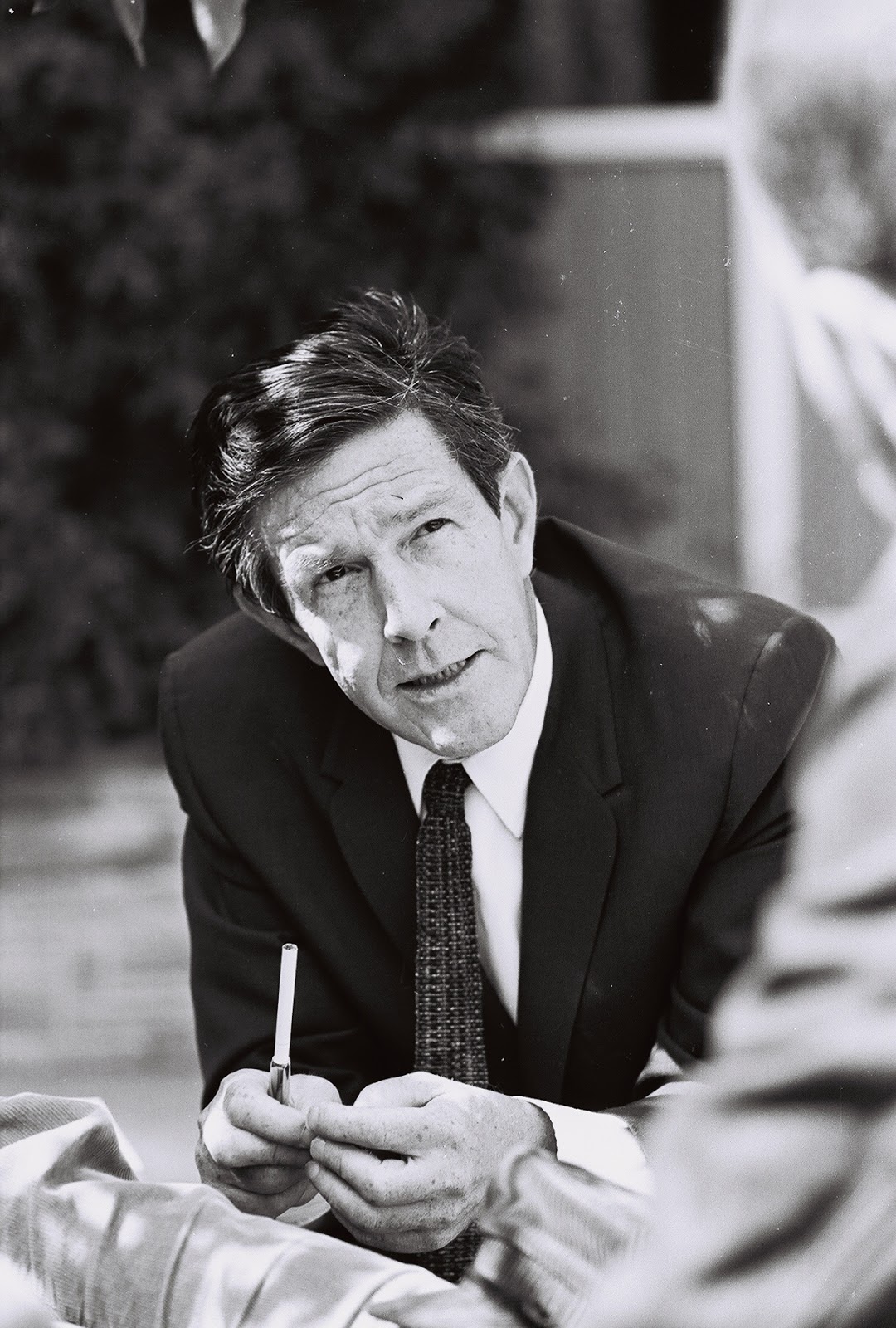
John Cage at Knox 1967 by Leonard Borden
His music and his ideas could confuse and infuriate people, but John Cage himself was such a calming, good-humored and seemingly guileless presence, that the word "disarming" could have been coined just for him.

 He was that way at Knox, and he charmed everyone with his storytelling, and with a simplicity that encouraged receptivity to the complexities and paradoxes of his ideas. Formally dressed, with his cigarette holder, he was almost courtly. He listened.  But he wasn't stuffy.  We got to experience that frequent and legendary laugh. He seemed to enjoy Knox and its surroundings, including the mushroom-hunting he loved.  Wendy Saul remembers picking mushrooms on the Old Main lawn with him, and I recall overhearing on his second visit to Knox his rapturous description of a local mushroom expedition, probably at Green Oaks.

 On that second visit (probably the following year), Cage brought Merce Cunningham and dancers, so Knox got the rare opportunity to see these dances in intimate surroundings, with the artists available before and after the performances. (My memory is meeting them in the rehearsal lobby outside the Studio Theatre.)

 As I recall, these dances were also governed to some extent by indeterminate means and chance procedures that decided what each dancer would do in a particular space for each interval of time, so that every dance was a unique event. It's worth noting that the Merce Cunningham dance troupe worked in obscurity for more than a decade, from 1953 to 1965. They started to achieve recognition, especially within the dance world, no more than three years before their appearance at Knox.  Cunningham's stellar career stretched over 50 years.  He died in 2009 at the age of 90.

There are several threads that link these people together, other than their appearance at Knox in 1967.  One would run through Allen Ginsberg, who knew them all, including W.H. Auden.  But the most meaningful thread linking Snyder, Ginsberg and Cage is Zen Buddhism, and specifically the man who largely introduced Zen to America, D.T. Suzuki.

 This common starting point is described at the beginning of Kay Larson's wonderful 2012 book Where the Heart Beats: John Cage, Zen Buddhism, and the Inner Life of Artists.  The book is mostly about Cage but it starts with Gary Snyder in 1951, sitting by the side of the road while waiting for rides through Nevada to school in Indiana, reading Suzuki's essays.  Before long he would be meditating five hours a day in a Zen monastery in Japan.

A couple of years later, Allen Ginsberg picked up a different book by Suzuki in the New York Public Library, and decided to check out Suzuki's classes at Columbia. He didn't go for long but this first foray into Eastern modes would bear fruit in later years.

 Meanwhile, John Cage was already interested in Eastern modes of thought when he first heard Suzuki lecture on Zen in 1950.  When Suzuki's regular classes began in 1953, Cage was there.

 To some extent, Zen came naturally to Cage.  The basis of Buddhist meditation is attention; to be fully present in the moment.  That was his approach to music and living.

 Indeterminacy comes from Zen, Larson writes, in which there is no fixed identity but only process. Ego and other, inner and outer, life and death and other foundational dualities in western thought are questioned in Buddhism, which, if nothing else, liberates the individual to question other assumptions and behavior.

 Cage also found the essential humor in the apparent paradoxes and the odd wit of masters such as D.T. Suzuki, S. Suzuki (founder of the San Francisco Zen Center) and the Dalai Lama. According to Larson (a veteran art critic for New York Magazine and afterwards a practicing Buddhist), one element that the artistic innovators of the 1940s onwards had in common is that they'd just talked to John Cage.  For them and for us, Cage provided two attitudes: encouragement to be open to new ideas and one's own way, and his own openness to others, even when their work was very different from his.  Our "proper business", he said, is "curiosity and awareness."

Cage and Merce Cunningham, maybe 1950s
Larson also observes something especially relevant to these Knox years: that while postwar existentialism expressed alienation and suffering, the long tradition of Buddhism was meant to liberate individuals and alleviate suffering.  She structured her book in part to show how Cage found a way out of his own suffering by the means presented to him in Buddhist teachings. Cage presented alternatives to approaches and attitudes underlying our academic programs.

  There was a period when I made some decisions using chance procedures, to see what happened.  I used them in some writing, even in the 1970s.

Ultimately there is the question of how to sustain a life with this commitment.  But just having Cage's ideas and example in the mix was valuable.

 One of Cage's Knox trips was the occasion for an anecdote in his later book M:Writings 67-72, about Sam Moon picking him up at the airport. Cage became more of an international globe-trotter in the 1970s, but he did return to Knox for a performance in 1983, and was interviewed in the student magazine Catch.  This was shortly before Moon retired, which is a reminder that the other common thread here is that Sam Moon brought them all to Knox. John Cage died in 1992, weeks before his 80th birthday, which was set to be celebrated around the world.

Thursday, December 21, 2017

Beyond the Self: Buddhism and Neuroscience

BEYOND THE SELF: Conversations Between Buddhism and Neuroscience
by Matthieu Ricard and Wolf Singer
MIT Press 

I remember seeing a public television documentary on the brain, in the early 1970s.  It was then orthodoxy that humans could not consciously affect internal workings of the body.  But the final shot was of a Buddhist monk in meditation, as the voiceover mentioned that meditators claimed to affect their own pulse rate and other functions, and this ought to be investigated.

Shortly after that, biofeedback and "the relaxation response" became New Age enthusiasms that by now have entered orthodox medicine.  The relationship of the brain and body continues to be explored, and for three decades now, the relationship of brain and mind has been explored through the agency of the Mind and Life Institute and the efforts of the Dalai Lama.  A series of gatherings of scientists and monks sparked laboratory research in which experienced meditators like Matthieu Ricard (a participant at several of the Dalai Lama's gatherings) wore sensors that recorded brain patterns, studied by neuroscientists (like Wolf Singer.)

These meetings resulted in a series of books (10 of which I've read and reviewed), with many of the more recent discussions viewable on the Internet.  This work profoundly affected some of the scientists involved, notably psychologist Paul Ekman, who wrote a book with the Dalai Lama.  But neuroscientists have also been fascinated by what they found, which clearly includes Wolf Singer.

The basis for dialogue between Tibetan Buddhists and brain scientists has been that both investigate the workings of the mind.  Tibetan Buddhist meditators have complied centuries of data and conclusions, based on what the meditators experienced.  This is the first person perspective, but with such elaborate data and systems that these scientists, wedded to the objectivity of only the third person perspective, could not ignore.  They also could not ignore how different the brains of very experienced meditators worked.

It's all come a long way and this book is one of the results.  It also turns out to be the  best book I've read on neuroscience, period, and the clearest explanation of Tibetan Buddhism and its approach to meditation.  More specifically, this is the clearest discussion I've read so far on the relationship of Buddhist meditation and the brain.  (I've tried to read James Austin but I failed.)

Ricard (in monks robes) at a Mind and Life dialogue in DC.
Jon Kabat-Zinn is speaking to the Dalai Lama.
Ricard, who is a trained scientist as well as a Tibetan Buddhist monk, has done a few of these dialogue books and he's very good at it.  He and Wolf engaged substantively and for the most part succinctly, which must be partly a product of the editing, as this book reflects dialogues over eight years.

 One impression I got is that at least the particular kind of Buddhism that comes from Tibet and neuroscience are very similar in their view of the brain.  Tibetan Buddhism as I observe from the Dalai Lama and others, and now Ricard, is highly logical.  It comports well with the mechanistic approach of neuroscience, though Wolf is pretty clear on where the mechanistic model runs up against limits.

There are six broad topics that expand to inevitable problems of epistemology and perhaps even (in "why is there something instead of nothing?") cosmology. That they agree on so much may surprise some readers.  The expected disagreement on on the ultimate nature of consciousness is minimized, and Ricard leaves it as an area for further research.

The logical rigor of Tibetan Buddhism may also be surprising.  I remember when as a Catholic boy I first read anything about Buddhist tenets (usually in popular literature), the romantic and mystical elements jumped out, like "enlightenment" and Zen koans.  The koan that seemed to capture everyone's imagination was: "what is the sound of one hand clapping?"  It promised such depths of paradox and maybe even, the Answer.

But Ricard uses it in a different context, to explain how a heated argument needs two participants.  "So, as the Tibetan saying goes, 'One cannot clap with one hand."  So it seems that for Tibetan Buddhists the answer to "what is the sound of one hand clapping?" is exactly what common sense tells you: silence.

Within the broad topics and technical discussions, I found at least one answer I've been seeking.  As Ricard says, the concentration of meditation is not rumination--in fact, ruminating is a distraction to be avoided.  I always wondered how a creative person reconciles meditational rigor with the creative fruits of rumination, daydreaming, imagination.

The answer is akin to the sound of one hand clapping--because the relationship is the contradiction it seems to be. Wolf surmises that unstable states (the wandering mind) could be a prerequisite for creativity.  Ricard agrees, citing a neuroscience study: "brain states favorable to creativity seem to be mutually exclusive with focused attention."

Which of course is not to say that writers and other creative people shouldn't meditate, for it certainly helps in many other ways which eventually contribute to the creative life.

For myself, even though Tibetan Buddhism presents the closest thing to a practical and congenial belief and value system, there are limits to its application. (Plus as much as the Dalai Lama laughs, I find Zen funnier, in that paradoxical way.) And there are many more limits to neuroscience, in my view.  It's interesting that to some this book is a revelation that Buddhism actually has something to say about the brain.  That's been clear to me for decades, but if its clarity finally gets through, then it has done its job, with elegant rigor.

Friday, November 23, 2012

Where the Heart Beats: John Cage, Zen Buddhism and the Inner Life of Artists
by Kay Larson
Penguin Press

Kay Larson makes a convincing case that, after gathering particular artistic and philosophical strands together from others, John Cage added his own insights and innovations to become a dominant influence in 20th century arts. Those insights were primarily from his understanding of Zen Buddhism, and it is Larson’s singular contribution that as a Zen practitioner, she can elucidate them.

Larson was a distinguished New York art critic before she began Zen studies with John Daido Loori (whose book Cave of Tigers I particularly admire.) This unique view of John Cage is organized by portraits of other artists—those who influenced Cage and those he influenced—as well as Cage’s own biography. As the subtitle suggests, the emphasis is on their inner lives.

Among Cage’s early influences was the artist Morris Graves. They met in 1938 after a Cage percussion concert in Seattle that Graves disrupted, to Cage’s delight. Eventually they shared a house. Graves, who had traveled in Asia, introduced him to Zen, though flavored with his wild Dadaist demeanor. Then again, as Larson points out, “Zen wit” has always been a draw.

Cage’s convictions were eventually consolidated by attending classes at Columbia University in the 1950s with D.T. Suzuki, the first Japanese expert to bring Zen to America. Cage refined his artistic credo: “To use art not as self-expression but as self-alteration. To become more open.” This was the basis for his techniques of chance operations. According to Cage, indeterminacy short-circuits pre-judgment, so it pushes open the doors of the mind to the discrete reality of what’s present. It can also suggest new ways in which sounds or the 90 stories Cage assembled by chance are related—complex relationships emerge.

  Larson makes good use of Cage’s writings, which were themselves (I think) even more widely influential than his music, and in some ways an essential part of the music.  The sense of liberation those writings gave those who didn't have the opportunity to experience his lectures and performances, was inestimable, as Larson demonstrates.  For me, it was not that Cage's own aesthetic was the absolute alternative, but that there were no absolute alternates:

They ask what/the purpose of art is.  Is that how/things are?  Say there were a thousand/ artists and one purpose, would one/artist be having it and all the nine hundred and/ninety-nine others be/missing the point?

Larson's book is full of the creative figures of 20th century art and music who felt that liberation and who were part of living it for others, from the fascinating but relatively obscure to the well-known, including Jasper Johns, Robert Rauschenberg, dancer Merce Cunningham, poet John Ashbery and Yoko Ono. Larson also writes about the impact of Zen on American arts in general, with Gary Snyder and the Beats. Together they explore an important substratum of particularly American culture.

John Cage (who died in 1992) was a presence. As a student I met him several times, heard him lecture and saw the Merce Cunningham dancers perform some of their collaborations. Several times Larson emphasizes the integrity of his presence, and his persistent open smile. That’s how I remember him. He embodied his world view more completely and serenely than anyone else I’ve encountered—apart from Buddhist monks.

Thursday, June 25, 2009

This new book by the author of Zen and the Brain continues his exploration of "contemplative neuroscience." See the post below.
Selfless Insight: Zen and the Meditative Transformations of Consciousness
by James Austin, M.D.
The MIT Press
342 pages with notes

Of the various books that explore relationships between western science and eastern meditation, or Buddhism in particular, James Austin's are among the most specifically technical. In large part, this book follows new findings in brain research conducted since his earlier well-known study, Zen and the Brain, and uses them to further the evolving study known as comtemplative neuroscience.

Austin explores such issues as attention, insight, the self, emotional maturity and wisdom, in the light of brain science and in the context of the practices and history of Zen. He also attempts to ask questions and make his points with broader contemporary cultural associations, but readers probably need an abiding interest in the physical workings of the brain to follow his arguments.