Tuesday, July 25, 2017

My Book House

These days I live in a house of books. There are book shelves in nearly every room, and in the two rooms where I spend the most time alone, overflowing bookcases line several walls in each, from floor to nearly the ceiling.

 Growing up most of a continent away, there were always some books in our house (though none in most other homes I visited), and I always had books to hold and look at. I had Golden Books of the 1950s, and other child-size books like Little Toot and The Little Red Caboose. But I also had a library of particular book-size books. My first house of books was My Book House.

Officially called The Book House For Children, they were illustrated anthologies of verse and prose edited by Olive Beaupre Miller and published under its own imprint in Chicago. The first set came out in a series beginning in 1920, and some version would continue to be published until 1971.

 The set that I grew up with was published in 1943. The prior 1920s editions were six thick volumes but by the 40s the same basic material was in twelve volumes of more than 200 pages each. They were deep blue, thinner but larger in size to better accommodate illustrations.

We had fifteen books in all, for the set included a Parents' Guide Book and two extra volumes, the orange Tales Told in Holland and the lighter blue Nursery Friends From France, both unchanged from 1927, when they accompanied the original sets as "My Travelship." There was a third Travelship volume called Little Pictures of Japan, but I don't recall we had it, possibly because it wasn't offered in 1943 since the US was at war with Japan.

Our set must have been acquired at my birth in 1946. I believe my mother's sister Antoinette, who was a teacher, either gave us the set or advised my mother to buy it. It became central to my childhood and that of my sisters, Kathy and Debbie. I have the set now, and evidence of each of us survives in the books themselves: my scrawls of the alphabet and attempts to print my name in pencil and crayon, a number of blank endpapers in the Parents' Guide volume decorated with Kathy's drawings, and a clutch of napkins stuck in one volume upon which Debbie wrote and drew--and signed, when she was seven.

We were not the only ones who grew up with these books, of course. In recent years they've become a favorite of home schoolers. Writers remember them. Novelist Jim Harrison mentioned the Book House set several times in his fiction and nonfiction. Larry McMurtry writes a few words about it in his autobiographical Walter Benjamin at the Dairy Queen, which I've recently read and which prompted these musings on my early experience with books.

 For me now, the color, slight shine and heft of these volumes, the very touch of their cool surfaces, still define "books." As I view their contents, browsing by the light of the floor lamp that had once been in my grandparents' living room, now nearest to the shelves where these books repose, I can be taken back to earliest impressions, especially by the relationship of these evocative, colorful and now singular illustrations to the text.

The content is comprised of verse and prose, often by (or adapted from) classic authors from many countries. The twelve volumes were arranged in a graduated sequence of readings for children from babydom to early adolescence. This approach is codified in a general way by the Parents Guide Book titled In Your Hands. It provides advice and information in a direct and informal tone, like the then wildly popular books by Doctor Spock.

 Once I'd learned to read I don't recall my mother offering any guidance as suggested, but she seems to have heeded some of the suggestions on reading to babies. (I have the advantage of having my own very real memories confirmed by watching her with my younger sisters, particularly Debbie, who was born when I was 8.)

 For example, the book suggests how to hold a baby's arms and clap while mother recites "Pat-a-cake, pat-a-cake, baker's man" (which sounded more like "patty-cake" to me) and how to play with the babies toes for "This little piggy went to market." It's exactly how my mother did it, although she sometimes added a rhythmic bouncing as she held me on her knee, which I believe was important in showing me that whatever else words in such arrangements were about, they were first of all about rhythm and music.

Since my mother's own babyhood was in Italy and the Italian language, and I was the eldest child of two eldest children in the vanguard of my generation, I believe she was following this book's instruction, including gradually getting me to chant along, and to anticipate the words and rhymes. The rhythmic bouncing, however, was probably homegrown. Since I remember my grandmother doing that with us, she probably had done so with my mother.

But other instruction she ignored, just as we ignored many of the other selections in that first volume, In the Nursery. I know that we used this book even for these common nursery rhymes because I remember poring over the illustrations. Many of the illustrations were comical, many quite literal, many romantic in a 19th century style.

When I look at them now, I feel the resonance of their magic then. Like the animals around a music stand under the verses about the sounds they make ( Bow-wow," says the dog; "Mew, Mew," says the cat; "Grunt, grunt," goes the hog; And "Squeak!" goes the rat.) Or the cow flying over the moon accompanying "Hey diddle diddle," the subject as well--as my mother once pointed out to me--of our cookie jar.

 After fifty pages of common nursery rhymes, there are successive sections of short rhymes from Scotland, Wales and Ireland; Norse, Italian, Spanish, Swiss, South American, Mexican, Polish, Swedish, Chinese and East Indian nursery rhymes, and one Japanese lullaby, before national and regional rhymes from America, including American Indian Songs.

Then another set of short sections of German, French, Dutch, Czechoslovakian, Canadian, Russian, and Hungarian rhymes, and a Roumanian lullaby. Rhymes from Finland, Africa; rhymes from Shakespeare, verse from Keats, Robert Burns, Tennyson, Christina Rossetti, Robert Lewis Stevenson.

 Some of the verses get longer before the book turns to prose, and explores childhood experience in a neighborhood, on a farm, in a big city and so on, sometimes in stories similar to those found in an early grade reader, sometimes adapted from authors like Hans Christian Andersen. Ending up with tales from Greece, Rome and the Bible. All in this first volume.

 This resolute international inclusiveness, the combination of folk stories, myths and work of classic authors, set one pattern for further volumes. Olive Beaupre Miller would change the mix over the years, but this edition seems to preserve some authentic cultural fragments, perhaps otherwise lost, with no apology for how puzzling many selections were and are.

Volume 2 is appropriately named Story Time because it introduces stories rather than anecdotes and descriptive narratives, including fables (Aesop and otherwise), folk tales from many cultures (one retold by Tolstoy), Bible stories ("Noah's Ark") and classic tales (Peter Rabbit, the Nutcracker) interspersed with verses, including two by William Blake, one ("Owl and the Pussycat") by Edward Lear, and one by the Indian poet Tagore.

 Some stories have morals and messages, but they aren't all "The Ugly Duckling" and "The Little Engine That Could" (which are included.) The one that stayed with me is "The Gingerbread Man" (who in the story is called the Gingerbread Boy.) The Gingerbread Boy comes to life, leaps out of the oven and over 8 madcap pages inset with illustrations, he laughs and outruns everybody. Until the last page when he reaches the river, still being pursued, and accepts the fox's offer to carry him across on his back. As the water gets deeper the fox counsels him to jump up on his shoulder and then his nose, until the fox eats him.

Not exactly a strive and succeed sort of story, but the impact of it hit me with the final illustration. Most of the figures had been cartoonish, except the fox in the final one, which is rendered with startling realism. I'm surprised now to see how small this illustration is, down at the bottom of the page, because it made a big impression on me, when my mother read me the story.

 The illustration in this book I most loved however was of the Sandman holding his wondrous umbrella over a sleeping child. The umbrella reminded me of a similarly shaped and decorated lampshade on a table lamp at my grandparents. (I believe my sister Kathy has it now.)

Volume 3, Up One Pair of Stairs was transitional--I remember reading parts of it myself. I learned to recognize words on my own, but didn't really read until taught to do so in first grade, where I was in the Rosebuds reading group, the most advanced one. We started with the classic Dick and Jane readers, though possibly a Catholic edition.

This volume of My Book House has more and longer prose stories, and the illustrations have changed. In the first two volumes the colors were bright and varied, with variations of reds. Though I believe they all were done with a four-color process (illustrations using similar colors appeared together), the palate mostly became restricted in this and subsequent volumes to shades of blue and orange as well as black and white, and more like art deco. They were less prominent usually, deferring to the text, but not always.

Both my sister Kathy and I especially remember the final selection, "Water Babies," with verses based on the story by Charles Kingsley. A kind of fairy tale that I can now see is touching upon issues of innocence, socialization and nascent sexuality, its illustrations probably seemed daring to us, as they modestly portray the nudity implied in the text.

By volume 3, the books in my set are also in better shape, showing less handling than the first two. Now I seem them as treasuries, but at the time they competed with schoolbooks and later with comics and library books. But I did read selections in all of the volumes, often in bed and especially when restricted to bed by my many childhood illnesses (mumps, chicken pox, measles twice as well as colds, flus, etc.)

In volume 4 (Through the Gate) I'm sure I read about Paul Bunyan and Pecos Bill, Johnny Appleseed and the Fisherman and His Wife, a cautionary tale about greed.


Volume 5 (Over the Hills) wove in more history, with several pieces about Abraham Lincoln (and the Gettysburg Address verbatim), along with Jack and the Beanstalk, a poem by Emerson, and William Dean Howell's "The Pony Engine and the Pacific Express" (I especially loved stories about trains, like those I could see a few blocks from my grandmother's house.)


Volume 6 (Through Fairy Halls) emphasizes magical worlds, though hewing close to impressive classical sources, such as libretto for operas, a tone poem by Debussy, Shakespeare (prose telling of A Midsummer Night's Dream) and Dickens, and stories about Leonardo da Vinci and composer Felix Mendelssohn. The versions of stories we would know in more popularized form like Hansel and Gretel and Sleeping Beauty are closer to original sources. Again, a mix of international tales, including Alaskan, Hawaiian, Northwest and Winnebago Native tales, and poems by Basho and Eugene Field.

 Now when I browse subsequent volumes I see poems, excerpts and rewritten tales from authors and works I've since read. If I read these as a child, their influence was subconscious, but then much of education is. There are bookmarks left in them (one indicating 1962) by one or another of us.

The one volume I remember best is the eighth: Flying Sails. At some age--perhaps 11 or so--I became passionately interested in tales of ships and the sea, and voyages. And of all the stories in this volume, the one I recall definitely reading first there is "Gulliver's Travels to Lilliput."

 Comparison to Jonathan Swift's text shows this to be only lightly edited and condensed, so Swift's voice is preserved as well as the now classic story. Again I remember reading it here because I recall the illustrations. But these illustrations are not so numerous, and the story lasts for some forty pages. The point being that while I was transported by the wonder of the story, I was given the opportunity to absorb its literary merits as well.

Volume 12 (Halls of Fame) is devoted largely to biographical sketches of authors, including authors of famous fairy tales with suggestions of their hidden historical references. It notably includes a long, illustrated retelling of Goethe's Faust. This final volume ends with an index to the entire set, plus a child development index that sends the parent or reader to appropriate pages for views on bravery, courtesy, imagination, shyness etc.


These books existed in my life within a context that prominently included movies (especially Disney), radio (early on) and television, as well as phonograph records. (I still have my battered 78 version of Tubby the Tuba.) But the point is that books were represented, and not just picture books or school books (which barely registered as books.) My Book House provided living examples of what books are, and the template for my further and continuing explorations of these nurturing, magical objects.


I may have begun to learn to read when my mother read from the early volumes of the Book House, and in other ways a pre-school child picks up the shape of letters matching with words in advertisements, etc. But mostly I started in first grade, where we read a Catholic-approved version of the Dick and Jane readers. We had a large class (in the same classroom as the second grade, so I listened to their lessons, too) and were split into reading groups, with the names of flowers.  I was in the top group--the Rosebuds.  These books had their own odd poetry of repetition, but I recall being energized in third or fourth grade when the readers suddenly took on new life, and there were verbs liked "zipped."  Eventually we got lists of vocabulary words, which to me were like new worlds.

Another influence had to be our main text, the Baltimore Catechism, with its question and answer guide to Catholic doctrine that provided another repetitive cadence.  Our Catechism had a cover with white figures on a blue background.
 
Throughout twelve years of Catholic school, the day began with the entire class standing and reciting from memory a parade of prayers--the Our Father, Hail Mary, Glory Be, Apostles Creed and the Confetior (in addition to the Pledge of Allegiance to the flag and another to the Cross.)  Throughout grade school we attended Mass one day a week in addition to the required Sunday, and adjourned to church to say rosaries and perform other rituals, all of which involved reading and reciting verses and prayers, with their imagery and particular language.  We did not read the Bible per se, but we certainly got major parts of it in the Epistles and Gospels at Mass, and chunks of the Old Testament in school.  It wasn't exactly the King James version, but close.  So these and their particular cadences and vocabularies were repeated experiences in my reading.


Monday, March 06, 2017

Don DeLillo and Zero K

I've been reading Don DeLillo's novels with admiration since the early 1970s, shortly after he began publishing them.  I caught up with his second novel End Zone in paperback, and after finding his debut novel (Americana) with the indelible first line ("It was the end of another dull and lurid year") I then reviewed his third, Great Jones Street.  I was a rare fan of his next and probably least known novel (largely regarded as a noble failure at the time),  Ratner's Star, and was pleased to see it's his personal favorite.  It's the one I've re-read several times over the years.

I pretty much kept up (or caught up) with his work for the next three decades (I remember reading The Names in Cancun, and I even managed to see a production of his play The Day Room) but lost the thread after Cosmopolis in 2003, which I didn't much like. (Though I did read it at one sitting in a bookstore cafe.)  So it was with a little gap behind it that I recently read his latest, Zero K.  It's nothing short of masterful.  So it got me looking at DeLillo again.

I saw a recent interview and was surprised by recent photos.  When we were both younger we looked completely different from each other.  But now the resemblance (nose, mouth especially) is pretty striking.  Apart from old white guys tending to look alike, there's also the Italian element.  His parents came from the Molise region, next door to the Abruzzi where my mother and her parents were born.  For awhile in middle age I thought I was moving towards favoring my father's side, but by now it's my mother's, or grandfather's to be more specific.

DeLillo grew up in the Bronx, with eleven people in a small house.  He's said he had no problem with this and had a happy childhood.  But once he was on his own he lived alone in a small and sparse apartment.  Many of his protagonists also live in limited spaces, carefully calibrating their environments.

Those constricted environments reach a kind of apotheosis in the facility where much of Zero K takes place--a fortress building isolated from the world, designed as a kind of art project (International Style blankness with postmodern quirks) to house cryogenically preserved bodies and brains of very wealthy people, awaiting a future that will provide them new life.  Many of these belonged to people on the verge of death from incurable illnesses (like the protagonist's stepmother) but some undergo the process while still healthy.  Their bodies go to an area called Zero K.

When the novel is situated in this brilliantly imagined facility I was mesmerized as I haven't been by a novel in some time.  It sags when it leaves it, but these sections are necessary to the novel, and the contrast is perhaps part of the point.

After reading it I felt compelled to go back to that first DeLillo I read, End Zone, about some unusual football players at a remote Texas college.  Maybe it was coincidence or maybe a vague memory (since I read it several times--for awhile I was working with a producer who wanted to option it for a film, and I was to get first crack at the screenplay. Rereading it all these years later, passages were very familiar) but its protagonist, Gary Harkness, seems to me very similar to Jeffrey Lockhart, the voice of Zero K.

Both are first person novels, both guys are self-confined, intent on words and their definitions, and obsessed with the vocabulary and imagery of violent death (Harkness the nuclear war scenarios of the 50s-70s, Lockhart the terrorism, refugees and natural disasters of this decade.)  They have similar names and even do similar physical exercises.  They could be the same man, but written differently.

Thursday, January 19, 2017

Reading, Writing and Obama

“At a time,” he says, “when so much of our politics is trying to manage this clash of cultures brought about by globalization and technology and migration, the role of stories to unify — as opposed to divide, to engage rather than to marginalize — is more important than ever.”

President Barack Obama in a wonderful story about Obama as reader and writer by Michiko Kakutani in the New York Times.  Yet another reason we're really really going to miss President Obama.

In addition to the article, there's the verbatim interview, with even more neat reading and writing stuff.

Wednesday, August 03, 2016

We've All Come to Look For America

My recent reading has tended to center on the 20th century, especially the 30s and 40s.  As usual it's been partly intentional, partly serendipitous, as one book led naturally to another.

One hand of chance was finding a 1968 first edition of The Generous Years by Chet Huntley, in a "free box" on the street (common in our campus town as students move out.)  This particular volume had been a gift.  Though the recipient's name is smudged, it appears to have been a birthday gift from "Mary Ellen & Lyle," when this book was new.

This is Huntley's vivid autobiographical account of his early years in the northern Montana frontier--literally a frontier, for his family was among the first to settle and attempt ranching and farming on this recently available government-deeded land.

It was incredible to me that this was Chet Huntley's early 20th century childhood--the newscaster on the Huntley-Brinkley report I watched in the 1960s, reporting on the space program.  His writing is surprisingly precise, descriptive and evocative. (Surprising perhaps because his on-camera persona was so spare and matter of fact.) Through his recollections, the specifics of the land and the times as he experienced them says a lot more generally about America in the first 30 years or so of the 20th century.

Also by chance I happened on a video version of another TV journalist's autobiography (though it's likely that it caught my eye because I'd started reading the Huntley book.)  It was so fascinating that I got a copy of the book itself--Not So Wild A Dream by Eric Sevareid.  Originally published in 1946, it is a more lengthy autobiography covering more of his life.  The edition I got (U. of Missouri Press 1995) includes an introduction he wrote for the 1976 anniversary edition.

I knew Sevareid from his reporting and commentaries on the CBS television news, and I have a vague idea I saw him in person once covering the 1972 McGovern campaign.  His boyhood in North Dakota had definite similarities to Huntley's though his book also covers his college years and early reporting in Minnesota, his pre-World War II reporting in Europe, and his war reporting in China, Africa, Italy, Paris and London (where he began and ended the war, working with Edward R. Murrow.)

It's a fascinating book, not only for the pith and depth of his thoughts but for his sharp scene creation and narrative.  The book describes at least two outsized adventures, once when he was young, and another when he survived an emergency parachute jump and several weeks among a tribe of headhunters in remote Asian mountains.

The book has a shape as well.  It begins describing the functioning democracy of his small North Dakota town of Velva, and ends with the end of the war that tied the world together as never before, with a new role for the US.  "America was involved in the world, all its little Velvas were in the world, and the world was now in them, and neither the world nor America would ever be the same."

The bulk of this book about the late 30s and 40s is a window on that era, and on what the war meant to those close to it.  Sevareid's title--Not So Wild A Dream--is a quote taken from one of the most famous radio programs to that date, "On A Note of Triumph," about the end of the war in Europe, written by Norman Corwin.

A separate stream of my reading had already brought me to Corwin.  I came upon Gerald Nachman's Raised on Radio among books that Margaret had on her office shelves as she prepared to retire from chair of the theatre, film and dance department.  From this book I learned how many more than I realized of the early TV programs I watched as a child were originally radio shows, and I learned about Norman Corwin.

I didn't know the name, but Norman Corwin was famous and influential from the late 30s into the 50s, most prominently during World War II.  As a writer, producer and director, he was variously called the Bard, the poet laureate, the Shakespeare of radio.  Corwin's works, Nachman writes, "were sui generis, blending drama, history, journalism, verse, narrative, music, and sound into a kind of radio tone poem, using the finest actors, composers, poets and special effects available."

 Yet as strange as they may sound now they were very popular programs, and CBS gave Corwin a free hand, never even asking to see scripts in advance.  There are several of the actual broadcasts available on the Internet, including "Untitled" , and the more directly topical (and patriotic) "We Hold These Truths" and the aforementioned "On A Note of Triumph," probably the most famous of his many World War II programs.  They still sound impressive.

Scripts for a selection of mostly World War II programs comprise the volume  Untitled And Other Radio Dramas by Norman Corwin (Holt 1947--available in libraries and ex-library used.) Especially with Corwin's explanatory postscripts, it is a document of the times, with insights well beyond the surviving cliches about WWII.  Some of these scripts were subsequently done on stage all around the US and elsewhere in the world.

I suppose the chief surprises, especially in the postscripts, are a couple of cliches knocked down.  We think of soldiers marching off to fight Hitler with a firm idea of what they were fighting for, and everybody on the homefront pitching in happily to do their bit for the boys in uniform.  In fact, a lot of businesses and individuals groused about wartime restrictions, including businesses on the coasts that were irate about being told to turn out their lights so that American transport ships weren't sitting ducks for enemy submarines.  And a lot of soldiers--and the general public--had no idea what the war was about.

So Corwin gave an American's perspective on England (the two peoples were not especially close at the time) with a series about an American's experiences visiting England.  He made founding concepts contemporary--and gave them some flesh and blood--in "We Hold These Truths."  And so on.

Another insight lost in the cliches was a purpose that gets ignored but that Corwin emphasizes--bringing the values of equality and cooperation that helped win the war into a lasting peace--not another debacle like the Great War's end.  It meant in part sustaining international cooperation, raising standards of living, and breaking down old barriers like the class system.  They weren't fighting just to defeat evil.  They were fighting for a better future.

That was expressed for example in those final words of "On A Note of Triumph" that Sevareid quotes: "Post proofs that brotherhood is no so wild a dream as those who profit by postponing it pretend..."

Also (and not unrelated) in these months I read playwright Arthur Miller's collected prose pieces (Echoes Down the Corridor) and re-read his autobiography (Timebends.)  I'm currently reading the third volume of his Collected Plays (Library of America) which includes his unjustifiably neglected late plays and some early work, including--for the first time in print--his 1930s/40s radio plays, commissioned by Norman Corwin.

Saturday, April 23, 2016

Coincidental Genius

Four hundred years ago today, the deaths of two literary giants were recorded: William Shakespeare and Cervantes. Though there's dispute over the actual day they died, officially it is the same day for both: April 23, 1616.

 The two men apparently did not meet (Shakespeare never left England, and after his soldiering days Cervantes stayed in Spain) and probably did not know about each other. Still the coincidence of this day is the occasion for a symposium at the Newberry research library in Chicago (and elsewhere), a which-said-what quotes quiz (it's predictably tricky) and an article on the subject in the Guardian, which points out that April 23 is also the death date given for William Wordsworth, Rupert Brooke and some lesser known poets.

 Also a comparison of the lives and work of Shakespeare and Cervantes that notes that a 2002 poll of 100 unnamed international writers named Don Quixote the "most meaningful book of all time."

 Oddly, I stumbled on the coincidental death day by sheer coincidence (Kowincidence?) I've started reading a few pages of J.B. Priestley's Literature and Western Man (1960--when "man" was still an acceptably encompassing synonym for human) before bed, and a week or so ago I got to the page where he noted these deaths on this date of April 23, 1616. Apparently my math skills were up to realizing this was an anniversary year, though it took a calculator to figure out the exact number of years.

(Though perhaps not directly pertinent, I began reading the Priestly book because it was recommended (or favorably mentioned) by novelist and playwright Roberson Davies.  He saw it as a Jungian view of literary history.  My desire to read it was instantly abetted by realizing I owned a copy of it, always an extra bit of confidence and delight.)

 What's fascinating about this coincidence of date is that these are not just two famous writers--their work is arguably the most famous in the western world and considerably beyond it. They are the most famous writers, in two areas of literature. As Priestly wrote, "Perhaps only Shakespeare has captured and delighted more minds than Cervantes."

Shakespeare worked in what became the dominant form of his time and place, plays for the stage. His work helped make it dominant, and transformed theatre for all time. The secret of his perennial appeal, Priestly writes, might be not only the range of what he dramatized but his insistence on not being one-sided.

 "In his desire to keep a balance, his wrestling with the opposites, even the very kinds of opposites they were, despite his immensely rich nature (and rich is surely his favorite word) and many-sided genius, he comes close to generations of ordinary Western men of intelligence and good will. It is perhaps the secret of his hold upon our world, century after century...."

 "Though he conjures up everything from lyrical young love and gossamer fairylands to darkest witchcraft and bloody murder, he always leads us home...If the day ever comes when Shakespeare is no longer acted, read, and studied, quoted and loved, Western Man will be near his end."

 Drama was also the dominant form in Spain, but Cervantes did something else. He put together some existing forms of tales to create something new. Don Quixote is generally considered to be the first novel.

 As Priestly writes: "...and in the gathering shadows of the age and his own time (in contemporary terms he was an old man), with no patron, no salaried place, few prospects, rich only in experience, memory, knowledge of men, the one-handed old soldier began to write his book. Then out of that experience, memory, knowledge, and an eruption of genius, he wrote the best novel in the world."

 But literary definitions aside, he certainly defined a huge area for the novels to come. "Through its bustle of roads and inns, its sense of movement, colour and life, he reached far forward to inspire all the novelists who set their characters wandering." So to Fielding, to Dickens, Melville, Kerouac, Jim Harrison. "And as the magical ironist of the relativity of reality, of truth at war with illusion, he might be said to have pointed further forward still..." To Ibsen, Joyce, and pretty much everyone since.

 "Of all our great novelists," he concludes, " he is the youngest, because he is the first, and the oldest, because his tale of the mad knight is an old man's tale. He is also the wisest."

 It is worth mentioning that though both writers were famous in their time, by April 1616 the world had seemingly moved on, never to return. Shakespeare's drama was already going out of style at the end of his career. Though some of his plays were always performed somewhere in the years after his death, his work was not so appreciated again until the end of the eighteenth and beginning of the 19th century. Similarly, the novel did not emerge in a big way until about then, especially in England, and Cervantes' role as a pioneer as well as an exemplary became cherished.

 So these two geniuses, together responsible for much of what life and letters are like today, died on pretty much the same day. Or...did they just return to where they came from on the same spaceship?

Monday, March 28, 2016

R.I.P. Jim Harrison

Writer Jim Harrison is dead at the age of 78. He is one of the great American writers of his generation, and unique in his evocation of non-urban America. His poems, fictions, essays and interviews pulsed with a lively and engaged intelligence and humor.

 His most famous fiction is Legends of the Fall, but I believe his greatest achievement will prove to be his late 90s novel The Road Home, interlaced with an earlier work, Dalva, to form an 800 page epic that qualifies as much as any to be a Great American Novel.

Harrison might have agreed with at least that intention.  He said in a 1998 interview: "I like to think that The Road Home addresses the soul history of our country."

 There was a certain quality of elegy to The Road Home, and it seemed like the work of a lifetime in several senses. Yet he kept writing for nearly another 20 years. And he was aware of what those years meant.

The NPR story that ran on All Things Considered Sunday quoted one of his poems:

Before I was born I was water. 
I thought of this sitting on a blue
 chair surrounded by pink, red, white
 hollyhocks In the yard in front 
of my green studio. There are conclusions
 to be drawn but I can't do it anymore.
 Born man, child man, singing man, 
dancing man, loving man, old man,
 dying man. This is a round river 
and we are her fish who become water.

 I've written about several of his books here and for several publications over the past 18 years, but I couldn't begin to summarize what I've learned and what I've taken from his words. On Saturday, the day he died (though it wasn't announced until Sunday), I watched a video of the late psychologist James Hillman (who Harrison often quoted) saying that as humans, our job in the world is to fall in love with it. The New York Times obit Sunday quotes Will Blythe reviewing Harrison: “His books glisten with love of the world."

May he rest in peace.  His work lives on.

Wednesday, December 30, 2015

R.I.P. 2015

It may be difficult at this remove to define the literary impact of E.L. Doctorow's 1975 novel Ragtime.  Mixing fictional characters and events with historical characters and events in real places has become an accepted approach within the novelist's standard choices.

Not so in 1975, at least the way that Doctorow did it.  He repeated this general approach in novels that followed but the voice of Ragtime was unique.  This novel influenced the literary acceptability of a kind of fantasy, paving the way for novelists defined as literary and as genre.  There are antecedents for the approach and style, but at least partly because he applied his form of magical realism to historical New York and the USA, this novel had a tremendous impact in American fiction and popular culture.

Doctorow was also part of a dying breed--the author with deep literary knowledge and taste, whose teaching, lecturing and non-fiction writing expressed authority as well as authorship.

Eduardo Galeano was an exemplar of the Latin American literary master--novelist, journalist, political activist and deeply cultured, he wrote angry screeds (We Say No), poetic observations (The Book of Embraces, Walking Words) --and some of the more famous prose on soccer (Sun and Shadow.)  He wrote about the presence of the past, and the importance of memory.

I met the poet James Tate once, when we were both quite young.  Though his poems could be surrealistic, he was an open, friendly and conscientious person (for much of the evening he hilariously recounted his efforts as caretaker to another talented surrealistic poet who was as crazy in his real life as in his verse.)  Tate went on to great renown, winning a Pulitzer and a National Book Award.  This excellent New York Times memorial alerted me to his passing.

Other writers who died in 2015 included novelists Gunter Grass, John A. Williams, Robert Stone, Paul West, James Salter, and a revered literary figure in Pittsburgh, Hilary Master.

Poets C.K Williams, Charles Tomlinson, Bill Kushner, Carlos Bousono and Frank Wright, who was the son of a poet I revered, James Wright.  They are the only father and son ever to both win the Pulitzer Prize for Poetry.  Irish playwright Brian Friel.

Poet, singer-songwriter, actor and Native American activist John Trudell.  Canadian First Peoples author Basil Johnson.

John Hoerr
John Hoerr wrote a masterful history of the rise and fall of the steel industry in Pittsburgh that is among the nonfiction books I most admire, with a great and transferably apt title: And the Wolf Finally Came.

William Zinsser, author of On Writing Well.  Writers on film Richard Corliss, Penelope Houston and Irving Singer.

Writer and editor Alan Cheuse.  Important environmental philosopher Paul Taylor.  Historian Allen Weinstein.  Pew pollster and author Andrew Kohut.  Mythologist Alexander Eliot.

May they and other writers who died this year, well known and unknown, rest in peace.  Their work lives on, in words and in the future lives of incalculable future readers.

Tuesday, October 27, 2015

The Deptford Trilogy (and More) by Robertson Davies

As in his previous trilogy, each of these three novels focuses on a character from a small Canadian town (in this case Deptford, Ontario, said to be based on Davies' birthplace of Thamesville), though this time all three of these characters appear in all three of the novels.

  As in the Salterton Trilogy, the first book takes place in the town, while the third takes place overseas (largely in the previous trilogy, entirely in this one) and is the story of the character's education, artistic and otherwise. This time the middle book also takes place in Europe.

As the author himself said, the trilogy follows the consequences of a single act: a boy throws a snowball with a stone hidden in it at another boy, who dodges, and it instead hits a pregnant woman.  Those consequences are followed over the subsequent sixty years.

Fifth Business is narrated by the boy who dodged the snowball, Dunstan Ramsey, who becomes a teacher and scholar, with a special interest in the topic of saints.  There is an especially haunting portrayal of the woman hit by the snowball, which bears on Ramsey's acute interest in saints. This novel more than any other established Davies as an important novelist, and though it continues particular Canadian concerns, as a novelist with international appeal.

The Manticore is the account of the son of the rich and powerful man who as a boy threw the snowball.  This is the first Robertson Davies novel I read, some 25 years ago.  It is the account of this character's analysis with a Jungian therapist in Zurich.  This narrative, along with a few other odd fragments and personalities that crossed my path at the time (an article on James Hillman, the Jung that Chris Stevens quoted on Northern Exposure, etc. ) first got me interested in Jung.  I now have nearly all of his books, as well as many about him, and have even read some.

Books as it turns out were as close as Davies got to Jungian analysis.  Though Jungians were convinced he had been analyzed, and even guessed by whom (the famed Marie von Franz--her book on creation myths was another of my avenues to Jung), Davies claimed he'd never had a single analytical session with anybody.

World of Wonders is the story of the boy born prematurely because of the trauma induced by that snowball blow.  He became a famous magician, but his hero's journey is harrowing--and told at length.  The Jungian influence is important throughout (even "the fifth business" is a term about archetypes on the stage), and there is a dramatic unity--the first novel ends very dramatically, and the rest of the trilogy follows more or less in chronology.

Re-reading this trilogy led me to a book of interviews with Davies and especially his collection of speeches, One Half of Robertson Davies.  This is a remarkable book I read with great profit.

  He spoke highly (and therefore bravely) of the much maligned dramatic form of melodrama. His immense knowledge of books and historical context was enlightening.   Davies turns out to be a champion of feeling, especially in the arts.  His series of four lectures on Evil is an eloquent corrective to some of the main intellectual currents of his time.  Regardless of how much one agrees with him on religious matters for example, it was intensely valuable to hear what he had to say with such clarity, fairness and good humor.  I'm happy to have known him in this way.


Thursday, July 30, 2015

The Salterton Trilogy by Robertson Davies

Henry James famously said that a writer should be a person upon whom nothing is lost.  Robertson Davies appears to have been that writer.  An actor, theatrical producer, a newspaper editor, all before and during his career as a fiction writer, Davies turned his experiences and observations in these and other areas, and in the various places where he lived and worked and just visited, into his distinguished collection of novels.

The three novels that comprise the Salterton Trilogy are his first, though they are assured and mature from the start.  They are comic novels in that they are wickedly funny if gentle social satire, and in that they have at least somewhat happy endings.

He starts from home.  Salterton is apparently based on Kingston, Ontario, where his family was prominent.  They published the local newspaper, well-regarded in the rest of Canada.  According to a Kingston resident commenting on Amazon, some of the characters are recognizably based on well-known figures in that town of the 1950s.

The three novels are somewhat interrelated, and consecutive in time.  One character in particular, though not a major character in all three, is a kind of through-line.  The first novel, Tempest-Tost, is about the townspeople involved in a community theatre production of The Tempest.  Leaven of Malice is about a tempest in a teapot over a mistaken wedding announcement.  A Mixture of Frailties has some of the same social satire concerning a will, but much of it consists of the education of a young woman singer.  It's the most serious, and its humor is most mordant and sly when a series of characters all confess to being responsible for another character's death.

It's not hard to figure out what's going to happen in the plots, but I suspect readers would be disappointed if the outcomes were any different (there are a few twists however.)  There are some puzzling aspects.  The first novel begins with the points of view of two characters who then disappear almost entirely.  The balance between characters in Salterton and in London (with the young singer Monica) is skewed perhaps excessively towards Monica.  But the assured prose and voice give the reader every reason to be confident in it all.

Though they form fascinating portraits of the times and places, which is entertaining enough, they also transcend them in their human wisdom.  There are malignant characters drawn with merciless humor (or humorous characters with malignant tendencies), but also characters who balance out as well-meaning and even courageous enough for readers to care about them.

In a later novel, Davies describes a Jungian analysis.  But even in these earlier ones, he uses archetypes beautifully to people his stories--they are recognizable and mythical, creating a fictional feedback loop.  If this was indeed a conscious method, I've not read anything that does it any better.

Next I'm off to probably his most famous, the Deptford Trilogy.  

Monday, June 15, 2015

A World of Falling Skies

For me, reading Apocalyptic Planet: Field Guide to the Everending Earth by Craig Childs felt like the end of a sequence of books I've read (and often written about) over the past decade or so--books specifically about the climate crisis.

The pre-history of this sequence begins in the late 1980s, when several very hot summers in the eastern US coincided with the first extended revelations of what were then called the Greenhouse Effect and Global Warming.  Bill McKibben claims to have written the first book on the subject in The End of Nature, but there were others at about that time, as well as After the Warming, James Burke's excellent television treatment (which included describing history that had been determined by climate, then a novel idea but now much more accepted.)  Science writer Jonathan Weiner devoted several chapters of his 1990 book The Next One Hundred Years to global heating research to that point, and its likely dramatic effect on the future.

After writing Earth in the Balance in 1992, then running for President without much mentioning these issues in 2000, Al Gore gave the climate crisis its highest profile to that point in 2006 with his film and book, An Inconvenient Truth.  Unfortunately, those needing political cover to oppose efforts to address the climate crisis so as to please fossil fuel billionaire donors, found it in a former Democratic presidential candidate--especially hated since they all knew he'd actually been elected.

 But for my purposes here, I note An Inconvenient Truth as representing other books and articles of the period, in that they made the substantial case for global heating caused by carbon pollution, and warned of future consequences.  Gore in particular talked about how there was still time to "solve" the climate crisis.  How do you solve a crisis?  You don't--you address a crisis, you solve a problem--but it did convey the idea that action now could mean there would be no climate crisis.

Other works generally followed this line.  Then came Forecast by Stephan Faris, in which the author reported on consequences already happening.  The bigger ones were far away (Darfur, where climate caused scarcity that fed warfare), South Asia, South America and the good news for some/bad news for others of Arctic warming.  More subtle effects felt in the US included changes in the California wine industry as the best climate for grapes was moving northward.

 Faris' book was largely ignored, however.  The idea of present consequences didn't follow either the rabid right line (move along, nothing will ever happen here) or the left line (we still have time to pass cap & trade or a carbon tax and solve this.)

  The Vanishing Face of Gaia: A Final Warning by James Lovelock (2009) was not the first to say it is basically too late, but Lovelock (co-originator of the Gaia theory) was both revered and considered a bit radical by environmentalists.  Bill McKibben gave this book a respectful review but found fault with main conclusions.  Lovelock wrote that perhaps only 200 million people on the entire planet would survive the climate crisis and related phenomena, all living in polar regions. There wasn't sufficient evidence for that, McKibben said.

But then something happened.  Scientific observations--particularly of polar melting--were showing consequences not predicted to happen for decades under worst case scenarios for global heating.  The change in tone was immediate.  For me the first and still most powerful was David Orr in Down to the Wire (2009.)  The evidence that global heating was causing grave consequences--and due to lag times in effects, would continue into the near future--became a guardedly accepted premise, it seemed almost overnight.

  As Orr wrote, "The news about climate, oceans, species, and all of the collateral human consequences will get a great deal worse for a long time before it gets better.  The reasons for authentic hope are on a farther horizon, centuries ahead...The change in our perspective from the nearer to the longer term is, I think, the most difficult challenge we will face."

So no longer were we going to solve the climate crisis.  We were going to have to deal with its effects, while at the same time attacking its causes, not to save ourselves or even our grandchildren, but the ultimate future of human civilization and perhaps the human race. (Al Gore eventually joined in this view.)

 This presented two basic problems that are both intellectual and emotional.  One is: how do you work up the hope and resolve to attack and try to solve these problems when you'll never see the better outcome, but you will see things get worse?  The other--and perhaps emotionally the first--how do you deal with what's to come, that (somewhat depending on where you are) may look a lot like apocalypse?

Both of these became the grim and delicate subjects of such books as Bill McKibben's Eaarth (2010), the title indicating that the planet has already changed and won't change back, and the best we can do is "manage our descent."

Paul Gilding's The Great Disruption (2010), while suggesting that the climate crisis will mean "we'll tragically lose a few billion people," maintained that humanity will rise to the occasion and save itself from extinction, thus providing this book's rep as "optimistic."  In his third book on the climate crisis and related matters, James Gustave Speth mixed the same dire assumptions and hope with a plan in  America the Possible (2013.)

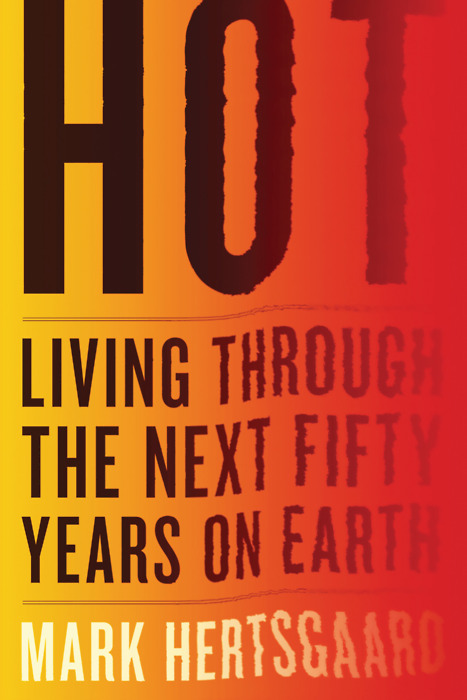
Mark Hertsgaard, who got onto the time lag consequences early, wrote clearly on the two time frames and what they mean in Hot: Living Through the Next Fifty Years on Earth (2011.) Since then, the news of effects has been--as Orr predicted--increasingly bad.  Though the far future looks a little better, with the rise of clean energy and new carbon regulations (both fostered by the Obama administration), and with hopes for a meaningful global treaty later this year, we still must deal with those two basic problems, conceptually and emotionally.

That all leads to Apocalyptic Planet (published in hardcover in 2012, and in paperback in 2013.)  Dealing emotionally with the apocalyptic possibilities is an ongoing process, with lots of changes in perspective and feeling.

 What Craig Childs did was to visit places where apocalypse is visible in various ways: where climate crisis consequences are visible and tangible and ongoing, and to extreme places where apocalypse already happened, perhaps a very long time ago, and in a sense is still happening.  Although I discovered this book late, it also took me a long time to read it all.  I could only handle so much apocalypse at a time.

Childs begins in the desert and moves on to the glaciers.  It's clear from these first two chapters that his writing is vivid, economical and eloquent.  He describes his own single set of experiences and those of companions in these extreme landscapes.

 The combination of beauty and fear in these places produces a complex awe.  As his party of documentary filmmakers finds one astonishingly fast-melting glacier after another, several couples find crevices in the ice where they have sex.

 These places are indicators of apocalypse. The extreme and alien landscape of the Mexican desert is inexorably expanding into Arizona, as drought deepens and consolidates.  Scientists in his party are astounded by the speed with which the glaciers they observe can melt and drain away--feelings echoed more recently in statements about melting in Antarctica.

 He goes to Alaska with his intrepid mother to look at consequences of sea level rise. He returns to his birthplace of Arizona to explore the rise and fall of civilizations, where he talks with an archeologist.  "As dark came on, Wright and I talked about how civilizations tend to fall, common themes you see throughout time: environmental decay, failure of top-heavy infrastructure, resource depletion, loss of social egalitarianism, disease, conflict." He asked Wright what such an apocalypse would look like.  It would start out looking like Phoenix today, with decay beginning at the edges.  Apocalypse can be a slow process in human time.

 Childs grapples with the twin sense that apocalypse simply happens over and over, and every civilization that has risen so far has fallen, but that once anticipated some of these fates may be avoidable. Or apocalypse can happen relatively quickly.  In Greenland he discusses with a climate scientist the possibilities of rapid climate change.  It's happened before, without human help--and this is one of this book's contributions: it deals in different time frames, including a multi-billion year perspective.

A major figure in this long Greenland chapter is Koni Steffans, an European climate expert whose research camp Childs is visiting.  From time to time, government officials and others visit the camp for updates.  "What he tells people who visit is not that the sky is falling but that we live in a world of falling skies and it is best not only to know your options but to make moves ensuring the worst does not happen." [p.176]

 Childs does not limit his explorations to consequences of the climate crisis.  He looks at tectonics in Tibet, volcanoes in Hawaii (a monster volcano eruption is probably the best candidate for near-instant, near-total apocalypse.) The Tibet chapter includes a daring ride down an uncharted river, a surprising release from the book's main tensions.

 But for me the scariest landscape he describes is a corn field in Iowa--genetically modified corn to resist predators is combined with chemical killers of all non-modified life.  The crops themselves are depleting the soil without regenerating it: they are killing the future they are feeding. This environment of deliberate industrialized death is the occasion for discussion of species extinction (the specific subject of Elizabeth Colbert's 2014 book The Sixth Extinction.)

 This somehow is the most emotionally powerful aspect of apocalypse, perhaps because there is nothing of awe and terror in it.  It is indirect but conscious destruction, invisible and hollow.  A scientist points out that individual animals of species about to disappear are mostly not ill or weak.  Their environment, their breeding grounds, makes following generations smaller and then impossible.  So one day they are just not there anymore.

 Childs and his companion spend days and nights in these corn fields, searching for any life at all--insects, birds, grass.  They find little, but the little they do find is a source of some hope.

 Time scales and the constituents of apocalypse, including the climate crisis, come together in the final chapter, as Childs searches out the limits of life in the severest desert he could find, in South America.  He looks beyond what we define as the living to find the life of the planet.  "The earth is a seed planting itself over and over."

 There is no easy solace, or easy despair.  This book expands the usual view of the Earth, in time and space, in levels and variety.  It becomes a little like contemplating the realities we suppress, of what happens over time in our own lives, in the inevitability of death and the mysteries of life changing and continuing.

 This book helps to provide a different perspective for thinking and feeling through future prospects as shaped by global heating.  But it doesn't simplify those thoughts and feelings into a philosophical complacency. Its strongest message is to experience fully what we are privileged to be part of in our own brief time on Earth, in all its dimensions.  It also supports hope as an operating principle, as a kind of responsibility that comes with being alive.  The responsibility is to contribute to a better future--even if that means a less awful future that it might otherwise be-- together with our responsibilities to people and communities and places in our present.  

Wednesday, June 03, 2015

The Highest Frontier by Joan Slonszewski

The Highest Frontier
by Joan Slonczewski
Tor 2011

I hadn't heard of the author before, but the mention of Robert Heinlein's young adult novels in a quote on this book's cover caused me to pick it up.  An endorsement from George Zebrowski on the back got me excited.

But besides Heinlein another precursor of the book has to be Harry Potter.  It's about the first year at an unusual school (it's on a space colony orbiting the Earth) with students who have magical powers (though it is more in the line of near future technologies that have the appearance of magic) and there's even a quidditch-like game.

 In his book on Heinlein, H. Bruce Franklin quotes him as saying among the differences between his adult and juvenile books are that "the books for boys are somewhat harder to read because younger readers relish tough ideas they have to chew and don't mind big words..."

This novel's protagonist is female--Jenny Ramos Kennedy--and we don't call them boy's books anymore, but otherwise the quote pertains.  The first several chapters drop you into a strange new world that requires a lot of attention to navigate.  Instead of just one or two new features there are many.  They all make sense as extrapolations of current technologies, but they aren't explained--they are part of the action.

This provocative, often convincing future is the best thing about this novel. Apart from being the author of the acclaimed Elysium series, Joan Slonczewski is a professor of microbiology, so her knowledge of science (as well as university politics) inform the clarity and complexity of this fictional world.  But the science here is less the rocket science or engineering you would find in an Heinlein juvie, or the physics of Interstellar.  The emphasis is on the biological sciences (as well as mad advances in computer tech) including genetics but not only that.  Some of her most provocative inventions have to do with plants and microorganisms, including a novel new use for anthrax.  And a new kind of alien.

A lot of the story has to do with electoral politics, and the author has a lot of fun extrapolating from the recent past, particularly family dynasties.  She manages to slide in several slogans and quotes from campaigns and presidencies of the 1960s forward.  There's little sense of a utopia here but it's also not exactly part of the dystopian YA trend.  There's a certain realism about politics as currently practiced, and where that's leading.  Even though it's leavened with a gentle satire, it's kind of depressing if you think about it.  (Even though this book was published in 2011, I'll bet a lot of it was written during the Bush years.)

For me the book was interesting and entertaining in its parts, and Jenny is an appealing character, but I don't see J.K. Rowling threatened by the storytelling. Too many strands seem to waft away, too much happens without narrative tension and the big character surprise was visible from the beginning, with such obvious tells along the way that I felt like shaking these people.  But the payoff eventually was nice.

One of the challenges here was to create kids being kids as we know them, even though they are mostly genetically designed according to a few prototypes, like Marilyn Monroe and Paul Newman, and social networks talk to you inside your head. Though I didn't find all the characters distinguishable or credible, there were enough to suggest that even in a culture that is at once more diverse and more conformist, there are still possibilities for soulful kids.

 The barriers to same sex relationships have fallen in this future, as they are falling now, but the sexual violence on campus that's become a bigger issue lately has more than survived.    

The author has said this might be the first of a Potter-like series (one per school year presumably) depending on readers' response.  Considering I bought the hardback at the dollar store, I'm not sure about the future of Jenny and Frontera College. (On the other hand, I don't understand the publishing business anymore, so maybe it means nothing.  Maybe it was a coup.) But whether or not there are sequels, the future that Joan Slonczewski imagined for The Highest Frontier will stay with me.